INDEXES AND BACKGROUND INFO

February 26, 2010

Jack Bilbo, Bilbo Bay sculpture garden

picture by unknown photographer

This larger than life sculpture is one of the three enormous creations which in the late 1940s were prominent in a garden in the community of Weybridge, England, United Kingdom.

Named Life, Devotion and Sanctuary, these sculptures have been made by the owner of the garden, self-taught artist Jack Bilbo (1907-1967), who lived in Weybridge from 1945 until 1949. 

One of the creations had a hidden door, through which Bilbo could slip in and secretly overhear comments of eventual visitors.

picture by unknown photographer
on the website of England  & Co

Jack Bilbo sold the house in 1949 to leave for France. The new owners did not hesitate to remove the sculptures they evidently did not like (as reported, dynamite had to be used to bring the statues down...).

Life and works

The story of Bilbo's life is truly fascinating. He was born in Germany as Hugo Cyrill Kulp Baruch, the son of a well-to-do Berlin family, that run a company in theater costumes.

Young Hugo went to the United States, where he was employed as a body guard by Al Capone, or so he said. He probably made this all up himself, just as the book he wrote about this job.


Anyhow, around 1930 he was back in Berlin. He was co-founder of a group that opposed Hitler's policies, the Kampfbunde gegen den Faschismus. Because of this, and by being Jewish, in 1933 he had to flee Germany, going via France to Spain. In Barcelona he run a pub, the SOS bar, that was frequented by many artists. Because of his active involvement in the Republican case, in 1936 he had to flee again. He went to London.

There he wanted to start a career as a visual artist, making paintings and sculptures. I understand that suddenly in 1939 he decided to start painting. He had to pawn some of his belongings to raise the money to buy some canvasses, brushes and paint. I could not find any reports about an academic artistic training. His visual artwork was definitely outside the mainstream.

When England became involved in World War II,  Bilbo as a German by birth was interned for some months, like other artists and intellectuals who had fled Germany. Bilbo will have met them and probably has participated in activities organized in the camp, like expositions and meetings.

Jack Bilbo's main occupation during the war was running an art gallery in London, the Modern Art Gallery, located in Charles II Street. He himself made paintings too, in a modernist style.


As this poster shows, Bilbo's Modern Art Gallery did not represent small fry (By the way: the works Schwitters exhibited at the gallery in December 1944 have been exhibited once more in an exposition in Tate Britain Schwitters in Britain  January-May 2013).

During the war some German artists and intellectuals who had fled Germany, lived in England, such as Kurt Schwitters. Bilbo's gallery probably was a meeting place for a number of them, because he also organized evenings with lectures and discussions about modern art.

In 1946 the gallery moved to Weybridge, a small community on the Thames River, not far from the city of London. The idea was to transform the house into a museum of modern art. The enormous sculptures he made probably had to be the start of an open air exhibition of modern sculpture.

After the war Bilbo applied a number of times to be naturalized as a British national, but his requests were declined.

In 1949 Bilbo left England

So, in 1949 he left England. He bought a ship (the Dutch boeier "Brave Hendrik"), crossed the Channel and sailed along the French canals to the south of France. There he stayed in Sanary-sur-Mer and Cannes, earning his living by (once more) running a café.

In 1957 Bilbo returned to Berlin, once more running a pub, this one named Kapt'n Bilbo's Hafenspelunke.

As has been noted in a comment on this post (Klaus Ferentschik, June 2013), Friedrich Schröder-Sonnenstern in the spring of 1961 had his very first exposition in Germany in this pub. It would be quite interesting to learn more about what happened in the Hafenspelunke in terms of artistic manifestations.

In 1967, the last year of Bilbo's life, the district mayor declared him an honorary citizen of Berlin-Schöneberg. Jack Bilbo died in Berlin in December 1967.

He was a very special person, who can be characterized by the title he gave to the autobiography he published in 1948, a title that runs: An Autobiography. The First Forty Years of the Complete and Intimate Life Story of an Artist, Author, Sculptor, Art Dealer, Philosopher, Psychologist, Traveller, and a Modernist Fighter for Humanity (London, 1948)

Documentation 
* article in Wikipedia 
* website England and Co with specimen of Jack Bilbo's drawings
* Ludwig Lugmeier, Gangster und Ehrenbürger, an extensive biography (April 2017), published on the website taz (in German)
* an interview in 1947 with Bilbo in Weybridge amidst his sculptures on a video by British Pathé on YouTube

first published February 2010, last revised June 2020

Jack Bilbo
Sculpture Garden
Weybridge, district Surrey, region South West of England, United Kingdom
the site has existed only for some years after WWII, until around 1949

February 19, 2010

Émile Taugourdeau, Le Jardin Zoologique / The Zoölogical Garden

pictures (around 2000) by Denis Lavaud , Zon'art ¹

Life and works

Émile Taugourdeau (1917-1989), a mason who lived in Thorée les Pins, France, around 1954 made an ornament decorated with mosaic to embellish his garden. This was the beginning of a lifetime activity of decorating the garden with sculptures of various personalities and all kinds of well known animals, such as elephants, giraffes and cows.

A couple of years after he started this project, he had to leave his job due to an injury he had received during World War II, and so he had a lot of time to make creations.

Taugourdeau was active in decorating the garden for some 35 years, embellishing the site with over 300 various sculptures.


An art environment in decay 

Taugourdeau passed away in 1989. His widow continued to take care of the garden and around 2002 the site still could be visited. But when she also had died  the garden was no longer cared for and the site became overgrown with greenery, sculptures were stolen and the site fell completely in decay,

And currently (2022) René Taugourdeau also has fallen into oblivion.

Documentation/more pictures
* The weblog of  Bruno Montpied of December 3, 2009 has a description of the site as it was in the past and as it was around 2008/2009 
* The Remy Ricordeau movie Bricoleurs de paradis. Le Gazouillis des Èlèphants (early 2011, 52') has scenes shot in 2010 of the site in decay, overgrown with blackberry
* Some sculptures have been transferred to the Luna Rossa garden museum in Caen, (France)
* Website Habitants-paysagistes (by Lille Art Museum from March 2018 on) has a series of pictures (1984-1990) by Francis David
* Website SPACES has an article and a series of photos taken around 1990 by Willem Volkertsz
Article about the site by Sonia Terhzaz on her website Cartographie des Rocamberlus (environments d'art singulier), reporting the visit she paid in May 2016

note
¹ The magazine Zon'art is not available anymore on the internet; see also OEE-texts

first published February 2010, last revised April 2023

Émile Taugourdeau
Jardin Zoologique
72800 Thorée les Pins, dept Sarthe, region Pays de la Loire, France
garden in decay, closed for the public

February 13, 2010

Roland Dutel, La demeure aux figures / The house with the figures


pictures by Kirsten (Flickr)
not available anymore

Roland Dutel is an autodidact artist, who belongs to the French group of artistes singuliers. The rather loose description art singulier is used in France for artists who in general are self-taught, are non-mainstream and practice a spontaneous, non-intellectual way of expression. 

The term has it's origin in the famous 1978 Paris exhibition Les singuliers de l'art: des inspirés aux habitants paysagistes. In Anglo-Saxon terminology one would use the term outsider art.  

Life and works

Born in 1955 in the community of Andrézieux in the Loire department, Roland Dutel currently lives and works in the south of France, in the center of the small community of Dieulefit.

He makes paintings and sculptural works by re-using all kind of materials, like paper, iron and plastics.

From 1989 on Dutel has transformed his house into an art environment by decorating its exterior and turning the cellars in the interior into kind of decorated grottos.


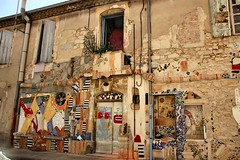
The decoration of the facade is very lively and expressive, with some representations of figures in it.

In a very general way this work is in the same range as the work of Danielle Jacqui, who decorated exterior and interior of her house in Pont de l'Étoile. Both Dutel and Jacqui adhere to art singulier.

Documentation
* Article (2010) by Jeanine Rivais, on her website
* In her weblog Sophie Lepetit in March 2014 had some posts about Dutel:
* Article (November 2019) by Dominique Clément on his weblog Hérault Insolite, with a variety of pictures

Video
* Video by Lucjeanluc (YouTube, 2'29", uploaded July 2010)


first published February 2010, last revised October 2022

Roland Dutel
La demeure aux figures
Place des Tilleuls
262220 Dieulefit, dept Drome, region Auvergne-Rhône-Alpes, France
as far as I know the house can not be visited
anymore as kind of an art gallery,
so visits -if any- only on appointment

February 11, 2010

Máximo Rojo, El jardin escultórico universal / The universal sculpture garden


 colored pictures (2010) 
courtesy of Amis Insolites

Alcolea del Pinar is a small community in the district of Guadalajara in Spain.

Life and works

Màximo Rojo (1912-2006), who settled in this community in the early 1940s, led a simple, industrious life as a farmer. When still a young boy his father died and Máximo wouldn't enjoy any schooling since he had to work to earn an income for the family.

It was only when he had entered military service that he got the opportunity to learn to read and to write, practicing his reading by using encyclopedias.

After military service Rojo became a farmer. During all the years he worked as such, he didn't show any interest in art or in making creative constructions. However, once retired from work in 1979, at the age of 67, he began making sculptures from concrete by applying a layer of cement to an iron frame.

For some twenty years Rojo has been passionately active in creating sculptures and ultimately his Jardin Escultórico would include some 300 sculptures, all gathered in the rather limited area of the site.


The sculptures depict persons and scenes which represent biblical events, stories about important personalities and about happenings in the history of Spain and the world, all together forming a scenic review of popular knowledge, as if Rojo was driven by the need to share with his fellow compatriots the knowledge he had gained by reading encyclopedias when in the military.

B/W pictures are screenshots 
from the 2004 Moriente/Neirak movie

The garden could be visited and attracted a lot of visitors during the years.


Actual situation

After Rojo died in 2006, for some time the garden still could be visited, as the colored pictures (taken in 2010) show. In later years the site was closed.

The local authorities made plans to assure the future of the site, seeking financial support from the province to realize these plans. but the economic crisis that began in 2008 prevented the allocation of public funds. The sculptures are in danger of deteriorating.

As shown on the video below made in 2015 by Sergio Flaquer Carraras (Serflac) the garden did still exist, although poorly maintained.

Documentation
* The site was reviewed in Escultecturas margivagantes: la arquitectura fantástica en España, Juan Antonio Ramirez, red (2006).
* Article and pictures by Jo Farb Hernandez (added autumn 2013) on SPACES website. The site is also described and documented in her book Singular Spaces, 2013,
* Article and series of photos (March 2023) on the weblog of Sophie Lepetit

Videos
* Scenes of the site (2015) on the South Spain trip video by Serflac (YouTube, starts at 34.32, cannot be embedded here)
* El jardin imaginario, movie (2012) by Guillermo G. Peydró (Vimeo, 50'31"), french spoken, subtitles in Spanish; this video has fragments of a film by David Moriente and Jazmín Beirak, shot in 2004, showing Máximo Rojo who presents the sculptures


first published February 2010, last revised  May 2017

Maximo Rojo
El jardin escultórico universal
Camino de San Roque 18
Alcolea del Pinar, Guadalajara, Castilla-La Mancha, Spain
site is closed, sculptures are slowly deteriorating

February 07, 2010

Euclide Ferreira da Costa, la Maison Bleue / the Blue House

picture from the city of Dives website

When in the 1990s I began researching art environments, la Maison Bleue was a somewhat lost garden, one could only view by secretly peeping over the enclosure wall. Nowadays (2010) the site still can be visited only occasionally, but anyhow it has a protected status, restoration has begun and the site has become known rather well.

Life and works


Born in a poor family, Euclide Ferreira  da Costa (1902-1984) in 1922 migrated from Portugal to France where he had found work. He first settled down in the Somme area and later on moved to the community of Dives-sur-Mer in Normandy, where in 1947 he was naturalized. 

He settled in a simple cabin, without electricity and running water, that he reconstructed into a house, located on a plot of land of some 300 m²  along the rue des frères Bisson. In 1959 he married Marie-Louise Duval, he had met in 1944.

Employee at the nearby Tréfimétaux metal factory, due to a tuberculosis da Costa in the early 1950s had to stop working.

In 1957 da Costa constructed a monument in memory of Laika, the dog that was sent into space with a Russian sputnik (November 12, 1957). This was the beginning of a project which would keep him active for the next twenty years.

picture from Facebook 

He continued his creative activity by making various replicas, typically a couple of meters high, which represent religious buildings, like the Notre Dame in Lourdes, the Fatima Basilique (1962), the Paris Sacré Coeur (1965) and the Sainte-Rita-de-Cascia (1967). He decorated these constructions with a lot of blue mosaic (pieces of pottery, glass, mirrors, flagstones) and displayed them in the garden . around the house.

Da Costa also made sculptures of all kind of animals, but he hasn't made sculptures representing people.

Around 1977 da Costa ended up making creations. He died in 1984.

this picture and the next one
from the city of Dives website

In 1989 his widow sold the property to the community of Dives, just a short time before she passed away. The couple had no children.

Saving the site for the future.

In 1991 the site was declared a Monument Historique. The city began to restore the garden, which included covering it with a protective device. However, due to the lack of funds, in 1994 further activities were suspended.

So the site remained closed for the public, apart from occasional visits arranged by an association of friends, founded in 2004.


This association also became active in raising funds to save the site for the future. With the help of a number of sponsors and public authorities enough money was collected to start a restoration project. 

In December 2009 the Dives community council decided to start such a project in 2010 . The first phase, a study to see which measures should be taken, also had the intention to raise the interest of other sponsors.

In October 2010 the local authorities decided that the next phase would include the restoration of two important elements of the site, the Laïka Mausoleum and the Sacré Coeur. This project was completed end 2011.

In 2013 the replica of the Notre-Dame de Douvres-la-Délivrande was restored.

As part of the national project Mission Patrimoine en péril (Heritage in Danger Mission 2019) the Maison Bleue was selected as one of the projects eligible for financial support. In September 2019 the city of Dives, the Association of Friends and the Heritage Foundation signed an agreement regarding the use of this donation for the further approach to the renovation.

Documentation
Claude Lechopier, Une mosaïque à ciel ouvert, la maison bleue de Dives. Cabourg (Ed. Cahiers du Temps), 2004. ISBN 2-911855-62.
* A movie by Ferdi Roth, Un jardin aux églises de faience (1979, 12' )
* Also from 1979, a thesis written by Pascale Herman, partly dealing with Ferreira da Costa. The text (in a translation into English) is available on OEE-texts
* Website of the association of friends (new version); there is also an older version
* Article on SPACES website, with pictures by Seymour Rosen (April 1988)
* A collection of pictures (2010) by Sophie Lepetit, in three posts of her weblog: .
     - general views
     - animals
      -details
* Article by Sonia Terhzaz, reporting the visit she paid to the site in 2015 on her website Cartographie  des Rocamberlus

Videos
* Video by Ren Ody (3'19", Daily Motion, published 2010)


* Video by franceorganum (6'37", YouTube, May 2018)


first published February 2010, last revised August 2023

Euclide Ferreira da Costa 
la Maison Bleue
13 rue des frères Bisson
14160 Dives-sur-Mer, dept Calvados, region Normandy, France
for opening hours see website 

February 02, 2010

Olivier Jullian, Decorated house

DSC_0690
first three pictures (May 2007) courtesy of  
Claude Vedovini,  Flickr (click to enlarge)

In  the 1990s, when I began collecting information about art environments, I made an annotation about someone named Olivier Jullian who was reported ¹ as being active in decorating the facade of his house in the city of Nîmes in the south of France. 

DSC_0694

During all the years thereafter I never found any information about this site and I also couldn't trace any pictures of it.

However, in 2011 when looking around on Flickr for an item unrelated with the presumed artwork in Nîmes, I saw pictures made by Claude Vedovini and surprise! he had seen the decorations and had made some pictures thereof. With his permission I share his photos in this weblog. 

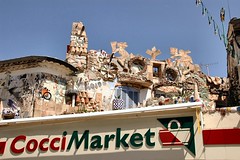
It appears, there is not only a decorated wall facing the street, but -as can be seen on the next picture- the roof of the house has been decorated with sculptures and constructed ornaments.

DSC_0695

In a earlier version of this post I only could refer to Google's streetview. Try it yourself. You end up in the rue Bec de Lièvre, nr 37, and there it is, the decorated wall on the outside of the house.

Commenting on what I saw on streetview I said that the artwork looked a bit poorly maintained, adding however that the general idea behind the lay out of the creation seemed fine. But that's what I said in 2011, now take a look at below pictures from 2015.... it's a wonderful site !

one of the pictures made early 2015
by Dominique Clément (weblog Hérault Insolite)

Indeed, in 2015 I got more information about who made this and when..... On March 30 Dominique Clément in his weblog Hérault Insolite published an article with a series of pictures of the site. He confirmed that indeed Olivier Jullian is the author of this site and he also reported that the decorating of the exterior of the house began in 1995.

And then, on August 22, 2015 the regional journal Midi Libre published an article about Olivier Jullian and his creative activities. This article is hidden behind a pay wall, but anyhow it is the first publication to inform the general public about this art environment.

In the following years the site received more and more publicity (see documentation), and so we now know that Olivier Julian was born in Lyon on February 27, 1949.

Documentation
* Article in Wikipedia (updated until 2023)
* Tripadvisor (with a series of photos)
* Posts in weblog Hérault Insolite: March 2015 and November 2017
* Article (behind pay wall) in regional newspaper Midi Libre (August 2015)

Video\
* Video (2021) by Nîmes Tourisme (YouTube, 2'02")


note
¹ it was a communication by Jean-Michel Chesné published in one of the early issues of Zon'art, a magazine (1999-2008) that doesn't exist anymore and also isn't available anymore on the internet; see also OEE-texts

first published February 2010, last revised January 2024

Olivier Jullian 
Exterior decorated
37 rue Bec de Lièvre
Nîmes, dept Gard, region Occitanie, France
visible from the street
streetview