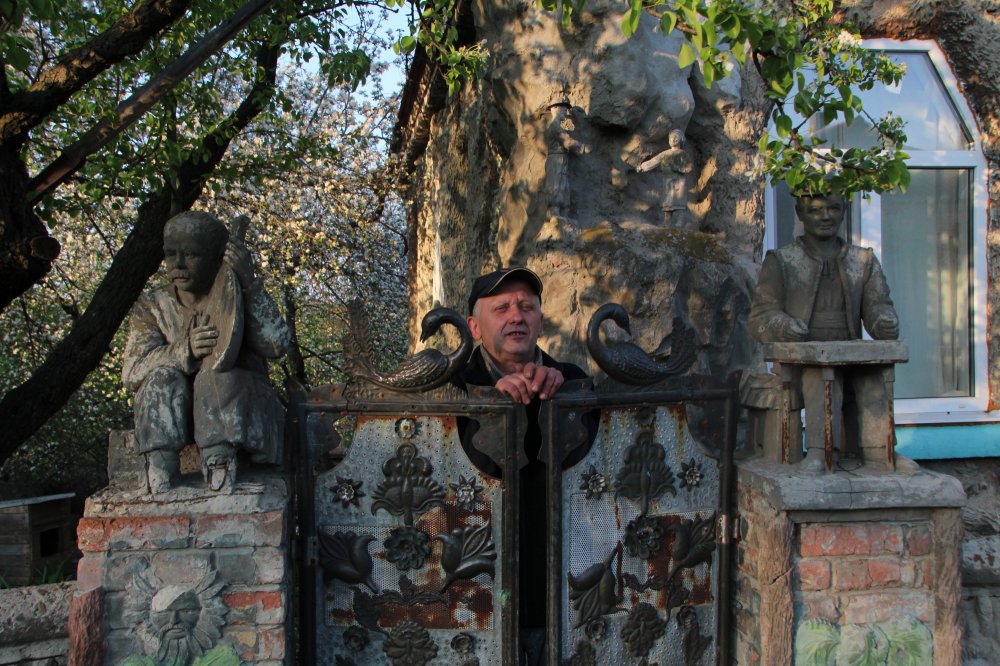
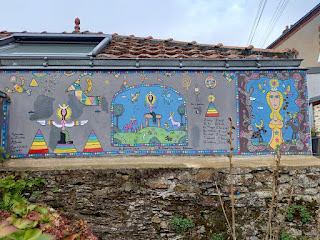
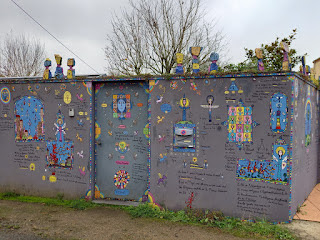
The house named The black Cat, located in a rock formation in the Spanish municipality of Bácor-Olivar, was originally inhabited by the grandfather of the current resident, who decorated the house and its surroundings in various ways.
the entrance door
Life and works
Rafael Moya, who created all those decorations, was born into a family of eight brothers and sisters., living in Bácor-Olivar.
Shortly after finishing school, the family moved to Alicante, hoping for a better future.
Rafael Moya worked for a time as a cook in Benidorm and Ibiza, but because this was mainly seasonal work, he founded a small construction company, which also allowed him to undertake decorative projects.
In his younger years, he traveled extensively, visiting not only Europe but also Asia and Africa, where he primarily visited historical sites.
His preference for working on decorative projects led him to return to his native region to restore his grandfather's house, which had fallen into disrepair. He did this from around the turn of the century, primarily during his holidays.
Besides restoring the house, Rafel Maoya also developed into aself-taught artist.
This meant that he not only provided the interior of the house with various artistic creations, but also created his own works of art. .
After many years of restoration, the house was opened to the public as a museum.
From the outside, various creations can be seen.
For example, the hill behind the dwelling has been sculpted into the head of a man with a pointed hat.
This head of a male, as shown in the image at the very top, meanwhile is accompanied by another sculpture of a head, as shown in the image below right.
Rafael Moya hasn't focused his artistic talent solely on beautifying his grandfather's house.
He has also begun creating independent sculptures, such as a life-size sculpture of a farmer with a hoe and a donkey, an ensemble located near a roundabout in Bacor.
photos by Olga Stenko, as in her article (May 2019) in newspaper Gazeta
Founded in the late 17th century and an estate for many years, the small village of Yakovtsi in 1929 was incorporated in the Ukrainian municipality of Poltava, traditionally a transportation node and an important cultural center.
In the 1950s the village experienced urbanization, with many newly built houses and other buildings
However, the modest, long-standing house of Viktor Kompaniichenko was not urbanized in the 1950s. It was transformed into an art environment when its occupant rather lavishly began decorating its exterior walls.
He would spend about forty years designing the site.
As the image above shows, the decorations Viktor Kompaniichenko added to the exterior of the house also included sculptures, which he made of concrete. Some of these sculptures are now damaged, but Oleksandr does not have the means to restore them.
Along the front of the house is a low concrete fence, decorated with stone flowers. There were also decorations with sculptures of musicians, which are partly damaged.
The brief description of the nature and content of this art environment is based on the documentation dated 2019. It is not inconceivable that the site has deteriorated further in recent years.
Documentation
*Article (May 2019) by Olga Stenko in newspaper Gazeta
Viktor Kompaniichenko
Decorated house
Dykanska street
Yakovtsi district, city of Poltava, region Poltava, Ukraine
can be seen from the street
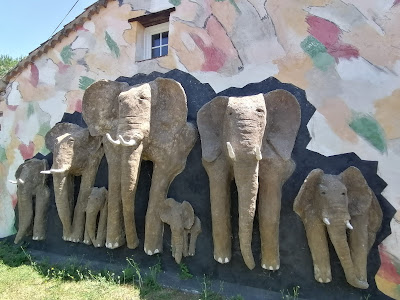
The image above shows a sculpted herd of elephants added to an outside 40 m² large wall of a house.
This ensemble is part of an art environment located in the hamlet of La Riviérette, which belongs to the municipality of Veilhes with some 110 inhabitants, located in the south of France, about 40 km west of Toulouse.
this image and the next four show
some sculptures in the outdoor area
Life and works
This ensemble of elephants is a creation of Pierre Silvestrin, also referred to as Quinquin.
He was born on March 28, 1951. After primary school he started working, first at the age of twelve as a helper in a bakery, and then from the age of fourteen as a house painter.
In his early twenties, in 1974, in addition to his work as a house painter, he also started to profile himself as a visual artist, a capacity that gradually prevailed in the course of years.
Silvestrin's house and studio are located a few km north of the built-up area of Veilhes in the hamlet of La Riviérette. The property is surrounded by a beautiful, rural landscape near a lake called Lac du Messal.
.
In his artistic work, Silvestrin mainly focuses on making paintings and sculptures.
The smaller sculptures are particularly arranged in the interior of the house, which has recently opened as a museum, the larger ones are set up in the outdoor area.
The surrounding images show some of these outdoor sculptures, which include more or less realistic images of people as well as fantasy figures.
These larger creations were made by finishing an iron mesh infrastructure with a layer of concrete.
The ensemble of elephants
In February 2022, Pierre Silvestrin embarked on a special project that involved transforming a 40 m² exterior wall of his house into an ensemble of sculptures in high relief depicting a herd of elephants.
On Facebook, he asked friends to contribute to the cost of the large amount of material needed for the voluminous creation, a request that was fulfilled in no time
The Ideal Museum of the Unsold
Subsequently, on March 28 of that year 2022, a lower and an upper space of his house were opened to the public as the Museum of the Unsold. Silvestrin saw this as a kind of gift for the day he turned 71.
The three pictures around give an impression of the sculptures that are exposed in the Museum. These sculptures usually have a small size and often show people's heads. They are mainly made of clay, found in the vicinity of his house, which Silvestrin kneads into the desired shape with his hands and then details with appropriate tools.
The sculptures and paintings exhibited in the museum are not intended for sale and can therefore be seen as part of the art environment, which also includes the sculptures in the outdoor area and the ensemble of elephants on an outer wall.
The designation Musée Idéal in the name of the museum is reminiscent of Facteur Cheval's Palais Idéal, which in all probability is Silvestrin's intention indeed.
Dolo is a city in the northeast of Italy, located about 25 km west of Venice. From west to east the city is bisected by the Naviglio del Brenta (Brenta Canal), once a river but now a canal.
South of the canal is the Via Brenta Bassa, a road with varied, alternating buildings, such as -about halfway along the road- a small block of three houses, of which the center house is lavishly decorated.
this picture and the next five courtesy of Giada Carraro
Life and works
These decorations were made by Armando Tiso (1939-2021), who came to live in the house after he, while working as a sailor, was disqualified on medical grounds and had to continue living on a disability pension.
Being in his mid or late forties he wasn't one to go idle and so he found an occupation in decorating the interior and the exterior of his house. For this decorative work he used small pieces of ceramics, which he obtained by crushing all kinds of plates, cups and tiles that he bought at flea markets.
The above and below images give an idea of the colorful patterns Tiso created with those small pieces of ceramics.
It can also be seen that the decoration was not only realized with pieces of ceramics, but that other elements were also added, such as intact cups, bronze figurines, vases and urns, small black characters standing around a goblet or a shield and more of these types of additions.
Tiso not only decorated the interior of his house, but also the area along the street in front of the house and the backyard, overlooking the canal, were richly provided with all kinds of creations.
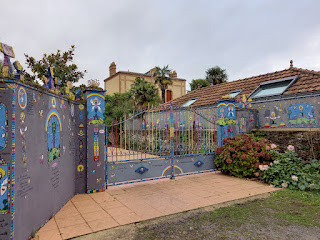
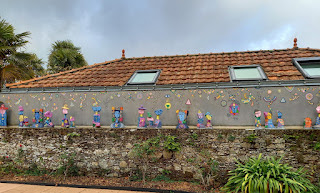
Where the front gardens of the neighbors on the left and right are screened off from the street by an open iron fence, Tiso's front garden, as can be seen in the very first image, has a solid stone wall, with a wide top provided with a series of connected characters, including a number of soldiers who seem to be on guard.
The stone wall separating the garden from the street was itself richly decorated, this in such a way that part of the public street was taken up with creations.
The images in this article mainly show the decorations that can be seen from the street.
The relatively small backyard of the house, shown in the image below, apart from a rear door and a small window, is fully equipped with a voluminous ensemble of mostly decorations, an exposition largely shaped like a buffet.
A narrow green strip separates the backyard from the Brenta Canal.
backside of the house, along the canal
Armando Tiso passed away on September 16, 2021. Soon after this happened, a petition -also supported by some people living near Tiso's house- was sent to the mayor of Dolo, asking him to promote that the decorated house would be preserved as a museum. The mayor expressed interest and wrote that he would investigate the conditions and possibilities of preserving the site together with the competent authorities.
At the time of publication of this article, no further information was available on the internet about eventual decisionmaking with regard to the future of the site, but Google Streetview shows that in June 2022 the decorations still existed.
pictures courtesy of Sophie Lepetit, from her weblog
Trentemoult is a small commune in France, located along the left bank of the Loire River, near the city of Nantes, which lies on the right bank. In a street in Trentemoult there is a house that has an exterior that is decorated with a variety of frescoes and sculptures.
Life and works
These decorations were added by Jean-Paul Baudoin, who lives in the house and has his workshop there.
Life and works
Baudoin was born in 1946. His father was a butcher who ran a shop on Place Delorme in Nantes, France.
After completing his primary education, Jean-Paul went to work in his father's business. He did so, although from a young age his heart went out to drawing and painting. Being active artistically was therefore an activity for the evening hours.
It is not known how long Baudoin combined his daily work in the butcher's shop and his evening creative activities, but at some point there was an intervention by a cousin who urged him to follow his heart, so actually entering the world of art and becoming a practicing artist.
Baudoin followed suit and probably in the late 1970s/early 1980s he began to manifest himself as a sculptor, painter and artisan potter.
As a potter, a craft he still practices, Baudoin focused on a style of work known as Old Quimper, creations of vases, cups and saucers decorated with hand-painted characters ("petit Bretons") in a style strongly influenced by traditional Brittany.
By working as potter he rediscovered the nature and meaning of the creative process: an activity through which a living form springs from formless, inert clay.
In his fist period as an artist Baudoin also began making metal sculptures composed from pieces of iron or old tools welded together and finished with a cover in bright colors.
In 1987, when he was in his early 40s, the first exhibition of his artistic work took place from his home in Trentemoult.
From 1991 Baudoin also began making colorful images on cardboard and recycled paper, evoking, for example, a whole world dedicated to pagan female deities, such as Isis and Ishtar, but also fairies, mermaids and the heroes of the Arthurian legend.
Perhaps the early 1990s were also the time when he started to decorate the outside walls of his house (sources on the internet are inconclusive), because among the images several are dedicated to goddesses.
These goddesses appear in the midst of an extensive arrangement of all kinds of colorful, mostly small-scale characters, captured in sculptures or frescoes. With his sometimes magical and kabbalistic-looking images, Baudoin is an artist who expresses the unusual in forms that nevertheless feel familiar.
Documentation
*Article (January 2022) on the weblog of Sophie Lepetit, with a variety of pictures
* Photographs (January 2019) by Corinne Grassy Photography on Facebook
this picture and the next one (2003) by Bruno Montpied, from his weblog
The house pictured above still can be seen along a departmental road just outside the community of Antignac in the Auvergne area in France, although the sculptures that in 2003 still decorated the frontside, meanwhile have been removed.
Life and works
François Aubert (1902-1982). a bricklayer who lived here, started in 1949 to give the front and the side of his house a different look.
In various places of the three-storey high building he made platforms that were connected with stairs with various types of handrails.
The facade of the ground floor got four niches crowned with a semicircular arch of red bricks with a narrow strip of white stone at the top.The most left niche, in which a red door, decorated with a skull, had narrow pillars left and right, again topped with a semi-circular arch, this time of gray stone.
The walls of the other niches were fitted with a window and with square gray colored paving stones, as well as a horizontal beam just where the semicircular arches begin. Next to the niche on the far right, a staircase goes up to the first floor where the main entrance is located.
The semicircular arches of the niches support the floor of the terrace on the first floor. This part of the construction was also colorful, with the thickness of the floor, as well as the front of the supporting cross beams provided with a distinctive yellow color. Currently these yellow colored aspects have disappeared.
The balustrade of the balcony also got a special design. This by a division into compartments, corresponding to the niches of the ground floor, each compartment comprising eight white pillars. The compartments were separated from each other by a block of light brown stone masonry.
Adding concrete sculptures
The in itself decorative architecture was further embellished by Aubert by situating single-handedly made concrete sculptures in all kinds of suitable places at he exterior of his house.
Just an impression. Upon and in front of the horizontal beams on the niches of the ground floor seahorses got a place. The upper edges of the balustrades of the balconies served as a place for concrete sculptures of animals such as wolves, deer and springbok.
The banister of the stairs to the first floor was decorated with a snake. On the wall separating the niches of the ground floor from the street, elongated pre-historic reptiles were given a place. The wall of an extension to the right of the main house was decorated with a large pitcher, male heads on a pedestal and a rearing horse.
Arranging the sculptures on the frontside of the property and on balconies made them highly visible to anyone who passed by the house and, in general, the inhabitants of Antignac appreciated the display.+ Aubert was also asked by some residents to make sculptures to brighten up their own garden.
After Aubert's death in 1982, the sculptures for some time remained part of the property. In the images at the very top of this post, taken in 2003, they still can be seen, but in the years after the sculptures, including creations in wood that Aubert also made, were spread over various parties.
In 2014 Aubert's property was bought by visual artist André Fialip. In the first outbuilding on the left side of the house, he established his gallery, which is now indicated on the facade with colorful inscriptions.
The adjacent outbuilding now houses the Maison de la Minéralogie du Massif Central, a continuation of the collection of stones already assembled by Aubert, which at his time was accessible through the door with the skull, as mentioned above.
Documentation
* notes and photos by Bruno Montpied on his weblog
* article and photos by Sam and Jo Farb Fernandez on website SPACES
* article in the book by Bruno Montpied, Le Gazouillis des Éléphants, 2017
* article by Emmanuel Boussuge in Revue Recoins, nr 2 (summer 2008), p. 42-47
François Aubert
Decorated house
along the D3, just outside Antignac
(about 1 km from the western border of the built-up area of the community)
Antignac, dept Cantal, region Auvergne-Rhône-Alpes
decorations have been removed, the house can be seen from the street
all pictures courtesy of Sophie Lepetit, from her weblog
Referred to by the locals as Les Guallino, the couple Anne Poiré and Patrick Guallino has enriched the French municipality of Belmont de la Loire with an art environment that features the bright site of life.
Life and works
Patrick Guallino was born on May 10, 1943 in Uzès. Later he would live in Cannes
At a young age he became interested in visual art and at the age of fourteen he was already working with oil paint and chalk.
a colorful character in the garden
He continued to do so until at age 25 he was upset by the Paris student revolt, May 1968, and he destroyed or burned all of his work, except a few paintings kept by his mother..
It was not until more than ten years later, in 1982, that he resumed the visual arts. He was and remained a non-professional artist without any art education.
In the meantime he was married and had two children.
mosaïque du tapis aux pierres précieuses (2011)
(gemstone carpet mosaic)
Anne Poire was born on September 10, 1965 in Thionville. From an early age she was fascinated by literature and music.
In 1983 she met Patrick and a close relationship developed, that would determine their further life.
Anne said about this:
When I met Patrick, painter, sculptor -I am more of a woman of words, rhythms, musicand vocabulary- his studio immediately seduced me. And the man.
I arrived in his smallvillage,and we have never left each other: since then, acrylic, vowels, pastel,consonants, ink intermingle.
Anne and Patrick got married and in 1990 they settled in Belmont de la Loire to live in a former tissue factory. Belmont is a small community of some 1500 inhabitants, located in a rural setting, north-west of Lyon.
Anne and Patrick in front of some of the architectures in their garden
They set up a space of the former factory as a studio and engaged themselves both personally and as a couple with artistic activities.
Anne Poiré would mainly focus on the literary craft and publish a large series of books (anoverview of the book covers can be found on her weblog). Patrick Guallino focused on visual art, initially creating small sculptures, later working on paintings (here is an overview of the development of his work).
an example of a decoration
Before moving on to an overview of the art environment created by the couple, two special events marking their artistic career should be mentioned.
First, on July 30, 2010 on the Place de la Fontaine in the center of Belmont de la Loire an artworkmade by Les Guallino was unveiled. It is a screen made from polychrome aluminum, resting on a reconstituted stone base, with a size of 3x3 meters, entitled Amour toujours (Love always).
The other event is of a completely different order, but from an artistic perspective just as interesting.
In the course of 2016, the couple began to paint umbrellas and put them up for sale. Given the responses published on their weblog, these parapluies de bonheur became a succes indeed. Customers made photos of the umbrellas in various situations, such as on holidays, in front of towers or shops, but also in combination with street art. Wearable art, indeed.
view of the site through an opening in a wall
Creating an art environment
In 1998 the studio was expanded and soon after that through their joint effort, the outdoor space of Anne and Patrick's residence gradually was transformed into an art environment, a development which is still going on today (2020).
With this creation the couple wants to convey cordiality and happiness, generally speaking they want to present a sunny, joyful outlook on life.
The site includes a garden area with ponds and a number of paths, flanked by an assembly of various several meters high built structures, all parts provided with in general small-scale, colorful decorations.
There are just a few separate sculptures of people or animals -like there is a human character made from stacked stones-. so this site isn't a sculpture garden. However, some parts of the surface of the site have been provided with small-scale boulders or rock formations.
a view of some architectures in the garden
The decorations are mostly of an elementary nature.
For example, the shape of a human being may be portrayed with a circle as head, a vertical line or triangle for the body and four outward reaching lines as arms and legs. Decorations of this type, or more elaborate variations of it, can be seen on various walls and other places in the site.
Other decorations with a human character, such as faces, are also simple in shape, although no less appealing, as in the picture below.
a series of faces
The paths and other parts of the site lying on the ground, are elaborately decorated with mosaics. An example of this can be seen in the video in the documentation called La mosaique de bonheur (Mosaic of happiness), made in 2011.
The video has images of celestial bodies, with suns depicted as red circles, houses consisting of a red square capped with a red triangle, and there is a multitude of hearts in all kinds of primary colors, all this interspersed with a few loose pieces of rock.
Another path, named Le chemin de l'espoir (Path of hope) has been decorated with trees, probably trees of life, and a third path Le chemin de la vérité et de la vie (Path of truth and life) has been covered with oval mosaics (pictures here)
the pond covered with bamboo sticks
The site has a round pond, which is covered with a number of decorated bamboo sticks, this in order to protect the fish in the pond from foraging herons.
About the architectures
Regarding the architectures set up in the site, the images in the previous section of this post already give a first impression.
It can be seen that all these constructions are provided with decorations, both in the form of depictions applied on and in the walls, as well as items situated on top of the structures, such as ornamental creations or assemblies of coarse-meshed grid embellished with small colorful items
enclosing wall with decorated panels
.
A specific example of a decorated built structure is the above pictured wall that encloses the site.
This far-stretching wall comprises a large number of panels, each of which is individually provided with wall drawings, as in the picture below.
some decorated panels
One of the panels in the wall refers to Venice with depictions of a gondola, a slender tower and the church on the San Marco Square.
tower with a bench
Above picture depicts a towery structure equipped with a (stone) bench. Sitting on the bench one can enjoy a pond, which is located in front of the tower.
The site also has a Tour de Solstice (Solstice Tower), that emerges on a circular surface of cement, inlaid with mosaic decorations. which was created in summer 2020.
two dragons crown the top of the cave (2014)
There is also a cave in the garden, formed by a semicircular open structure sunk into a wall, as partly can be seen in above picture. This cave is named Grotte des amours, des fées et des secrets (Cave of loves, fairies and secrets) and was created in 2010.
The top of the cave is decorated with a colorful sculpture. The bulging semicircular rear of this cave is richly decorated.
sculptures around a pond; in the background a sculpted gate
Apart from the large pond covered with bamboo sticks, mentioned more above, there is a another, smaller pond, surrounded by multicolored candle-holder-like creations.
In the background there is a sculpted gate, crowned with a sculpture of a friendly smiling two-headed character.
decorations on top of the sculpted gate
Near the small pond and the sculpted gate, a new structure has been built, called the Cabane des énergies (Energy cabin), a functional equipment transformed into an artwork with a gable roof, multicolored strips across the left and right sides of the roof and a ridge decorated with small creations.
No photo of this cabin is available here, but on a page in the joint weblog of the couple photos can be seen of the cabin, as well as from front- and backside of the cave, from the gate with the double-headed character and from the candle-holder shaped creations.
a stained glass wall (on top of an old wall dating back to the 12th century
Finally, here above is an image of a stained glass wall, which has some resemblance to the sculpture unveiled in the center of Belmont de la Loire. This creation rests on a wall that dates back to the 12th century.
The overview given here of the art environment gives a broad outline of what the site contains in terms of creations. It is good to realize that there are also many small parts and decorations, which have to remain unmentioned here, but which each in their own way contribute to the artistic richness of the site as a whole.
Documentation
* Weblog by Anne Poiré (with an overview of books she published)