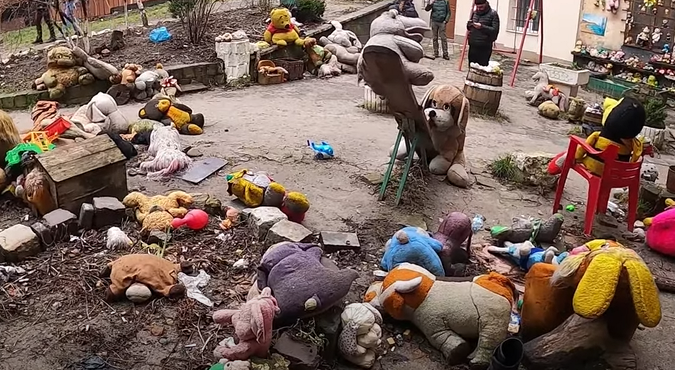
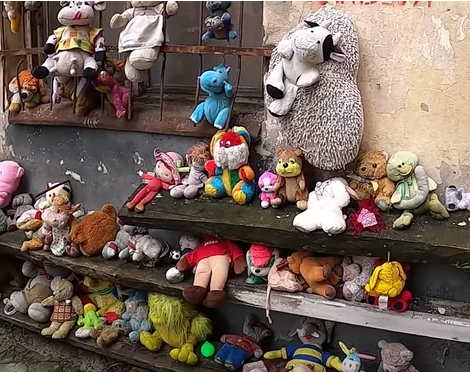
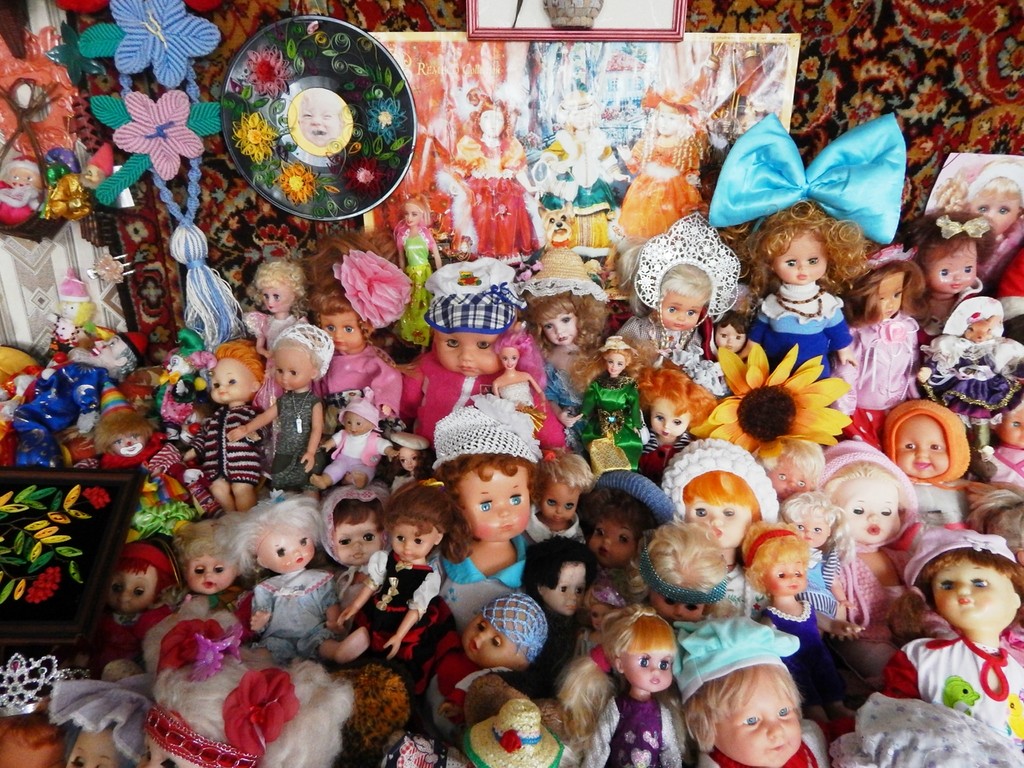
pictures are screenprints from the video in the documentation
Introduction
The following post is about an art environment in Lviv, the sixth largest city in Ukraine, located in the west of the country near the border with Poland. With regard to art environments in Ukraine, 11 reviews have now been published in this weblog. This new article is the first to appear after Russia invaded Ukraine.
This weblog is not about politics, but an indication of the situation in the area where the site is located from he perspective of the ongoing war, is in my opinion indispensable. In this regard, a good source is a recent interview (end of February 2023) by Eurocities with the first deputy mayor of Lviv, Andriy Moskalenko, who is responsible for economic development.
One can read about the challenge of housing the hundreds of thousands of Ukrainians who had to leave their homes because of the war and ended up in Lviv. And one can also read about the attacks on the energy supply, which resulted in 40% less capacity being available. The article shows that the city's administrators are not giving up, as the title of the article says: We are finding a way to continue living.
The Yard of Lost Toys
It all began in 2009.
Vasily Petrovich Hlushkovskyi, a bricklayer, born in the early 1960s and living in the old center of Lviv, found two dolls, which he placed in the yard behind a block of houses in the old center where he lived, assuming that the owner would find those dolls and take them back.
However, that didn't happen.
At that time, the moment was approaching when Vasily would get a grandson. It occurred to him that he could turn the yard, which is open to the public, into a play area for that grandson, with a swing and, a sandbox. and a display of dolls, including lost ones.
So Vasily Petrovich started collecting dolls, asking friends and acquaintances if they still had dolls that were no longer played with. His neighbors also contributed to the growth of a display of dolls.
As the site became more widely known, residents from other parts of the city also brought their superfluous dolls.
People also came to bring all kinds of other things, such as toy cars, a train to play with, children's stools, all kinds of portraits, a birdcage, a pair of boots, books, old musical instruments. They were given a place in the yard or in cupboards and on shelves along the walls all around.
Gradually, the display also became a place that attracted tourists, although the site was not mentioned in tourist guides.
Exhibiting dolls in the open carries the risk of them deteriorating and becoming a pitiful sight.
The photos all around, from a video taken in the early months of 2020, show that the dolls are generally looking good. It has been reported that Vasily Petrovich regularly got up early to check the collection and if necessary remove decayed dolls or other broken props.
People who visited the Yard of lost toys could react very differently to what they saw.
There are people who have a pleasant experience and find the site joyful. but there are also those who refer to the site as awesome, creepy and bizarre. For example, see the more than 3300 comments from visitors to the entry related to the site on Google Maps (see documentation)
In the course of 2020, the art environment came under siege. A commentary published in June 2020 said that local women threw all the toys in the trash. The site has since been closed.
Nevelsk is a port city in the Far East of Russia with about 12,000 inhabitants (2010), located on the southwestern coast of the island of Sakhalin ¹
Along a busy road just outside the city, there is a special creation in the form of an extensive collection of dolls arranged along the street, in the yard and in the trees belonging to the house located on the plot.
Life and works
This collection was created in 2014 by Yuri Vladimirovich Sidorov, who was born in 1955 and all his life has lived in Nevelsk.
He had a job as a chief engineer on ships and then until his retirement he was an electrician in the company Rostelecom.
Sidorov acquired what would later become the house with the dolls in the early 1990s as a summer cottage. Around 2012, he and his wife Vera decided to live there all year round, because due to back surgery she had trouble climbing stairs in the flat where they lived.
The couple had four children and (in 2017) six grandchildren.
Decorating the house with dolls started in 2014. A grandson was found to have an allergy to a dust mite who loved soft toys and on medical advice all toy bears and dolls had to be removed from the house.
At first it seemed a good idea to donate the dolls to an orphanage in the area, but that was not possible because of hygienic standards.Then grandfather Sidorov came up with the idea of giving the dolls a place on the fence at the front of the summer house.
The collection of dolls, initially small in size, grew to about a hundred in 2021. Local residents and people from the city brought surplus toys. Sometimes they threw seven dolls at a time over the fence.
The collection, which includes all sizes of dolls, is not only displayed on the street side, but also on the fence along the side of the front garden. There is also a tree in the front yard, which is filled from head to toe with dolls.
Besides dolls there are also very large teddy bears and -lying on a fence- there is a large spotted dog, .
A lady from Japan brought a lion cub and asked to place it as high as possible, because after all, a lion is the king of animals..
Documentation
* Article and pictures (2021) on the website of Tutu Art
* Article (2019) on the website of newspaper BezFormata
Note
¹ The reviews in this weblog relate to art environments in Europe. Nevertheless, characteristic sites in the Asian part of the Russian Federation are also included, this in order to give a balanced and coherent picture of the entire field of Russian art environments.
Yuri Sidorov
Exterior decorated with dolls
Nevelsk, Nevelsky-district, region Sakhalin, Russian Federation
pictures courtesy of Justyna Orlovska from her website
"Off the Beaten Track"
In the field of art environments in Europe, there are some sites with a decoration mainly composed of dolls, such as those of Francis Barale (France), Daina Kučere (Latvia) and Margarita Travkina (Russia). This small group of creations can be complemented by a site in the Czech Republic curated by Lubomir Votava.
Life and works
Votava was born in the early 1960s in Havlíčkův Brod, a town in the Vysočina region of the Czech Republic.
Initially he worked as a tractor driver. In 1989 he attended a rally of the Republican Party, often referred to as extreme right and represented in the Czech parliament from 1992-1998. Votava joined that party, working his way up to become an advisor and bodyguard to the party's leader.
In that capacity Votava gained notoriety for some incidents, like he punched an opponent with his fists. Later he was convicted for being violent against a journalist, after which he left the world of politics and in 1998 retired to the small village of Rváčov, also located in the Vysočina region.
Votava settled in Rváčov in a simple house, built around 1870, initially inhabited by his grandparents and thereafter used by his parents as a summer home.
Rváčov was now in his late thirties and living on his own. Away from the urban hustle and bustle of Prague, Votava now focused on the quiet rural life in the village.
Especially pleased with the garden located between the cottage and the main road that crosses the village, he spent a lot of time maintaining it. He built a pond with his own hands and from ten kilometers away, in a wheelbarrow he carried a large amount of stones into the garden, some of these stones being three feet high
As a result, in 2016 the garden was reviewed in the Czechian magazineChatar Chalupář, a practice-oriented monthly magazine about housing and lifestyle.
But what would make him known, both in the village and beyond, was not the composition of garden, but the special way in which he provided house and garden with decorations.
From his early years a lover of old toys and discarded dolls, he started to decorate interior and exterior especially with dolls, which he obtained from people around who wanted to get rid of them, which he found in trash cans or which sometimes were just left behind by people, deposited at the garden's entrance.
About a thousand dolls cover the outer wall of the house and are attached to the branches of trees in the garden.
Varied reactions
His way of decorating house and garden, which is visible from the main road that runs through the village, has led to varied reactions among the residents, both appreciation and disgust or fear.
Votava has said he doesn't exhibit the dolls to scare passers-by. He wants to prevent them from ending up in the garbage and being destroyed. He has explained that for him dolls are a medium from which energy passes. Looking at some dolls he sees in their eyes the child that played with them many years ago.
This train of thought is reflected in most arrangements of the dolls, as demonstrated in the pictures above.
But an arrangement like the one in the photo above, in which dolls -partly without a head- are suspended from a rope around their necks, arouses less sweet associations.
So in presenting both the lovely and the harshness, this art environment shows an ambiguity. It is not clear if this ambiguity is intended or unintentional, but in any case it can confuse a potential visitor.
Documentation
* Article (November 2014) on the website of TN Nova, with a short video and a series of pictures * Series of photos with explanation (December 2015) on website Off the Beaten Track, editedby Justyna Orlovska
Videos * Detailed impression of the site in wintertime (November 2015, YouTube, 14'35")
* Video by Vladimír Havlíček (July 2019, YouTube, 3'57") with Votava talking about the collection
Lubomir Votava
House and garden decorated with dolls Rváčov, Vysočina region, Czech Republic can be seen from the road
photos published here in agreement with the photographer click on pictures to enlarge
In Saint Petersburg, Russia's second largest city, with nearly 5.5 million inhabitants, Nelson Nikolaevich Iskandaryan for several years has been developing an art environment, generally known as Nelson's courtyard. This site has existed until summer 2020, when the courtyard was vacated, as far as I understand on order of the municipal authorities.
Here is the story of this site.
Life and works
Not much has been reported about Nelson's life before he settled in the small basement at the courtyard at Polozova Street nr 6 in Saint Petersburg.
He was born October 28, 1959 and he did his military service in the 1980s in Vinnytsia (Ukraine). But what happened after he left the military, is not clear, except that he -being homeless- wandered around for many years.
the (currently decorated) entrance of the courtyard
Around 2011 Nelson finally managed to find shelter in the basement in the courtyard of a residential block in Saint Petersburg, a yard that at that time still was a mess, where children by their parents were not allowed to play
Nelson's accommodation at the courtyard
The space in the basement, probably the abandoned room of a former janitor, offers Nelson just a small living area, but he does have a water tap, electricity and a connection to the internet.
Photos of the interior of the accommodation show a colorfully painted, rather cozy interior that is decorated with all kinds of motifs and embellished with parts of birch trees. Nelson is often pictured playing a guitar, singing one of his many self-written songs. The pictures also show a tame raven and cats, Nelson's roommates.
Nelson's accommodation. also called The Temple of Songs, with its colorful decorations, can be seen as a small-scale art environment, a prelude to his magnum opus, the transformation of the court yard into an art environment full-scale.
Creating an art environment
The earliest photos of the site on VKontakte date from May 2016 and show Nelson's art environment in an early phase of development, in which two shamed cars in particular are central.
Indeed, it all started when someone offered Nelson a large quantity of pink paint and he decided to use this to paint an old car that was in the courtyard. Thereafter, Nelson managed to get someone willing to give him a second old car, which he also painted.
The two cars, arranged diagonally, in some way mirroring each other, formed the central part of the creation, an arrangement that as far as I know does not occur in this way in any other art environment in Europe.
With its painted walls, pavements and doors, the centrally placed cars and other colorful decorated items that Nelson added, the site soon began to attract the attention of the residents of the neighborhood.
Most neighbours apparently appreciated the project and began delivering old toys, bikes, a huge teddy bear and other things to Nelson, gifts that gradually turned the art environment into a varied set of colorful items. Incidentally, if Nelson received a toy that was still in good shape, he gave it away to children from the neighborhood. Back and forth, he and children in general were on good terms.
The site included a cupboard that contained books made available by local residents. Those books could be taken by interested people, who in turn could also add books. Such a provision in the field of book exchange -which is also found in other large cities in Europe- has an important social function for the immediate vicinity of the site.
But in the meantime the site also became more widely known and the art environment became part of the city's sights.
For example, photo shoots were held for wedding photography, there were performances by groups of young children, as can be seen in the video below. and on the Russian websitePintaram one can see how the site can served as a background for people who like to make selfies.
Informal guides led groups of tourists to the courtyard, and publications on the internet about tourist travel included Nelson's art environment in their description of what to see in Saint Petersburg.
Many visitors, including children, enjoyed having a chat with Nelson. With this and the time he needed to maintain the site and to regroup the collection when new items were delivered, he was fairly busy every day
And then, he also had to find time for practicing his true hobby, playing the guitar and singing his self-made songs.
Whatever this may be, Nelson remained in a good mood and was considering to paint a nearby, unprocessed wall, perhaps together with a group of children, thus extending his art environment.
The courtyard was vacated in the summer of 2020
Reports on Nelson's account on VKontakte indicate that the decorations in the courtyard were removed in July 2020, this on order of the municipal authorities.
Documentation
* Nelson's account on VKontakte (with a large series of photos and some videos) * Some texts of Nelson's songs on websiteStihi * WebsiteFoursquare (with over 70 pictures)
* Illustrated article (2017) on website Newsland
* Illustrated article (March 2018) by Leonid Kaganov on his website * Illustrated article (August 2018) on websiteFiesta
Video
* YouTube has a number of videos of the site, including the one presented here:
Nelson Nikolaevich Iskandaryan
Nelson’s Court
Polozova street, 6
Saint Petersburg, Russian Federation
the courtyard has been vacated in the summer of 2020
The small community of Corralejo in the far north of the Spanish island of Fuerteventura is home to a house that is exuberantly provided with all kinds of creations. It's the Villa Tabaiba, home of Carlo Calderón Yruegas and his wife.
Life and works
Born in 1940 in Sevilla, Spain, Yruegas already at a young age showed signs of an artistic talent.
After high school he focused on courses in the field of linguistics and architecture, studying at the Colegio Padres Escolapios and at the Escuela Técnica Superior de Arquitectura of the University of Sevilla.
In France he visited the Université Rouen Normandie located in Mont Saint Aignan, where he qualified in French language and literature.
After these studies he obtained a scholarship to study the Abasi architecture in Iraq, a specific variety of architecture that originated in Baghdad and via Damascus arrived in Spain. Yruegas stayed for some 18 months in Baghdad, where he also was involved in projects to realize single-family houses, created some sculptures that were included in a local modern art museum and supplied articles to Spanish (art) magazines.
Once returned to Spain he published a book about the Iraqi sculptor Mun'im Furat: El Extraño Mundo de Mun'im Furat (Escultor) (The Strange World of Mun'im Furat (Sculptor)), 1975.
In a review of this book in a Spanish magazine, Yruegas was introduced as "... esperitu cultivado, sensible y noblemente, inquieto, artista, critico de arte, poeta,amante y cultivador de las sciencias biológica....." (a cultivated spirit, sensitive and nobly, restless, artist, art critic, poet, lover and cultivator of biological sciences), in short: someone with a broad cultural interest.
In the late 1970s Yruegas and his wife got the idea to find out if they could continue their lives at Fuerteventura. They went there, but in Puerto del Rosario, the capital of the island, there were no houses to rent, so after some days in a hotel, they left for Corralejo, where they could rent a house.
They probably soon felt at home, while Yruegas also had noted that from this location he could do his work as an architect.
So after some time the couple bought the house, where they currently still live, located at the end of the Avenida Corralejo Grandes Playas in Corralejo, near the community's large beach.
Yruegas turned out to be a man of many talents, besides being an architect he is a painter, sculptor, photographer, poet and writer. In that last capacity he published, among others Escrite en Fuerteventura, 1978-1998, published in 1995.
And then he also transformed the area around his house into an art environment
It began as a whim, Yruegas said in an interview in December 2017.
Asked why he made these specific creations, he said:
“For my personal pleasure, it's like a joke. I am an architect and I'm very rational and minimalist while designing houses, but with this Villa I can have fun, entertain me and enjoy my own art.”
And indeed, already for the passers-by there is a lot to enjoy from the street.
One sees a long white wall that separates house and garden from the street and on that wall there are colorful scenes with sculptures partially sunk into the wall, such as those with two mermaids against a blue background (as in the top picture).
One can also see from the street that in the area behind the wall, the walled garden, there are structures that rise high above the wall
This art environment includes a number of sculptures that characterize people in all kinds of capacities. Some have been created on the basis of mannequins which Yruegas acquired and subsequently processed (That's why he sometimes is called the "artist of the mannequins.")
Yruegas apparently enjoyed creating all sorts of surreal scenes, such as an arm emerging from a hole in a green surface with a bell, or a lady consisting of a head and two legs appearing on a predominantly blue wall, and various other comparable scenes. .
The walled garden of the site includes, in addition to a beautiful green plantation and many colorful decorations and sculptures, a number of raised structures, such as a square tower-like red structure, an elongated panel with transparent circles flanked in front and behind by mannequins watching and a large weather vane with a triangular wind catcher.
Currently (May 2019) in his late seventies,Yruegas is still active in maintaining the site, although it is quite a lot of work. Documentation * WeblogHérault Insolite (May 3, 2019) with a series of pictures
* Article (December 2017) on the websiteCorralejo Info with a large series of photos
* Interview in Fuerteventura Magazine, nr 97 (june 2014), p 27 (available on ISSUU)
Videos * Video (December 2014, 7'40") by Akinoryvy
* Video (December 2017, 3'57") by Time Beat (some shots appear more than once)
The doll-decorated front of a shed, as depicted above and below, can be seen in Kolomna, an old city in the Moscow region, Russia, about 110 kilometers southeast of the capital.
Life and works
The dolls attached to the barn are only a small part of the collection of dolls assembled by Margarita Leonidovna Travkina, who was born in the early 1940s.
It all started in 2005 when she walked past a lot of rubbish and noticed that there was a discarded doll in that garbage. She took the doll home, washed and restored her dirty doll clothes, repaired damaged parts and gave her a nice spot in her house.
At that time Margarita Travinka was in her mid-sixties, she lived with her husband after her two sons got married and had left home. She was artistically gifted, loved embroidery and also made small paintings of special material, as in the composition below, where the basic material consists of processed shoe leather.
Repairing the rescued doll probably inspired Margarita Travinka to continue this kind of activity and so she asked friends and neighbors if they had old, disused dolls available. And indeed, they had......
It was the start of a project to which she would spend all her time in the coming years and that resulted in a collection that now includes 13,000 dolls.
Indoors, the dolls are arranged side by side on chairs, benches, tables and other furniture.
They are all nicely dressed, their hair is cut, some wear hats. If female dolls have nails, these are provided with nail polish.
Margarita Travkina creates the beautiful and often richly decorated clothing of the dolls herself on the sewing machine. One garment takes about four hours to make, so this activity requires a large part of her daily time. This besides the time needed to clean the set up of the collection and keep it in order.
Her house has a modest size and includes only a couple of rooms, which means that almost all available interior space is occupied by the collection. After her husband died some time ago, Margarita Travkina lives alone in the house.
Unknown in which year, but probably in an early phase of the project, a small part of the collection of dolls has been attached to the front of the barn outside. These are generally smaller ones, made of rubber or plastic. The facade has also been decorated with a number of clocks.
Documentation
* Article (November 2015) in news website Vittasim (IiveJournal)
* Article by Diana Strazin(July 2017) on website 360tv.ru
Video
* Video (30'47'. 2017) by Life Новости (Life News) as published on Facebook
Margarita Leonidovna Travkina
House with dolls Ulitsa Posadskaya 50 Kolomna, Moscow region, Russia exterior decorations can be seen from the street streetview
Just outside the community of Gardanne on the road (D7) to Luynes in the Provence area of France, one could drive past a house with a decorated facade.
Life and works
Francis Barale (1932-2017) was the author of this project. A local Gardanne magazine from early 1998 (on page 7) has the story, reporting that Barale at that time was retired and had over twenty grandchildren. In 1998 he was 66 years old.
Barale has been a gardener and he has worked in a touristic pottery shop in Valabre, making and selling tiles and other tourist items. He told the local journal he felt "attached to things", and didn't like throwing away objects.
So in the garden of his house he made kind of an exposition of many objects, mainly children's toys, and he abundantly decorated the facade of the house with dolls, in this way producing quite decorative scenes, as next pictures show.
Francis Barale told the journal: "When my grandchildren do not use their toys any more, I ask them to give them to me, and when they visit me, they enjoy themselves (---). It gives them pleasure to see them there, exposed"
As far as I understand, in March 2011 the dolls and other objects have been removed (see documentation) Francis Barale died on September 30, 2017, 85 years old..
Documentation * pictures (November 2010) on weblogphotopus13, with a variety of photos
* post in weblogAnimula Vagula (August 2009), with pictures and comment (April 2011) saying that the dolls have been removed
Francis Barale Maison des poupées Gardanne, dept Bouches-du-Rhône, region Provence-Alpes-Côte d'Azur, France streetview (as it was in 2008)