all photos (June 2021) courtesy of Hannes Bürgelin
Safenwil is a municipality with about 3600 inhabitants in the canton of Aargau in northern Switzerland, bordering Germany. Some two kilometers south-west of this city is a forested area called Sodhubel, which is characterized by sandstone rock formations.
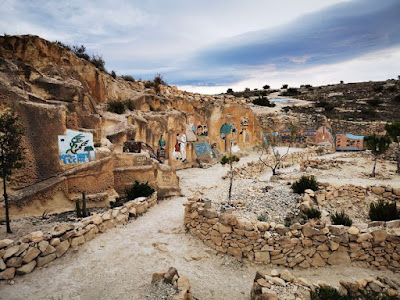
In that area there is an art environment formed by sculptures mounted in a vertically rising rock wall
Life and works
Hans Widmer (1887-1964) was born in the village of Schönenwerd as the son of a local baker. He grew up in this village, which is about six kilometers north of Safenwil.
After his primary education, he did an internship as a gardener and then worked as a mechanic in a small shoe buckle factory.
As a young man he was a member of a gymnastics club and during an exercise he had an unfortunate fall that left him with back pain for the rest of his life.
Widmer was a somewhat withdrawn personality, who did feel an urge to improve the world. From that point of view, he joined the religious group Jehovah's Witnesses in Safenwil.
Here he met the woman he would marry, Amalie Hilfiker (1890-1967), living in Safenwil. She was a somewhat dominant but also charitable person, who did a lot of good for people in Safenwil who were struggling financially. She herself had a good job at a regional firm.
Partly because of the financial security that his wife offered, Widmer was able to develop activities as a preacher. and missionary. He also had himself hired as a comedian at weddings and association events, but that was not such a success, because people preferred to hear funny jokes instead of his message that one should strive for the good life.
Widmer only found his true destiny in terms of work when he became acquainted with a local cabinetmaker and woodcarver from whom he learned woodcarving. Here he discovered his artistic talent.
He started designing boxes, tables and chairs and he carved his first animal figures. And then, when in 1939 he was in his early 50s, he began carving all kinds of creations into the sandstone rocks at Sodhubel, a project he would work on until 1945
Creating an art environment
In earlier centuries, on the hilly spot where Widmer started making sculptures, there was a building named Scherenberg Castle, which was abandoned in the 17th century.
Then the inhabitants of Safenwil used the already cut sand stones of the castle walls to build their houses. And after the castle was completely demolished (only a few foundations remained) the stones for constructive projects in Safenwil, were extracted from the hill itself, which resulted in the vertically sloping sand and stone expanses, into which Widmer could carve his sculptures.
The very first image and the one above give an impression of the rock face that Widmer used.
In a studio in a small basement space owned by people in Safenwil he knew, Widmer could spend days working on drawings of the sculptures he wanted to make. And then suddenly he got the urge to act, and he would go to the sandstone walls of the Sodhubel and work there day after day on his sculptures.
In the area in front of the sandstone walls he had built a wooden barrack to store his tools and to shed in bad weather.
The themes that Widmer expressed in his sculptures have been aptly summarized by Walter Hess in an article (see documentation) as a biblically substantiated fairytale patriotism.
Indeed, there are biblical stories portrayed, such as an Angel of Peace, there are scenes taken from fairy tales, such as Little Red Riding Hood, and there are expressions of Helvetic patriotism, such as the Rütli Oath, an oath sworn in 1307 by the delegates of the three states that united and were the beginning of what would later become Switzerland (see the picture all the way down).
In addition to the sculptures related to the above-described theme, there are also stand-alone sculptures of, for example, a vase with flowers, as well as all kinds of animals, such as an elephant, a deer and others.
After completing his creation, Widmer remained active in carving mainly wooden boxes, tables, candlesticks and clocks until the end of his life.
In the field of art environments
the site isn't very well known
There are only a few publications on the internet about this art environment, and certainly no articles that offer a systematic analysis of the sculptures. It seems that Widmer's art environment has not become very well known in the field of art environments..
For example, the Swiss Collection de l'art brut in Lausanne on its website has no referral to Widmer, although the museum published many monographs on non-professional artists and also payed attention to non-professionals who created art environments, such as Schulthess (Switzerland) and Nannetti (Italy).
Gradual decay of the sculptures
Standing in the open air, the sculptures are highly exposed to weathering. The sandstone of the rocks into which the sculptures are carved is very soft and treating the sculptures with a hardening agent means that the outer layer in winter would harden by freezing, but would peel off when thaw sets in, which eventually leads to large damage.
Surrounding the entire sandstone rock with a building that protects the sculptures against the weather, might technically be possible, but the question is whether that is financially and spatially acceptable.
this cold be the scene of the Rütli Oath
Documentation
* Article by Ernst Lüscher, Steinskulpturen beim Sodhubel in Safenwil (Stone sculptures at the Sodhubel in Safenwil), in Magazine Heimatkunde Wiggertal, Volume 51 (1993)
* Article (March 2007) by Walter Hess, Sodhubel Safenwil: Friedensengel mit Löwe bei Rütlischwur (Sodhubel Safenwil: Angel of peace with lion at Rütli oath)
Hans Widmer,
Sodhubel sandsteinskulpturen,
Höliweg, 5745 Safenwil, Canton of Aargau, Switzerland.
Bem-Vindo, or in English, Welcome to José Meigalão's museum, an art environment along a bend in a road in the interior of the island of Madeira, about 7 km north-east of the coastal community of Madalena do Mar.
It is a voluminous, elongated creation with a variety of colorful elements, rising up some six to eight meters against a cliff, on top of which there are a number of residences.
The photo below gives a good idea of the current site (2022), and on Google Streetview one can see the creation as it was in June 2021.
Life and works
Meigalão was born in the early 1950s in Funchal, the capital of Madeira. After his primary school he followed a craft training. In that kind of work he could not find a job and like many others in Madeira, he emigrated with his wife to Jersey, one of the Channel Islands.
Here he worked for about 48 years as a bricklayer and a house painter in the construction industry.
In 2017, as a pensioner, he returned to Madeira, where he settled in the village of Socorro, in a house located in the area above the cliff. His wife and children didn't join him, but stayed in Jersey.
Pretty soon, perhaps late 2017, but in any case early 2018, Meigalão started decorating the spot along the road below the cliff.
Initially, he wanted to pay tribute to two people, each famous in his own way, the well-known American singer Elvis Presley and the equally famous football player Ronaldo, who helped Portugal to a victory in the 2016 European Football Championship. The tributes consist of framed photos of Elvis and Ronaldo, all kinds of other attributes, such as framed documents, and, as far as Ronaldo is concerned, festive flags. These items are now getting somewhat jaded.
Decorations on the cliff
He then began to work the wall of the cliff, in such a way that a colorful ensemble of all kinds of sculpted creations of different sizes and qualities was created.
There is a referral to the Ten Commandments and a niche with statuettes of the Virgin Maria.
There are places with sculptures of many human heads in haut relief, elsewhere there are sculptures of animals, large ones such as a dinosaur, a large number of elephants and smaller ones that resemble goats or monkeys.
enlargement of a part of the image above right
The sculptures of human heads often refer to local celebrities, such as Max Madeira, a fado singer (1918-1980) and Alberto João Jardim, who was president of the regional government from 1978 to 2015. As can be seen in the pictures around, these people often wear a cone-shaped cap, which is typical for Madeira
Because the rock wall as such also was painted in all kinds of colors, the sculptures at first did not jump out, but they sank into the rock wall, as it were, which meant that the entire cliff appeared as one cohesive creation. However, Meigalão spent a lot of time maintaining his creations and gradually got the hang of coloring individual creations so that they stood out more from their background.
The ground floor along the street
The ground floor of the art environment, located along the street, has also been filled in and expanded over the years.
In the center, between two red colored barrels and under an airy cover marked "Museu José Meigalão" is the entrance. To the left and right of those barrels are walls of stacked stones along the street, in front of which various panels have been set up.
the entrance
The right part of the ground floor has been attractively transformed into a kind of garden with a lot of flower pots made of stacked car tires, that cover the entire space of the cliff from bottom to top. In the middle of the garden a staircase has been built consisting of reclining car tires.
The space at the bottom of the cliff also has a part dedicated to Meigalão's parents and the entire lower area is decorated with dozens of framed photos.
All together, the area is a bit messy and full of atmosphere at the same time.
Documentation
* Review by Daniel Bizeul, La transfiguration d'un monde décevant (The transfiguration of a disappointing world) on website lebazutvitamine
Videos
* Video (March 2021) by Frank Roland Seger (YouTube, 9'24")
* Video (September 2021) by No Paraiso by VB on Facebook
* Video (February 2022) by Serflac (YouTube), with a fragment about the site that starts at 1'49")
picture (2009) by lapin88 licensed under Wikimedia Commons
One of the art environments created by non-professionals in France, well known to the general public, is the complex of sculpted rocks in Rothéneuf, Brittany, created by Adolphe-Julien Fouré (1839-1910).
On the other side of France, in the Vosges, there is a small community with about 200 inhabitants, named Relanges, which like Rothéneuf is located at 48 degrees north latitude.
Both places can boast of a collection of rock sculptures in their vicinity, and on top of that, these are -so far- the only two places in France with art environments in the quality of rock sculptures.
Compared with Fouré's art environment the one in Relanges is much smaller in size, because housed in one large piece of rock. It's also much lesser known than Abbé Fouré's creation. Both artworks were made in earlier times, and somehow have stood the test of time.
That is to say, the sculptures in Rothéneuf can still be visited, the creations are still present, although they have lost color and much of their shape due to coastal wind and rain. From the site in Relanges a number of sculptures has disappeared, probably stolen, but the remaining ones still look good, this also because in recent years some maintenance has been carried out, probably thanks to the municipality.
picture (January 2016) by Syrdonlicensed under Wikimedia Commons
Relanges' large sandstone rock with small-scale sculptures is located in a forest north of the community and the sculptures were made in the 1790s by Dominique Plancolaine (1745-1804). Except that he was a local stonemason from the neighbouring village of Thuillères, there are no biographic data about this self-taught artist available.
The site is known as la Belle Roche (the beautiful rock). but also as la Roche des 12 apôtres (the rock of the 12 apostles).
The front of the rock, parallel to the forest road, covers a plane 6.5 m long and 2.5 m high. The side of the rock, on the right-hand side as seen from the road, is 6 m long and descends from a height of 6 m to 0.5 m.
The panel at the front side has a number of niches, some of which are still filled with sculptures, some of which are empty. The side panel mainly has sculptures in high relief.
picture (October 2014) by Espirat licensed under Wikimedia Commons
The theme of the sculptures is the life of Christ, especially the Passion.
The picture below has a number of scenes that depict moments from the Passion, such as Christ carrying the cross, the entombment and the resurrection.
On the front of the rock, parallel to the road, at the right side of the plane there is a scene in high relief with Roman soldiers nailing Christ to the cross, and more to the left there is, also in high relief, a sculpture depicting Christ on the cross with some grieving persons underneath.
In this front plane there are also a number of niches, which are partly empty because the sculptures have been stolen, and partly have scenes which probably portray some apostles, as can be seen in the image at the bottom.
picture (October 2014) by Espirat licensed under Wikimedia Commons
The field of art environments in Europe has only a few sites with sculpted rocks. In addition to the two sites in France, there are seven similar sites elsewhere in Europe.. That is to say, as far as is known today.
picture (October 2014) by Espirat licensed under Wikimedia Commons
Documentation
* A tourist website about Relanges includes a page with a number of photos of the sculptures in the rocks
* Review of the site (with pictures) on the websiteLieux insolites, which also has a review and pictures of the ruins of the former Bonneval priory, located not far from the Belle Roche
* Review of the site (with pictures) on the websiteLunetoile
The building pictured above is located near the hamlet of Fiumicello, part of the municipality of Premilcuore, a small community some 65 km south-east of Bologna, Italy.
This building, amidst the wooded and rocky environment of the Parco Nazionale delle Foreste Casentinesi, is a millwhich runs on a stream that on the spot has a lot of decline.
The centuries old mill for a long time has been managed by the Mengozzi family, most recently by the brothers Sesto and Domenico Mengozzi. It was well known for its flour of grains, but especially that of chestnuts.
However, due to the declining population in the area, the mill had to close in 1963. But the brothers, who were aware of the historical and cultural value of the mill, succeeded in 1993 getting it back up and running, now as a museum and tourist attraction.
the text above reads "Dea del parco, regina della foresta,
vigila su mulino, proteggi il turismo diffida chi protesta"
(Goddess of the park, queen of the forest, watch over the mill,
protect tourism, beware of those who protest)
Domenico Mengozzi: hobby sculptor
Domenico Mengozzi, the oldest of the two brothers, was probably born in the mid 1930s and passed away in 2006. Besides being a miller, he has become known as a self-taught artist, who made sculptures as a hobby. activities he started in the early 1960s.
His oeuvre includes stand alone artworks, but also high reliefs in the rocks that surround the mill or are located along the road that leads to Fiumicello. All the creations he has made, are located in or around the mill.
the text says "sculture in pietra serena eseguite dall'artista (scultore per hobby)
(Serena stone sculptures made by the artist (hobby sculptor))
As the text on above plaque says, Mengozzi worked mainly in pietra serena, sandstone that is common in the area surrounding the mill and is typical of the Tuscan-Emilian Apennines.
In the living area on the third floor of the building there are notably smaller creations, such as busts of religious and political figures, a group of small-scale sculptures depicting a nativity scene, chains of different sizes, but also a carved fireplace.
Outside, in the rocky area that surrounds the mill, Domenico Mengozzi has created a variety of sculptures.
Apart from creations such as a fountain or the head of an older gentleman (Domenico's father Ferdinando Mengozzi?), these sculptures are mostly representations of individuals or animals, standing alone and often executed in high relief.
a sniffing pig
A number of examples can be seen in the photos, such as the lady with the clock (all the way up), a bearded man, an animal head and a sniffing pig (above), a deer with antlers and a sitting lady (below).
a deer with antlers
a text higher on the rocks says (translated into english): "You who wander
in the forest are happy with that weight on your head"
After the death of Domenico Mengozzi, the mill and its surroundings are maintained by his brother Sesto, who is now in his early eighties, so for him and the next generation the moment might come to consider how the site will continue to be managed in the future.
* a booklet Fiumicello - Sulle tracce dell'uomo (Fiumicello - On the trail of man) can be bought via the website of the Parco Nazionale del Foreste Casentinesi
* article on the websiteInspirock website with travel- and contact details
* article on Facebook (Romagna da Scoprire) with a variety of pictures both about the mill and the sculptures
* Instagram #mulinomengozzi
Video * a video on Cico's Channel (4'41", YouTube, August 2017), views of the site with a drone
Domenico Mengozzi
Sculptures around the mill Fiumicello, Premilcuore, Province of Forlì-Cesena, region Emilia-Romagna, Italy
can be visited on Sundays in summer, or on appointment
Czech Switzerland, also known as Bohemian Switzerland, is a touristic area in the north west of the Czech Republic, north of Prague, characterized by a a lot of natural beauty, in particular rocks of sandstone.
A specific touristic spot is the art environment named Trpasličí Skála, an ensemble of sculptures of dwarfs carved into the rocks in a rocky area high above the road between Jetřichovice and Rynartice.
This art environment originated in the 19th century, but the available sources on the internet give different information about who created the site and when it was started. Some sources mention that Eduard Vater was the creator, starting the work either in the early 1830s or in 1870, other sources say it was Ernest Wahr, who began in the early 1830's.
Following Andrea Svitáková who in her doctoral dissertation about Stanislav Rolinek (see documentation) sideways mentions the Dwarfs Rock, in all probability a native stone mason named Ernest Wahr in 1833 created the rock sculptures, while a local farmer named Eduard Vater around 1870 has been working with the rock, probably taking care of maintenance and repairing the path that leads to the site, a project that later was completed by his son Ernst, who died in 1882.
In making his creation, Wahr may have been inspired by a local legend concerning an old poor woman collecting wood in the forest, who got into trouble and was rescued by a number of dwarfs popping up out of nowhere.
The art environment includes a number of separate sculptures in relief of dwarfs in various poses, such as reading a book, crawling up on hands and feet or just sitting. A relation with the fairytale of Snow White and the seven dwarfs seems also obvious.
For decades the site was only known locally. Not much attention was paid to it and the sculptures became covered with moss.
In the 1980s, especially because of increasing tourism, the significance of the site was recognized. In 1989 the sculptures have been cleaned and repainted and the access stage of the site has been improved.
This art environment has now also been included in a list of protected monuments.
Documentation * Andrea Svitáková, Stanislav Rolineka sochartstvi v prirode (Bakalářská diplomová prác. Masarykova univerzita. Filozofická fakulta), Brno, 2010.The relevant text is on p. 40 and footnote 146
* On the websiteTales of the Czech Forests by photographer Vladimir Pomertzeff a beautiful series of photos and an extensive review of the work of Ernest Wahr (look for Vater)
* The internet has a variety of sites about this art environment, which in general refer to the creations from a touristic point of view, for example vybezek and Turistika Ceské Syýcarsko
Ernest Wahr Dwarfs rock along the road from Jetřichovice to Rynartice, not far from Rynartice Děčín district, Ústí nad Labem region, Czech Republic the spot is marked with a small sign on a pole along the road streetview
In the Sierra del Ferriol, some ten kilometers north of Elche (Alicante province in the south-east of Spain), a quarry has been transformed into an art environment, a creation by Mariano Ros Martinez (1926-2017).
Life and works Already as a young boy Mariano Ros, the one with the beard in above picture, loved to wander in the mountains, like he also herded goats in the mountainous area around Orihuela, a city in the Alicante area.
Later, settled in the neighbouring city of Elche as a shoemaker, his love of nature and the outdoors manifested itself in hiking, mountaineering and travelling to destinations such as Mount Kenya, the Kilimanjaro and the Mont Blanc. With a group of friends he founded the Union Excursionista de Elche.
In his mid seventies, around 2000, Ros began sculpting the rocks in Castellar, a location in the Sierra del Tabayá in the neighbourhood of Elche. He had no education in sculpting at all and maybe he was inspired to make sculptures when somehow he carved some rocks when outdoors.
Anyhow, carving stones earned him an amazing experience. As he said in an interview: Estaba ya drogada con las piedras (I became almost stoned by the stones).
Ros' choice of the location in Castellar was not very appropriate, since it was a protected, archaeological significant area and after he had made a number of sculptures the authorities ordered him to stop this activity.
Ros was not discouraged and in 2004 he shifted his worksite to another area, an abandoned stone quarry in the Sierra del Ferriol, a site that over the years grew into a popular art environment with some seventy creations.
Different from Ros' first spot, the stones at the quarry are rather soft and easier to carve. Ros also decided to color the carvings and in this way the depictions acquire the character of high relief frescoes.
Most creations have been made in the upright rock wall and have a vertical or rearwards inclined position. The site also has some (more or less) horizontally situated works, such as a crawling crocodile, a plane, birds, a discobolus and two ladies.
All creations in conjunction form a tribute to the city of Elche. As Ros said in the interview already referred to: Yo a Elche la admiro, la quiero (Elche, I admire her, I love her).
There are scenes, as pictured above, which depict the city as a world heritage with its palm trees which have a protected and UNESCO heritage status indeed. But there are also many scenes that depict daily life in the city, former crafts, local monuments or outdoor activities such as mountaineering.
The videos in the documentation below give a good impression of the various scenes depicted in this art environment.
In addition to the rock sculptures the site also includes caves equipped with tables and chairs, and the site also has some built constructions, such as a pyramid with a globe on top.
In making this art environment Mariano Ros was assisted by some friends, among whom Candide Escribano and José Perez Alcaréz, who for example kept the site clean and also planted and watered palm trees.
In 2008 the authorities once more ordered Ros to stop and refrain from further enlargement of the site, which at that moment included some seventy creations. Ros, who meanwhile was 82 years old, did not oppose this decision, realizing that he did not own the land and that he already was advanced in years.
Mariano Ros Martinez died on April 24, 2017
The art environment such as formed until 2008, has continued to exist and has become a local landmark.
Situation in 2021
The picture above, made in December 2021 by Tiramisu Bootfighter, who traveled through Spain in the context of his projectLa Valise, Galerie Ambulante, shows that the site at that time still was in good condition. It is maintained by Candide Escribano, a friend of Ros..
Documentation
* Interview with Ros (2011) in weblogAventur-arte-la revista
* Article (July 2013) in Wim Kuyps' weblog about Hondón de las Nieves, with a series of pictures of the site
Videos
* Video by Costa Blanca Directory (2'01", YouTube, uploaded May 2015
* Video Ilicitanos.Los Mundos de Mariano Ros, by Andrés Maestro Cano (2'38", YouTube, uploaded March 2014)
* Video The artistic Mariano Ros nestled in the mountains of Ferrio. Elche by Jan van Droffelaar (3'54", YouTube, uploaded August 2013)
first published March 2016, last revised December 2021
this picture and the next four licensed under creative commons (Petr 1868)
A footpath of some 12 kilometers along rock-cut sculptures, made some 175 years ago, has become an attractive touristic route in the Czech Republic. In the field of art environments in Europe such rock sculptures are rather unique.
Life and works
Václav Levý (1820-1870), who made these sculptures, was born in
Nebřežinách as a son of a shoemaker. His parents wished he would become a cabinetmaker and carpenter, but the local clergyman thought the young man would benefit more from getting an education in a monastery, probably also because at age ten he already made wooden crucifixes and carvings of the Holy Virgin. So Levý lived in some monasteries, but when in his early twenties by chance he met a patron of art and owner of a castle in Libechov, a small town some 50 kilometer north of Prague, he went to work in the kitchen of this castle. Although Levý at young age already was engaged in making wood carvings, he had no artistic education at all, so it was rather an adventure when he tried his hand in creating sculptures in the sandstone rocks around Libechov.
In 1841, when he was in his early twenties, he made his first sculpture in the rocks just above the small community of Želízy, not far from Libechow. It became a huge, some nine meters high ensemble of two heads with a rather fierce expression, denoted as the Devil's Head.
Currently still extant, this art environment has become a renowned part of theCzech Republic's cultural heritage. Of the various creations Levý made in the rocky area between Želízy and Libechov the Devil's Head is the best known , but following the footpath one also comes along Klácelka, an equally interesting ensemble with a variety of creations.
Klácelka
This site has a decorated cave with sculptures of dwarfs and haut-reliefs with representations of Reynard the Fox.
scene with dwarfs inside the cave
At the outside of the cave there are statues of legendary Czech persons (such as Jan Zizka and the sleeping Blanik knights, which however were made by Levý in the 1850s, after his study in Germany).
Other sculpted items on other locations along the trail include a spot with an ensemble consisting of a number of heads and a woman playing a harp. Another spot has an enormous snake in haut-relief.
Levý made these sculptures and scenes in addition to his daily activities in the kitchen of the castle.
The owner of the castle and patron of art, Antonín Veith, recognized the artistic skills of his employee and offered him a further study at his costs. So in 1845 Levý left for Munich in Germany where he studied with Ludwig Schwanthaler (1802-1848), a well-known classicist southern German sculptor.
In 1848 Schwanthaler died and Levý returned to Libechov. In 1850 he added new elements to the Klácelka scene and later on he was active in restoring the Zákupy castle. However, when in 1853 his patron Veitha died, he left in 1854 for Rome, where he stayed for twelve years and mainly created classical religious sculptures, which earned him much fame. After Rome, Levý stayed for a short period in Vienna, to return in 1867 to Prague, where he died in 1870 as a respected artist. Rock sculptures in the field of art environments
In the field of art environments in Europe rock sculptures are a rather unique phenomenon. France has Abbé Fouré's sculpted rocks, in Rothéneufalong the Breton coast and la Belle Roche, made in the 1790s by Dominique Plancolaine (1745-1804).
The Czech republic, apart from Levý's creation, has two other ensembles of sculpted rocks, the one made by Vojtech Kopic, located in Kacanovy and the ensemble of Jan Hus and companions made by Stanislav Rolinek in the rocks around Hudka. Not protected from the weather and human activities such as climbing and scratching, these ensembles get damaged in the course of time, and somehow it is a miracle these sculptures are still extant after so many years. In general authorities take no measures to protect these sites. Documentation * The internet has various websites which describe the trail from a touristic point of view, for example this one, with a little map
* On the websiteTales of the Czech Forests by photographer Vladimir Pomertzeff a beautiful series of photos and an extensive review of life and work of Václav Levý
* Article in Wikiwand
* Series of pictures on a touristic website
* Series of photos of the Devil's Head and other creations by Marcus O.Bst on Flickr
* An article (2015) by Marcus Obst on his website, with a variety of photos
* Marie Černá, Václav Levý, Praha (SNKLU), 1964, -125 p ill
* Pavel Konečný and Šimon Kadlčák, Atlas spontánního umění (Atlas of spontaneous art), Prague, 2016 (ISBN 978-80-906599-1-9). p. 44-51
Václav Levý Devil's head and other rock sculptures along a footpath in the rocky area between Libechov and Želiziy Mělník district, Central Bohemian region, Czech Republic