images (by Veli Granö) published here in agreement with the Finnish Association for Rural Culture and Education (MSL)
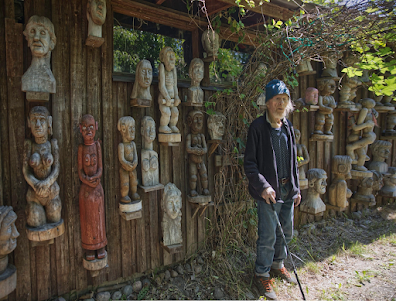
Characterized by a large number of hand-made artistic items in both the interior and exterior, Heikki Merilainen's house is located in Hanko, a town with approximately 8,000 inhabitants on the south coast in the far west of Finland.
Life and works
Meriläinen, currently in his mid-80s, was born in 1938 on the other side of the country in Tuupovaara, a community in North Karelia in eastern Finland, near the border with Russia.
He grew up in a farming community, and because it was wartime, many young fathers had been drafted to serve in the military.
After primary school Meriläinen studied to become a construction draftsman and architect.
Once qualified, Meriläinen moved to the city of Hanko, where he started working as an architect.
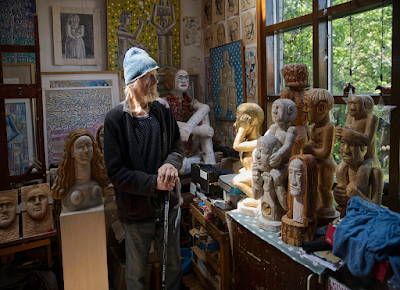
The family lived in a house designed by Meriläinen and built with his own hands. It became a nice, light house with a studio, which he needed for his work. But not only that, he also had the studio because he had become interested in art and wanted to be creatively active. He had therefore previously taken a course by correspondence in art history and artistic design.
In his spare time he made sculptures, paintings and drawings.
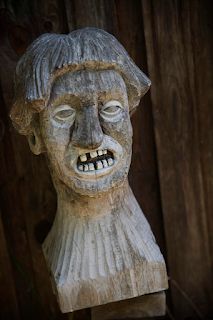
Images in this article show some of the sculptures he made. All in all a considerable amount, not too large qua format, quite expressive and partly mounted on the wall of a shed near the house, a method of exhibition we see more often in Finland.
In his paintings and drawings he depicted Finnish landscapes that no longer exist in that capacity and also Finnish ways of life that are now lost, such as horses pulling sleds, however not in a nostalgic style, but rather with a timeless character.
Nowadays Meriläinen lives alone in his house.
Documentation
* Article by Heini Heikkilä on the website of the Finnish Association for rural culture
On April 23, 2011, this weblog had a post entitled Visiting some environments in northern France with Laurent Jacquy. This post listed a number of art environments in Northern France, based on the information collected by Laurent Jacquy in his weblogLes Beaux Dimanches.
Among the sites reviewed in this article are those by Joseph Meyer en Monsieur Goldoni. It so happened that at the beginning of September 2014, Joseph Meyer, who built a castle in the outer space of his house in Berck-Plage, got his own review.
And now it's Monsieur Goldoni's turn to get his own review.
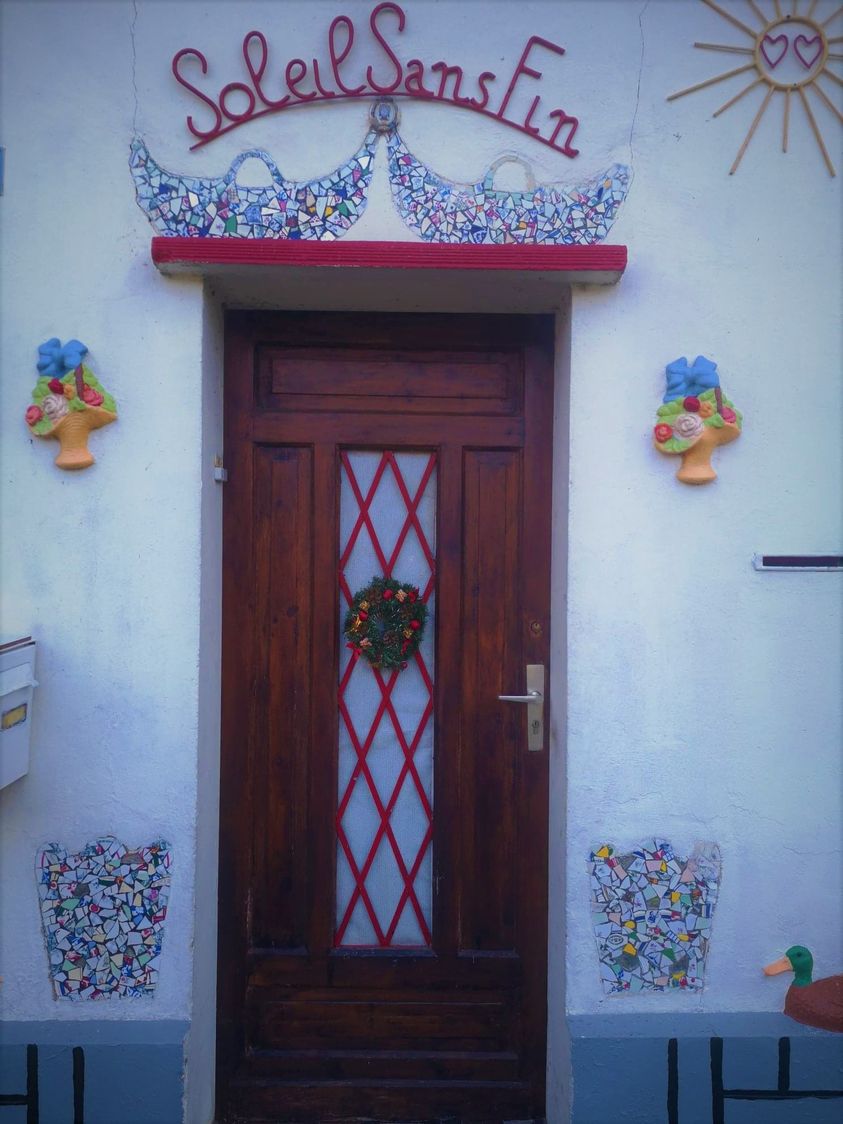
decorated exterior of "Soleil sans fin" in 2011
this picture and the one of the left below
courtesy of Laurent Jacquy
Life and work
Mario Goldoni (1922-1994) was born on January 16, 1922 in San-Possidonio, a city in the north of Italy.
He became a craftsman, mainly working as a mason, and emigrated to France in his mid-20s, after the end of the Second World War when France could use a large workforce.
His permanent residence in France became Quesnoy-sur-Airaines, a small commune with 475 inhabitants (2005) in the Somme area in Northern France. He married a French woman and had six children. His wife died before all the children had grown up and Goldoni was largely responsible for their upbringing.
the same scene in 2022
detail of the garden (2011)
In 1965, when Goldoni was in his early 40s and had become a widower, he began to transform the garden on the street side of his house into an art environment by placing all kinds of creations there, both made of wood and cement.
The very first image in this post, made around 1982 by Francis David and published in his book Guide de l’art insolite Nord/Pas-de-Calais (1984), gives an impression of the nature and extent of the decorations that were added to the site over the previous 15+ years.
We see a variety of wooden creations, such as a windmill and some houses and tower-like small buildings, there is a scene with snow white and gnomes grouped in front of two cylindrical towers. Goldoni was busy making the creations in the evenings, when the children were asleep.
After Goldoni died at the age of 72 on August 29, 1994, the size of the art environment, which had already existed for almost thirty years, began to decline. Due to lack of maintenance and vandalism, the wooden structures disappeared and small sculptures were also stolen.
The second photo from above, which presents the situation of garden and house in 2011, shows how little had remained of the originally lavishly decorated garden.
However, the decorations above the door and on the facade of the house are still untouched and the sculpture of a young lady is unmistakably present (although the color of her clothes has changed).
the entrance of he house in 2022 this picture and the next ones courtesy of Sonia Terhzaz
The latter also applies to the situation in 2022 when Sonia Terhzaz, author of a website about art environments in France, visited the site.
The decorations around the entrance door, the sculpture of the young lady and the characters standing in the background were still in good condition.
This also applies to the decorations in the interior of the house, which, as it turned out, was inhabited by Marie-Hélène, a daughter of Goldoni, 64 years old in 2022.
Sonia was welcome to visit the interior and take pictures of paintings and decorations made by Goldoni,
It turned out that Marie-Héléne, who was still saddened by the passing of her father, in many ways was involved in the maintenance of the artistic legacy, for example, by recoloring items whose paint has faded.
The floors of the house were apparently paved by Goldoni himself, using dissimilar cement tiles, which gave the house a special atmosphere of its own.
The five surrounding photos give an impression of Goldoni's decorations as they are in the interior, with in the top right photo not only a painting, but also a collection of miniatures with the same appearance as the castle-like structures that decorated the garden.
Then, pictured above, there is a decorative mantelpiece, surrounded by smaller creations.
Below are two small paintings in a round frame, which seem to evoke the atmosphere of a cozy family gathering, perhaps for Goldoni a reminder of earlier times.
Documentation
* Entry (April 18, 2011) about Soleil sans Fin on the weblog of Laurent Jacquy
* Article about he site by Sonia Terhzaz, reporting a visit she paid in December 2022
* Entry on the website Habitants-Paysagistes by Lille Art Museum, with a series of photographs of the site (around 1982) by Francis David
Mario Goldoni
Maison "Soleil sans Fin" (Endless Sun)
1 place Clémenceau
Quesnoy-sur-Airaines, dept Somme, region Hauts-de-France, France
pictures (2018) courtesy of Sophie Lepetit, from her weblog
In the Haut-Rhin department in the Alsace region in France the town of Zillisheim is home to a rather special art environment, namely a rather large collection of gnomes, spread over various areas of a private house.
Life and works
This site was created by Joseph Ress (1934-2008), who was a farmer during his working life.
Joseph Ress was a special person. He felt most comfortable during periods such as around Christmas, when the house could be lavishly decorated and most people would be in a good mood.
And so he probably got the idea that the house could also be decorated in a more permanent way. When exactly he started collecting gnomes is not known, but seeing the size of the collection, it seems that he started at a young age.
The gnomes were grouped in all kinds of places in and around the house, not only in the garden, but also in various courtyards, in the garage and in the sheds.
The images above and below of the garden show that in addition to the gnomes, other decorations were also placed, such as small-scale windmills, small sculptures, and the like.
In addition to various arrangements of gnomes, several walls of the house were also provided with all kinds of colorful decorations.
The two images below give an impression of this.
The first image shows oil lamps hung in a row in front of a wall that is painted with pictures of fairytale figures and some gnomes.
The other image (below) also shows an arrangement of gnomes on a table, from which also hang some oil lamps. The table stands in front of a decorated wall, this time with horseshoes and other decorations, including attributes from the farm.
On a blog started by Joseph Ress in February 2007, he writes in July of the same year that, stricken with cancer, he finds it more and more difficult to care for his gnomes.
Aged 74, he passed away on November 16, 2008,
The family continued to take care of the collection of gnomes, which - as can be seen on Google Streetview - was still in good condition in 2019. A granddaughter has continued the weblog, adding a variety of colorful photos.
Documentation
* Post (August 14, 2021) on the weblog of Sophie Lepetit
* WeblogLe logis des nains .(created February 2007), continued after Ress died by a granddaughter
Joseph Ress
The shelter of gnomes
8 Grand Rue
68720 Zillisheim, dept Haut Rhin, region Grand Est, France
all pictures, except the one of the summer-market,
from Facebook
The small town of Valence d'Agen, a community with about 5,000 inhabitants in the south of France, can feel happy that an exceptionally colorful art environment was begun the past year (2020) , a year that was also characterized by a pandemic which brought a lot of grief and limitations. It is a site created with the aim to propagate Bonheur (Happiness) ...
Life and work
The site is being developed by a female artist in the field of what in France is referred to as art singulier. She calls herself Kahl, which is a pseudonym formed by a number of letters of her real name.
two videos showing mobile creations
Born in 1965 in Troyes, in the north east of France, it was not obvious that she would work in a creative setting, and initially, because of her studies, she had very different work, such as activities in the fields of communication and the education of children.
However, she began to feel more and more that there was another direction ahead for her, more artistic, and especially in the direction of art singulier.
As she said: Mon parcours de vie m'a guidé sur ce chemin que je n'envisageais pas et voilà ... C'était écrit quelque part ....(My life journey has guided me on this path that I did not envision and here it is ... It was written somewhere ....)
She overcame a disease and after great efforts and thanks to a strong character she felt reborn, able to take a New Beautiful Color Path.
In the late 1990s she moved from Troyes to La Rochelle, on the French west coast. There she opened a small art gallery, where she sold works of art singular artists.
She started painting herself and signed her paintings with the pseudonym KAHL. And then, it turned out that many people, not knowing that Kahl was the owner of the gallery, were interested in her paintings which they valued as attractive work full of color, made by an artist with a distinctly feminine palette.
Stimulated by the apparent appreciation of her work by visitors to the gallery, Kahl began to give painting an important place in her life. She participated in exhibitions and the appreciation of her work continued unabated. It was also a nice experience that the characterization feminine palette turned out to be correct when, for example, at awards ceremonies after participating exhibitions, she publicly announced that she was the artist named Kahl.
In 2008 she was awarded the first prize in La Rochelle's Festival d'Art.
Move to the area of Tarn et Garonne
In 2010, Kahl moved from La Rochelle to the Tarn et Garonne region, an area in the south of France she had met many years earlier while on holiday. She went to live in Bardigues, a community about 10 kilometers south of Valence d'Agen, where she later would establish the art environment that ultimately gave rise to her presence in this weblog.
She became a well-known artist in the area, which she crossed with a van full of paintings, her own work and that of others, to sell at markets in various villages and towns around.
photo of a summer market in 2013 on the Place Nationale
In 2017, she had to temporarily interrupt her busy work to undergo surgery because of a cardio problem and a back ailment, but after that rest she was able to quickly return to her places in markets and in the art trade.
In many places in the region she also was active in giving painting lessons, especially to children, in participating in exhibitions and with the sale of paintings in art galleries, the latter for example from May 2019 in the Galerie d Art Singulier on the Rue Notre Dame nr 1 in Valence d'Agen.
Then, in early 2020, she took a new step in her development as an artist. She left the gallery and moved into new accommodation.
This new accommodation was a free-standing building in the style of a chalet, situated on a generously sized lawn in the vicinity of a McDonald's in Valence d'Agen.
The walls in the interior of the chalet are fully occupied by Kahl's paintings, and maybe also those of other artists, just as was the case in the galleries she managed.
It is the outdoor space where the difference with the past manifests itself.
The images in this post show that now also large-scale creations, often more than man-sized, have become part of Kahl's creative activities.
Some of these rising creations represent more or less human characters, others consist of colorful poles with a wheel placed horizontally at the top, and they all have a cheerful appearance, full of bright colors, smiling faces, whatever, and in any case they are composed of recycled material (Récup, in French).
In addition, many of the creations have a lively character, with elements that move up and down in the wind, rotate or they move as its suits.
The outside space, where Kahl's green-decorated van has a place too, now also includes items such as flower boxes, a decorated chair, panels with texts ...
It is almost unbelievable to see how, in about a year's time, an ordinary piece of grassland has turned into an attractive, cheerful and happiness-radiating art environment where visitors are welcome.
Documentation
* Kahl's website (with pictures of her paintings and the creations in the garden)
Efim Vasilyevich Chestnyakov (1874-1961) almost all his life lived in the tiny village of Shablovo in the Kostroma region of Russia, except for some years he was a teacher in other communities and a few years he had an art education in St Petersburg,
He was a complex artist, active in various artistic fields, such as photography, writing literary stories and fairy tales, making paintings, doing theater performances ....
He also made large scale miniature scenes with figurines and structures from clay, as shown in the photo above and the one below.
another part of the clay figurines
Life and works
Born on December 31, 1874 in a farmers family living in Shablovo, Chestnyakov at a young age already showed he had a talent for making drawings.
After his primary education, he followed from 1889-1894 a training, to become a teacher (1894-1899) first in a village near the town of Kostroma, then in Kostroma itself and later in the village of Uglets near the town of Kineshma in the Kineshemsky district (Ivanovo oblast).
When Chestnyakov was a teacher in the Kineshemsky district (1896-1899), he participated in the circle of local intelligentsia, he read books on philosophy and culture, drew a lot and painted watercolors. He also developed a passion for theater when in December 1897 in Kineshma a theater was opened.
At the end of the 20th century in rural Russia the Petruschka theater was in particular popular, a performance with marionettes and hand puppets, the main character being kind of a jester dressed in a red costume and sometimes with a long nose.
Later in his life the phenomenon of theater would be an important aspect of Chestnyakov's artistic activities.
portrait (around 1900) of Chestnyakov as a young man
During Chestnyakov's stay in the Kineshemsky district his talent for drawing was noted and friends raised funds which enabled him to move to St Petersburg, where from 1900 he would take lessons. both in the workshop of a well-known professional painter and at an art academy.
In 1905, because of rebellions in Russia, the Academy closed and Chestnyakov -his education not yet completed- returned to his native village, where he settled in a small house, as pictured below.
Chestnyakov's original house, built in the early 1900s
He was in his early 30s and his decision to return to his native village meant that prospects for a career as a professional painter would become less obvious.
It may be that he meanwhile had become aware that his artistic interest was much broader than just making paintings, and that this capacity, combined with his inner drive to contribute to a better future for people around, and especially children, could be better realized in a rural than in an urban setting.
Whatever this may be, the first quarter of the 20th century, was the period in Chestnyakov's life with the greatest artistic achievements, both in making paintings and in his other activities like doing theater performances, making clay figurines or writing books with fairy tales.
The miniature city
From a point of view of art environments, one of his various activities is very interesting, namely the making of a large collection of figurines of clay, an activity he started some years after his return to Shablovo.
Some 800 of these figurines, together with other small items, were combined into an ensemble that depicted a city named Cordon. It is a city with houses, palaces and streets, inhabited by children and adults.
The ensemble, situated in Chestnyakov's house, as such ranks as a work of art and can be referred to as an art environment in the category miniature constructions and scenes. Moreover, given the lavish decoration of the walls of his house with paintings, Chestnyakov's interior can also be seen as an art environment, but then in the category decorated interiors. .
Today this ensemble of clay figurines doesn't exist anymore; just some forty clay items have been left.
'
picture of Chestnyakov's house, from website rusmir-media
the house, a copy of the original house, now is a museum
After another period in St. Petersburg Chestnyakov settled in Shablovo for the rest of his life
From 1913 until 1914 Chestnyakov once more stayed for some months in St. Petersburg, this time to get lessons from prof Kardovsky. But then the first World War began and Chestnyakov, who had been rejected for military service, returned to his home in Shablovo.
He would now stay in Shablovo for the rest of his life (1914-1961), focusing on the daily life of the inhabitants of the region, and without any relation with institutes and other artists in the Russian art world.
Chestnyakov remained active as a painter, showing a certain preference for rural and peasant life, depicting local people, often gathered in large groups and in settings with a specific atmosphere that characterizes his paintings.
He did not want to sell his paintings but kept them in his house, usually not framed, but nailed on battens. Sometimes he would give a painting to people living around.
The various pictures below of the interior of Chestnyakov's (in 2004 rebuilt) house, give some impression of his paintings.
this picture and the next one
screenprints from the March 2019 video
Chestnyakov transformed the ground floor of the house into kind of a theater, where he had performances and amused the children of the village with fairy tales, which he mostly wrote himself and which also have been published (such as The Magic Apple, a collection of fairy tales, illustrated with his own drawings, published in 1914).
In his performances in the theater his paintings could function as scenery, just as his clay figures could act as puppets.
The ground floor of his house could also serve as a Kindergarten for village children whose parents had to work.
The various elements of Chestnyakov's artistic and social activities were interrelated and ultimately formed a large coherent whole. An intelligent, selfless, well-educated man, Chestnyakov saw the poverty and deprivation of the villagers, and wanted to contribute, in particular, to a better future for the children. He dreamed of a City of General Prosperity, where everyone was happy.
the cupboard has a small selection of clay figurines
In the 1930s, Chestnyakov -at that time in his mid 50s- finished creating paintings. He continued to give his performances, also in neighboring villages that he visited with a cart full of attributes, including some paintings as decor.
Chestnyakov died on June 27, 1961 He was in his late 80s. Villagers carried the coffin to the cemetery four kilometers away in the neighboring village of Ileshevo, where Chestnyakov was buried in a simple grave, just decorated with an iron cross.
Discovery of Chestnyakov's paintings
Seven years later, in the summer of 1968 employees of the regional museum in Kostroma (some 350 km west of Shablovo) visited the Kologriv district, looking for unknown artists. An inhabitant of Shablovo informed them about Chestnyakov's legacy. which was left to waste in the now uninhabited house.
For the museum this was a historical discovery.
A number of the paintings was restored and added to the collection of the regional museum. The Museum of Local Lore in Kologriv, a town some 18 km south of Shablovo, also got a part of the paintings.
this picture and the next one
screenprints from the December 2019 video
In the following years, the village began to depopulate as residents moved to neighboring towns. Today, the former village still has about ten houses.
Chestnyakov's house became a House Museum
Chestnyakov's house survived as it was during his lifetime, until in 2002 an initiative group started collecting donations for its renovation. In 2004 the House Museum opened, in 2008 it formally became a subsection of the Museum of Local Lore in Kologriv
Attempts have been made to maintain the atmosphere of the original building as much as possible with the help of paintings and other parts of the former establishment that were still available. Various (former) residents of the village who owned artwork by Chestnyakov, also cooperated by making these items available to redecorate the museum.
The museum got its own administrator. In the 2010s there were discussions about the position of the Museum due to the recast of administrative arrangements in the region, but -as the videos below show- in 2019 the Museum was in full operation, lectures were held and thematic exhibitions and festivals took place.
* Thesis by Igor Sergeevich Shavarinsky, Театр Ефима Честнякова как культурный феномен: к проблеме синтетической природы творчества и его восприятия(Theater of Efim Chestnyakov as a phenomenon of culture: the problem of the synthetic nature of creativity and its reception. Thesis for an academic degree in cultural studies. Ivanovo, 2016
* Website about the artist, with a biography, a gallery of pictures and texts of some fairy tales
* Article (August 2007) on LiveJournal about the museum in Kologriv, with information about and pictures of artwork by Chestnyakov (and by Ladyzhensky)
* Article (undated) by Andrey Anokha about Chestnyakov as a photographer on website Starina44
* Article (April 2019) The Russian soul of Efim Chestnyakov on website Rusmir-media
* Article on Wikipedia about Chestnyakov's painting City of General Prosperity
Videos
* Short video with an aerial view of the (former) village of Shablovo, with some shots of the exterior and the interior of Chestnyakov's house (YouTube, March 2019, 2'39")
* Video of a meeting in the Museum at the occasion of the 45th anniversary of the birth of E.V. Chestnyakov. in two parts (Part 1, YouTube, 5'47", December 19, 2019)
In Chudovo, a Russian town some 100 km south-east of St Petersburg. self-taught artist Konstantin Ekshibarov transformed his house into a museum by filling its rooms with a large variety of copies of paintings by Europe's leading classical painters.
Life and works
Born in 1926 in Barnaoel, a town in the south-west of Siberia. Konstantin Sergeyevich Ekshibarov already at a young age was very interested in visual art. Going to an art school however wasn't an opportunity since in 1944 at age 18 he was immediately drafted into the army which was engaged in the war with Germany. During the war he witnessed that soldiers destroyed valuable artistic items in a library and at that moment he decided to devote his life to the copying of paintings by classical painters.
this picture and the next ones (2005):
screenprints from the TV1 video (see documentation)
After the war Ekshibarov went to the Military Medical Academy, although he later regretted he had not followed his calling to go to an art academy. After the academy he stayed in the army as a medical doctor.
In 1956 he left the military for a job as biochemist-toxicologist at the Russian Institute for Toxicology in Leningrad (named St Petersburg from 1991), where he worked until he retired in 1984. During all the years in the army and at the institute, in his spare time he was active in making copies of classical paintings.
In doing so, he focused in particular on copying paintings of famous classic masters, such as Rubens, Goya, Velazquez, Titian....
He has created hundreds of copies, with a certain preference for portraits of women and the female nude, working by means of illustrations of paintings in magazines and books about visual art.
During most of his professional life Ekshibarov was not allowed to make trips abroad to see paintings of his beloved masters in European museums, but of course the Hermitage was at his fingertips.
Once retired, Ekshibarov and his wife Anna Vasilyevna decided to leave the big city. In 1985 they settled in Chudovo, a town of some 15000 inhabitants in the Novgorod region, where they had acquired an old two-storey house.
Ekshibarov single-handedly transformed this property into a building with some fifteen rooms, which came in very handy to exhibit Ekshibarov's already extensive collection of copies of paintings. So the couple used two of the rooms to live in and all other rooms were intended for exhibiting the paintings. That is to say, a selection of the paintings, because the collection was so extensive that a large part of it had to be kept stored.
Some rooms were dedicated to a particular country or region, for example Italy, France, Russia, Germany, Flanders...... By adding attributes Ekshibarov and his wife have tried to give each room the atmosphere that fits the paintings and the era they were created.
Ekshibarov was not a man who sought publicity with regard to his artistic work. He performed his artwork in isolation and had no contact with others about his artistic activities. The local committee on culture did not know about his museum.
This situation lasted about twenty years, until in October 2003 a first article about his creations appeared in the Russian newspaper Izvestia, followed by articles in other newspapers in the same month and in 2005 and 2007 (see documentation).
At that time the artist was around age 80, so in these articles also the question was raised what should happen with his legacy of over 450 paintings. Ekshibarov himself on principle never considered to sell separate items of his artwork, neither would he consider to donate separate items to a museum. His ideal was that his entire oeuvre would be exhibited in a separate museum, preferably in a building in Chudovo and maybe under the auspices of an already existing museum. In such an arrangement he would gladly donate the complete collection to a foundation or a museum.
It is a pity to have to end this post in 2017 by concluding that after 2007 no further news has appeared on the internet, neither about Ekshibarov himself, nor about the status of the collection.
Documentation
* Tatiana Romashenkova, Hermitage in the garden, article in newspaper Kommersant, July 2005
* Andrey Ivanov, My dear Titian, article in newspaper Novaya Gazeta, October 2005 * Sofia Prokosheva, Kopiist from Chudova, article in newspaper Nevskom Vremya, 2007
Konstantin Sergeyevich Ekshibarov
Museum of copied paintings
Chudovo, Novgorod region, Russia no information available about the actual situation
this picture and the next two from weblog los necios se conjuran (December 2008)
This art environment in Sanlúcar de Barrameda, Andalucía, Spain, doesn't exist anymore. Economic interests were more important than cultural considerations.
Life and works
José María Garrido (1925-2011), from the Spanish community of Sanlúcar de Barrameda, near the city of Cadiz (Spain), was a sailor, but when in 1959 his best friend drowned in the sea, he decided to quit seamanship and to stay on the mainland for the rest of his life.
In honor of this friend, in 1960 he began embellishing his house with with various items related to the sea and to seamanship and with shells he collected from beaches around.
Garrido explaining
The Museo del Mar las Caracolas had around 80.000 shells. Together with all other items relating to the sea and a lot of placards with explanatory texts by Garrido, these covered all walls of all rooms of the house.
In the early years of the museum Garrido was always ready to meet visitors and to explain the collection. If tourists would not find the site on their own, he would look for them on the adjacent squares and persuade them to come and take a look.
In later years, when Garrido became too old to entertain visitors, the museum only occasionally could be visited by those who were allowed an appointment.
The museum, with its fully decorated interior, ranked as an art environment, a designation that was reinforced by a very special construction Garrido had added to the roof of his house.
On the oblong flat roof he built from scrap material a fully equipped ship, with a flight, masts, gunwales, a sleeping cabin, you name it.
this picture courtesy of Ketari
site not available anymore
The local authorities were not amused. They preferred that this ship's construction would sail off to the seven seas, in order to realize plans of urban reconstruction.
this picture (2007) from the weblogCrónicas de une cámera
Garrido however announced that he wanted to maintain the house, which dated from 1503 and was located is in one of the oldest neighborhoods of the community. Various placards announced that this ship would not move away, that it belonged to Sanlúcar, that it was no al Derrida
The struggle between Garrido and the authorities has continued until the artist died, although, according to an article in a local newspaper, in November 2010 Garrido and his family were invited by the (new) mayor to come to the town hall to be honored and hear words of praise for his contribution to the city.
Garrido died in 2011.
The museum doesn't exist anymore. After Garrido's death the authorities succeeded in implementing their plans for urban renewal, The house/museum was razed to the ground
Documentation
* Derek Workman, He sees seashells - Museo de las Caracolas, article in weblog "Spain Uncovered", undated (probably around 2010)
* Jo Farb Hernández, "José Maria Garrido: Sailor without the Sea", in: Elsewhere, International Journal of Self-Taught and Outsider Art, issue 1 (August 2013), pp. 91-104.
* Article on SPACES website (2013)
first published July 2010, last revised November 2023
José María Garrido El Museo del Mar Calle del Truco Sanlúcar de Barrameda, Andalucía, Spain the museum doesn't exist anymore