unless indicated otherwise pictures are screenshots from the video in the documentation
The house pictured above, with a three-headed snake on the roof, is located in the village of Durasovo, in Russia's Yaroslavl region, about 250 km north of Moscow.
Life and works
This snake is a creation of Nikolai Anatolyevich Krylov, who - as far as could be determined - was born in the late 1950s.
As a young man Krylov dreamed of becoming an artist, but for practical reasons he became a carpenter. But then, a carpenter with a lot of imagination.....
He married and in 1980 he bought the house in Durasovo. During the first years that he and his wife lived in this house, he paid a lot of attention to furnish it with all kinds of self-made or self-decorated furniture, such as tables, chairs and sofas.
But he also took a more creative path by, for example, providing the headboards of the beds with decorative wood carvings, and presumably also the rooms of the daughter and the three sons the couple had over the years.
He also made a side table with a top surface designed in such a way that it could be used to play a game of chess.
The outdoor area also got Krylov's attention.
This space was surrounded by a beautiful fence and a special hand-made fountain, as in above image, gave the garden in front of the house a special allure.
Not only was the facade painted in a vibrant sunny shade of yellow, also carved wooden decorations were applied around the windows and on the rest of the facade.
But the decorations on the roof were the items that attracted the most attention from passers-by.
To start, the image above shows a weather vane decorated with a rooster carved from sheet iron.
And then there is a hand-made rotating viewing dome, pictured below, with an interior decorated with fairy-tale characters. This dome is located at a height of about 15 meters, from where one has a panoramic view of the surroundings of the house.
But what most attracts the attention of passers-by is the three-headed snake that, as can be seen in the very first images, views the world from a trypan in the facade.
This creation was completed in 2011, after Krylov had worked on it for two years. He made the snake from driftwood he found in a nearby forest and he selected the parts in such a way that he had to sharpen them as little as possible. Krylov's snake is covered with pieces of sheet metal and has eyes in each head consisting of photocells, which shine in the darkness and occasionally flash red.
In Russia this snake is a well-known (fairytale) character called Zmey Gorynych, which means Snake of the Mountains. It usually has three heads, sometimes seven or nine, and can talk and breathe smoke and fire.
On the image below there is a second snake, also a large one, which has been installed on the part of the roof at the rear of the house, not visible from the street. The available documentation about this art environment says that this creation is based on a fairy tale about Mowgli.
This probably has to do with Mowgli and the snake Kaa, characters that initially appeared in Rudyard Kipling's Jungle Book, a 1994 film in which Kaa is a friendly character. However, in later videos from other producers, Kaa was presented as the villain. It is not clear to which Kaa Krylov referred.
Someone who is driving on the road named after Célestin-Dubois in Waziers, northern France, looking for Alain Lefranc's art environment, will probably pass the house pictured above, because from the road there is not much to see of the site, except for the rooster on the roof and a fenced area behind the house.
this photo and the next ones (2011) by Hubert Bouvet published here with \ permission of the Inventaire Général du patrimoine des Hauts-de-France
But once arrived in in the elongated, shielded space -with the part near the house converted into an art environment and the part at the back serving as a vegetable garden- one can see the creations, albeit less flourishing than in the photo above, which was made some twelve years ago.
Life and works
Alain Lefranc (1951-2022), who created this art environment, started working in a mirror factory at the age of 14. During that job he trained as a house painter, which enabled him at the age of 18 to start working at a factory that produced zinc and other metals. He first worked there as a painter, and later held various positions, until he retired in 2005.
In 1975 he started to refurbish and shape the garden, laying tiles and locating and constructing ponds. The first decorations, such as decorated tiles, came in the 1980s.
In the years when he had a day job, he probably worked on the garden mainly on weekends. Once he was retired, he was able to work every day, which he described in the following way: When I got up in the morning I had my coffee, my newspaper, my cap, my keys, I opened the doors and let my cats out and then I went to work, my cement mixer was running, come on and that was my passion.
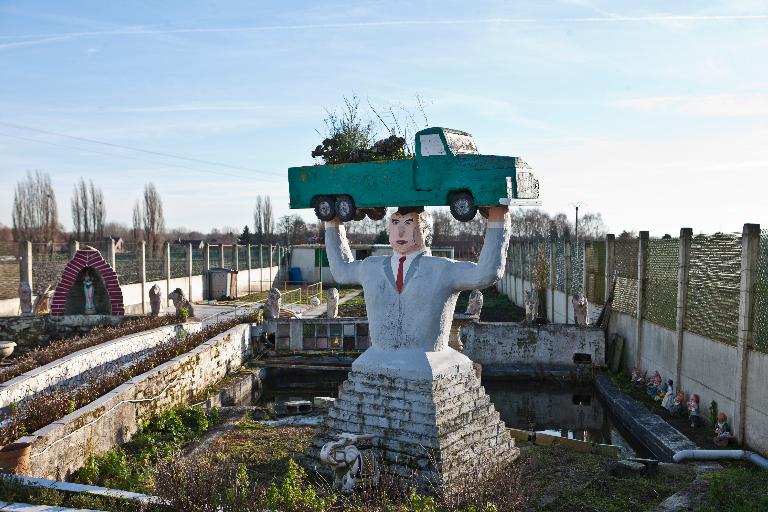
The three photos above all show a man carrying a car. He is seated, or so it seems, on a truncated pyramid and is dressed in a neat suit and tie. This dominating sculpture, which determines the image that this art environment evokes, was added around 1990, when Lefranc had already been working on his project for many years.
Making this sculpture did not go so smoothly, because when the creation was just finished and was still drying, a violent storm came along, causing the man, who was still standing on both legs on the pedestal, to fall apart. Lefranc, who had already foreseen this misfortune, then placed the sculpture without feet and legs, so from the waist down, on the pedestal.
The person portrayed in the sculpture is not just anyone. In the area he was referred to as Arthur Bils with a truck, a reference to the owner of Bils Deroo, a transport company located near Lefranc's house. The truck that is being towed is the first type purchased by Bils Deroo.
Currently, the sculpture is still standing proudly, although the colors have faded somewhat.
Another striking decorative manifestation is the ensemble of lions arranged along pools with fountains, as if acting as guardians. Jets of water could come from the mouths of these lions, which, together with the working fountains, must have been a beautiful sight. However, this spraying event is a thing of the past.
Along the edge of one of the basins is an arrangement of small sculptures, most notably gnomes. Currently that setup is no longer there.
A little further in the garden there used to be two ponds with fish, separated by a path with two sculptures of lions. One of those ponds has now become a large flower bed.
At the entrance to the garden, near the house, there used to be a replica of a metal tower as was often used in the mining industry in the 1950s.
It is almost impossible to see in the photo above, but this replica was made from all kinds of recycled materials, such as two bicycle wheels for the wheels in the top and parts of iron bed frames for the construction of the scaffolding as such.
Flanked by two unrecognizable sculptures, we see a purchased sculpture of a Madonna in the pointed-arched niche above. The niche has now deteriorated, but the Madonna is still lying somewhere in a pile of rubbish.
To end this post a few more pictures of creations that decorated or still decorate the roof of the house
a paddle wheel
a weather vane
Its seems that the paddle wheel and the weathervane above no longer exist.
Below is a rooster, which, as can be seen in the very first image, still adorns the roof.
Alain Lefranc died on March 28, 2022.
It remains to be seen whether Lefranc's art environment will stand the test of time. A comment below says that by May 2023, the garden has become overgrown, with only large elements still visible, such as the metal tower and the man holding a truck.
Documentation
* Article by Sonia Terhzaz on her website Cartographie des rocamberlus, with a report of a visit she paid to the site in march 2021
* Article with a variety of photos on the website of the Inventaire Général du patrimoine des Hauts-de-France
Alain Lefranc
Decorated garden and house
169 rue Celestin-Dubois, Waziers, dept Pas-de-Calais, region Hauts-de-France, France
Located in the extreme east of the Crimean peninsula, the city of Kerch is dominated by a 90 meter high legendary hill called Mithridates. At the foot of that hill, in Rybakova Street, was a building with remarkable decorations, the house of Viktor Fedorovych Golovnya, who was born in the mid 1940s.
It is very unfortunate that this article about the site has to be written in the past tense. This because in December 2020 the house was badly damaged by fire. This happened just two and a half years after the site in May 2018 -probably for the first time- was reviewed in the local press and featured in a video.
Luckily Golovnya survived the fire. But it is not clear where he lives, now that the house has become uninhabitable.
the side of the house, decorated with rims of car wheels
Life and works
Probably retired, Golovnya when he was interviewed in 2018 lived alone in the house. His three daughters already had left home and his wife probably had passed away, in any case she was not present at the interview.
In his working life Golovnya kept sheep, which he let roam on a part of the Mithridates hill behind his house. When he wanted to expand his sheep farm and build new stables, he did not get permission from the authorities that managed the hill.
On the contrary, to protect the classic allure of Mithridates, by court order he had to end the sheep farming and he was only allowed to use the house and keep a small number of sheep in a stable.
composition on the roof
The now burned-down house was built by Golovnya himself.
Self-building is often a labor-intensive affair and especially now that the house was quite large and, for example, also included bedrooms for each of the three daughters, constructing he house must have taken a considerable part of Golovnya's time.
In addition, Golovnya tried as much as possible to acquire material for construction that was left unused elsewhere, which also included visiting garbage dumps.
Some neighbors have referred to Golovnya as being an eccentric because of this way of working, but probably it is rather so, that he was someone with limited financial means, who in this way could build and decorate his house with simple, cheap things, a pattern not unknown in the field of art environments.
another composition on the roof
This way of obtaining and using scraps of building material led to the appearance of the house being somewhat untidy, as depicted in the very first photo.
At the same time, this form of collecting material gave Golovnya the opportunity to find things to use for making exterior an interior decorations.
Exterior decorations
So the second photo from above shows the side of the house with a structure that is unclear in terms of function, situated behind grilles, with decorations such as car wheel rims, bells and other things.
The third photo from above was a composition that probably also was added to the roof, although pictures do not confirm this. It's a colorful fantasy character, possibly part of a children's bicycle, with a base of three metal hemispheres.
Another composition on the roof is depicted above. It's a weather vane composed of metal basins, flanked by a number of spiral items.
decorations on an interior wall
Interior decorations
As far as the interior is concerned, the photos above and below only to a limited extent give an impression of the lavishness of the decorations. In this respect the video referred to in the documentation, is more informative.
A wall with many photos and portraits documented Golovnya's family history. There were pictures of his daughters and there was a painting that portrays his grandfather, Mikhail Ivanovich Bondarenko, and another one of his father who, as told by Golovnya, was in the Russian army, fighting against the Germans in 1942 near Kerch.
However, the family photos were just a small part of the many, many items that decorate the floor, the ceiling, the tables and cabinets, but especially the interior walls.
There were carpets on the floor, canvases on the ceiling and walls filled with a multitude of paintings and photos, cabinets covered with teapots, a variety of pendant lamps, thermos jugs ..... an extensive and at first sight disordered combination of all kinds of items. together however making an overwhelming visual impression.
Not all items displayed in the interior were collected by Golovnya himself. Neighbors and friends also came along with remnants.
Some of those donors assumed aloud that the decorated interior for Golovnya was kind of a paradise, but he himself said that his house was more of a barn. This may indicate that he was not so much characterized by an inner urge to transform the living room of his house into a kind of an artistic collection, but rather that he was not able to stop collecting things.
A good look at the types of items that made up the collection (as shown in the images in this post) reveals that these are items that are typically found in living rooms in European countries, such as paintings, photos, clocks, lamps, bottles, curtains. Other items from the dump, such as old clothing, parts of old bicycles, garden equipment and the like, are missing in the items exposed in the interior.
So the peculiarity of the interior was not primarily in the type of decorations. The impressive, even alienating effect of the collection had mainly to do with it's large size, which in turn is related to the fact that Golovnya could hardly stop collecting and displaying leftover stuff, a characteristic that is encountered in many people who create an art environment.
The size of the collection, in conjunction with Golovnya's passion for collecting, contributes to the conclusion that the now-burnt items on the roof and the interior collection of leftover stuff could be viewed as a modest art environment in the capacity of a decorated interior and exterior.
Documentation
* Article (May 2018) on the website of local newspaper Kerch.com
* Article (December 2020) on the same website with a report about the fire
thanks to Alexander Emelyanov, who not only drew my attention to this art environment, but also helped to make accessible the Russian spoken in the videos