Showing posts with label installation (windvanes). Show all posts

September 16, 2019

Juris Audzijonis, Dieva dārzs "Jūras" / God's Garden "Jūras"


entrance gate of the park
this picture and the next one from Facebook

Vecumnieki is a community in Latvia of around 2100 inhabitants, located some 50 km south of the country's capital Riga. In the rural area north-west of the community a collection of wooden creations catches the eye. This is Juris Audzijonis' art environment generally known as Jūras, God's Garden, a park with a variety of single handedly made wooden and metal creations.


Life and works

When he was in his early fifties the life of Jūris Audzijonis, who was born in 1942 or 1943, took a special turn. During a cardiac arrest that had hit him, he had a beautiful vision that he experienced as the divine light that brought him back to life.

Prior to this experience he was not a believer, but now he was converted to the Christian faith, and moreover, he also felt inspired to propagate that belief by making and installing creations that reflected that belief.

In 1996 Audzijonis started a project that has kept him busy until now (2019) and that has resulted in a park-like art environment that includes single-handedly crafted wooden sculptures, metal assemblies and singular architecture in various forms.

a sculpture of Our Lady
this picture an the next ones screenprints from the video 
referred to in the documentation

As the picture of the entrance (at the top of this text) shows, Jūras is the original name of the site. However, after a journalist, with the approval of Audzijonis, designated the site as God's garden, this name was widely used in addition to the original name.

The most pronounced reference to the Christian faith in this art environment is the life-sized sculpture of Jesus on the cross, placed directly next to the main entrance of the site.

Then there is a wooden sculpture of the Virgin Mary, also life-sized, about which the story goes that a miracle happened with this sculpture when two holes in the wood near the heart opened and resin began to flow out of those holes.


The Christian character of the site is also expressed in the built structures Audzijonis created, first of all a number of churches or other places of worship, such as the one as in above picture with towers at the front- and backside, that are covered with hexagonal spires.

One of the built structures is a small wooden prayer house where at most one visitor can sit on a chair (that turns around three times) to pray or meditate.

One day a number of students came to visit the garden, waiting patiently in a row at this prayer house. Audzijonis wondered what happened, but it turned out that the students had to take an exam the next day and came to ask for a blessing.


Among the buildings in the capacity of a church there are large ones such as the aforementioned church with the four towers, but also small ones, such as the one in the picture above built by Audzijonis for his granddaughter Freya on the occasion of her fifth birthday.

Freya lives in Vienna and does not speak Latvian, just as Audzijonis does not speak German, so her mother, Audzijonis' daughter, has to assist as interpreter.


Other striking wooden constructions in this art environment are an above pictured elongated bridge that crosses a pond ........


..... and a large-scale seesaw pictured above, suitable not just for two children, but also for two adults, a device that when used exerts a calming effect on the participating persons.


Above picture shows the spire of the tower of the large wooden church with four towers crowned with an installation formed by rotating metal items, typically assembled by using leftovers, in this case metal pans

The site has a variety of such mobile items. For example, there is a high rising towery structure with an immobile pedestal and an upper part - provided with metal protrusions in the form of blades - that can rotate in its entirety.

And there is a wooden gazebo that also can turn around in its entirety.


Above picture of an all metal windmill with blades that turn in the wind, shows that Audzijonis who in reviews is mostly presented as a woodcrafter, also knows about handling metal parts.

Documentation
* Account of the site on Facebook 
* Article (August 2016) by Antra Gabre on website NRA.LV

Video
Video (September 2017, 3'19", YouTube) by Latvian Time 


Juris Audzijonis  
God's Garden "Jūras"
on the P89 road, just outside the community
Vecumnieki, Latvia
streetview
the site can be visited on appointment (see FB account)
donation welcome

July 04, 2014

Roméo Gérolami, Girouettes / Weathervanes


Many French communities have a street named after Jean Jaurès, a well known French politician, but probably only the avenue Jean Jaurès in Bléneau, France, can boast the presence of a site with kinetic (outsider) art as in above streetview (2013).

Life and works

Born in 1929 in Italy, Roméo Gérolami after World War II moved to France where his father had a job as a mason. Maybe he was in the masonry too, but anyhow he felt more attracted to a profession where he could give way to his technical skills and interests.

this picture and the next ones courtesy of Laurent Jacquy

So Gérolami found a suitable employment in the automotive industry, where he had a job as a foreman. 

Living in an apartment in Paris, he would not have much room to install self-made kinetic constructions, although as far as I understand he decorated the living room with spiral-like constructions from the bearings of wheels.


However, once retired he and his wife moved to a house in Bléneau (Burgundy area) with sufficient outdoor space to install large kinetic constructions.

So from the mid 1990s on Gérolami embellished his garden with a dozen of such constructions, installed on high poles.


His creations include small scenes of activities of daily life, such as cyclists pedaling on their bikes, and a carpenter sawing a piece of wood, but he also made airplanes, all items with movable parts driven by the wind.

Busy for hours in his workshop in the basement of his house, processing all kinds of discarded material, such as parts of old washers, Gérolami is typical what the French so eloquently call a bricoleur.

Documentation
Post (June 2012) with pictures on the weblog of Laurent Jacquy
* Article in regional newspaper l'Yonne (July 13, 2012)
Article about the site by Sonia Terhzaz on her website Cartographie des Rocamberlus (environments d'art singulier), reporting the visit she paid in June 2022 (with a series of pictures)

Video
* Video (2015, 18'36") by Jacques Burtin on Vimeo


Roméo Gérolami
Weathervanes
29 avenue Jean Jaurès
89220 Bléneau, dept Yonne, region Bourgogne-Franche-Comté
can be seen from the street
streetview

January 25, 2012

Giacomo Rebecchi, Il giardino delle ventole / The garden of fans


pictures courtesy of Cristina Calicelli

A garden in Italy with a lot of poles bearing colorful devices, that can rotate in the wind: ventole in Italian, fans or, my favourite, whirligigs in English.

Life and work

This art environment, located in the Lombardian community of Cremona, Italy, is a creation by Giacomo Rebecchi (born 1932).


Rebecchi had a job as a machinist with the Italian railways and when in the 1980s he got retired, he began constructing mobiles, using wheels of discarded bicycles and all kinds of recycled material, which he painted in bright colours.


In January 2012, when this article was first published,  the garden all together had some fifty poles with these colorful mobiles and constructions on top. A number of the creations have been dedicated to members of Rebecchi's family.

Almost twelve years later, in December 2023 the garden is still maintained by Rebecchi, who is now 91 years old.

Documentation
* Article in the website Costruttori di Babele
* Article (December 2023) on the new French website Tipeek Photos

first published January 2012, last revised July 2024

Giacomo Rebecchi
Il giardino delle ventole
Via dei Ferrovieri Caduti 7
26100 Cremona, Lombardia, Italy
can be seen from the street

October 29, 2011

André Pailloux, Moulins à vent / whirligigs


this picture and the next one courtesy 
of Sophie Lepetit, from her weblog

This post is about an art environment in a small community in the French Vendée area, facing the Atlantic and often endowed with strong winds. Rather suitable to bring the abundance of whirligigs located in this site into motion.

Life and works

The mobile devices in the garden have been constructed by André Pailloux (1943). 

Currently (2011) retired, he had a technical job at a shipyard in les Sables-d'Olonne, not far from where he lives. Around 2000, some time before he would end his job, he began decorating his front garden with rotating devices, which in English probably best can be called "whirligigs". 

The site as such has no special name, like Pailloux has no special French term to denote his constructions. They rotate in the wind (the more wind, the better, to some extent) and they are colorful, so colorful, kaleidoscopic colorful.......


The proximity of the ocean implies that the paint quickly goes lost and that the moving parts are easily damaged, so Andre Pailloux has much to do in maintaining the constructions, meanwhile a collection of some 120 girouettes. A very severe storm has occasionally led to the blow-over of a number of whirligigs

Besides the windmills, Pailloux also decorated some bicycles. The next picture, by Bruno Montpied, shows one of these bikes, that really can be ridden. It is an item that would not be inappropriate to be exhibited in a museum as an object of kinetic art. And indeed: early 2023 Bruno Montpied reported that the decorated bike had been added to the collection of the Musée de la Création Franche in.(Bègles)

photo by Bruno Montpied, made available by him 
to be published on the weblog of Sophie Lepetit

André Pailloux has become active in making paintings too. He has a variety of themes, including ships, as the next picture shows.


Documentation
* Pailloux's garden is depicted on the cover of the book by Bruno Montpied, Éloge des jardins anarchiques, Montreuil-sous-Bois, 2011, which includes a chapter about this art environment. The site is also included in Montpied's Gazouillis des Éléphants (2017)
* In her weblog Sophie Lepetit published her impression of the creations (in french) together with a number of pictures: text August 11, 2011, the paintings September 1, 2011, the bike and the paintings September 21, 2011 and more pictures September 29, 2011
* Display on the website of Jeanine Rivais of an interview she had with André Pailloux (January 2018)
* Article (November 2018) in regional journal Ouest-France
Article about the site by Sonia Terhzaz on her website Cartographie des Rocamberlus (environments d'art singulier), reporting the visit she paid around 2022 to André Pailloux
* Article (March 2024) on the new French website Tipeek Photos

Videos
* Video by Le Parisien (July 2012, Daily Motion, 2'30")


* Extract from the movie Bricoleurs de Paradis by Rémy Ricordeau/Bruno Montpied (April 2012, 
YouTube, 2'03")


* Video by TV Vendée (2017, YouTube, 11'31")


first published October 2011, last revised July 2023

André Pailloux
Moulins à vents
13 chemin Bacqueville
Brem sur Mer, dept Vendée, Pays de la Loire, France
can be seen from the street

November 02, 2010

Yves Floc'h, Girouettes / Wind vanes

pictures courtesy of Art Insolite Amis

Girouettes....... wind vanes.....  devices that will turn around in the wind......I like how these are named in French, because of the association the word girouette has with "rotating", but that is an incorrect association, because etymologically girouette comes from Anglo-Norman wire-wite.

Whatever.

A nice collection of homemade rotating devices could be seen from the street in  the small community of Bosgouet in Normandy, France.

Life and work

These girouettes and other rotating devices have been constructed by Yves Floc'h (born around 1938) who had various jobs in the blacksmith profession and later in his life worked as a fireman (experiencing a gas explosion in 1963) and as an operator in an enterprise.


Floc'h began making his kinetic constructions in 1995, probably when he became retired. There is a story that says he wanted to do something so as not to get bored.

He used all kinds of recycled material, old parts of  lawn mowers, bicycles, cars, accessories of machines that are used in and around the house, and so on, all painted in bright colors.

Like other bâtisseurs de l'imaginaire Floc'h began by constructing a windmill, but in the course of time he developed his own personal style in transforming the front of his house into a colorful ensemble of rotating devices.

The site doesn't exist anymore

According to Francis David, who in 2012 made photo's of the site, all elements of the ensemble had disappeared in 2017. 

Documentation
* Pascale Lemare, Normandie Insolite, (Ed Bonneton), 2005
Weblog of Pascal Levaillant (May 2011) with pictures

Video
* This video (2009, 1'29" on YouTube is a fragment from the TV-movie Un monde modeste (France, 2009, 54') made by Stéphane Sinde for Arte TV


first published November 2010, last revised July 2021

Yves Floc'h
Girouettes
4 cité du Beau Soleil
27310 Bosgouet, dept Eure, region Normandy, France
the ensemble doesn't exist anymore

November 16, 2008

Robert Coudray, l´Univers du poète ferrailleur / The universe of the "poète ferrailleur"


pictures courtesy of Sophie Lepetit, 
from her weblog

Educated as a filmmaker, Robert Coudray (1954) from Brittany, France, had all kinds of professions, but eventually, following his vocation, he became a creator of kinetic constructions, mostly made from recycled and scrap material.

He calls himself in French a poète ferrailleur, what in English would be something like poet/scrap trader. In the title of this post I left this denotation untranslated, because in English it doesn't sound as poetic as in French..

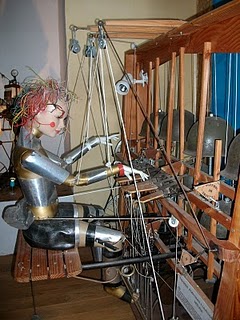
Around 1988 Coudray began making creations, which he located in and around his house. This eventually resulted in a most wonderful and fantastic collection of flying objects, mechanical puppets, machines, clocks, bikes, cars......


Most of these creations can make movements, such as above young lady. Outdoors there is a variety of whirligigs, set up amidst fairytale-like buildings. All together these creations constitute an amazing art environment, visited with pleasure as kind of an open-air museum by both adults and children.

The video by Robert Coudray (1'57", YouTube, January 2017) gives a good idea of the site


Making movies

Although occupied by making creations and running the museum, Coudray through the years continued shooting short films. As an example here is the trailer of the movie (24 min, 2008) entitled Le secret de Mermoz (The secret of Mermoz), about a solitary man, who as boy dreamed of flying in his self-made flying machine.

trailer of the movie (YouTube, uploaded February 2013)

Prevalent in Coudray's cinematographic work is the theme of man pursuing his dreams.

All his life Coudray himself has dreamed of one day making  a lengthy feature film. That dream has come true. From 2008 on with a lot of sacrifice a (rather modest) budget was raised and from October 2010 until July 2012 the film was shot, with hundreds of people from the region participating as figurants or as technical or administrative volunteers.

As Coudray says on the film's website: "We show that in this countryside that is remote from cultural powers, their subsidized structures and their standardized schemes, we are able to gather our energies to bear innovative ideas. We are all creative".

The movie, entitled Je demande pas la lune, juste quelques étoiles (I don't ask for the moon, just a few stars) had its premiere in March 2013.

Documentation
Website l'Univers du Poète ferrailleur
* On Sophie Lepetit's weblog lesgrigrisdesophie, pictures both of the interior and the exterior of the museum
* Website of the movie Je demande pas la lune, juste quelques étoiles

first published November 2008, last updated October 2017

l´Univers du poète ferrailleur
Robert Coudray
56460 Lizio, dept Morbihan, region Brittany, France
open from 1/4 - 1/11
July & August all days 10.30-12.30 and 14-19,
other periods: restricted opening hours