Showing posts with label garden with sculptures from painted concrete. Show all posts

April 21, 2018

Ivan Khristenko, Музей "Край Долгоруковский" / Museum "Krai Dolgorukovsky",


this picture and the next five (2017) 
from Livejournal courtesy of Vadim Razumov 

 Although the building pictured above has a pleasant appearance, at first sight there is nothing special about it, but looking at the more detailed photo below, one can see that this building is rather special, if only because of the way the facade has been decorated.


This is the facade of a museum in the village of Dolgorukovo, Russia, some 425 kilometers south of Moscow.

This museum has the rather unique feature that -apart from the hull of the building- all parts, structures and decorations have been made single-handedly by its director, Ivan Aleksandrovich Khristenko.

Life and works

Nothing initially indicated that Ivan Khristenko (1930-2012) would become director of a museum. He was born in the Prikhidki village in the Poltava region (currently part of Ukraine),  graduated in 1957 in law at the Moscow State University and became a successful lawyer, first practicing in Moscow, then in the Ryazan region and eventually in the Lipetsk region.

Khristenko was a convinced communist and he was actively involved in committees and organizations in Lipetsk affiliated with the communist party, like he was a correspondent of the newspaper Path to Communism and a teacher of the district committee of the CPSU.

tower on the premises of the museum

So when in the mid 1960s the plan arose to create a museum dedicated to the history of Dolgorukovo, where Khristenko lived, he became involved. The museum was formally established on October 14, 1967.

Khristenko was appointed as its director, but since the museum initially was located in just one room of the local CPSU, this in the beginning probably was an activity as volunteer.

In 1979 a building belonging to the CPSU with four rooms and an outside space of 2500 m² (10890 sq ft) was allocated as a new, more spacious housing for the museum and probably this was the moment when Khristenko began to devote himself full time to the further substantive and spacial expansion of the museum.

a bust of Vladimir Ilyich Lenin

In terms of design of the space, these developments got a distinctive signature, incomparable with those of other museums. Khristenko began to fill the outdoor space with self-made sculptures and structures, creations he built up with the aid of cement and all kinds of surplus material found on the dump. The interior got all kinds of decorations, often made from paper mache, wall paper, styrofoam and other cheap available (waste) material.

In doing so, it came to a tremendous explosion of creativity, resulting in numerous works of art being added to both the interior and the exterior which in this way together were transformed into an art environment.

left in the picture a scene with
Gorbatsjov and Jeltsin

The history of Dolgorukovo was placed in a broad context and so there were sculptures of important persons in Russian political history, such as Vladimir Ilyich Lenin, the founder of the USSR, Michael Gorbatsjov, the last president of the USSR and Boris Jeltsin, the first president of the Russian Federation.

Prince Dolgorukovo 

The village of Dolgorukovo in former times was property of the Dolgorukovo family. When in 1896 a railway was built, the station was named after the former owners of the village and so the museum also pays attention to this particular relation, as evidenced by, among others, the sculpture above that depicts the founder of the village, Prince Yu.V. Dolgorukovo.

in memory of Russia's estates


Khristenko's interest in the Russian past is also reflected in the attention he paid to country estates. This can be seen in particular with regard to the (in Soviet times destroyed) estate of the brothers Zhemchuzhnikov.

a portrait of Kozma Prutkov
this picture and the next four (early 2018) 
courtesy of Evgenia Gorlova

The brothers Zhemchuzhnikov became especially known for the fictional personality Kozma Prutkov they created together with A.K. Tolstoj. In the middle of the 19th century Prutkov published numerous publications under this pseudonym. Especially his aphorism became well known.

One room of the museum features the brothers Zhemchuzhnikov and Prutkov's aphorisms appear on its walls. Although Prutkov did not exist, the museum just as well has a portrait of him and on the tower in the outdoor space he is -immortalized in a sculpture- looking at the spot where the estate once was located.


The interior of the museum includes 11 rooms and they all have been exuberantly decorated with pillars crowned with friezes, wall decorations, inscriptions or colorful paper mache items.

In some rooms just one specific theme is addressed, like there is room dedicated to the Great Patriotic War. Dolgorukovo was in a war zone and in the early years of the museum inhabitants of the village came donating pieces of war material, found in the area.

Another room is dedicated to the Soviet Five-Year Plans.


In July 2000, when Khrishtenko approached the age of 70, he transferred the management of the museum to his daughter Nadezhda Ivanovna Kryukova. Although over the years his health had declined, he continued his activities for the museum as an employee and so he remained involved in its policy.

Ivan Khristenko died in 2012.

The museum had as small professional staff, financed by the regional government. On average it was visited yearly by around 4000 people, who didn't have to pay an entrance fee.


The financial situation of the museum became problematic, especially because there were no means to carry out maintenance. Khrishtenko never wanted to accept eventual contributions from funds or other private parties, because in his opinion the financial support should come from the central government. However, Moscow did not respond to requests on this matter.

The museum was closed in 2019 because of technical problems.

An investigation into the constructional situation

In September 2020, the inspectorate of the Ministry of Culture and Art of the Lipetsk region visited the museum to assess the situation. It was noted that some technical problems needed to be solved, such as renewal of the electric lines and improving the accessibility for visitors with limited mobility.

Thanks to the regional authorities and the director of the Lipetsk Regional Museum of Local Lore, Evgenia Smelova, the technical problems could be solved and the museum was reopened at the end of October 2020. 

A commemorative plaque was unveiled in honor of Ivan Khristenko and the museum's 55th anniversary was celebrated.

The museum in the field of art environments

People who visited the museum often said that it offered surrealistic or modern art. Since the phenomenon art environment in Russia is not very well known, it is not obvious that Russian researchers rank the museum within this conceptual framework, which elsewhere in Europe is gradually receiving more attention, accompanied by a growing appreciation for the encountered artworks.

From the perspective of the field of art environments the museum is a unique creation, comparable with some of the most important sites in France, Spain or Italy. It would be regrettable if this museum in the (near) future would cease to exist or would be "normalized".


Documentation
* Article (October 2010) by AAUUMM on LiveInternet with information about and pictures of the site as it was in 2010
* Article (May 2011) in newspaper Gorad48 with a description of Khristenko's personality
Article (June 2012) in regional website Lipetskmedia
Article (December 2017) by Vadim Razumov, also with a series of photographs on LiveInternet
* Article (September 2020) in newspaper Gorad48 about the findings of the Inspection of the Ministry of Culture and Art of the Lipetsk region  

Videos
* Video (January 2013) by regional television NTV (can not be embedded here)
* Video (June 2015) by Evgeny Sokolsky (YouTube, 9'53"), with Ivan Khristenko presenting the site


first published April 2018, last revised May 2022

Ivan Khristenko
Museum "Krai Dolgorukovsky"
Lihachova Street 24
Dolgorukovo, Lipetsk region, Russia 
awaiting renovation, the Museum is closed
the museum is located in the center of the village, not far from the station

November 22, 2017

Vasily Artamonov, Скульптуры в городе / Sculptures in town


screenprint from the video in the documentation

The picture above shows some of the sculptures made by Vasily Artamonov, displayed in front of his house in Rylsk, Kursk region, Russia.

It's just a small part of the over two hundred sculptures he created since around 1995. The largest part of his oeuvre has been relocated to various places in the public space in the Kursk region.

Like François Michaud in the 19th century decorated his village Masgot with sculptures or like in
our time a collective of conscripted soldiers embellished the Russian city of Teykovo with their creations, Artamonov has the desire to brighten up the public space with his fairy-tale characters, first of all on spots in his hometown Rylsk, but in line with that also on spots in the public space in other communities in the region of Kursk.

this picture and the next two by Yuri Fedorov 

Life and works

Born in a family with six other children in the small village of Bredy in the Chelyabinsk area in the southern Urals, Artamonov studied at a school for agricultural engineering. He got a job at a farm, married and got a son. However, after a couple of years he experienced this work as too routine.

He felt more attracted to a varied, creative type of work, so he tried growing roses. This was not succesfull and he moved to the Caucasus where he worked as a driver at a small farm owned by a brother.

After his military service he noticed that he longed for the Kursk region, the residential area of his father and grandparents in the west of Russia. So he decided to go there. On the way something happened that was decisive for his further life. He saw a sculpture of a huge dragon with children happily strolling around, laughing and feeling happy.

The scene triggered him and gave him the idea  to undertake something similar. Artamonov could move into the house on Pervomaiskaya Street in Rylsk, where his grandparents and his father, all deceased, had lived before.


Here, around 1995, he made his first creation, a huge dragon. This one was followed by two bears flanking a bench, and a dinosaur. All creations were displayed on the narrow space separating the house from the roadway.

Artamonov's creative project was based upon a philosophy stating that if a whole city has such sculptures, life will be better. Embellish Rylsk with fairy tale characters and the city will shine, it will be a city of happiness and dreams........!

He invited the local authorities to (financially) support such a project, but at that moment they hesitated to make a decision. So Artamonov had to combine his creative activities with various jobs, such as cook, agronomist, driver, plumber and handyman. Currently he works as a guard and driver at the House of Creativity in Rylsk.


But making sculptures was paramount. During his career  as a self-taught artist of over twenty years Artamonov focussed especially upon creating sculptures related to Russian fairy tales, which for him are a source of joy and patriotism.

When making a sculpture Artamonov first makes a body from sturdy metal elements he welds together and shapes into the desired model. This basis is covered with wire mesh, after which the creation is finished with cement and/or plaster, applied layer after layer.

Creating a sculpture on the average takes two weeks of painstaking work. He works in the warm season, from May till October; in the other months the weather is too cold to work with cement.

Artamonov's sculptures in the streets of Rylsk (screenprint)

As Artamonov's creative activities became rather well-known in and around Rylsk, his dream came true that his work would be displayed in public space in the region.

For example, one day the mayor of the town of Kurchatov, situated some 80 km east of Rylsk, personally visited Artamonov to inform if the town could buy some sculptures. This resulted in the purchase of twenty sculptures (incidentally for a modest fee), which now are displayed at a park in Kurchatov.

Other sculptures are displayed in playgrounds, parks and kindergartens in the community of Khomutovka (50 km north of Rylsk), Koersk, the capital of the region (some 125 km east of Rylsk), in the community of Koerstsjatov (80 km east of Rylsk)  and even in the city of Belgorod in a neighbouring region (some 200 km south-east of Rylsk)

Artamonov's sculptures in the streets of Rylsk (screenprint)

Vasily Artamonov is a modest man who does not care about wealth. A smiling child, enjoying his sculptures is his greatest reward. Convinced that his sculptures can contribute to a better life in the city, he relentlessly continues his creative activities.

Documentation
* Article by Yulia Matveeva (October 2017) in the website seyminfo.ru
* Another article by Yulia Matveeva (April 2017) on the same website
* Article by Marina Krapivnaya (August 2005) on the website of regional newspaper
Drug diva druga 

Video 
* Video by TV and Radio Company Seim (2'23", YouTube, published October 2017)


Vasily Artamonov
Sculptures in town
Pervomaiskya Street (workshop)
Rylsk, Kursk region, Russia
sculptures can be seen in town and in front of Artananov's house/workshop

August 02, 2017

Jean Poteau, Le havre du pêcheur / The fisherman's refuge


pictures courtesy of
Hubert Bouvet© Hauts-de-France 2014

When in December 2015 this weblog reported the publication of d' Étonnants jardins en Nord-Pas de Calais, a book about art environments in France's northern regions Nord and Pas de Calais, a short mention was made of Jean Poteau's art environment, referred to in the book as Le Havre du pêcheur (The fisherman's refuge). 

The following post has more about this modest art environment.

Life and works

Jean Poteau (1947-2010) was the son of a mine-worker living in Rouvroy, a community some 40 km south of Lille in northern France. 

When it came to choosing a future profession Poteau Sr advised his son not to become a miner, with which Jean Poteau agreed and so he became a construction worker, specialized in form work and woodworking. He continued to live in Rouvroy and conducted his work especially in the Lille area. 

In 1989, at age 42, Poteau added a pond with fish to the garden at the rear of the house in Rouvroy where he lived with his wife. 


Some 8 years later, in 1997, he began transforming the already well-flowered garden into an art environment by adding a variety of single-handedly created decorative elements.

On the edge of the pond a fisherman got a place, as well as a heron, another person and a mill.

The windmill, with a build-up from red bricks and a roof covered with tiles, evokes the regional architecture of northern France. In winter it can give shelter to birds. A weather vane indicates the direction of the wind.

The bodies, arms and legs of he persons are made from all-purpose residual material, the faces were molded from self-made molds and the clothes and other attributes of the persons are dismissed items.

a lion

In addition to the heron which is part of the scene around the pond, Poteau has created a variety of other animals which got a place in the garden or around the house, such as dogs, ducks, frogs, and lions.

All these figurines were molded from cement in molds made by Poteau himself.

a crocodile

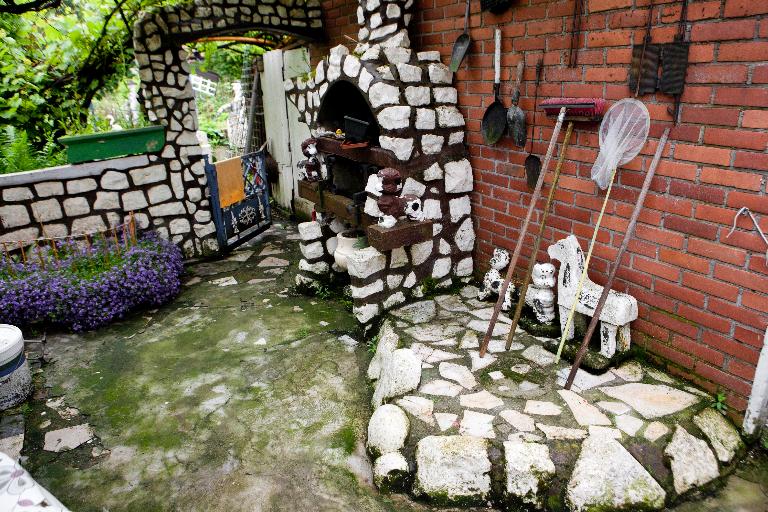
The fireplace/barbecue in the picture below has some animals made from gypsum (a cat, a dog and a rather small horse).

Poteau covered the walls with cobblestones, ballast from a nearby small railroad along which trash was transported.


Poteau passed away in 2010. 

His wife (✝ 2012), who wanted to move to a smaller home, had to arrange that the rented house, the garden included, was returned to its original state and so Poteau's modest art environment was demolished, although some smaller, transportable items may have been included in private collections.  

Documentation
* "Le Havre du pêcheur de Jean Poteau (1947-2010)" in: Le Service du Patrimoine Culturel de la région Nord-Pas de Calais, D'Étonnants Jardins en Nord-Pas de Calais. Inventaire général du patrimoine culturel (Images du Patrimoine, 293). Lyon (Ed. Lieux-Dits), 2015, pp 106-109
* "Jardin de Jean Poteau" in: Inventaire général du patrimoine culturel (background information and photo's)

Jean Poteau
Le havre du pêcheur
(formerly) 63 Boulevard des Italiens
Rouvroy, dept Pas de Calais, region Hauts-de-France, France 
site doesn't exist anymore

July 17, 2017

Pierre Jaïn, Musée-exposition / Museum-exposition


the card player (high 53 cm)
picture courtesy of Jean-Michel Jaïn

Still rather unknown in the field of outsider art, a recently published book (Benoît Jaïn, Pierre Jaïn. Un hérétique chez les "bruts") retains Pierre Jaïn's artwork from oblivion fifty years after his death. His sculpture garden in Brittany, France, which to a very limited extent currently still exists, included just a small part of his creative outburst in the 1950s/60s. 

Life and works

Born in Kerlaz, Finistère, France, in a large family, Pierre Jaïn (1904-1967), due to long-term problems with a broken ankle only went to school at the age of ten. After three years he left school to go to work on the farm of his parents. 

He was in the military from 1924-1925 and when in 1931 his father died, he took his place at the farm.

Because of the imminent war with Germany he was mobilized in the army in 1939.  In March 1940 Jaïn broke his legs by a collision with a car and he had to stay in hospitals for a long time to rehabilitate. 

 the bishop (high 63 cm)
this picture and the next three courtesy of Benoît Jaïn

During that long period of rehabilitation he discovered his interest in drawing and sculpting, which he showed by for example processing small pieces of wood with a pocket knife. 

In 1942 Jaïn returned to Kerlaz, to resume the management of the farm, a task he transferred  in 1948 to a brother. 

The effects of the accident had reduced his physical abilities and he would always have problems with walking. 

 tribute to the deported 
(by Germany during the second world war)

Jaïn wouldn't marry. In the early 1950s he arranged his own accommodation on the farm's grounds to which he linked a three-to-seven meters large shed he could use as a studio.

In the late 1950s, around 1956, Jaïn got retired from his job and then he actually began creating artworks. He was in his early fifties.

An explosion of creativity

In his studio Jaïn dedicated himself to making sculptures, some of these from animal bones obtained from the local butcher, others from locally available pieces of granite and a rather large number from tree stumps or other pieces of wood. Rising early in the morning he worked steadily, making some 400 creations during the next eight years.

In his artworks Jain expressed his interest in Breton folklore, legends and belief systems.

the Breton village, a creation from a tree stump (63x64 cm)

On shelves along the walls of the studio dozens of sculptures were arranged, often stand alone characters such as devils, saints, historical persons, ethnological types or Breton celebrities, but also more composite creations, such as a scene of a Breton village or a woman and a dragon, as depicted above and below.

the woman and the dragon, sculpted wood (high 52 cm)

The sculptures from granite or cement, a selection of which is pictured in this article, in general were displayed in the garden and the orchard.

Living near the bay of Douarnenez, directly connected to the Atlantic Ocean, Jaïn feared the power of the waters of the ocean. Familiar with the legend of Ker-Ys, comparable with the biblical story of the flood, he had surrounded the site with a system of protective devices, such as a series of wooden sentinels with a repulsive look to ward of evil intentions, a Groupe Tricéphale (a three headed granite sculpture) at the entrance, a Gargouille (Gargoyle, a legendary dragon) and a three meter high wooden totem with a thin face under a zinc cap.

The art environment had also some other special features. 

There was a Hutte d'Adam (Adam's hut), kind of a man-sized  molehill with an opening through which a seated Adam could be observed, linked with a chain to Eve who was located in a hut named Tentation d'Eve (Temptation of Eve). All together an ensemble depicting the paradis terrestre (heaven on earth).

Head of Gorgon
this picture and the next one courtesy of Jean-Michel Jaïn
  
And then there was a self-made musical instrument, the Jaïnophone, a percussion set of mainly metal tubes constructed by Jaïn from all kinds of obsolete materials such as copper pipes, bed springs, plowshares and other sound producing items. Jaïn actually played this instrument, producing music hors normes

A sign at the entrance with the text Musée-Exposition welcomed visitors and people from the U.K. and the Netherlands on holiday in Brittany indeed came by.

Jaïn hospitalized

In June 1966 Jaïn got very serious psychiatric problems. He was admitted to the psychiatric hospital in Quimper, where he stayed for more than a year. Returned home in August 1967 he passed away on November 21, 1967.

Later developments

Pierre Maunoury, a psychiatrist and artist from  the region, who already in 1964 had visited Jaïn, wrote about the artworks in the Fascicules d'Art Brut no 10, published by the Collection de l'Art Brut in Lausanne. He also donated a set of decorated bones to the museum.

In 1991 Bruno Montpied rediscovered Jaïn's artwork and wrote about it both in specialized magazines and in his weblog (see documentation).

The artworks could be seen in various regional and local expositions: in 1965 in Douarnenez (organized by Pierre Jaïn himself); in 2001 in Dol de Bretagne (l'Art Brut à l'ABRI); in 2002 in Kerlaz (organized by Jaïn's family) and in 2013 in Brest (l'Art Brut à l'Ouest).

At the time of the publication of this post in this weblog there was an exposition in Kerlaz (july 12-23, 2017), also at the occasion of the new book by Benoît Jaïn.

capped character (60 cm high)

Actual state of the artworks

With a number of exceptions the some 400 self-contained wooden sculptures, divided among the various members of the Jaïn family, are still existing.

However, the wooden sculptures which were displayed outside in the Musée-exposition perished by the effects of the weather, in so far they haven't been removed in time. Most other decorative items, the Jaïnophone included, have been removed

In fact the garden currently only includes some granite sculptures, partly weathered by growing moss.

The farmhouse has become a gîte, where holidaymakers can rent a room. The presence of the sculptures promotes the attractiveness of the site as a holiday residence.

Documentation
* Website about Pierre Jaïn edited by Benoît Jaïn
* A book by Benoît Jaïn, Pierre Jaïn. Un hérétique chez les "bruts". Kerlaz (YIL Editions), 2017. -115 p
* Article on the weblog of Jean-Yves Cordier about  sculptures by Jaïn at the exposition l'Art Brut á l'Ouest (2013) 
* Various articles and referrals on the weblog of Bruno Montpied
* Article on Wikiwand

Pierre Jaïn
Musée-exposition
Kerioret Izella, Kerlaz, dept Finistère, region Brittany, France
site doesn't exist anymore, except some granite sculptures

October 02, 2016

Petr Leonidovich Zhurilenko, скульптуры в саду / sculpture garden


picture courtesy of  Sergey Chegra 
 Museum of Russian lubok and naive art, Moscow

Petr Leonidovich Zhurilenko (August 1929 - ??) was a folk art artist who lived in the small community of Sudbodarovka in the Oldenburg region in the Russian Federation ¹. 

He made a variety of naive paintings, which were exposed in the region, but also in Moscow, where he took part with a single painting in the large exhibition of naive and outsider art in 2013.

The catalogue of this exposition said that Zhurilenko meanwhile had switched from making paintings to making sculptures.

this picture and the next one by unknown photographer

Above picture also has the scene as in the first picture, but then with added signs, that say the sculptures have been made in 2014.

The sign on the left indicates that the three characters are Mikhail Illarionovich Kutuzov with his adjutant and a guard as in 1812. 

The sign on the right, insofar readable, says that the queen is in Moscow because of negotiations. 

Kutuzov (1745-1813) was a famous Russian army commander, who in 1812 repelled Napoleon’s invasion of Russia. The queen must be Queen Elizabeth, who, accompanied by Prince Philip, in October 1994 was the first British monarch to visit Moscow, where she met former president Boris Yeltsin.


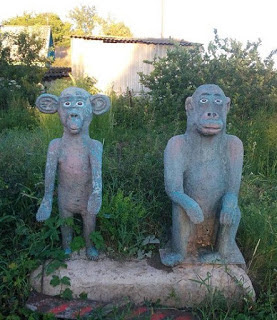
The in my opinion rather impressive scene with general Kutuzov and Queen Elizabeth is undoubtedly part of a just started and gradually expanding art environment in Zhurilenko's garden, because another picture of a creation by Zhurilenko is available, that shows two monkey's (?) with in the background a barn and another construction, which might be the residential house.

Up to now the internet has no descriptions of Zhurilenko's art environment. but further research has begun and this will hopefully bring more information ².

In 2021 it has been reported hat Zhurilenko had passed away, this without any referral to  in what year this happened. 

notes
¹   I am grateful to Alexander Emelyanov, creator of an art environment in Samara, Russian Federation,  who contacted the museum in Moscow about the first photo in this post and is actively engaged in collecting more information about this art environment
²  I would like to get in touch with the unknown photographer(s) of some pictures in this post

Petr Leonidovich Zhurilenko
Sculpture garden
Sudbodarovka, Orenburg region, Russian Federation

August 13, 2016

Stanislav Sartsevich, Sculpture garden


black and white pictures courtesy of Volodmyr Marchuk 
(Volart Art Gallery, Lutsk)

The sculpture garden in above picture could be seen in the 1970s and 80s in Lutsk, a city with a history of over 900 years, located in northwestern Ukraine, along the river Styr. 

Life and works

About Stanislav Sartsevich (1904-1987), who created this sculpture garden, only just a few biographical details are available. He had a job as a teacher, was head of a post office and the longest time he was an accountant at the department of social security.

Maybe during his working life he already made folk art paintings, in any case once retired, probably around the late 1960s, he became active as a self-taught artist, mainly by passionately creating sculptures and to a lesser extent also by making paintings.

Sartsevich posing in front of the site (1980s)

Sartsevich displayed his extensive production of sculptures in the front garden of his house which was located along a street in the old part of the town near Lubart's Castle, one of the oldest medieval fortifications in Europe.

His neighbours resented this use of the garden because in their view the grounds should be used to grow vegetables. They approached the local authorities who tried to restrain Sartsevich, but he diligently continued the development of his sculpture garden.

It became an extensive site with a variety of closely spaced sculptures made from cement and painted in appropriate colors. Ultimately the collection comprised mostly sculptures of people and animals.


His life-sized sculptures of people are rather naturalistic and those depicting well dressed fashionable ladies wearing a hat, especially got some reputation.

this picture in color: screenshot of some ladies 
from the 10'38" video (see documentation)

But he also made a large number of sculptures of people from Lutsk, family members, friends, swimmers, partisans, military people, a winged angel ....

The pictures in this post just give a limited insight in the large number of personalities that populated the garden.


In general he modeled his sculptures without using an image of his subject, although when creating a Madonna he used an image of the Madonna in the Sistine Chapel in Rome.

Sartsevich's sculptures of animals depict lions, deer, giraffes, elephants, all kinds of birds, in short the animals one sees in a zoo, all mostly executed in a realistic way.


Appreciation and indifference

Sartsevich has received appreciation for his creative activities. For example: in 1979 he was invited to take part in an exposition of folk art in Lutsk. 

He also got positive nationwide publicity when in 1982 art historian Oleksandr Naiden wrote a benevolent article about him, entitled Portrait of the artist at old age, in the Russian magazine Decorative art of the USSR nr 5.

However, after Sartsevich in 1987 had passed away, both the family and leading artistic circles in Lutsk did not attempt to maintain the garden. His art environment was demolished, as well as the house, which was replaced by a modern two-storey building

All that remains are the old photos and videos.

Documentation
* Website of Volodmyr Marchuk's Art Gallery in Luts'k

Videos
* The video (13'53") entitled Борис Амаров в Луцьку (Boris Amarov in Lutsk) shot in 1980, uploaded to YouTube December 2012 has scenes of the sculpture garden, Sartsevich and visitors from 3'37"-8'55"


* The next video (10'38", You Tube, uploaded March 2014) has a compilation of some old videos of the sculpture garden and a slideshow of the various sculptures


Stanislav Sartsevich
Sculpture garden
(formerly) Plytnytsy Street 1
Luts'k, Volyn region, Ukraine
house and garden have been demolished
and replaced by a modern building

June 22, 2016

Jean Cathelain, Le jardin du mineur / The miner's garden


view from the street of
the garden in front of the house (2008)
 
In December 2015 this weblog announced the publication of a book about art environments in the former mining area in the north of France: d'Étonnants jardins en Nord-Pas de Calais. Lyon (Ed. Lieux-dits), 2015.  The following post is about one of the sites presented in this book. Currently the site doesn't exist anymore.
 
Life and works

Jean Cathelain (1932-2011) spent his early years in the Meuse area in north-east France but settled with his parents in the community of Billy-Montigny at age 11. He began his work at the mines as an underground miner, later he became a dispatcher, entrusted with regulating the underground coal transport. He had to stop working because of silicosis in 1974 at age 42.

Fond of tinkering in his spare time, in the early 1970s he began to decorate the front garden of the house he rented from the mining company since 1959.  To house the workers mining companies in northern France owned many blocks of houses, formed by rows of uniform dwellings usually with a garden, in front, at the backside, or both. 

Cathelain's art environment was relatively simple in design. It's main elements included a couple sitting on a bench under a tree with a nest of storks, a miner and a windmill. These elements were complemented by a variety of other, mainly smaller items, of which some were bought or received as gifts.

detail: the miner (2008)

The sculptures of people and of various animals have been made of a mixture of newspaper clippings, cement and water. After hardening they would be painted in appropriate colors.

The miner depicted above expresses Cathelain's love of the coal mining profession. He is 1.64 m high, and equipped with his usual attributes: helmet, pickax and cased torch, items that occasionally were stolen.....

Near the house's outside wall a neatly dressed couple was seated on a bench. The sculptures measured around 1.60 m. Although the male figure had some similarity with Cathelain, this sculpture was not a portrayal of Mrs and mr Cathelain, but rather a representation of Cathelain's love for his wife.

detail: the mill (2008)

On par with the miner stood a single-handedly constructed mill, which had a platform with two persons on the outlook. Besides the mill was a small rectangular pool with a bridge and a gnome. Once fishes swam in this pool, but later these were replaced by toy ducks.

Compared with other art environments with a much more exuberant lay out, Cathelain's garden indeed has a simple design. However the obvious affection Cathelain shows in creating his sculptures gave the site an engaging look.

A replica of a mine gallery

In addition to the sculptures and decorations in his yard, Cathelain also had made a model of a mine gallery, which represented a timbering site of a coal mine as it was before 1950. This maquette, of which no pictures are available, was donated to the Musée de la Mine in Oignies, where it currently is exposed.

Actual situation of Cathelain's art environment

The review of Cathelain's art environment in the book d'Étonnants jardins en Nord-Pas de Calais is based upon a meeting the author had with Cathelain, shortly before the creator of the site in august 2011 passed away. 

Editing this post in 2016, I couldn't find information whether or not the site had continued to exist after its author died. However, in August 2023 a reader of this blog reported that on Google Streetview one could see, that he site had disappeared.

Documentation
Le Service du Patrimoine Culturel de la région Nord-Pas de Calais, D'Étonnants Jardins en Nord-Pas de Calais. Inventaire général du patrimoine culturel (Images du Patrimoine, 293). Lyon (Ed. Lieux-Dits), 2015, pp 74-77
* l'Inventaire général du patrimoine culturel. Région Hauts-de-France, pictures and description

first published June 2016, last revised October 2023

Jean Cathelain
Le jardin du mineur
39 rue de Châteauroux
Billy-Montigny, dept Pas de Calais, region Hauts-de-France, France
site doesn't exist anymore

January 27, 2016

Vivi Fortin, Jardin aux sculptures / Sculpture garden


pictures courtesy of Vivi Fortin, from his weblog

On Vivi's weblog the caption of above picture reads Que du beau monde sur le sentier pédestre (Such beautiful people on the footpath).

Indeed, these pedestrians look very nice, but this also goes for the sculptures as such, which emanate a special charm.

Life and works

Vivi Fortin, who made these sculptures, was born in November 1953 (Actually his first name is Yves, but he prefers to be called Vivi). He currently lives in the small hamlet named le Pas Français, which belongs to the community La Flocellière, located in the Pays de la Loire area in France. His house has a large garden of some 5000 square meters (0.5 ha).

After primary school he went to work. He became a mason and tyler, a profession he has practiced for some forty years.

In the spring of 2011 he got such troubles with his back, that he had to stop working.

sur les chemins de l’école au Kenya
(on the way to school in Kenya)

Not being a man to sit quietly on the couch, Fortin looked for something to do, and although he had no artistic education at all, he first tried his hand on making paintings, to switch after some months to making sculptures, which would become his great passion.

As he told a regional newspaper in 2014: During my professional life I did not invent anything. Now I want to go on creating and performing, just to bring joy on people's faces.

entente cordiale¹ la chasse à courre n'aura pas lieu
(entente cordiale¹ the hunt with hounds will not take place)

Fortin is a prolific worker. When interviewed in 2014 he already had created some 300 sculptures. In 2016 he had made about 500 works and currently (2022) the number is around 900.

He makes ensembles, as can be seen in the pictures above, but also stand alone sculptures, as can be seen in the picture below.

the French painter Claude Monet

Most sculptures of animals and people are not very large, about 30 to 50 cm high (except giraffes or so) and the whole collection of sculptures is more or less on scale.

Fortin began his sculpting adventure by making animals, mainly those from the farm and other well known ones, later he also portrayed famous personalities and characters from strip books.

Lucky Luke, the Daltons and Vivi

In creating a sculpture Fortin first makes a model from iron- or chicken wire which he plasters with a layer of cement that he models with hands and fingers. All sculptures are painted in appropriate colors with a specific paint, with a composition he strictly keeps secret.

The creations populate the large garden, but also find a place on the courtyard of the house, occasionally displayed on table plates.

Currently Vivi Fortin is still active in making new sculptures. Here are some examples of recent creations (pictures from Vivi Fortin's account on Facebook):

November 2016: a scene inspired by a fable by La Fontaine


March 2017: a scene inspired by Melkmeisje (Milk girl), a painting by Dutch painter Johannes Vermeer


June 2017: a scene with whirling dervishes


in February 2019 a scene with  "yellow vests" (gilets-jaunes, a recent protest movement in France)


and in 2020 a scene of a cozy chickens family.


In 2021 Vivi Fortin began decorating a wall of his property with sculptures in high-relief, like below portraits of Simone Weil (1909-1943) and Jean-Paul Belmondo, who passed away early September 2021.


This project was continued in 2022, the image below showing the development until March of that year.


Documentation
* Fortin's weblog Sculpturedupas
* Article (August 2014) in regional newspaper Ouest-France
* Article (January 2016) on Jean-Louis Bigou's weblog
* Entries about Vivi Fortin on Sophie Lepetit's weblog (9 entries, 2016-2022)
* A review (May 2, 2019) of Fortin's artwork by Bruno Montpied on his weblog
* Article by Jean-Marie Poirier (March 2022) on website Pose Vagabonde
* Article about the site by Sonia Terhzaz on her website Cartographie des Rocamberlus (environments d'art singulier), reporting the visit she paid in May 2020 and January 2023
* Article (January 2023) by Ingrid Fleury on het weblog

Videos
* Early January 2023 Guy Tarbass added two short videos to YouTube with scenes of Vivi Fortin's creations.  Here is part 1:


here is part 2:


and there also is a part 3


* Video by Yadid Borjas (1'50", YouTube, February 2016)


* A video (2024 ) on Facebook


note
¹  entente cordiale: a series of agreements in 1904 between France and the UK which marked the end of some 1000 years of conflict between these states

Vivi Fortin
Jardin aux sculptures
lieu-dit le Pas Français
85700 La Flocellière, Sèvremont, dept Vendée, region Pays de la Loire, France
visits in the afternoons, when the artist is at home
see his weblog to make an appointment

first published January 2016, last revised April 2023