images by Jedrzej Labarzewski and Eliza Labarzewska
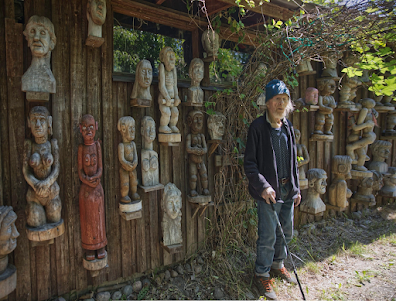
As can be seen in the image above, a house in Kierwik, Poland, features a number of sculptures, two of which are so large that they tower over the side wall of the house.
Life and works
These sculptures were created by Zbigniew Redyk, who worked his entire life in construction, primarily in the Polish capital. He is now retired and will be be around seventy at the time this article is published.
Once retired he settled in Kierwik. a village in northeastern Poland known for its picturesque landscapes and proximity to natural attractions.
There he began creating sculptures from concrete.
one of the other sculptures
The image at the top of this article, made in 2022, shows an arrangement of some of these creations.
The red-hued sculpture on the right side of the house, over 3 meters tall and weighing approximately 300 kilos, is referred to as the the Sun Follower.
Next to him stands a smaller, black sculpture depicting Anubis, a god in Egyptian mythology who was depicted as a jackal
Then there is a small white structure with two flags with the colours of Poland and the scene ends with a sculpturen of a warrior.
At the entrance to the garden stand two large wolves.
The images in this post were made in early 2022 and by now Zbigniew Redyk may have made more creations.
Documentation
* Article on the website Znalezienie, edited by Radek Labarzewski
Video
* Video (made around 2021) by TVP3 Olsztyn on Facebook, with scenes of the decorations in the interior of the house
Zbigniew Redyk
Sculpture garden
Kierwik, municipality of Świętajno, region Ermland-Mazurië, Poland
picture as on the website created by the family in honor of Lino Corradi
The tower pictured above is a replica of the tower of the La Ghirlandina, the tower next to the main cathedral of the city of Modena, located in the province with the same name in the Italian region of Emilia-Romagna
Life and works
This replica was constructed by Lino Corradi (1935-2023), who was born in the municipality of Bastiglia. He worked his whole life in the marble sector, where he gained a lot of experience and skill in manually processing pieces of hard rock.
He married Bassoli Osvalda in 1962, and in 1973, when he was 37 years old, he and his wife decided to build a house in a small village in the Apennine area of the province of Modena..
With his manual skills he also made parts of the furnishings himself, such as tables and cabinets.
a marble seagull
When he retired in the 1990s, Corradi did not opt for a quiet life, but he began kind of a a new career in making sculptures which he used to decorated his house and garden.
He made creations from marble, such as the seagull in the image above.
canon
But he also made creations from wood, such as the cannon above, and a series of wooden figures depicting all kinds of types, such as a cowboy, an Indian, and Pinocchio below.
a cowboy
an Indian
Pinocchio
Below an image of l due angeli (the two angels), a creation made of sheet metal, which was not situated in the garden, but on a nearby hill .
In selecting the images of Corrari's artistic work for this article, the emphasis was put on creations that are situated outdoor. this in order to stress the concept of carving as part of an art environment.
During Lino Corradi's lifetime his creative work received virtually no recognition. Fortunately, thanks to Giada Carraro, an art specialist and writer who publishes articles about art environments in Italy, his artworks were given publicity with an article about Lino Corradi that appeared in her website Bric-à-brac Italia.
Documentation
* Website about Corradi's creations made in his honor by the family after he passed away
* Article about Corradi's life and work by Giada Carraro on her website Bric-à-brac Italia
Lino Corradi
Decorated garden and interior
Located in a small mountain village called Riolunato
all images published here in agreement with Justyna Orlovska, from her website Off the beaten track
Zgon is a small village with about 150 inhabitants, part of the municipality of Piecki, located in the north-east of Poland in the Warmian-Masurian region. The village is located south of a large lake called Mokre and has a pictorial appearance, especially because of the atmosphere evoked by the many old-style houses.
The village is intersected by the national road DK58 and where this road runs right along the lake, there is a special house, equipped as it is with a sculpture garden.
Take a look at Google Streetview, which has the scene at the location.
\
The sculpture garden is a creation of Adam Szubski (1931-2008), who was born in Warsaw.
His father, Stefan Szubski, had a job in metalworking and won many prizes in the years before the Second World War.
Adam Szubski became a stonemason, but he also worked with metal, especially with sheet zinc, .a material he also used at that time to create works of art.
Indeed, although he had no artistic training, he showed in the 1960s that he was motivated and had a talent to create works of art.
He was admitted as a member of the Association of Polish Artists and exhibited his work not only in Warsaw in a café on the Old Town Square, but later also in museums in for example Germany, Italy and Austria.
Szubski had married Anna Sierpińska and in 1972 the couple moved to Zgon to live in a cottage located along the national road DK58 where it runs right next to the lake. Buying the house also meant that the couple saved it from demolition because of its poor condition.
One of the first projects they undertook was to renovate the hundred-year-old house, which they did by restoring the original interior as much as possible and refurbishing and reusing what was left of the equipment from earlier years, such as old stoves and fireplaces. By doing this the house was eventually recognized as a monument
The couple was also active in projects that benefited the community in Zgon. For example, they founded an association that focused on creative activities with the inhabitants and Szubski arranged for the restoration of the local old windmill, which not only resulted in a tourist attraction. but also contributed to pumping water from the surrounding meadows.
The FACES project
In the 1990s, when Szubski was in his sixties, he became inspired by the idea to decorate the garden near the house and so he began making sculptures using a mixture of cement, resins, acrylic and paint.
It became a project, called Faces, which resulted in some 200 creations, mainly of human heads.
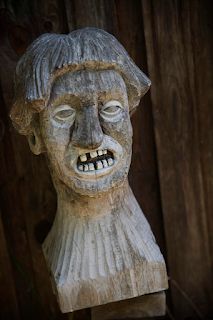
These heads got different shapes, sizes and expressions, sometimes realistic, sometimes fantastic, but occasionally also grotesque, strange or creepy for some people visiting the site.
,.,.
The sculptures depicted heads of famous people, friends, acquaintances and residents, but also .characters from mythology, fairy tales and literature.
Among the celebrities were depictions of people such as Pope John Paul II (a cardinal from Poland, elected pope in 1978), Lech Wałęsa (president of Poland from 1990-1995) and Marilyn Monroe (American actress, 1926-1962).
By the way, as can be seen in the images, besides the collection of heads there are also sculptures that depict people in full length.
Adam Szubski died on November 15, 2008.
His family takes care of the maintenance of the sculptures and occasionally organizes exhibitions and workshops in sculpture
The gallery is open to visitors from May to October.
Documentation
* Article (2024) by Justyna Orlovska on her website Off the beaten track
* Article (2022) by Radosław Łabarzewscy on his website Znalezienie
* Article(undated) on website Mazury24, with a large number of photos
Videos
* Video (2004, YouTube, 0.47) by Center for Education and Cultural Initiatives in Olsztyn.
The scene above with sporty characters is set in an art environment in Baron, a small commune with around 1200 inhabitants (January 2021) in the Gironde area in the south of France. about thirty kilometers east of Bordeaux.
Life and works
This art environment is a creation of Jean-Claude Villot, who was born in the early 1960s, initially was a carpenter, later worked in a factory and nowadays is retired.
The art environment consists of two completely different types of creations, on the one hand a large field of sculptures situated in the exterior, as can be seen in the very first image, and on the other hand a number of decorated walls in the interior of the house whose occupants own the decorated field.
The pictures around give an idea of the decorated interior.
The house, that was occupied for many years by Villot's meanwhile deceased mother, is now the home of his sister and her husband, who inherited it.
Villot began decorating the walls around 2010.
His decorations have a light-hearted character, generally depicting events from everyday life, such as someone making a walk, a stream of water with fish swimming around or a dog being walked.
The field of sculptures
Around 2015 Villot began making sculptures from wooden pallets he collected at the local dump.
In agreement with his sister and her husband, these sculptures got a spot on the field they owned, located next to the house in which they now lived.
It's a field with a generous size that can accommodate a large number of creations.
Because he mainly used pallets Villot's creations are predominantly two-dimensional. They have no artistic pretensions, but they are distinctly amusing to look at
Like the murals inside, they are made by Villot to depict an everyday event and to provide commentary on it, if that's convenient.
These current events can include anything, such as activities of all kinds of political figures, but also of wearers of yellow vests, a common wear in France in recent years for people demonstrating.
Sport does have its own place in his creative work, especially rugby. When in 2023 the rugby championships were held in France, Villot paid a lot of attention to this event by making a sculpture of Antoine Dupont, who is captain of the France national rugby team.
The 2024 Olympic Games in Paris also got a lot of attention.
There are also comic characters.
Above we already encountered Tintin, and below on the left one can see Mickey Mouse.
The designation Ponpon le Cheval (Ponpon the horse) in the image below right is a tribute to a horse that helped in a vineyard in the French Languedoc area.
The sculpture garden is located north-west of the centre of the commune of Baron, along the departmental route D936, opposite the company Aquitaine Matériaux.
Documentation * Article (August 2023) in newspaper France Bleu
* Article (September 2025) on Facebook by Martin Besnard, with a series of recent pictures
Jean-Claude Villot
Decorated interior and sculpture garden
32 Route de Branne (also D936)
33750 Baron, dept Gironde, region Nouvelle-Aquitaine, France
this image and the next one (June 2024) published here in agreement with the editors of the website Tipeek Photos
In Durtal, a community with about 3300 inhabitants (January 2021) in the west of France in the Maine-et-Loire department, there is a sculpture garden that some ten years ago has disappeared for several years.
Here's the story.
Life and works
The sculpture garden was created by Bernard Aubert, who was born in the mid 1920s and passed away on April 30, 2013, aged 88 years.
The internet has virtually no biographical information about him, also not regarding the year he started decorating the garden near the house just outside the built-up area of Durtal, along the departmental road D18.
As to the moment of inception, the photos of Francis David, added below, are important, because these photos were taken in 1990 and it can be seen that in that year the site was already somewhat developed, which could mean that Aubert started construction in the 1980s.
However, since the art environment in 1990 did not yet have the allure that we see in the photos from 2024 and it is known that Aubert was admitted to a retirement home in 2010, it can be assumed that most of the design took place in the 1990s and in the early years of the 21st century.
this image and the next three show scenes of the garden in 1990 on photos courtesy of Francis David, currently in the collection of the Lille Art Museum
Aubert, who had a son and a daughter, lived alone in the house from an unknown moment and because his health was declining he was admitted to a home for the elderly in 2010. He would die there in 2013.
After his departure to the retirement home, his daughter would have liked to live in her father's house, but the she would have had to buy out her brother, who was entitled to half of the inheritance upon Aubert's death, but such a deal was beyond her reach at that time.
So the house was put up for sale in 2012, but before this took place, the daughter had removed all the creations from the garden and stored them safely.
The house was bought by a young couple, who broke up after a few years and left the house, that was put up for sale again
Aubert's daughter and her husband seized their opportunity, bought the house and redesigned the garden with all the stored creations.
Bernard Aubert's art environment is looking beautiful these days, which can especially be seen in the images posted in June 2024 on the recently published new French websiteTipeek Photos.
Documentation
*Entry on the website Habitants-Paysagistes of the Lille Art Museum
* Article (June 2023) on the website Tipeek Photos
* Article in Brno Montpied, Le gazouillis des éléphants, Paris (Ed du Sandre), 2017
Bernard Aubert
Sculpture garden
Route de la Promenade 277 (D18)
Lieu-dit La Promenade
49430 Durtal, dept Maine-et-Loire, region Pays de la Loire, France
The small hamlet of Leggiana with sixty inhabitants in the 2001 census, is located in central Italy at an altitude of more than 500 meters.
It is crossed by the Strada Statale (national highway) No. 77 and along that road, visible to passers-by, is a sculpture garden.
Life and works
This garden is a creation of Ermilio Billegi, who died in 2018 at the age of 94. His wife Antonia was left alone, and July 2023 was still in good condition
Born in 1924, Billegie was in the early 1940s, when Italy was entering World War II, at such an age that he had to participate in the war as a soldier.
In that situation he suffered such an injury that he was no longer able to work for the rest of his life and was financially dependent on war benefits.
There is no documentation available regarding the year in which Billegi settled in Leggiana with his wife, or when he started decorating the garden along the street in front of the house.
The art environment is particularly characterized by a multitude of concrete sculptures, including many that depict animals, such as a goose on a fountain (as in the image above right), a rooster (as in the image below), but also a dog, a duck, a snail, storks, horses and a giraffe.
A special creation, which is generally not found in art environments, is a horizontal map of Italy contained in a white-stone border line, depicted in the image above left
As the image at the very top and the one below show, the garden also includes sculptures of people, including Adam and Eve, and also, in the form of a bust, portraits of the Billegi couple.
The garden also features sculptures of celestial bodies, such as the five-pointed star below, and a sculpture of a moon elsewhere in the garden.
Documentation * Article by Giada Carraro on her website Bric-a-Brac Italia. (To my knowledge, this article is the only documentation available about this art environment, so I would like to mention that the text above is based on the information provided in this article)
Emilio Billegi
Sculpture garden
10 Strada Statale 77 della Val di Chienti
Leggiana, hamlet in the city of Foligno, dept. Perugia, region Umbria, Italy
images (by Veli Granö) published here in agreement with the Finnish Association for Rural Culture and Education (MSL)
Characterized by a large number of hand-made artistic items in both the interior and exterior, Heikki Merilainen's house is located in Hanko, a town with approximately 8,000 inhabitants on the south coast in the far west of Finland.
Life and works
Meriläinen, currently in his mid-80s, was born in 1938 on the other side of the country in Tuupovaara, a community in North Karelia in eastern Finland, near the border with Russia.
He grew up in a farming community, and because it was wartime, many young fathers had been drafted to serve in the military.
After primary school Meriläinen studied to become a construction draftsman and architect.
Once qualified, Meriläinen moved to the city of Hanko, where he started working as an architect.
The family lived in a house designed by Meriläinen and built with his own hands. It became a nice, light house with a studio, which he needed for his work. But not only that, he also had the studio because he had become interested in art and wanted to be creatively active. He had therefore previously taken a course by correspondence in art history and artistic design.
In his spare time he made sculptures, paintings and drawings.
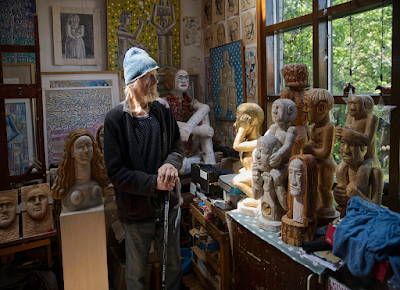
Images in this article show some of the sculptures he made. All in all a considerable amount, not too large qua format, quite expressive and partly mounted on the wall of a shed near the house, a method of exhibition we see more often in Finland.
In his paintings and drawings he depicted Finnish landscapes that no longer exist in that capacity and also Finnish ways of life that are now lost, such as horses pulling sleds, however not in a nostalgic style, but rather with a timeless character.
Nowadays Meriläinen lives alone in his house.
Documentation
* Article by Heini Heikkilä on the website of the Finnish Association for rural culture
unless stated otherwise, images are courtesy of Jaroslav Horák
The community of Černilov with about 2,200 inhabitants in the east of the Czech Republic, can boast of the presence of two art environments.
These sites were created from the early years of the 21st century by Jaroslav Horák, who lives in Černilov and was born into a family of millers.
The art environment with a mill
and an area named Pohádkov (Fairy Tales)
Jaroslav Horák owned a piece of grassland just outside the village, along the road from Černilov to Libřantice.
This meadow was no longer used for grazing cattle and there was only some dilapidated shed.
Around 2011 Horák decided to renovate this shed, but the renovation wasn't just a matter of repair, it rather was a creative project, as a result of which the shed became a house with a lovely appearance, beautifully designed, especially with regard to the windows.
As the above image shows, near the now renovated and embellished barn, there is an area with arrangements of small-scale decorative wooden creations, made by Horák himself, This are was named Pohádkov, which means Fairy Tales.
There are all kinds of fairytale items here, such as mushrooms, strange trees and giant flowers.
Children of visitors can have fun here to their heart's content, such as playing hide and seek, using the many bushes to hide.
As the images show, the colorful elements are characteristic of the art environments created by Jaroslav Horák.
They can also be found, for example, on the entrance gate, which has been decorated with colored round plates.
In 2016, Horák started a big project that he had dreamed of for a long time. On the highest part of the meadow he built the mill that would become rather iconic for Černilov
Just as the renovated shed, the mill is characterized by colorful accents, such as the blades that are colored at the ends. These blades can rotate, but they do so powered by an electric motor.
The tower has three floors, is 13.5 meters high and has a diameter of 8 meters. The blades are 12 meters long. The interior of the mill includes a gallery with photos of interesting and attractive locations in Černilov and there is also a room for meetings and other social/cultural activities,
A plaque is attached to the facade in memory of victims of the 1950s, among whom Horák's parents.
As shown above, on the site also a special a creation has risen, consisting of nine high poles.
This ensemble is referred to as Černilov's Stonehenge, this because of the association with the megalithic monument in the English county of Wiltshire.
The two areas with semi-circular shelters are equipped with a table and benches, this to offer visitors a place to consume a drink or meal, if they have brought something similar.
This art environment can be visited by the public and visitors are welcomed with the text on the entrance gate saying Vitel kdo v dobrém přicházíš, which means Welcome who is coming in a good way.
The art environment Wet Meadow Gallery
this image (April 2024) as on Google Streetview
Around 2020 Horák started to create another art environment, also located on an arterial road from Černilov, but this time the one to Librice.
The site is located on a somewhat boggy piece of grassland and is referred to as the Wet Meadow Gallery (in Czech Mokrá louka-galerie)
The image above shows a small cottage, reminiscent of the shed near the mill site.
Seen from the road, a fairly long series of colorful sculptural ensembles starts to the right of the cottage, and it seems that this line, probably running along a ditch, continues until a side road of the arterial road.
Along the line there is a tulip tree, as in the image below, and then there is a group of aliens and there sheep, vases of flowers, gentlemen with parasols and so on.....
Gallery Mokrá Louka can be visited for free all year round.
Documentation
* Website dedicated to the two art environments, edited by Jaroslav Horák, with a variety of images
* Brief article about the two art environments in a publication dedicated to sights in the Czech Republic
* Facebook "Mlýn Černilov" (Černilov Mill) with various recent photos
Video
* Video(2023, YouTube, 5'32") by Patka Filmové studio
Jaroslav Horák
Art environments in Černilov
along the roadsto Libřantice and to Librice
Černilov, region Hradec Králové, Czech Republic
visitors welcome
Google Streetviewwith over 750 photos of the mill and the area around