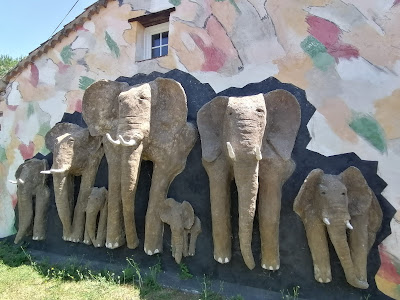
The image above shows a sculpted herd of elephants added to an outside 40 m² large wall of a house.
This ensemble is part of an art environment located in the hamlet of La Riviérette, which belongs to the municipality of Veilhes with some 110 inhabitants, located in the south of France, about 40 km west of Toulouse.
this image and the next four show
some sculptures in the outdoor area
Life and works
This ensemble of elephants is a creation of Pierre Silvestrin, also referred to as Quinquin.
He was born on March 28, 1951. After primary school he started working, first at the age of twelve as a helper in a bakery, and then from the age of fourteen as a house painter.
In his early twenties, in 1974, in addition to his work as a house painter, he also started to profile himself as a visual artist, a capacity that gradually prevailed in the course of years.
Silvestrin's house and studio are located a few km north of the built-up area of Veilhes in the hamlet of La Riviérette. The property is surrounded by a beautiful, rural landscape near a lake called Lac du Messal.
.
In his artistic work, Silvestrin mainly focuses on making paintings and sculptures.
The smaller sculptures are particularly arranged in the interior of the house, which has recently opened as a museum, the larger ones are set up in the outdoor area.
The surrounding images show some of these outdoor sculptures, which include more or less realistic images of people as well as fantasy figures.
These larger creations were made by finishing an iron mesh infrastructure with a layer of concrete.
The ensemble of elephants
In February 2022, Pierre Silvestrin embarked on a special project that involved transforming a 40 m² exterior wall of his house into an ensemble of sculptures in high relief depicting a herd of elephants.
On Facebook, he asked friends to contribute to the cost of the large amount of material needed for the voluminous creation, a request that was fulfilled in no time
The Ideal Museum of the Unsold
Subsequently, on March 28 of that year 2022, a lower and an upper space of his house were opened to the public as the Museum of the Unsold. Silvestrin saw this as a kind of gift for the day he turned 71.
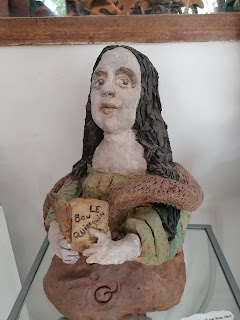
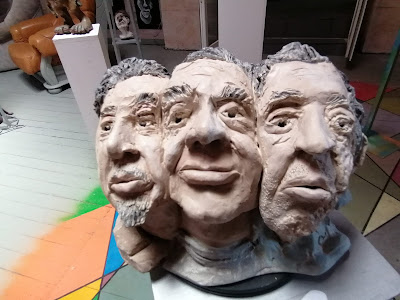
The three pictures around give an impression of the sculptures that are exposed in the Museum. These sculptures usually have a small size and often show people's heads. They are mainly made of clay, found in the vicinity of his house, which Silvestrin kneads into the desired shape with his hands and then details with appropriate tools.
The sculptures and paintings exhibited in the museum are not intended for sale and can therefore be seen as part of the art environment, which also includes the sculptures in the outdoor area and the ensemble of elephants on an outer wall.
The designation Musée Idéal in the name of the museum is reminiscent of Facteur Cheval's Palais Idéal, which in all probability is Silvestrin's intention indeed.
this image and the next eight from Burnel's Facebook account
The image above shows a creation that is part of an art environment that has developed over the past few years. The site is located in the small village of Jouy-en-Argonne with about 50 inhabitants, 13 km west of the town of Verdun in the north-west of France,
Life and works
This art environment, which currently is still in development, actually was started as a creative project in July 2021 by Philippe Burnel, born in 1966. The photo below shows the very first cement-formed creation added to the site,
the first sculpture in the garden, July 2021
Burnel, who lives in Verdun, where he has a job in the archives of the post office, was active as a sportsman in his younger years. However, he was increasingly drawn to making works of art. Following this vocation, he started working as a self-taught artist around the year 2000, when he was in his early thirties.
Initially, as an admirer of Salvador Dali, Burnel made surrealist paintings, but after meeting the Verdun painter Serge Pighi (1941-2018), he found his own style, characterized by a lively, colorful palette and a critical, sometimes rather sharp view of what happens in everyday life.
The persons and other items featured in his work are often depicted in relief, what he achieves by adding paper-mache to the canvas or panel used for the creation and transforming this layer in such a way that the intended image appears and can be painted after the drying of the paper mache.
Numerous works by Burnel can be seen in the videos in the documentation below.
In 2010, Brunel bought an old barn in Jouy-en-Argonne, in which he set up a studio. As shown in the very first image there is a large, elongated piece of hilly grassland behind this barn.
Apart from some decorated wooden totems, placed by Burnel on this area, it remained untouched for over a decade. However in July 2021 Burnel began developing an art environment on this area by adding a variety of sculptures made from cement.
Just as Burnel uses a fixed technique for his paintings to achieve dimensionality, he has a specific method for making these sculptures. An infrastructure of iron mesh, broadly in the shape of the desired image, is covered with cement, after which the resulting structure is transformed into the intended design of the sculpture by means of mortar.
Over the past two years, Burnel has already produced an ensemble of sculptures in a style on parts similar to that of his paintings. This, however, with one major exception: Brunel has chosen not to color the finished creations, but to set them up unprocessed in the gray tint the mortar has.
This might be significant.
In Burnel's paintings the color scheme underlines the character of the person depicted, in the art environment the ubiquitous color gray has a connecting effect. The ensemble as such is paramount and the parts each contribute to the impression that the whole evokes.
The interrelation within the ensemble is expressed in many parts of this art environment, for example characters that are connected to each other by an actual embrace or by a long winding sculpted tube.
So far the regional press has not given any publicity to Burnel's growing art environment, nor has it been reported in publications in the French field of art environments. Burnel's Facebook page is the only place so far where photos have appeared and (much positive) comments have been made.
One of those comments suggests that Burnel could open the site to visitors once he retires, which Burnel, who is in his late 50s, thought was a nice idea.
However, at the moment there is no visitor regulation yet, so this article does not mention the address of Philippe Burnel's sculpture garden.
New additions
After this post was published in July 2023, Burnel published photos of new additions to his art environment:
* Entries about Burnell's paintings on websitePassions-art, with a video and on websiteArtpulsion
* Article in regional newspaper l'Est Républicain about an exposition (April 2022) of Burnell's paintings, with a short referral to the decorated garden
* Article in the same journal about an exposition in 2016
Videos
*Video (123.47) May 2016, YouTube, with Burnel being interviewed in a radio-show
* Video l'Atelier by Patrice Velut (2021, YouTube, 1.55)
* Another video by Patrice Velut (2021, YouTube, 2.30) with an impression of an exposition of Burnel's artwork in Château de la Chaussée in Saumur
first published July 2023, last revised August 2024
Philippe Burnel
Sculpture Garden
Jouy-en-Argonne, dept Meuse, region Grand Est, France
this picture and the next three by Veli Granö, as on the
website of and in agreement with the
Association for rural culture and education (Finland)
Pori is a city of some 83.000 inhabitants (2023) in the south-west of Finland, located nearby the coast along the Gulf of Bothnia.
The city is part of the ten largest cities in Finland and surprisingly there is a sculpture garden in this city, which in terms of number of creations ranks among the largest art environments in Finland....
Life and works
This sculpture garden was created by Irja Alinen. She was born in 1944 and had an experience at the age of six that had a major impact on her life.
Irja had that experience when she saw an angel in a dream, who asked her to join her on the way to heaven. Irja indicated that she had to discuss this with her mother first.
The angel would come back the next day and indeed the next evening the shape appeared again. Irja indicated that her mother had said that she was still too young to go to heaven and then the angel turned heavenward in a beam of light.
This experience would have a major influence on Irja Alinen's further life. She realized that there could be life in a parallel environment and that in some way she could interact with personalities from that other world.
Creating a visionary garden with sculptures
For Irja Alinen creating an art environment started in the late 1990s, when she was in her mid-50s, By then, her three sons had already left home.
She lived on her own in a house with a large garden. A neighbor, who also lived on her own, had a pile of sand and cement after work in her house or garden, which she didn't know what to do with.
Irja thought of a pair of swans. In many cultures, swans have a specific symbolic meaning and, for example a sculpture of two swans looking at each other, can be a representation of loyalty and inseparability.
Irja did indeed make a sculpture with two swans and this was the beginning of the project of many years that would involve the creation of a few hundred concrete sculptures.
Her awareness of the existence of parallel worlds played a major role in the realization of the project.
The experience gained as a six-year-old was later in her life supplemented with similar experiences, such as it happened one evening when she turned off the light in her bedroom, that she saw an alien standing in the doorway.
When making sculptures, she noticed that she experienced a certain guidance, as if something external was telling her how and what to do. As she has said: If the guide is not there, there is absolutely no point in trying to work, the work will not go well....
Before making sculptures, the water in the concrete mix is blessed and ashes from burnt trees are added to connect with tree spirits.
In her creative activities, Irja Alinen is inspired by visions she gets and the people she sees.
This includes all kinds of people who are part of a parallel reality, as depicted in the image above and the three images below. This series of three consists of screenprints from the video in the documentation, made in 2018 by Veli Granö., in which Irja talks about her creations and the context in which she does her work.
By watching the video, which is subtitled in English, one can get a good insight into Irja Alinen's ideas.
Veli Granö is also the one who referred to Alinen's garden as Näkyjen Puutarha (Garden of Visions)
this picture and the two below left and right
are screenshots from the video in the documentation
Irja Alinen's sculpture garden as it currently is, does not only show people from another dimension, there are also numerous sculptures that depict characters from our everyday world.
For example, in the very first image there is not only a group of angels, but also a clergyman dressed in a habit on the right and a lady in a sitting position on the left. All those characters stand peacefully together.
The same applies to the people and animals depicted in a variety of other sculptures, such as mermaids, unicorns, dragons, Indians and well-known cartoon and fairytale characters, which all are arranged in harmony with each other.
Documentation
*Article on the website of the Association for rural culture and education in Finland
* Article on the website of Veli Granö, with a video, subtitled in English and with a rendering of Irja Alinen's remarks
Kudirkos Naumiestis, a small community in western Lithuania, located close to the border with the Russian region of Kaliningrad, is home to a striking art environment, as shown above.
Life and works
This ensemble of 21 sculptures was created by Pranas Sederevičius (1905-1971).
It has been said to be the only example of primitive folk art of this nature in Lithuania, and indeed in this country until now no other art environments in the capacity of a garden with large and realistic concrete sculptures have been known.
this picture and the next six are screenprints from the video by Lithuanian TV, see documentation
Sederevičius started creating his art environment in 1951, when he was in his mid-forties and had a job as a factory worker.
With regard to the years before, the internet has no biographical data available.
If he was born in Kudirkos Naumiestis or surroundings, in his early years he must have known about the First World War, but as a young adult he must have experienced the Second World War close by, because in those years his native region bordered on Germany and when the war between Germany and Russia broke out there was a lot of war violence in the area.
Sederevičius has been described as a sympathetic person, often good-humored, easy-going and tactful.
one of the sculpted horses on the right side of the house
And he loved horses......
This preference is very clearly reflected in his ensemble of sculptures. The scene around the house is dominated by a number of more than life-sized sculptures of horses.
At the right side of the house, seen from the street, there are some five horses, including three that rise more than life-size ....
another sculpted horse, on the left side of the house
..... and as shown in the picture above, on the left side of the house there is also a sculpture of a horse, this one rising high above the house's roof ridge.
To make these large sculptures Sederevičius used a method, in which he first made an iron infrastructure from all kinds of iron remnants, such as parts of old bicycles and bed spirals, bound in the desired shape by a lot of iron wire. Then he covered the resulting form with cement, which would be painted after hardening.
Obviously, large amounts of cement were needed for the large sculptures. There are no clear reports about this, but it could be that Sederevičius obtained the loads of cement that he needed, through the company where he worked.
sculptures on the right side of the house
The photo above once again shows the size Sederevičius' horse sculptures got.
However, his art environment also includes a variety of smaller creations, like the one at the bottom right of above photo, a sculpture in high relief on a wall, which is a self-portrait of Sederevičius, flanked left and right by the head of a horse of course.
Among the smaller sculptures, there is also a series of busts, predominantly featuring celebrities from the history of Lithuania.
two busts and a horse head
To give an idea what kind of persons have been depicted, here is a small review.
There is a bust of a historic person named Vytautas the Great (1350-1430), who was a ruler in what was then the Grand Duchy of Lithuania.
And then there are busts of famous people from the Lithuanian cultural sphere, such as Vincas Kudirka (1858-1899) who was a poet and wrote the lyrics and composed the music of the Lithuanian National Anthem, but also Pranas Vaičaitis, (1876-1901), also a poet who violated a press ban and was imprisoned for a month in 1899.
There is also a depiction of Vincas Grybas (1890-1941) a professional sculptor, who was arrested and killed by the Germans in the first year of the war.
the two famous pilots Gyrénas and Darius
The two busts of uniformed persons, as in the picture above, depict two pilots. Stepona Darius and Stasys Gyrénas, who got fame in Lithuania in the early 1930s.
Darius (1896-1933) migrated with his family to the USA, returned to Lithuania in 1920 where he completed a pilot training and actively promoted various (American) sports'. Early 1923 he participated in the Klaipeda revolt. Later he returned to the USA where he worked in civil aviation.
The Klaipeda revolt had as a result that the German Memelland area along the western border of Lithuania -an area which after World War I was under specific international rule- in 1924 came under rule of Lithuania, a situation which ended in March 1939 after a German ultimatum.
The other pilot, Gyrénas (1893-1933) also migrated to the United States, where in 1927 he acquired an airplane and worked in civil aviation.
Together flying in an airplane named Lituanica, Darius and Gyrénas were among the first to fly across the Atlantic Ocean from New York to the planned landing site in Kaunas, Lithuania's second-largest city,
Their plane crashed under unclear circumstances above Germany, some 650 km away from the airport in Kaunas, according to an official report due to bad weather conditions and engine problems, according to un-official opinion the aircraft was shot down by the Nazis.
two more busts and a couple of deer
The descriptions of the background of the people depicted in the busts, show that most of them have a specific link with Lithuania as a nation and consider the independence of the country of great importance.
It should be borne in mind that Sederevičius made his sculptures in the 1950s and 1960s, when Lithuania was part of the USSR and allusions to the independence of the country were not accepted by Moscow. Lithuania did not gain independence until 1990.
That Sederevičius nevertheless presented these persons in his creation, says something about his character, as it also says something about the inhabitants of the community of Kudirkos Naumiestis, of whom no one reported to authorities, but who approached the site with appreciation and admiration.
The site became a cultural landmark
Sederevičius died in 1971 of a stroke.
It is unclear who subsequently became the owner of the house and the garden with sculptures. It has been reported that the house has been occupied by persons who were teachers from a school.
In any case, it can be concluded that the sculpture garden is well maintained, because today (2021), fifty years after the death of their creator, the sculptures still stand as if recently made.
Currently the site is a cultural landmark that attracts a lot of visitors.
Documentation
*
Article (May 2018) on the website of Lithuanian Radio and TV (LRT), with pictures and a video by Lithuanian TV entitled Pranas ir Julija
*
Article (undated) on website Panatyk Lietuvoje, with pictures and a map
* Article (undated) on website Atlas Obscura, with a series of pictures
* Article (undated) on website Pamatyk Lietuvojelt, with a series of pictures
pictures courtesy of Risto Salmi, from his website and Facebook-account
Savonlinna is a municipality with around 33000 inhabitants in South Savonia, Finland, an area known for its many lakes.
From the point of view of art environments, the area also deserves to be known for the specific creations made by Risto Salmi, both masonry structures and a large variety of iron sculptures mainly made of scrap metal from brick kilns that needed to be renovated.
Olavi, the housekeeper
Life and works
Born in 1956, Risto Salmi after his primary education probably had a vocational training before starting to work as a bricklayer at the age of 20.
He has now worked in this profession for more than 40 years. In 2007 Salmi founded his own company called Uunisuutari Risto Salmi. His son Antin is also employed there.
As a bricklayer, Salmi gradually focused his attention on making brick kilns. In this occupation it also happened that he was asked to dismantle old ovens before building a new one.
That old material, such as shutters and rings, was usually not reused and Salmi got the idea to use these leftovers to make creations as usual in Finnish ITE art.
One of the first creations he made was the structure shown above, a kind of tower with a huge copper tile roof and four sides with a total of 75 old oven doors.
This structure was a gift to Salmi's wife on the anniversary of their wedding. It became an iconic element in the garden at their house.
Another large structure, made by Salmi in 2016, is the pizza oven pictured above.
It is a replica of one of the towers of Olavinlinna. a 15th-century castle, built on an island in the Kyrönsalmi strait that connects the lakes Haukivesi and Pihlajavesi. The castle is known for the Savonlinna Opera Festival, which has been held since 1912.
The round holes at the top of the tower are loopholes in the original one, and that's where the replica blows out the smoke from the internal barbecue.
There are also sculptures made mainly of materials other than iron, such as the ensemble depicted above with two musicians and a spectator.
The musician with the guitar is Irwin Goodman (14-9-1943/14-1-1991), a popular folksinger who toured Finland for 25 years and with whom Salmi was friends. The drummer is Remu Aaltonen. And the spectator made from white concrete, wearing a black metal cap, is Finnish comedian actor Masa Niemi.
Salmi has also made creations out of wood, as the photo above shows. It is a horse made of a large number of loose wooden elements, which pulls a sled with a number of tree trunks on top.
The construction of the horse is so sturdy that Salmi can sit on it as a rider.
In the background the picture shows kind of garden shed, also made of wooden components
a sportsman wearing a four wind cap
But the majority of Salmi's sculptures mainly have been made of metal parts from old stone ovens.
Like the above depiction of a sportsman, probably the in Finland well known Korte-Heikki, wearing a specific Lappish cap, referred to in Finland as four wind cap.
From an early age Salmi loved to write poems and poetic texts. Examples of this can be found on his website. The way in which he uses the iron elements that form the basis of his creations, also bears witness to a great creative capacity.
The four photos (click to enlarge) grouped around also show this quality, with top left an African grandmother with a lantern in hand going to meet the grandchildren, top right a character guarding the entrance of the site, down left a bear with a pot of honey and down right a character dressed in a work apron
And then, to conclude this article, the photo below of a car that will remind many older readers of the years when they for the first time could afford a car and bought something like a second-hand Citroën 2CV ......
Although above depicted English art environment with reportedly 300 teddy bears made of cement, disappeared years ago, the house to which the site belonged is currently (2020) still referred to as Teddy Bear Cottage, as can be seen in the screenprint below.
screenprint of the website of real estate agent On The Market advertising the Teddy Bear Cottage as an object to rent
Life and works
The house, located on 14 Church Street in the town of Bradford-on-Avon, not far from Bristol, in the Wiltshire region in the south-west of England, was bought in 1935 by Charles Edmund Palmer, who was born in 1883 or 1884.
The internet hasn't much biographic information about him. He had a job with British Railways as a line inspector, his wife was Harriet Isabelle Palmer, the couple lived in Bath in the early 1940s, but when because of the war their house was destroyed, they moved in 1942 to the house in Bradford-on-Avon.
Creating a Teddy Bear Garden
After Mr Palmer retired, probably in the late 1940s, he developed a hobby of making teddy bears out of cement, which he grouped together in the garden belonging to the house. Thus arose in the 1950s and 1960s an art environment with hundreds of teddy bears, a site that became known as the Teddy Bear Garden.
British Pathé in 1961 made a film (now a video 1'25" on YouTube) that shows Mr Palmer at work.
The video shows how he puts the cement in a mold and processes it into a bear shape, which is whitewashed after drying.
The sculptures generally have the same appearance, sitting with arms forward, sometimes standing with arms raised. The setup is simple, in a circle, sitting in a row at a table, and sometimes attributes are added, such as a book or a cane. Occasionally a specific scene is depicted, such as a schoolmaster bear teaching some student bears.
As is often the case with art environments. it is the overall picture of the hundreds of white sculptures that gives the site its specific appearance, which in this case is further enhanced by the sloping surface of the installation.
In the 1950s and 1960s the site attracted visitors, mainly from the immediate vicinity.
The end of the Teddy Bear Garden
After Charles Palmer and his wife had died (it's not clear when), their house was for sale. In the 1970s it became part of the office and laboratory of the St Ivel dairying company, which at that time settled in different buildings on Church Street. In the mid 1990s the company left the location and it is likely that he firm in the approximately twenty years it was on Church Street, hasn't cared for the bear garden.
At the time of the departure of the company an employee took four bears with her, because she assumed that the site would be demolished. The new residents of 14 Church Street have restored seven bears. And maybe other people also have acquired some bears.
Its quite possible that the remaining teddy bears were so battered that demolition of the garden was inevitable.
So some of the site's items may still exist, but the Teddy Bear Garden as such is history.
Charles Edmund Palmer Teddy Bear Garden 14 Church Street Bradford-on-Avon, county Wiltshire, region South-West England, England, UK
Stretching over some 220 km (137 miles) the Grand Union Canal in England connects London with Birmingham. Along the part of the canal that leads through West London one can find a 50 meters long wall with decorations and sculptures, part of a larger art environment that also includes a sculpture garden and an interior with various creations (located at the backside and inside of the white house in the picture below)
view from the canal on the decorated wall at the rear of
the houses along the Hormead Road, West London
Life and works
This art environment has been created by Gerald Dalton, usually addressed as Gerry Dalton, who was born in 1935 in Athlone, Ireland. Due to severe asthma, as a young boy he was often unable to attend school, so his education remained limited.
In 1959, at age 24, Dalton migrated to London, where he worked at the postal service in the Paddington district, had a job in cleaning machines in an aeroplane factory and was employed at the cafe of a business organization for company directors. He retired from work in 1995 at age 60
facade of Dalton's ground floor house on Hormead Road
(Streetview, April 2019)
In the early 1980s Dalton moved into a small ground floor apartment on Hormead Road in West London. Over time, he began to provide his living environment with all kinds of decorations and creations, a project that he would continue for some thirty years. Interior
The walls of the house have been lavishly filled with framed colorful images of historic sites and personalities, interspersed with mantelpieces and wallboards filled with an abundance of small-scale, brightly colored sculptures made by Dalton, that impersonate all kinds of characters from British history, including soldiers, princes, kings ...
replicas in the interior
Then, as can be seen on the picture above, the space inside also includes a number of replicas of in particular English palaces, castles and stately homes, such as Windsor Castle, Buckingham Palace and St Paul's Cathedral. The front room of the flat alone contains some twelve replicas.
alook at the interior of a replica
These replicas, made from wood, paper-mâché or card, mostly painted white on the outside, are very accurately modeled after the original and often the roof can be lifted, making the indoor spaces visible.
These spaces are usually equipped with furniture, wall covering and representations of residents, everything in dollhouse format, nicely furnished and colorfully executed.
The back garden
sculptures in the back garden
As depicted in above picture, in the back garden a large number of sculptures have been arranged in rows. Dalton often used the same mold to create them, making a distinction between the figures by differences in color and variations in small details
In a thematic sense in this arrangement once more a lot of attention is paid to historical personalities, such as Oliver Cromwell and Jonathan Swift
detail of a sculpture
A large row of mainly female persons is arranged in the front or a bright red painted side wall. The picture above shows a character in detail.
The sculptures are arranged on identical cube-shaped cement blocks, with texts on the front describing the person. The relative similarity of the sculptures and the arrangement in rows gives this sculpture garden a rhythmic, as well as a coherent nature, qualities that mean that this back garden doesn't include just a separate collection of objects, but rather a work of art in its own right.
Decorated wall and arrangement of sculptures along the canal
some sculptures of female persons lined up
in front of the decorated wall along the canal
A wall separates the back gardens of the houses on Hormead Road from a small strip of bank alongside the Grand Union Canal. The strip is property of the housing company. It has a double row of conifers and it was quite messy before Dalton figured out that he could turn wall and strip into another part of his art environment. With permission of the housing company Dalton cleaned up the area, which took him a couple of months.
The side of the wall facing the canal is covered with white plaster, which contains numerous individual decorative elements, such as tiles, busts and plaques, but also handwritten informative texts about the sculptures arranged in front of the wall.
These sculptures, neatly emplaced along the wall, have for the most part the same design as the sculptures in the back garden, but there are also a number of sculptures, especially of female characters in classical poses, executed in classical white.
sculptures of female characters on the strip along the canal
One would say that a strikingly decorated wall with a parade of sculptures in front of that wall does not go unnoticed and receives some publicity in the local press. But apart from the locals who in general appreciated Dalton, both because of his personality and his creative activities, outside of that group it remained silent around the self-taught artist and the way he embellished the public area along the canal, let alone that his indoor creations got public attention.
In July 2019, as part of a personal project freelance photographer Jill Mead, who works for various London newspapers and had tracked down the garden, interviewed Dalton and photographed his art environment. Publication of her photos might have led to a broader awareness of the site, but before it came to that, Dalton, aged 84, became ill and died in August 2019 in a London hospital.
Action and publicity after Dalton's death
After Dalton died, Sasha Galitzine, a friend of Dalton and current custodian of the property, took the initiative to start an action to preserve the site. The house and garden were opened to visitors, not just local residents, but also well-known people were deliberately invited, including Jarvis Cocker (well known in the field of art environments for his TV series Journeys into the Outside, 1999), influential people from the museum world, and of course TV people and journalists.
This opening up was a great success in terms of publicity, because, as can be seen in the documentation below, many large news media paid attention to Dalton's art environment and its future.
In this respect there is a major problem, Dalton rented the house and the rules for these homes include that the rented property must be vacated fairly soon after the tenant's death. a rule that does not allow that the house becomes a small-scale local museum. The housing company is willing to sell the property.
A crowd funding action started to raise £ 550,000 to buy the house, but they couldn't raise enough money to do so.
Items of the site have been removed by family
Early August 2020, it was reported in the press that various parts of the site had been removed, this on behalf of a nephew of Dalton, a lawyer in Dublin, who so far has not provided any further explanation.
An association to save the exterior creations
Now that it has not been possible to preserve the creations in the interior, an association has been founded that focuses on the preservation of the sculptures located in the public space along the canal.
Documentation * Website The Keepers Project has a variety of pictures of the site and an interview (2020) with Sasha Galitzine, temporary keeper of this art environment
* WebsiteHelp us saveGerry's Pompeii, edited by the action committee
* Alys Fowler, Hidden treasures: a statue-filled canal garden, article with a lot of pictures by
Jill Mead, in newspaper The Guardian, October 26, 2019 * Digby Warde-Aldam, What happens when an “outsider artist” dies, and who decides their legacy?, articlewithphotographs by Miguel Santa Clara in Elephant Magazine, October 2019
* Various newspapers in October 2019 had articles about Dalton's art environment and its future, such as the Times, the SUN, the Telegraph, the Daily Mail and the Evening Standard
* Mariella Landolfi, "Gerry's Pompeii", article (January 2020) in Raw Vision # 104
Videos
* short video by Raw Vision (0'59", October 2019, YouTube)
* Video by BBC (October 2019, 1'34")
* Video by RTE News on Facebook (October 2019, 1'44")
first published November 2019, last revised June 2024
Gerald Dalton Gerry's Pompeii 34 Hormead Road, W9 3NQ London, England, UK the decorated wall along the canal can be seen