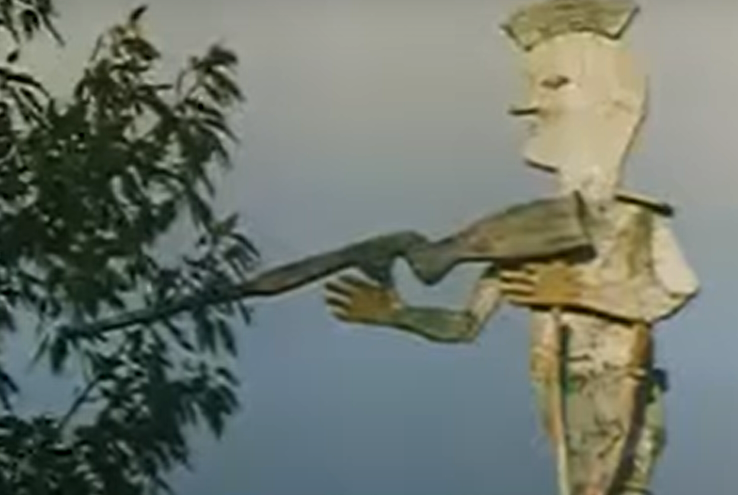
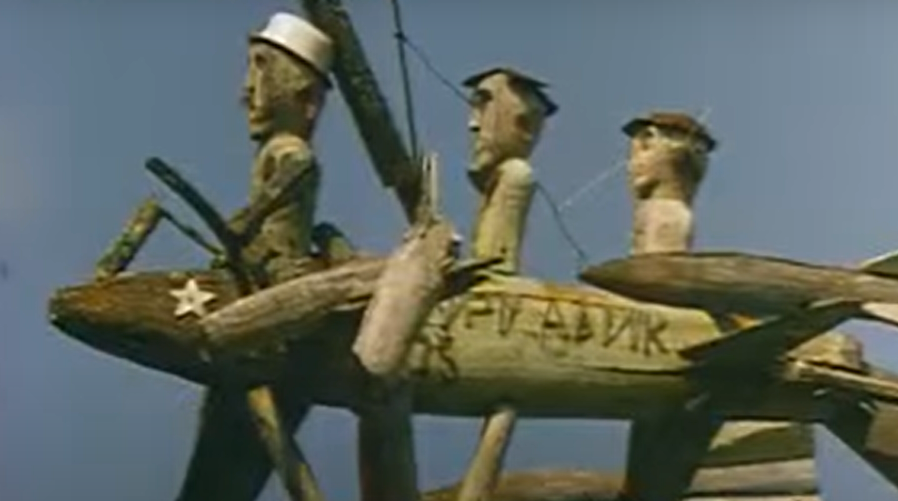
pictures in this post are screenprints from the video in the documentation
The image above shows a wooden sculpture depicting Russian astronaut Yuri Gagarin, as he could be seen in 2002 with arms flailing, standing on a pole in the garden of a house in the hamlet Vacarino, located in a beautiful area in the Tver region, a kilometer away from a turnoff halfway the M11 motorway between Moscow and St Petersburg
At that time the hamlet had only a few inhabitants, because most residents had sought their living and working elsewhere. Today (2022) no one lives there anymore
The wooden sculpture of Gagarin was created by Anatoly Alekseevich Varlamov, pictured above as he was filmed in 2002 for a video about him and his his art environment in Vacarino.
There is a limited number of articles devoted to him and his creations, all listed in the documentation, and none provides biographical information, so we don't know when and where he was born or in what year he died, like it is also unknown in what year and why he began to create the site..
The house where Varlamov lived, was located on a small hill at the end of the village.
The photo above shows that the sculptures were situated on the roof of the house and in the garden. It's hard to tell them apart, but here are some more detailed images.
Varlamov used simple tools to transform the tree stumps he found in the area into sculptures. They therefore mainly have a little detailed look, what contributes to their charm.
His art environment mainly included historical characters associated with the origin and history of the Soviet Union.
The astronaut Yuri Gagarin has already been mentioned. The image above shows Joseph Stalin, with pipe and moustache.
There was a sculpture of a rider on horseback, depicting Vasily Ivanovich Chapaev, the hero of the Russian Civil War (1917-1922), as there was also a sculpture of Nikolai Aleksandrovich Shchors, an officer of the Russian Imperial Army, who became a commander in the Red Army during that civil war.
Other sculptures depicted the Russian fairy tale character Baba Yaga, a soldier, and other not so easy to identify personalities, such as the people in the plane below.
When in 2002 the video in the documentation was made, about half of the sculptures ever present were still intact. This video and the articles in the documentation provide a chronological sketch in text and photos of the decline of the art environment in Vacarino.
As noted in one of the articles, its creator, Anatoly Varlamov, has since passed away.
Documentation
* Article (May 2018) in Live Journal by Andrey Sinyushkin, with a report of a visit to the hamlet and a variety of photos
*Article (June 2018) on weblog La Camorra, similar to the article above, but with one photo
* Article (June 2020) by Ilya Varlamov (no family) with many photos, including the interior of the abandoned house. When she visited the village there was only one inhabitant.
* Article (February 2021) on website Dzen by Alex Polyakov, who walked through a high layer of snow to Vacarino, and there had to realize that no sculptures were sticking out above the layer of snow anymore.
Video
* Video Varlamov's land (YouTube) made in 2002 by Film studio Fatherland directed by T. Karpakov
all pictures, except the one of the summer-market,
from Facebook
The small town of Valence d'Agen, a community with about 5,000 inhabitants in the south of France, can feel happy that an exceptionally colorful art environment was begun the past year (2020) , a year that was also characterized by a pandemic which brought a lot of grief and limitations. It is a site created with the aim to propagate Bonheur (Happiness) ...
Life and work
The site is being developed by a female artist in the field of what in France is referred to as art singulier. She calls herself Kahl, which is a pseudonym formed by a number of letters of her real name.
two videos showing mobile creations
Born in 1965 in Troyes, in the north east of France, it was not obvious that she would work in a creative setting, and initially, because of her studies, she had very different work, such as activities in the fields of communication and the education of children.
However, she began to feel more and more that there was another direction ahead for her, more artistic, and especially in the direction of art singulier.
As she said: Mon parcours de vie m'a guidé sur ce chemin que je n'envisageais pas et voilà ... C'était écrit quelque part ....(My life journey has guided me on this path that I did not envision and here it is ... It was written somewhere ....)
She overcame a disease and after great efforts and thanks to a strong character she felt reborn, able to take a New Beautiful Color Path.
In the late 1990s she moved from Troyes to La Rochelle, on the French west coast. There she opened a small art gallery, where she sold works of art singular artists.
She started painting herself and signed her paintings with the pseudonym KAHL. And then, it turned out that many people, not knowing that Kahl was the owner of the gallery, were interested in her paintings which they valued as attractive work full of color, made by an artist with a distinctly feminine palette.
Stimulated by the apparent appreciation of her work by visitors to the gallery, Kahl began to give painting an important place in her life. She participated in exhibitions and the appreciation of her work continued unabated. It was also a nice experience that the characterization feminine palette turned out to be correct when, for example, at awards ceremonies after participating exhibitions, she publicly announced that she was the artist named Kahl.
In 2008 she was awarded the first prize in La Rochelle's Festival d'Art.
Move to the area of Tarn et Garonne
In 2010, Kahl moved from La Rochelle to the Tarn et Garonne region, an area in the south of France she had met many years earlier while on holiday. She went to live in Bardigues, a community about 10 kilometers south of Valence d'Agen, where she later would establish the art environment that ultimately gave rise to her presence in this weblog.
She became a well-known artist in the area, which she crossed with a van full of paintings, her own work and that of others, to sell at markets in various villages and towns around.
photo of a summer market in 2013 on the Place Nationale
In 2017, she had to temporarily interrupt her busy work to undergo surgery because of a cardio problem and a back ailment, but after that rest she was able to quickly return to her places in markets and in the art trade.
In many places in the region she also was active in giving painting lessons, especially to children, in participating in exhibitions and with the sale of paintings in art galleries, the latter for example from May 2019 in the Galerie d Art Singulier on the Rue Notre Dame nr 1 in Valence d'Agen.
Then, in early 2020, she took a new step in her development as an artist. She left the gallery and moved into new accommodation.
This new accommodation was a free-standing building in the style of a chalet, situated on a generously sized lawn in the vicinity of a McDonald's in Valence d'Agen.
The walls in the interior of the chalet are fully occupied by Kahl's paintings, and maybe also those of other artists, just as was the case in the galleries she managed.
It is the outdoor space where the difference with the past manifests itself.
The images in this post show that now also large-scale creations, often more than man-sized, have become part of Kahl's creative activities.
Some of these rising creations represent more or less human characters, others consist of colorful poles with a wheel placed horizontally at the top, and they all have a cheerful appearance, full of bright colors, smiling faces, whatever, and in any case they are composed of recycled material (Récup, in French).
In addition, many of the creations have a lively character, with elements that move up and down in the wind, rotate or they move as its suits.
The outside space, where Kahl's green-decorated van has a place too, now also includes items such as flower boxes, a decorated chair, panels with texts ...
It is almost unbelievable to see how, in about a year's time, an ordinary piece of grassland has turned into an attractive, cheerful and happiness-radiating art environment where visitors are welcome.
Documentation
* Kahl's website (with pictures of her paintings and the creations in the garden)
this picture and the next two (around 2008) from the weblog of Thierry B
Feurs, a community of some 8000 inhabitants, located along the River Loire, some 70 km west of Lyon, according to reports dating from 2008 was home to an art environment in the capacity of an ensemble of flying objects mounted on high poles.
Life and works
This ensemble was created by Roger Jeampierre, who was born in the early 1930s.
Jeampierre worked in Feurs as a plumber, who at some moment became responsible for monitoring the network of the company that distributes the drinking water in Feurs, a job named fontanier in French.
As such he lived in or next to some old buildings of the city's water company.
The above picture depicts Jeampierre's house, located along the route de Chambéon in a rural area on the left bank of the Loire river, opposite the town of Feurs, which is located on the right bank.
A view of the site made by Streetview in 2008, shows that the poles bearing the flying items stand along the (vegetable) garden of the house and could therefore also have acted as scarecrows.
Jeampierre has been an admirer of aircraft all his life, so it is not surprising that the items on the poles in particular include a number of replicas of aircraft. The models date from earlier years and most aircraft have a pilot on board, such as the single-engine biplane pictured above.
There are no recent reports about this art environment, but Streetview shows that in October 2019 the poles with the planes had disappeared.
Documentation * Article by Thierry B. on his weblog * Entry on website Art Insolite
Roger Jeampierre Flying objects Route de Chambéon Feurs, dept Loire, region Auvergne-Rhône-Alpes, France poles with planes have disappeared streetview
The picture above shows an island on the grounds of the outsider art museum La Fabuloserie, in Dicy, France, with an arrangement of in particular a number of girouettes ("wind vanes" or also "whirligigs").
These creations were made by Jean Bertholle, an outsider artist I quite some time wanted to add to this weblog, but about whom so little information was available, that I preferred to wait for more.
Now that also Bruno Montpied in his recently published very comprehensive survey of French art environments Le gazouillis des éléphants confirms that the information is limited indeed, it's time to publish anyway what is known about this self-taught artist.
Life and works
Jean Bertholle (1910-2002) had a job in Châtillon-sur-Seine (in the Bourgogne-Franche-Comté region, France), where he worked in a factory that produced shoe heels. Retired in 1974, he began making girouettes and other creations, which he displayed in the garden of his house ¹.
Bertholle lived in Chamesson (a community some 10 km south of Châtillon-sur-Seine in the same region), where he was known as "Toto" and as a sabotier (someone who makes clogs). Some distant family members (cousins) still live in the community. In general, the inhabitants are not aware that Bertholle's art environment ever existed ².
At a given time, in the 1980s or 1990s, Bertholle's creations will have been transferred to la Fabuloserie. This private museum about outsider art in Dicy, located in the same region as Chamesson, was opened in 1983.
The open air part of the museum includes various creations from French art environments that for some reason ceased to exist and were saved by Alain de Bourbonnais, the founder of the museum (More about la Fabuloserie in the page in this weblog about Museums and Collections) Documentation
* Bruno Montpied, Le Gazouillis des Éléphants, Paris (Eds du Sandre), 2017, p 133-134
* Video, published by La Fabuloserie onFacebook, August 6, 2016
notes
¹ this info from the book by Bruno Montpied who notes that the info is based on the publication "Des jardins imaginaires au jardin habité: des créateurs au fil des saisons. Hommage à Caroline Bourbonnais", La Fabuloserie, Dicy, 2015
² personal communication by Fabien Ansault (Galerie, museum of curiosities and café des Z'uns Possible in Chamesson)
Jean Bertholle
Girouettes
originally displayed in the garden of his house in Chamesson, Cote d'Or, region Bourgogne-Franche-Comté, France
currently displayed in La Fabuloserie, Dicy (from 2016 part of Charny-Orée-de-Puisaye), same region, France
Automates.....in France this term does not just refer to machines and instruments, but also to creations depicting people that are capable of making all kinds of movements.
We encounter such creations also in the field of art environments. For example Marcel Landreau's site had a scene of people dancing at a wedding party, Pierre Avezard's Manège has a variety of animated characters and Fernand Chapet's Parc des attractionsis an outdoor collection of moving creations.
This post introduces Bruno Dehondt's world of automates.
photo by Musée des gigottes automates
Life and works
The internet hasn't much biographical information about this artist.
Dehondt was born in 1962 or 1963, so currently (2017) he is in his mid-fifties. In interviews he has said that already at age fourteen he was trying to create impersonations of people. There is a single reference to an artistic education, but as a young man he did not succeed in settling as an artist and he had to work in some job.
However, as an artist in heart and soul Dehondt kept trying to realize his passion of making automates. Around 2000 he could fully devote himself to this activity. Initially he drove around in the region with a van loaded with automates to give performances on markets and other public places.
In 2006 he opened a museum/studio in Steenvoorde, where he stayed until the rental contract ended, after which he moved to Esquelbecq where, from December 2013, he has his current studio and museum.
the front side of the museum in Esquelbecq picture from weblog Histoires du Nord 3
Both Steenvoorde and Esquelbecq are situated in the north of France in an area adjacent to Belgium that runs to the east and south of the city of Dunkirk and is known as French Flanders.
In Esquelbecq (Eikelsbeek in Flemish) Dehondt found a place for his studio and museum in a building complex called La Minoterie, formerly a factory where grain was processed into flour.
Locatedin the center of the town near the market place it is an ideal location to attract visitors. And indeed, currently about four to six thousand visitors a year come to see the gigottes automates.
(above two pictures and the next three courtesy of Pierre André Leclerq)
These visitors will see a variety of life-size creations that depict all kind of characters one can meet in daily life. They can make movements and are programmed to interact with people around.
So one will see a group of musicians as in the upper pictures in this post, but also a shoe polisher, someone who is snoring, a cleaning lady, someone who drinks from a glass, an elderly lady knitting, a group of majorettes and so on......
Dehondt is constantly supplementing the collection.
In creating his automatesDehondt uses a variety of discarded materials, such as household appliances, vacuum cleaners, computers or parts of washing machines. It happens that people bring him materials they no longer need.
He himself also arranges the electronic mechanisms which generate the movements of the characters.
Body parts such as faces and hands are made from resin and pulp, plaster or clay. The characters are dressed with hand-made appropriate garments, designed by the artist.
the knitting lady and the shoe polisher
Although Dehondt may have enjoyed artistic training, his way of creating and portraying his characters has the connotation of a non-mainstream artist creating popular art, which is reinforced by the great passion he shows. As a visitor of his museum wrote: "Bruno Dehondt is the boy who always stared through the window, dreaming in the classroom and after a few decades finally woke up in a world he created himself".
Dehondt participates in exhibitions and also in various street performances. including the parades of Géants (giants) customary in the north of France, spectacles in which meters high dolls are led through the streets. He has created géants for parades in various communities in the region.
He also organizes workshops for young people where they are guided to create automates.
Documentation * The various websites of tourist offices in northern France refer to the Museum Les gigottos automates, for example the tourist office of Hauts-de-France
* Bruno Dehondt's own website and his page on Facebook
* Article (2013) in regional newspaperVoix du Nord about the removal from Steenvoorde to Esquelbecq
Videos
YouTube has a variety of videos.
Here is a selection:
* A video by MrStudio 231 (8'52", YouTube, February 2017)
* A video by Taïna Cluzeau about the new location in Esquelbecq (2'29", YouTube, January 2014)
Bruno Dehondt
Les gigottos automates
Rue de Bergues 3 bis
59470 Esquelbecq, dept Nord, region Hauts-de-France, France
In the Ukrainian city of Lutsk since 2009 a rotatable metal installation that represents a dragon rises on the roof of a residential house. It's a creation by self-taught white-smith Pavel Andrikevich
Life and works
Born in the late 1950s Andrikevich studied at the Civil Aviation Technical School in Leningrad, Russia (from 1991 on St Petersburg). After his study he worked as a dispatcher at the traffic service of the regional airport of the Rivne region in the north-west of Ukraine.
In the 1980s he got a job at the in 1984 newly opened Volyn regional airport, not far from the city of Lutsk, where he went to live.
Around 1986 Andrikevich became interested in working with metal. Just as other self-taught artists make sculptures or other creations from wood, it's for Andrikevich an artistic adventure to work with metal.
In part his metalwork just delivers decorative items, for another part it results in functional products which are nice to see as well, as for example a decorated turbo vent as on the picture below.
The airport of the Volyn region, where Andrikevich worked, was successful in the 1980s, but it encountered problems following the dissolution of the USSR in December 1991. It officially closed in 1997, but Andrikevich may have lost his job earlier.
He got a new job at the TechnoModul company in Lutsk, which makes equipment for ventilation.
Next to this job Andrikevich also focused upon the manufacture of metal domes for churches, monasteries and other buildings in Lutsk and in the surrounding Volyn region. An example of such a dome is the one installed on the chapel at the site of a fire brigade in Lutsk.
A very special part of Andrikevich's metalwork is his series of decorated helmets for motorcyclists, made from shining steel and adorned with various colorful stones.
These helmets indeed are suitable to wear when driving a motor cycle, but Andrikevich rarely will do so to avoid problems with the police.
In addition to these helmets, Andrikevich's house and garden include many more metal items, such as above shield and sword, but also a swing for children, storage boxes and various other decorative items.
However, Andrikevich's most spectacular creation is the dragon on the roof of his two story house.
The idea to construct such a creature had been with Andrikevich for a while, but it actually took shape when he had to rest for weeks due to an accidentally broken thigh.
Made of aluminum in order not to be too heavy and resting on a base of galvanized steel, the five-meter long dragon can turn with the direction of the wind. It is flanked by decorated chimneys, crowned with pigeons.
With the help of his two sons, Andrikevich installed the creation on June 7, 2009.
Visible from afar, it attracts a lot of public interest, as it also resulted in various articles in the local and regional press.
Documentation * Article (April 2017) in newspaper Volyn News
* Article (March 2016) in newspaper Rayon Lutsk * Article (January 2012) in newspaper Volyn News
* AlbumThe House with the Dragon in Lutsk by Masha Pylypchuk on Facebook (July 2017), with a large variety of pictures of the site
Video
* Video by Masha Pylypchuck on Facebook
Pavel Andrikevich
The house with a dragon (name of street unknown)
Lutsk, Volyn region, Ukraine
no public visits, the installation can be seen from the street
It's an ordinary house in an ordinary street in the community of Meurchin in northern France, but once inside and in the backyard as if by magic one enters a fantastic world.
Welcome in Philippe Hermez' monde fantastique. Life and works Born in 1964, Hermez at a young age already was fascinated by transforming things, for example transforming a piece of wood into a giant clothespin.
He became a plumber and carpenter and currently he is working for EDF, the French electricity company. His fascination with transforming things has persisted, but -hopefully- is restricted to his spare time.
In 2001 he adressed this fascination in a large scale way when he began transforming the backyard of his house into a fantasy garden, which ultimately would become an art environment.
First he made kind of dragon which could spit fire.
Then he constructed an open kiosk populated with two plastic skeletons and a witch.
Already in these first creations the specific characteristics of this art environment are discernible, namely that these creations can make movements or otherwise may come in motion and also that they mostly are somewhat ghostly and/or fantastic.
The fantastic aspect does not occur in the next projects Hermez took up, a very large cascade along one of the walls of the garden (as in below picture) and a bassin, but there sure is movement, since the waterfall splashes water and the bassin has a rotating paddle wheel.
However, the fantastic aspect returns when Hermez subsequently from tree stumps he gathered in a forest, crafted a tree with illuminated eyes and a mouth that makes speech movements and produces sounds.
One would think of Tolkien's Ents, but Hermez was especially under the spell of Harry Potter.
In 2011 he enriched the garden with a self-constructed cabin, located along the Allée Harry Potter (Harry Potter Alley).
this picture and the next one: stills from Hermez' video
This cabin nowadays has a large collection of all kinds of creations that can be associated with Harry Potter's world, such as a large owl, a ghostly apparition floating through the room and a self-writing goose quill.
Hermez has also made tabletop miniature scenes, such as one that represents an orchestra in evening dress that can come alive, and another one that shows skaters doing figures on an ice rink.
These creations, together with other well-dressed, movable characters, are located in the house, which in this way also has a number of fantastic stagings.
* "Le monde fantastique de H.P. par Philippe Hermez", in: D'Étonnants Jardins en Nord-Pas de Calais. Inventaire général du patrimoine culturel (Images du Patrimoine, 293), Le Service du Patrimoine Culturel de la région Nord-Pas de Calais, Lyon (Ed. Lieux-Dits), 2015, 82-83.
pictures courtesy of Sophie Lepetit, from her weblog
The French community of Saint-Coulomb, located along the Baye de Saint Michel in Brittany, had its own attraction park, a rather special site because it was made from recuperated materials by a local inhabitant, In 2017 the site was closed.
Life and works
Born in 1929, Fernand Chapet at age 14 went to work. He was active in the car industry and in the marines as an electrician.
Once retired, in the late 1990s he began transforming a meadow-like area near his house into a Champ des attractions, adding various self-constructed items with the common characteristic that they can make movements.
In French such creations are designated as automates, a term that refers to a device mimicking the movements of a living being. In the terminology of this blog they could be designated as animated creations.
In the course of some twenty years Chapet made around fifty of such creations.
A cycling enthusiast in his youth, Chapet made various creations in which old bikes have been processed, as in the picture below.
But Chapet also paid attention to local and regional major events, such as the opening in 2017 of a high speed train link from Paris to Saint Malo. a train à grande vitesse (TGV).
Maybe that's why the regional train from Saint Malo to Cancale -pictured below- had the abbreviation TPV (train à petite vitesse ?).
In making his creations Chapet devoted most attention to the technical aspects.
The life-size dolls that depict people, were dressed in discarded clothing and to portray the faces Chapet used masks, what according to him was the toughest part to do, because where he lives these are not so easy to obtain.
The site derived its charm from the movements of the creations that populate it, a capacity that was especially been devised by Chapet to amuse people.
Located in a tourist area, especially in summer the Parc des automates attracted numerous visitors indeed.
In 2017 the site has been closed
In 2017, Chapet suffered a heart attack at the age of 88. Weakened by this, he has decided to close the site and sell all creations.
Documentation * Article by Jeanine Rivais on her website
* Article in regional newspaper Le Télégramme (December 2014)
Videos
* Video by France3 TV (1'48", made in 2012, December 2014, YouTube)
* Video by TV Rennes (1'12", February 2012, YouTube)
Fernand Chapet
Parc des automates
Saint-Coulomb, lieu-dit la Ville-es-Treux, dept Ille-et-Vilaine, region Brittany, France
picture (October 2017) by Tiramisu Bootfighter (Facebook)
(project Tour de France Insolite)
Insert Récup'art in a internet search engine and you will get over half a million of hits which mainly refer to activities in France in the field of making artistic creations from recuperated material.
Jean-Pierre Moreau is among the half a million results.
(for privacy reasons private address and telephone number
have been removed from this business card)
Life and works
Born in 1941, Jean-Pierre Moreau in his professional life was active in a factory in Limoges as a welder and as operator of a lathe and of a milling machine. In these technical jobs he learned to work with metal and iron and became acquainted with the specific characteristics of this materials.
In 2000, some years before he retired (2004), without any prior artistic training, Moreau began making installations and sculptures from excess iron and other material. He made life-size items, such as the installation in above picture.and small ones, such as the insect depicted below.
Currently, Moreau has produced some 300 sculptures and installations, which are displayed on a plot of land of 5000 m² (1.2 acres) he owns, named Récup'art and located near the house where he lives.
Because of the carefully maintained greenery and many trees the site has the allure of a park and Moreau likes to welcome visitors and show them around. Moreau's park is located in the small rural community of Saint-Priest-Taurion (some 2700 inhabitants) near the city of Limoges in the south-west of France.
Visitors will see all kind of real or imaginary animals and monsters, strange machines, robots, and installations like a sailboat or a wind-turbine, all made from recuperated items.
They also can meet Don Quichotte (in two versions) and Sancho Panza (one version to date)
As can be seen in above picture, the park also houses a mill. Here Moreau keeps his paintings made in the style of painters he admires, such as Picasso, Dali or Giacometti,
To date this art environment hasn't raised much publicity among those interested in outsider art. It is mentioned in some regional touristic websites, a local journal and an occasional weblog. Documentation
* Article on weblog Parceque c'est beau (August 2014)
Jean Pierre Moreau
Récup'art
Route du barrage de
Chauvant
87480Saint-Priest-Taurion, dept Haute-Vienne, region Nouvelle Aquitaine, France