Showing posts with label miniature constructions and scenes. Show all posts

November 14, 2025

Bert van Houten, Kermis attracties in miniatuur / Fairground attractions in miniature


images are screenprints from the video in the docmentation

A collection of miniature creations can be seen as an art environment on a smaller scale, as is the case, for example, with the collection of miniature vehicles that Willem van Genk -from the Netherlands-  had brought together in his home.

The following post addresses a similar situation, albeit one involving a collection of fairground attractions in miniature, handcrafted and assembled by Bert van Houten, also from the Netherlands.


Life and works

Born in the early 1940s, Bert van Houten currently lives in Liempde, a village part of the municipality of Boxtel in the Dutch province of North Brabant. 

At the age of seven he crafted a merry-go-round from a cardboard box and he would carry this interest with him throughout all of his his life.

Currently in his early 80s, he owns a collection of five miniature fairground attractions. 

As the images in this post show, his creations are incredibly realistic and accurate down to the smallest details.

Each of the structures he created required thousands of hours of work, often taking five years to complete. He made every part himself and did everything from memory, working without drawings.

And if something went wrong, he would start again.

Bert van Houten wasn't just fascinated by creating miniature amusement rides, he was also interested in the fair itself.

So for many years he was vice-chairman of the fondation for Kermis Cultuur in Nederland.(Fair Culture in the Netherlands).

With his miniature attractions he was a regular guest at the renowned Dutch fair in Tilnurg, a town in the south of the Netherlands. The fair was the largest in the Netherlands, Belgium, and Luxembourg (Benelux). 

When Bert van Houten in 2016 approached the age of 75, he announced his intention to retire from the fairground industry.

Van Houten's creations were not only on display at the Tilburg fair, but were also regularly exhibited in nursing homes, often accompanied by gatherings for residents featuring singing and music. 

The residents of these homes found these gatherings a fond memory of times gone by and the appreciation Bert van Houren received was the crowning glory of his work.

Documentation
* Article (October 2022) in newspaper DTV nieuws
* Article ((October 2022) by Omroep Brabant

Video

* Video (YouTube, August 2025,  4'58") by Mediamannen


Bert van Houten
Fairground attractions in miniature
Liempde, Noord-Brabant province, Netherlands

August 23, 2024

Miroslav Stránský, Sochy v lese a výtvory podél pohádkového potoka / Sculptures in a forest and creations along a fairy stream


this picture and the next five courtesy of Pavel Konečný 

Havlíčkova Borová is a picturesque village with 950 inhabitants, located in the center of the Czech Republic in the border area of ​​the Bohemian-Moravian Highlands.

Life and works:

In this village lives Miroslav Stránský, who has become known because he created a rather special art environment. 

He was born in 1949 and trained as a bricklayer, but worked as a forest worker for most of his working life.

Once retired he had a lot of free time, which he mainly filled with making wooden sculptures. Around  2020 he made a special creation along a stream with moving mini-sculptures.


The wooden sculptures he makes are not placed near his home, but are situated in the forests and meadows near the village and many creations have also found a place in the gardens of inhabitants of the village.

The surrounding images give a good impression of what the creations look like. They are about as tall as adult humans and are made from pieces of wooden planks, tree trunks and other wooden material that is  suitable for being transformed into a creation.

Stránský doesn't paint his sculptures once ready, nor are they treated with a protective liquid. So they are rather vulnerable and will eventually be lost, as happened for example with the wooden sculptures of Frank Bruce in Scotland.


The image above shows one of the last sculptures made by Stránský. It is a creation in memory of his best friend, the hunting warden Pepík Smejkal. 

Local hunters consider this work as a memorial monument that can also be used to commemorate others and so they feel free to add their names. 

A wooden statue of a woodcutter stands to the right of the monument. The person on the left is Miroslav Stránský.


Pohádkový potůček / A fairy stream

Around 2020 Stránský started a new, special project. On a spot north of Havlíčkova Borová, where a stream is flowing along a local road, he added  to the stream's banks several miniature scenes with a fairy-tale character.

this image and the next three courtesy of Justyna Orlovska, 
from her website Off the Beaten Track

The miniature wooden houses are inhabited by miniature characters that can be associated with all sorts of Czech fairy tale figures.

A surprising feature of these figures is that they can make movements, which is realized by means of a paddle wheel hanging in the flowing stream.


Due to the fragile nature of the mobile creation, Stránský pays a lot of attention to regular maintenance. 

Scenes with all kinds of characters moving on flowing water are rare in the field of art environments. In this weblog there is an article about Vincent Navratil, who made such a creation in the community of Vir, also located in the Czech Republic


Documentation
* Article (April 2024) by Justyna Orlovska about the fairy stream, on her website Off the Beaten Track,
with a variety of photos
* Article (July 2024) about the memorial sculpture, in the magazine  of  radio Český rozhlas Vysočina
* Article (June 2024) about the creations along the fairy stream, in  the magazine of Rádio Střední Čechy, with a variety of photos
* Photo series (2023/2024) of the fairy stream, on the website Mapy.CZ

Video
Video (April 2024, YouTube, 3'08") by Justyna Orlovska showing the moving parts of  the creation


Miroslav Stránský
Sculptures in a forest and creations along a fairy stream
Havlíčkova Borová, region Vysočina, Czech Republic
all elements of this art environment are situated 
in the open air, accessible to visitors

May 03, 2024

Pierre Auger, Le Mont Saint Michel en miniature / Mont Saint Michel in miniature

 
photos published here in agreement with the photographer
Francis David, as on the website Habitants-Paysagistes, LAM

Saint-Marcan is a small village with about 400 inhabitants, located in Brittany, France, about 12 km as the crow flies south-west of the well known French tourist spot Mont Saint-Michel, pictured above in a miniature version 

Because the area north and northeast of Sant-Marcan is virtually unbuilt and mainly includes pasture and agricultural areas, the Bay of St. Michel can be seen unobstructed from the slightly higher located village Saint-Marcan. 

And from some places in the village, on clear days Mont Saint-Michel itself can also be seen.


Life and works

The miniature version of the Mont Saint-Michel was created by Pierre Auger (1920-2001). the man in the red sweater in the top photo.
 
He  was a farmer, running a farm located at some distance from Saint-Marcan. However, he saw himself more as a handyman and builder of large and small creations. He loved working with pebbles, cement, slate and concrete blocks and built a stone (holiday) house and a wooden creperie in Saint-Marcan.

Auger probably chose that village because it was home to many holidaymakers, who provided a welcome public for the art environment he built in the area at the foot of the house.
 
The image above gives an impression of this site, which on the left side includes the miniature St. Michel, while more in the distance an oval space can be seen, walled and with some mini-towers, as pictured below.


Auger started the project in the year 1968, when he was in his late forties. 

The most impressive part, which also had its own place with accompanying entourage, was the miniature replica of Mont Saint Michel. a creation with a height of about two meters, which, as he has said, took 1,000 hours of work.

The separate walled part of the site was mainly intended to entertain children. They could take a ride on a decorated bicycle, there was a mechanical horse that could make all kinds of movements, there were ropes hanging vertically in a scaffold so that you could climb up, there was also a kind of railway train. 

Children had a great time and nearby neighbors heard them roaring with laughter.

The site also had some miniature creations, mainly depicting well-known buildings in Normandy and Brittany, such as the churches of Pontorson and Saint-Brice-en-Coglès


Pierre Auger died in 2001. 

After that, visitors could visit the site for a number of years, but in 2008 it was permanently closed, also for safety reasons, and fell into disrepair. The newspaper Actu.fr  mentioned in the documentation, has a photo from 2021 showing a completely overgrown mini-Mont Saint-Michel.

Documentation
* Pictures of the site by Francis David on the website Habitants-Paysagistes by the Lille Art Museum 
* Article on the website of newspaper Actu.fr

Pierre Auger

Mont Saint-Michel in miniature

Saint-Marcan, dept. Ille-et-Vilaine, region Brittany, France

site in disrepair, no visits

November 17, 2023

Gérard Brion, Le Petit Paris / Little Paris

 
the Eiffel Tower as created in 1984
this picture and the next five courtesy of Gérard Brion

In the field of art environments the Eiffel Tower in Paris is a building that is often chosen to replicate by non-professional artists who express themselves in creating singular architecture. Some examples are mentioned at the end of this post. 

The replica of the Eiffel Tower in the image above was made in 1984 by Gerard Brion when he was 14 years old. He made the vertical elements of the structure as such from wood and the connecting crossings from corrugated sheet metal.

Life and works

The tower rose in the vegetable garden of a house, located in the green and open rural area of the municipality of Vaissac, a small community of now some 600 inhabitants in the Tarn et Garonne department of France.

view of the Seine with partly Eiffel Tower

Gérard Brion, who grew up in this house, was already at the age of five making all kinds of drawings, sometimes even including perspective. As a boy he also enjoyed painting and gardening.

He also thought of making miniatures, an idea he realized when in 1984 he saw a TV program about the Champs Elysées in Paris.

So at age 14 he made a replica of the Eiffel Tower and this was the start of a creative project in which he reconstructed in miniature the area in Paris near the tower: the striking buildings, the bridges over the Seine, the roads with busy car traffic, the trees along the roads.... 
 
Place de l'Obélisque

Brion had never been to Paris (that only happened when he was 25), so he did not have his own photos of buildings around the Eiffel Tower and he had to use images in magazines and books to replicate 40 characteristic buildings of the area. In addition, the replicas all had to be manufactured in the same 1:130 scale.

Using recycled materials, Brion built this art environment entirely by hand.

The images in this post show that he has succeeded wonderfully in producing replicas that correspond to reality. an this not only in terms of the similarity of the buildings, but also because of the representation of the liveliness of the great city that is Paris.

In this way it happened that in the vegetable garden of his parental home, on an area of some 500 m², gradually the miniature creation Petit Paris emerged.

Arc de Triomphe 

This development, however, went unnoticed by the general public. In all probability only people from the Vaissac area knew about it.

In the mid-1990s, when the site was already of a certain size, it had not yet been opened to visitors. Brion had moved to Brignoles in the south of France, more than 550 km away. and his father was already beginning to consider abolishing the creation.

But an event occurred that led to the official opening of the site. it's further development and a continuation with many visitors. On August 31, 1997, Lady Diana, member of the British royal family, lost her life in a car accident the tunnel of the Pont de l'Alma in Paris, a place that was part of the site of miniatures. 

Sympathetic residents from the area laid flowers at the location in question. Petit Paris became a place of pilgrimage, and got unparalleled publicity in national newspapers and TV broadcasts, which not only led to a large flow of visitors, but also to an irrepressible national fame.

Brion returned to Vaissac to help his father deal with the flow of visitors and the events made him decide to restart the further development of the site.
Notre Dame
 
And so it happened that in 2002 Petit-Paris officially opened as a tourist attraction. 

Brion's collection of reproductions he had made of paintings in the Louvre Museum in Paris, the Mona Lisa included, was added to the site, a small-scale museum called Petit Louvre.

Another new part of the site was la Petite-France, a place where famous French buildings can be seen in miniature, such as castles along the Loire and the Cathedral of Strasbourg.

Intended relocation of the site to another location

Currently (2023) Gerard Brion intends to move the art environment, which has been open to the public for more than twenty years, to a location in the community of Champagne in the Chharente Maritime department, an area in France bordering the Atlantic Ocean. He already owns a 3-hectare site there.

The p[an has been explained in detail on a separate website Projet Petit Paris. There is a possibility of co-financing the new project.

The website includes a video (see below) with information about the realization and design of the current art environment. The intended move should be completed in 2025.

Assemblée Nationale

Documentation
Website of Le Petit Paris
* Facebook account of Le Petit Paris 
Entry on TripAdvisor with a series of photos
Article on website Vivre Paris
Article (August 2023) in regional journal L'Opinion 
* Website Projet Petit Paris about the relocation of the site

Videos

* Video (September 2023) on the site of NEO on Facebook with Gérard Brion talking about the development of Petit Paris


* Video (YouTube, May 2023, 7'37" by Petit Paris Parc


Note
Here are some examples of art environments in this blog that feature the Eiffel Tower: Henri Travert in France, Henk Olthof in the Netherlands, Albert Diekmann in Germany, Jaan Alliksoo in Estonia and Atom Grigoryan in Russia.

Gérard Brion
Petit Paris
3225 route des Teularios,
82800 Vaissac, dept Tarn et Garonne, region Occitanie, France
visitors welcome
Google Maps, with pictures

July 03, 2023

Chris van der Sman, Miniatuur kerken in buitenruimte / Miniature churches in outdoor space


seen from the street via Google Maps 
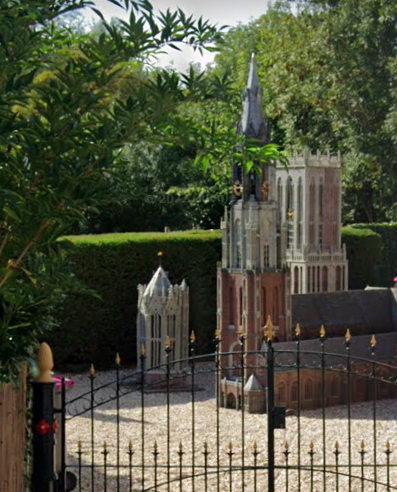
a view of the outdoor area with miniature churches

The miniature churches in the image above are set up in an outdoor space in Nootdorp in the Netherlands, a village with 19.000 inhabitants (2021), located east of The Hague, the city where the Dutch parliament is located.

Life and works

These life size stone replicas were made by Chris van der Sman, who was born in 1935 as one of a set of twin boys. The twins had an older brother and ten other children would be born after them.

The older brother, called Kees, made a miniature town in his younger years, a creation which has now almost been lost. Chris, who in later years would surpass him in building miniatures, went to work in a painting company after primary school at the age of 14. 

He would continue to do this work until his retirement, the last thirty years working from his own one-man business.

Nieuwe Kerk (New Church), Delft
this image and the next four are screenprints from the
video by Omroep West referred to in the documentation

Chris married on January 24, 1962 and the young couple moved into a house along Sportparkweg (Sportspark road) in Nootdorp, where they still live. They had two daughters.

In the same year 1962, Chris started the creative project, which he would work on with great passion for the rest of his life. His choice to make replicas of churches is related to his great admiration for the work of builders of churches in earlier centuries.
 
It started with the manufacture of a replica of the Nieuwe Kerk (New Church) in the city of Delft, located near Nootdorp. On July 21, 1962, his wife laid the foundation stone for the structure, which on a scale of 1:20, has a tower with a height of 5.40 meters,


The image above shows in detail the a few centimeters large building blocks used by van der Swan to build the walls. He has developed a method that allows him to manufacture more than 1100 bricks in an hour. 

A project such as that of the Nieuwe Kerk comprises about 100,000 such stones.

In 1987, after 25 years of work, Chris van der Sman's first replica of a church was completed. Striking aspects of this creation are the stained glass windows, the clockwork and the copper bells.

Making replicas of towering structures now had such a place in his life that he immediately started a new project.

Oude Kerk (Old Church), Delft

This new project was again a 1:20 replica of a church located in Delft, this time the Oude Kerk (the Old Church), 

The tower of this church is 10 centimeters out of line, and the same is the case with van der Sman's replica. 

This project took some 20 years. It was finished in 2008. when van der Sman was in his early seventies.


 part of Dom Toren (Dom Tower, (Utrecht)
the upper part had been brought down, probably for
maintenance, as can be seen in the very first image

Van der Sman tirelessly started on the next major project in scale 1:20, the Dom tower in Utrecht, which is the highest in the Netherlands at over 112 metres. His grandchildren laid the foundation stone in 2008 on his birthday, when he became 73.

Van der Sman had thought it would take twelve years to complete the construction, but after ten years the creation was already finished, so at the age of 83 he started a somewhat smaller project that was expected to take two years.

This became a project closer to home, the small Village Church in the Dorpsstraat in Nootdorp. 

It's a church with a long history. Founded as a wooden church somewhere between 1225 and 1250, it became a stone church in 1547, which has experienced many disasters over the centuries. Currently a national monument, it requires the necessary attention in terms of maintenance.

Building and tower are relatively small, so van der Sman made the replica, which only includes the tower, on 1:11 scale, so that it doesn't blend in with the other creations in the ensemble of creations.

Another project ?

When this project was completed, Van der Swan did not immediately start a new project. He filled his time with cycling and walking tours. 

However, when he was interviewed in June 2023 at the age of 88, he said he missed building and that he was already making drawings for a new project: the Bartholomeuskerk along the Veenweg in Nootdorp, not far from his home (image below).

Let's see whether and how this project develops. In the field of art environments, there are more non-professional artists who were still building creations at an advanced age.

this image from Google Streetview

A plan to relocate the two largest churches 

In 2025, a regional broadcaster reported that Van der Sman, after consulting the municipality, planned to relocate the two largest churches to a location near a local healthcare center and to the botanical garden of the University of Technology in Delft, respectively. Such a relocation would cost €130,000, and a crowdfunding campaign has been launched for this purpose.

popular Dutch theme

In the Italian internet magazine about outsider art Bric-à-Brac  (2022, nr 5) I published an article entitled Arquitectura Fantástica en Los Países Bajos caracterizada par torres y castillos, discussing the fact that a quarter of the art environments in the Netherlands, documented in this weblog in early 2022, had to do with a skyward-facing structure (tower, church with tower, donjon, etc). 

Now that van der Sman's site is added to this blog, the share of such creations has only increased. This relatively large interest may have to do with an affinity of non-professional Dutch artists for beautiful buildings from former times. 

Documentation
* Article (August 2016) in newspaper Nederlandse Dagblad
* Article (February 2022) in journal Telstar Online, 
* Article (May 2022) in magazine Kerk in den Haag
* Article (June 2023) on the website of Omroep West, with a video (2'51", can't be embedded here)

Video
* Video (2023, YouTube, 1'56") by Hart van Nederland


Chris van der Sman,
Miniature churches in outdoor space
Sportparkweg 4
Nootdorp, Zuid Holland province, Netherlands
can be seen from the road

May 26, 2023

John Usher, Miniature village


picture (October 2003) by Karen Beach, Flickr 

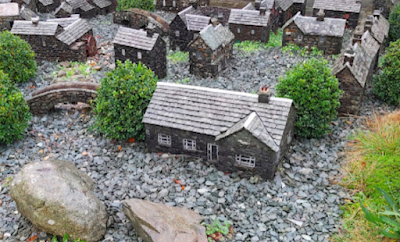
The above image depicts a miniature village as it is situated today in the outer space of a museum devoted to the local history of the commune of Coniston in England's Lake District.

Life and works

This miniature village was created by John Usher (1940-1993) who lived in Coniston all his life. He became a bricklayer and builder by trade, just like his father, grandfather and great-grandfather.

Living in his native house as a young man in the late 1950s, he already showed his delight in making miniature structures, and when  in the 1960s he built his own house, named Brow Close, he set to decorate the garden of his house with miniatures of all kinds of buildings.

family photo of Usher in the 1960s, in his garden amidst his first creations
from the Facebook of the Ruskin Museum

He started with buildings common to most villages, such as cottages, a pub, a bridge, following the style of building as usual in the Lake District.

Later he would also make replicas of famous buildings in the Lake District, such as the Bridge House in Ambleside, the Round House on Belle Isle in Lake Windermere and St Andrew's Church in his hometown Coniston.

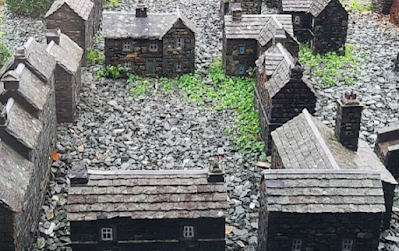
Over a period of about 30 years, Usher gradually created an entire village of some 90 miniatures, each about 20 inches high, a complex he named Riverdale.

For the construction of the bases and roofs of the buildings, Usher used gray slate, which he found in the area. The walls were made of other stones or of cement, depending on the nature of the building. Windows were made of perspex, with narrow strips of wood for the window sills and frames. Doors consisted of small pieces of wood.

this picture and the next one by Dave Hawkyard 
as on Google Maps

John Usher passed away in 1993, when he was only in his early 50s. 

He had remained unmarried and had arranged for his estate to benefit a Coniston denomination and some local associations.

Almost all of the miniature buildings were bequeathed to the local Ruskin Museum, devoted to local history. A replica of the local St  Andrew's church found a place in that church.

The Ruskin Museum stored the miniatures for some time to formally arrange that they could be placed in the outdoor area of the museum. They have been situated there since 2000, cared for by volunteers. 


Documentation
* Article by Mariella Landolf, "A model legacy", in: Raw Vision #105, Spring 2020
* Entry about the miniature village on the website of the Ruskin Museum
* An article (September 2018) in a website about trips in England, featuring attractions in the Lake District, including the Ruskin Museum and miniature village

John Usher

Miniature village

Coniston, Lake District, North-west England, England, UK

can be visited in the local Ruskin Museum

April 07, 2023

Breyton family, La Maison des Contes de Fées / The House of Fairy Tales

pictures are screenprints from the video by France 3 TV
as referred to in the documentation

Notre-Dame-de-Bellecombe is a small mountain village of about 500 inhabitants, in the French Alps, with a ski area that was in 1937 one of the first to have a drag lift. It is a quiet place with not much evening entertainment and therefore very suitable to be visited by families with young children.

Those children will undoubtedly enjoy visiting La Maison des Contes de Fées (The House of Fairy Tales), located in the hamlet of le Cheloup, part of the nearby of Notre-Dame-de-Bellecombe.


An enchanting interior art environment

This house of fairy tales is included in this weblog because its interior is imaginatively decorated with many personifications of fairytale characters, handcrafted by the owners Edith and Daniel Breyton and their children Claudine, Lise and Bruno.

It's a family project of non-professionals, resulting in a enchanting small-scale indoor art environment.


Starting in the early years of the 21th century, the family has spent more than two years crafting a first collection of various characters to populate the tableaus that present them. Continuing this activity, the collection in 2018 had a size of around 150 characters. 
 
The heads and other body parts of these characters are made of paper machée and, once dried, they are painted in appropriate, rather natural colors, as can be seen in the image above. 

All clothing worn by the fairytale characters is handmade. All together, the way in which the characters are formed, painted and dressed gives them a very realistic and authentic appearance.


The fairytale characters are grouped into some 40 scenes that depict all kinds of fairy tales, including some well-known ones such as Little Red Riding Hood and the Wolf, Cinderella and Snow White and the Seven Dwarfs.

Little Red Riding Hood and the Wolf

The exhibition space covers a total of about 150 m², of which about 60 m² is used for the various scenes, a size that contributes to a homely atmosphere. Therefore the family doesn't refer to the exhibition space as a museum, but as a house.

Cinderella

Each fairy tale scene is situated in a beautifully executed and recognizable miniature environment, matching the relevant fairy tale. In addition, certain parts of each scene can move, are beautifully lit and supported by sound fragments.

A feast for the eyes.

Snow White and the Seven Dwarfs

The fairytale house can be visited all year round. In addition, the house also includes a B&B facility (see their website and FB page for further information)

Documentation
Website of the Fairytale House
* Facebook page (with info about exceptional closures)\
* Article on the website of France 3 TV, with a video of the exposition

Edith & Daniel Breyton and their children 
La Maison des Contes de Fées (The House of Fairytales)
8 Impasse du Bois Dormant 
Hameau Le Cheloup 
Notre-Dame-de-Bellecombe, dept Savoie, region Auvergne-Rhône-Alpes, France
visitors welcome, entrance fee
Google streetview (with photos)

March 24, 2023

Octave and Roland Berthelot, Village miniature / Miniature village

picture (2022) courtesy of Sonia Terhzaz

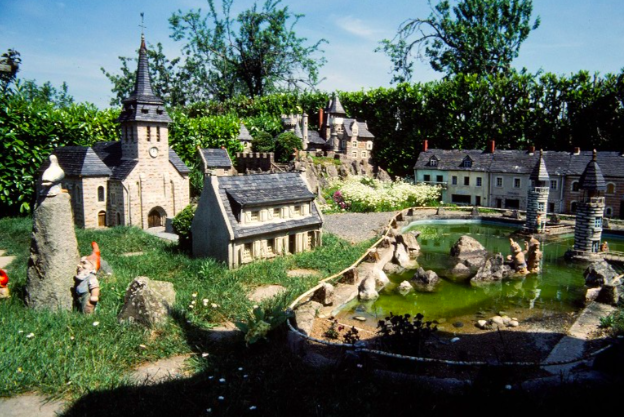
The above image shows part of a miniature village, an art environment in a garden in the small hamlet of Saint-Martin Villenglose, located along the departmental road D27, about three kilometers from the municipality of Saint-Denis-d'Anjou, of which it forms part.

The town of Saint-Denis-d'Anjou, located in the Mayenne region in the north-west of France, with approximately 1550 inhabitants (2019). is also not extensive. 

picture (2009) of the chapel in Saint-Martin Villenglose,
by Benjamin Smith, licensed under Creative Commons

However, the town attracts many visitors because of its characteristic atmosphere due to the various buildings from previous centuries, such as churches, mansions, wooden halls from the 16th century and a house inhabited by monastics from the 15th century, which has been converted into a town hall.

One of the town's ecclesiastical buildings, pictured above, is the chapel in Saint-Martin Villenglose, which was built in the 15th century using local tuff and freestone. The chapel is located along the departmental road crossing the hamlet Saint-Martin Villenglose, and it attracts many interested visitors. 

When these people look over the hedge that surrounds the chapel, they will catch glimpses of a castle-like miniature building in the neighboring garden, as can be seen on Google Streetview 

This miniature is part of an ensemble of miniatures, an art environment which is not open to visitors on a regular basis. 

this picture and the next one courtesy of  © Francis David

More about this art environment

This ensemble of miniatures was created by Octave Berthelot (1930-2015). 

At a young age he wanted to become an architect, but his parents couldn't afford the education and so he had to earn his living by working at a poultry farm and later as a bricklayer.

He married and the couple settled in a house in the hamlet Saint-Martin Villenglose. next to the chapel.


In the early 1960s, when he was in his early thirties, Octave Berthelot started building a miniature village in the backyard of his house. 

He worked with slabs of slate and with pieces of marble from the Bouère quarry near Laval, the capital of the Mayenne region. To reduce the size of the slabs, he first used a sledgehammer and then a small hammer. In addition, he also used concrete for the base of the creations and white cement for the interconnection of construction elements and for their finishing.

Some of the buildings he constructed are inspired by existing ones, such as a garage in Saint Denis d'Anjou, the church of Saint Pierre in the commune of Bierné-les-Villages, not far from St Denis d'Anjou in the Mayenne region, the church Notre Dame de l’Assomption in Ernée, also in the Mayenne area and the Montfort Castle in the Dordogne area..

Other larger constructions have sprung from his imagination, such as the Château Mon Rêve (Castle of my dreams). And then there is a variety of miniatures of all kinds of structures such as a windmill, a grocery store, a farrier, a lighthouse, and one can also see composite scenes such as a fishing port and a waterfall.

The buildings in the site can be illuminated at night.

this picture (2022) courtesy of Sonia Terhzaz

When in the late 1990s Octave Berthelot wanted to move to another village, his son Roland was willing to take care of the maintenance of the creations. He was born in 1955 and became a carpenter by trade. He is currently retired and lives in the parental home. 

Roland was about seven years old when his father started the project, and as a boy he already helped develop the creation if it turned out that way.

Roland Berthelot himself had also a hobby of making miniatures, but then mainly from wood and not for outdoor use. For example, he had covered with matches the model his father had made in preparation for the actual construction of the Montfort Castle.  He had kept track of his working hours and the number of matches: 612 hours of work, spread over three years, and 15.000 matches.

He also made a miniature house, with an interior provided with a variety of furniture and a spiral staircase, all clearly visible after lifting the roof of the house.

Roland also took care of the restoration of the structures in his father's creation, which were now decades old. He didn't mind to renew all slate roofs, an extensive project that must have required a lot of energy and willpower, but which also testifies the respect he had for his father's creation.

Currently Roland is limited in his activities due to an arthritis that has affected his hands.

Octave Berthelot
photo Francis David
Ronald Berthelot
photo Sonia Terhzaz


This site with miniature constructions is little known in the field of art environments in France. Just a few publications are available on the internet. The creation was also not regularly open to visitors, perhaps with the exception of an opening announced in the regional press in the summer of 2021.

Documentation
* Entry on the website Habitants-Paysagistes (Lille Art Museum) with a series of pictures by Francis David
* Article (March 2017) in French newspaper Actu
Article about the site by Sonia Terhzaz on her website Cartographie des Rocamberlus (environments d'art singulier), reporting the visit she paid in April 2022

first published March 2023, revised April 2023

Octave and Ronald Berthelot
Miniature Village
on a side street of the D27 near the chapel in the hamlet of Saint-Martin-Villenglose, 
part of Saint Denis d'Anjoudept Mayenne, region Pays de la Loire, France
visits on appointment
streetview (October 2021)