Showing posts with label park with a variety of sculptures. Show all posts

August 29, 2025

Todor Atanasov and partners, Музей на света / Museum of the creation of the world

images (June 2025) in this post published here in agreement 
with photographer Martin Besnard

The municipality of Novo Selo, with over 2,900 inhabitants (2011), is located along the southern bank of the Danube River in northwestern Bulgaria. The Danube also forms the border with Romania, located north of the river.

The municipality, which includes several wine-growing estates, encompasses a number of villages, including Novo Selo, which forms the administrative center.

A Museum about the Creation of the World

Novo Selo is a community that has existed since ancient times and when Todor Atanasov was its mayor, he was very interested in its history. 

This led him to the idea at some point of ​​creating an open-air museum depicting this history, also to attract tourists.

He shared the idea with several people in his circle, and it turned out they were also enthusiastic and wanted to contribute to such a project. And so a kind of an open air museum would indeed be realized on a four-hectare site near Novo Selo.


Among the people who volunteered to participate in the project, were a local librarian, a school principal and a former municipal official. They each contributed to the development of the project in their own way, based on their own knowledge and research.

The construction of what can be considered an art environment, based on substantive contributions from various interested parties, began in 2010.

As the construction of the art environment progressed, a problem arose because creating the buildings and decorative elements, realized in a protected nature reserve. was not based on an officially granted permit.


The national inspectorate in question assessed the existing violations and issued a fine, which was paid by the parties involved. 

It was then up to the Novo Selo municipal council to decide whether or not the site could further develop, .

The council apparently made a favorable decision  with regard to the site, as in 2015 the newspaper 360Mag (see documentation) referred to the art environment in Novo Selo as "one of the most successful projects in Bulgarian tourism."


When this article about the art environment was published in 2025, accompanied by photographs also taken in 2025, the mayor had retired, and the area where the site had been built was adorned with a variety of creations.

The connection between the somewhat isolated creations is not clearly visible in the images, but the underlying idea that the development of humanity is depicted in the sculptures and structures can, with a little effort, be discerned.

The images in this post provide a first impression of the creations on display in the site.

The dinosaurs, pictured above and below, are quite dominant and take the viewer back to times before humans began to inhabit the Earth.


The scenes presented in the four small-format images, further above and below, show how, during the early development of humanity on earth, people were housed in small, self-made shelters, 

These are clearly scenes related to the development of humanity, with which most people are familiar.

However, in addition to these scenes clearly linked to the development of humanity, the site also includes a number of smaller creations, such as various animals, Indians, a ship, a tree of life and also a kind of a tomb, scenes in which it is more difficult to see in which stage of humanity's development they fit. 


The massive gateway depicted in the very first photo can be associated with a medieval structure, a supposition more or less supported by the white rider riding a white horse,.

Todor Atanasov, portrayed in 2025 in the very first photo, now retired, devotes a great deal of energy to maintaining the art environment as it has developed thus far.

He does have ideas about expanding the site, for example with a replica of an Egyptian pyramid, but whether he should embark on such a project at his age, remains to be seen.

The video in the documentation shows how the art environment is situated in the area outside Novo Selo.


Documentation
* Article (2014) in regional newspaper btvnovinite 
* Article (2015) in newspaper 360Mag
* Website (2016) with a series of photos

Video
* Video (YouTube, February 2024, 3'31") by Dancho Yanakiev


Todor Atanasov and partners  
Museum of the Creation of the World
3784 Novo Selo Municipality, Vidin Oblast, Bulgaria

August 16, 2024

Alpo Jaakola, Patsaspuisto / Sculpture park

all pictures courtesy of Sophie Lepetit from her weblog

The sculpture park reviewed in this post is located in Karhula, a hamlet that is part of Loimaa, a municipality of about 15.000 inhabitants in south-western Finland. 

The park is situated near the E63 highway, approximately 8 km southwest of the built-up area of ​​Loimaa.


Life and works

The park was created by Alpo Jaakola (1-4-1929/7-2-1997) who was born in Loimaa. 

At an early age he showed an artistic talent and in 1951 he enrolled at a drawing school, where he stayed for only a few months because the teachers recognized his talent and felt that their lessons should not influence his further development. So Jaakola established himself as an independent visual artist, but wthout a formal art education.

He married Seija Nykänen, but this marriage did not last and ended in divorce. His second marriage, to a gallery owner, did survive and both Alpo Jaakola and Marja Jaakola, who passed away in 2012, now have a grave on the grounds of the sculpture park reviewed in this post.

 
Creating a sculpture park

In 1953, when he was 24, Jaakola took an important step.

In the wooded area in the hamlet of Karhula, where the sculpture park now is located, he built a forest hut from wooden planks, a construction  that would serve as a home to live in. 

This was the beginning of the transformation of the piece of forest into a sculpture park, a project that would take place over the next more than 25 years.


In making artistic creations to decorate the park, Jaakola focused mainly on sculptures, but he also produced all kinds of paintings, which were presented in accommodations built in the park.

In the first years of working on the collection, Jaakola must have had to improvise, because a studio only became available in the early 1960s, after he had built such a facility himself.

In the 1960s other facilities became available, such as a disused mortuary located in a nearby village, which could serve as a storage facility in the park. 


As for the sculptures, the park would eventually be decorated with about fifty large sculptures, largely made of cement, to a lesser extent of wood or iron. 

The images in this post give an idea of ​​the character of these creations.

The sculptures show something of Jaakola's style of creating, which testifies to a certain mysticism and primal power.


In 1972, a major event occurred, providing direction for the further development of the park at that time.

The local road near the park was converted into the E63 highway, which for Jaakola and his family meant that they were faced with a lot of traffic noise, but also with many curious motorists who wanted to take a look at the meanwhile well-known site. 


Jaakola was not focused on exploiting the park and he kept it closed to the public. 

He built a fence and posted signs prohibiting entry into the area. This did not limit public interest. the public kept coming and on a nice summer day as many as 200 people would stop to try to visit the sculptures.

As a result of all this, Jaakola lost his peace of mind and even indicated in an interview in 1974 that he was about to hate his sculptures.


He looked around for another accommodation and found it in a recently closed public school in the village of Torkkala in the eastern part of the municipality of Loimaa. In 1979 Jaakola and his wife Marja moved there.

Jaakola made new sculptures, together with Marja he planted hundreds of trees around the school and the former classrooms were used for exhibitions and numerous concerts. These activities led to Jaakola, who was also seen by some as a shaman of the region, being appointed professor (honoris causa in all probability) in 1985, which to my knowledge is unique in the European field of art environments by non-professionals.

After Alpo Jaakola's death in 1997, his wife continued to live in the former school and after she died in 2012, the accommodation was run by the couple's daughter Minni Nummila.


After Jaakola and family left the park in 1979, the accommodations and creations were left behind as they were, perhaps occasionally cared for by Jaakola. 

And then, in the early 1990s, the municipality of Loimaa had the idea of ​​purchasing the park as a tourist attraction, so in consultation with Jaakola a trial opening was organized in 1992. This was so successful that in 1993 the municipality decided to purchase the park and today the sculpture garden is an indispensable tourist attraction in Loimaa.

In the year 2000, a restoration project was carried out, largely financed by the European Union.


Documentation
* Website of the city of Loimaa with information about the museums in the city, including the park
Website of the association of friends of Jaakola, with a lot of information and a variety of photos
* Facebook-account of the park, with recent information
* Weblog of Sophie Lepetit (February 2021). with a variety of photos

* Video
* Video (August 2020, YouTube, 1'22") by Rajala


Alpo Jaakola
Sculpture park
Aura-Pirkkatie 84, 
32300 Loimaa, dept Western Finland, region  Southwest Finland.  Finland
visitors welcome
Google Streetview with over 700 photos

April 19, 2024

Teijo Monni & Pertti Riikonen, Middle of Nowhere Taidepuisto / Middle of Nowhere Art park

pictures published here in agreement
with Middle of Nowhere

In a wooded area in the village Kaukanen in Finland, 50 km north of Helsinki, work has been done on the design of a park exposing outsider art (ITE-art in Finnish). This park, new in the field of Finnish art environments, was officially opened on June 29, 2024.

The initiators

It is a project undertaken by two entrepreneurs, Teijo Monni who was a wholesaler of office supplies for over twenty years and Pertti Riikonen, who was an electrician by training and had a business in that field.

Inspired by the publications of the Finnish organization Maaseudun Sivistysliitto (Rural Culture Association) that promotes ITE art in Finland, they visited art environments and studios in that field to take photos and then it happened that they gradually became great enthusiasts of this form of art.


Creating an art park

Their enthusiasm went so far that they decided to quit their current jobs and start working on the realization of a park where ITE art would be exposed.

A daring undertaking indeed. The two initiators also thought so .....

Anyway, they bought a wooded site of two hectares near Kaukasten and began working on this project in November 2022. 

The site included an old, abandoned farmhouse and a barn, that needed to be renovated. But these buildings also included many old items that could be used. There is also a beautiful apple orchard.


After just over a year and a half of preparation, the park now has opened and it has got the shape the two initiators had in mind. The existing accommodations have been renovated and made suitable to receive visitors, provide refreshments, repairing bicycles and so on.

Paths have been laid out, along which visitors can make a walk to take a look at.....well, that is the most surprising happening of the past period:.....various ITE artists have contributed in many ways to enrich the park with sculptures and other creations, both for permanent placement in the park and for contributions to intended stand-alone exhibitions.


Meanwhile, the park already has a large number of sculptures. For example, the family of ITE artist Pekka Lampinen donated sculptures and other works to the park after his death, a gesture based on the expectation that they will be better maintained in the park then in their own environment.

The second photo from the top shows an airplane painted in many colors, a creation by ITE-artist Paula Huhtanen.

The three-time chainsaw champion Juha Käkelä contributed some image-defining works, namely Big Foot and Green Man.

Big Foot, pictured above, now accompanies the large Middle of Nowhere nameplate seen in the photo at the very top.

The Green Man, pictured above Big Foot, is a large pine that grew on the property and had to be felled. This tree had a rare three-armed top and, after being processed by Käkelä , is now exhibited in an inverted position as a three-meter-high Green Man with a triple beard. 

The Green Man, usually depicted with a face made of leaves and the like, is a legendary creature, often seen as a symbol of rebirth or the dawn of spring.


The park meanwhile has a collection of almost a hundred sculptures and other creations, made by about twenty artists. They are partly located in the vicinity of the main building where refreshments are available, and partly along the constructed walking path as shown in the photo above.

Photos of the creations can also be seen on the Facebook site of the art park, but given the atmosphere provided by the wooded area, there is a lot to be said for seeing the creations in reality.

The opening season, started July 2024,  will feature all artists who have so far been nominated for ITE artist of the year. They are presented on the park's website

Documentation
* Article (September 2023) in Finnish journal Helsingin Uutiset

Video
* Video (December 2020, YouTube, 1'54") by Middle of Nowhere


Teijo Monni and Pertti Riikonen
Middle of Nowhere Art park
Koskenmaantie 187,
village of Kaukaasa, part of Hyvinkää, region Uusimaa, Finland
park is open for the public from June 29, 2024

April 05, 2024

Raoul Cardo, Cardoland parc d'attractions / Cardoland amusement park


this image (2018) by Benoit Prieur, published here under 
license of Creative Commons CCO 1.0

The road sign near the village of Chamoux in eastern France in the Bourgogne-Franche-Comté region indicates that Cardo Land is nearby. an area with an art environment composed of dozens of sculptures, mainly of prehistoric animals, handmade by Raoul Cardo. 

It is a complex that became one of the first amusement parks in France.

Life and works

The parents of Raoul Cardo, who was born October 28, 1924 in the  Spanish city of Bujalance in the Andalusia region, were prominent in the Spanish art world. His mother, Emelina Torres, was a renowned dancer and his father was a professor of fine arts in Madrid.

At an early age the boy would come into contact with this world, like it happened when he was five years old, that he accompanied his mother on a trip to Paris, where she had to appear as a dancer in a film. This happened more often when she had to perform elsewhere in Europe.

unless indicated otherwise, this image and the 
next ones are published here in agreement with
Francis David, as on website Habitants-Paysagistes LAM

In addition to what he learned at primary school, he gained all kinds of knowledge of the art world through those travels, which was also supplemented by lessons that his father gave him on this topic.

In the 1930s a civil war raged in Spain and in this context, in 1938, Raoul Cardo's father was murdered by Spanish troops. His mother decided to migrate to France with her children. Raoul was 14 years old at the time.


In Paris he could become a novice dancer with a theater company, where he mainly expressed himself in flamenco dance, but also as a novice choreographer. From 1948 onwards Cardo wrote ballets for which he created the sets and costumes.

The highlight of his career as a dancer was when he became principal dancer at the Paris Opera. He also appeared in a number of films, including one in which he teaches flamenco to Brigitte Bardot.

On the way to an amusement park

Raoul Cardo was broadly oriented artistically. In addition to his activities in the field of dance, he made paintings, drew comics and did architectural work.

In 1967, when he was in his early 40s, he added a new hobby: creating life-size prehistoric animals, made by adding a layer of cement to a properly shaped infrastructure of iron wire.

He started this hobby with the idea that one day he could set up a place with an exhibition of these creatures from the past. 

The choice of this hobby may also be related to the fact that he was now in his early forties, an age at which a career in the dance world generally ends. (The exact moment when Cardo stopped dancing is not available on the internet).


In the 1970s, Cardo and his family left Paris to move to the hamlet of Moulin Granard, part of the village of Gâcogne in the Morvan region. There he had the necessary space to store the sculptures of prehistoric animals. The thought of opening a park for those creations must have occupied him more and more.

In 1981 the idea became reality when, aged 57, he moved to Chamoux, a village some 40 km north of Moulin Granard. 

Just outside Chamoux, along the departmental road D951, he had bought a 10 hectare plot of land.

the entrance of the park (as on Google Streetview)

In 1984, the Jurassic Park called Cardo Land was officially opened. It included more than 80 life-size sculptures of prehistoric animals and people.

Cardo would manage the park for the first 25 years.

From the opening of the park, visitors could follow a walking path of more than 900 meters that leads past the sculptures. From the beginning of the park there was also a cave with decorations made by Cardo, a spot reminiscent of the Lascaux caves.

There are all kinds of activities for children, such as drawing, painting and sculpting, but also assisting with the "birth" of baby dinosaurs.


After Cardo died in 2009, the park was managed and run by his wife, children and now also his grandchildren. The park is therefore still a business run by the Cardo family.

In 2019, at the initiative of Cardo's daughter Mélusine, a new presentation was added to the park's activities, the so-called Prehistoric Circus

This is a performance of over an hour with all kinds of demonstrations and acrobatic equestrian sports by Mélusine and other family members. 

A special event is also the appearance of family members dressed as dinosaurs, who perform an act that appeals to the audience.


Documentation
* Website of Cardoland
Tripadvisor with more than a hundred photos

Video
* Video (2020) from Facebook with a short impression of the Prehistoric Circus show 


Raoul Cardo
Cardo Land  amusement park
35 Rue Principale (=Departmental route D951)
89660 Chamoux dept Yonne, region Bourgogne-Franche-Comté, France
open from July 1 to August 31

May 20, 2022

Sylvi Hauhia, Veistoksia vesimyllyssä ja galleriassa ja sen ympäristössä / Sculptures in and around a watermill and gallery

pictures courtesy of
Heli Kallio-Kauppinen and Raija Kallioinen

The photo above very well summarizes what the following post is essentially about, namely a mill (symbolized by the grindstone), two sculptures (representing an extensive display of sculpted creations)  and all of this surrounded by a beautiful landscape.

This landscape is depicted in the two images below, where the two sculpted characters, lined up along the edge of the forest, are overlooking the Vaalimaanjoki river in south-east Finland.

Welcome to Sylvia Hauhia's art environment, which is very special, not only because of the hundreds of attractive and captivating sculptures the site includes, but also because of the way they are arranged in a very natural way, both in the landscape and in a variety of buildings.


Life and works

Sylvi Hauhia, born in 1928, grew up in Hauhia, a small village that is part of the municipality of Miehikkälä, with about 1800 inhabitants, located in south-east Finland not far from the border between Finland and Russia. 

Sylvi was 11 years old when the family was evacuated after Russia at the end of November 1939  invaded Finland without a declaration of war. The Winter War, as the battle is called in Finland, ended in mid-March 1940 and Finland had to give up parts of the country. The Salpalinja, the 1200 km defense line along Finland's eastern border, built in the years 1940/44, bisects the municipality of Miehikkälä, which also houses a museum dedicated to the line

Returned to Hauhia, as a teenager Sylvi already felt attracted to making small-scale sculptures from clay.

In 1953, when she was in her mid-20s and had married, she and her husband moved into a house near the mill of Hauhia, located near a rapids named Hauhiankoski (Hauhian Rapids) in the Vaalimaanjoki river,  just outside the village. Her husband was a farmer and Sylvi assisted him in caring for the cattle. 

Currently (2022) in her 90s, Sylvi Hauhia has lived in this area for some seventy years, steadily working on her collection of sculptures, which now includes some thousand creations.


Initially Sylvi mainly made small sculptures, as can be seen in the surrounding images, with above a scene of a group of people dancing, perhaps a memory of her wedding or a comparable festivity. 

These and similar scenes fill the shelves of a barn on the premises of the mill, near Sylvi's home, an exposition space opened in the summer of 2021 and referred to as Gallery Sylvi.

The small-scale creations, mainly made of clay, have a benign, sympathetic appearance and are often based on the artist's personal experiences. Sylvi collected the necessary clay by paddling in the rapids and scraping the material from the bottom with her own hands. 

Real handicraft indeed ....

After living in the house near the mill for some time, Sylvi Hauhia started making large-sized sculptures, as the following series of images shows. 

These sculptures, mostly made of cement, currently are partly set up in the outdoor space of the mill and can be freely visited. 

Another part, some hundred sculptures, is exhibited in the courtyard of the mill and in the residential building near the mill, where the collection can be visited (freely) during opening hours. 

The images show that these creations also mainly radiate a good-natured atmosphere, with mostly everyday characters in everyday situations (Sylvi and her husband are the couple shown in the image below right).


The Hauhia mill

The Hauhia watermill dates from 1882 and was created thanks to the carpenter Petter Lundgren and the farmers Emmanuel Hauhia and Erkki Hauhia.  In August 1885 the mill was bought by Sylvester Manikin, who became a respected miller whose company contributed to the food supply in the area.

In the 1920s the mill was equipped with a sawmill and later an electricity generator was installed, which supplied the village with electricity. This machinery is now obsolete and no longer works

In January 2020, Markku Hauhia, a son of Sylvi Hauhia, bought the mill and surroundings, and as part of an environmental project to improve the river basin, the mill was refurbished.

Rearranging the site

Since that purchase, the Hauhia family has worked to give the area around the mill a new allure, promoting the site as an artistic and recreational facility.


The barn at Sylvi's house, in former days a cow house, but currently no more used as such,
reopened in 2021 as Galleria Sylvi Hauhia.


A small coffee shop was installed with some tables and chairs, making a small terrace available to the visitors. Not far from the mill, bicycles and rowing boats can be rented.

The outdoor arrangement of the large sculptures was adapted to the new character of the site.

In January 2022, the Regional Advisory Council for Environmental Policy announced that the Hauhiankosken (Hauhian Rapids) environmental project, which also included the renovation of the mill, was the best environmental project of 2021.

the three young men in the image above are sons of Sylvi Hauhia, 
one of the three is Markku Hauhia

Documentation
Hauhia village website
* Hauhian Milly on Facebook
* Entry on the website ITE taide
* Entry about the village of Hauhia on the website of the municipality of Miehikkälä

Video
* Video on the Facebook page of Hauhian Mily


Sylvi Hauhia
Sculptures in and around a watermill and gallery
Hauhiantie Road 340 
49700 village of Hauhia, municipality of Miehikkälä, region Southern Finland, Finland
visitors welcome (a donation is appreciated)
info about opening hours of the gallery and the coffee shop 
on the Facebook-page of the site

March 16, 2021

Vesa Väänänen, Puistossa on rautaveistoksia / Park with iron sculptures

picture by the city of Heinola

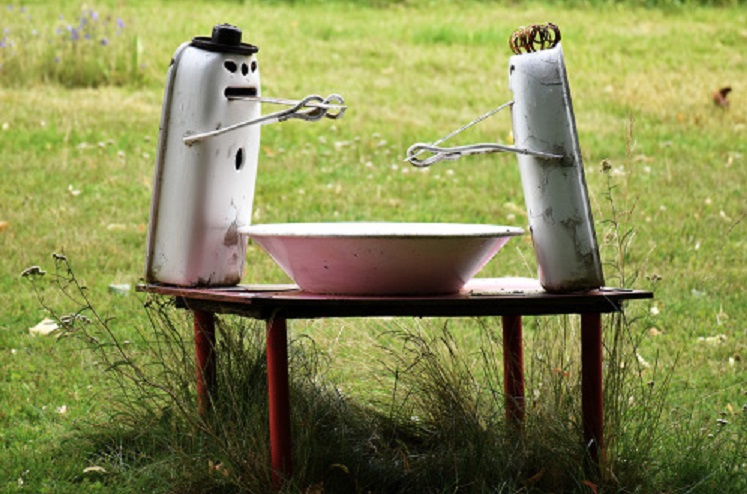
Above image shows an iron sculpture of a colorful character against a background formed by a park landscape with many more of such sculptures. The were displayed in the Dork Park in the Finnish city of Heinola, some 140 km north-east of Helsinki, until they were removed to the city of Joursa in October 2024.

Life and work

Väänänen, who was born in 1949,  worked as a sheet metal worker and as a gardener until he became unemployed in the 1990s due to economic developments.

this picture and the next four courtesy
of Antii Kastén, from his website

He lived in a former railway house on the edge of the Dork Park in the eastern part of Heinola, also called the Railway Park, because it is adjacent to the railway, which was used for passenger traffic until 1968.

As a sheet metal worker he occasionally made sheet iron creations that got a place in his house, but when he was unemployed for a while, he decided in 2001 to work more systematically on this.

It became a project that would keep him busy for years to come. In 2020 Väänänen  had created more than a hundred sculptures, which he had situated in an open area of Dork park near the house where he lived and had installed his workshop. 


In the course of the following years this park area got filled with predominantly small-scale creations that Väänänen made from all kinds of iron residual material, such as the metal casings of kitchen geysers as in the picture above.

The owner of the park (maybe the railway company) may have had other plans regarding the further development of the area, but these ideas apparently were not very concrete and so the sculpture park was tolerated for the time being, a situation that has existed for many years. 

However, this situation of tolerance has changed, as will be seen at the end of this article.


As to the nature of his work, in 2016 Väänänen himself has remarked: Yleensä käytän töissäni myös huumoria, ironiaa ja farssia (Usually I also use humor, irony and farce in my work).

Indeed, this is recognized in reviews of the site included in the documentation below, where it is often noted that Väänänen's sculptures are cheerful and funny in nature. 

They made the visitor smile, which may also be partly due to the humorous character of the captions placed on plates next to the sculptures, such as the one in the photo at the very top, which reads: The miracle of growing teenage mustache.

This artwork was also characterized by the way in which the processed metal base material in the design by Väänänen suddenly takes on a completely different appearance once incorporated into the creation, such as the casings of kitchen geysers that magically become human characters who -sitting at a table- enjoy some food.

The same goes for the items used in the creation pictured below and in a lot of other creations..


New developments because of a fire in the park

In mid-December 2020, it was reported in the local press that a fire that had hit Väänänen's house, had rendered the property uninhabitable. Väänänen was injured, but was soon able to leave the hospital.

The question now arose as to how to proceed with the exhibition of sculptures in an area owned by an association that tolerated their use for years, but now retained the right to use the area for other purposes.

Consultations about a solution  -such as eventually another location for the sculptures- started, talks in which the municipality also was involved. 

In April 2021, a Finnish daily newspaper reported that a holding company had been formed that owned the site and that the second shareholder in size -Apulanta- had reported that they were also participating in this holding company to protect Väänänen's sculptures.

The final resolution came in October 2024. Newspapers reported that Vesa Väänänen’s artworks were moved from Dorki Park to the city of Joutsa, this with his consent. They are being cared for at the Haihatus Art Center and Residency, a non-profit organization run by volunteers, with support from local artists.

the little elephant above is now alone; 
a pink-colored piglet standing opposite him has been stolen

Documentation
* Article  on website ITE-taide
* Article (August 2020) on website Ajatusmatkalla, with a series of pictures
* Entry (July 2020) on weblog Marjoin Matkassa, also with a series of pictures
* Entry (August 2013) on weblog Tellunkonstanelamaa, once more with a series of photos
* Review of the site (November 2011) by Erkki Pirtola on website Voima
* Article (July 2009) on website Suomi Tour, with a series of photos

first published March 2021, last revised October 2024

Vesa Väänänen 
Iron sculptures in Dorkin Park
Ratakatu 20 
Heinola, Päijät Hame, region Southern Finland, Finland 
sculptures were located in the park until October 2024, when they were removed to:
Haihatus Art Center and Residency
Joutsa, dept Central-Finland, region Western and Central Finland, Finland
,