Showing posts with label garden with sculptures from stone. Show all posts

August 28, 2026

Vytautas Jasinskas, Sodas su akmens skulptūromis / Garden with stone sculptures

.
this image is a screenprint from the video in the documentation

In he northeast of Lithuania lies Kupiškis, a city with over 16,000 inhabitants, beautifully situated at the confluence of the Lėvuo and Kupa rivers. 

Culturally and economically, the city is an important center in the Panevėžys region.

this image and the next three published here .
in agreement with the website Pozicija.org

Life and works

As a renowned sculptor, Vytautas Jasinskas, who was born in the late 1940s, contributes to the cultural aspect of the city.

He had a difficult childhood because his father, who had escaped from a concentration camp, had to go into hiding and frequently change his place of residence.

Those circumstances also meant that Jasinskas, who had a clear talent as a draftsman, could not receive training as an artist, but had to learn a trade to help his father in earning a living.

.

Jasinskas gained experience in stonemasonry while working in the monument workshop of the Kupiškis Domestic Service Complex. 

He learned from experienced craftsmen how to break, chisel and polish stones.

The work was not easy, because at the time, in the Soviet era, stoneworking technology was nowhere near as modern as it is now.

Many years passed, during which the young stonemason developed a fondness for artistic stone working .

The desire to reveal the natural beauty of the boulders in the fields, the desire to let the stone speak, grew ever stronger, until it eventually became his daily occupation.


Jasinskas recounts that when he worked as a stonemason at the former domestic services factory in Kupiškis, he and his colleagues were called upon by museum staff, not only to put their skills to use, but also to create works of folk art.

Currently Jasinskas lives in a house along Topolių Street, a relatively short street situated along the northeastern edge of Kupiškis, a place where the urban development gives way to green fields with a small hill.

There is a spacious green area between Jasinkas's home and the street, which he utilizes to situate his sculptures.

As the very fisrt image shows, people walking down the street have an unobstructed view of the sculptures displayed in Jasinska's art environment..

.
Documentation
Article (April 2023) on website Pozicija.org
Article (May 2020) on newspaper Sekunde.lt
* Article (April 2023) on newspaper Ukininkopatarejas

Video
* Video by Jolita Pipynienė entitled Kupiškėna folk artist Vytautas Jasinskas (2018)  


Vytautas Jasinskas
Garden with stone sculptures
at the end of the Topolių street
Kupiškis, region Panevėžys, Lithuania


August 20, 2022

Jean-Marie Pidou, Pierres Initiatiques de Saint-Nicolas / Initiatic Stones of Saint-Nicolas


this image and the next ones courtesy of
Sophie Lepetit, from her weblog

Surrounded by rolling green hills, the city of Limoges in south-west France, some 400 km south of Paris, is known for its production of Limoges Porcelain, a hard-paste porcelain produced in factories around the city. 

Jean-Marie Pidou, the protagonist of this article, lived in a hamlet 18 km east of Limoges and all his professional life he was a decorator of porcelain products, working in a factory in Saint-Léonard, some 5 km from his home.
Life and works

The hamlet where Jean-Marie Pidou lived, named Saint Nicolas, is part of the municipality of La Geneytouse with all together some 975 inhabitants. Because of the name of that place of residence, Pidou was also known as Jean-Marie de Saint Nicolas.

Jean-Marie used a bicycle to go to his work, but also to make longer trips through the region to photograph scenes that he would capture in a painting at home. 

Performing such artistic activity occupied an important place in his life


This was also clearly expressed when, after his father's death, he inherited the granite quarry that his father had exploited for years. With no training in sculpting at all, in 1981 he embarked on a project to transform the grounds near the house into a sculpture garden.

After about a quarter of a century of carving, he had made some 140 sculptures of Limousin granite, a material with a white appearance as the images show.


The generally man-sized sculptures include all kinds of different representations, such as animal figures, sometimes with political puns, various female characters, whether or not inspired by mythological creatures, but also images of religious buildings, Celtic menhirs and other structures.

The surrounding images only give a limited impression of the variety of the creations. 

Neither can the appearance be depicted here which radiates from the collection of sculptures as a whole, set up on a sloping site as it is, with a view on the more eastern Vassivière mountains, 


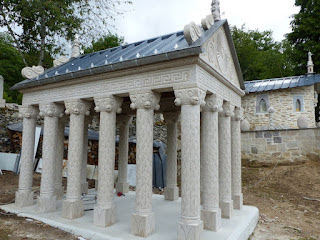
Once the collection of sculptures was more or less voluminous in size, Pidou began to create structures that could make the stay even more enjoyable for visitors, such as a studio where his paintings could be viewed (and eventually purchased), a Greek temple-like building for visitors to pause (Temple de Léonard) and a seven-meter high tower (Tour de Jeanne) from which one gets a beautiful view of the entire art environment, and Pidou's herd of sheep roaming freely.

the studio

A guided tour provided by Pidou for visitors can last an hour and a half, part of which is devoted to an explanation and discussion on topics close to Pidou's heart, such as dietetics, metaphysics, geobiology and aura measurements, which can be arranged on site if desired.


Documentation
* Weblog (August 2022) of Sophie Lepetit with a variety of images
* Article about the site on the website of the Tourist Office of Noblat
Article on the HenriTrip website with some photos and route map
* Article (May 2021) on the website of regional journal Le Populaire du Centre 
Article on the touristic website Haute Vienne with photos of the architecture in particular

Video
* Video (3'28", YouTube, undated) by France 3 Nouvelle Aquitaine


Jean-Marie Pidou 
(also known as Jean-Marie de Saint Nicolas)
Initiatic Stones of Saint-Nicolas
208 Route De La Porcelaine (=D65)
87400 Saint Nicolas, La Geneytouse, dept Haute-Vienne, region Nouvelle-Aquitaine, France
open for visitors in July and August, 14-17 hrs
other months on Sundays, 14-17 hrs, on appointment

June 05, 2021

Agnès et Nicholas Brückin, Structures en pierre du jardin des Sambucs / Stone structures of the Sambucs garden

all pictures (May 2021) courtesy of
Claire Schneider

Located on a slope in a valley in the Cévennes National Park in the south of France, surrounded by tree-filled hills and enriched with creative stone structures, the Jardin des Sambucs is not only an attractive garden with flowers, ponds and nice trails, but it's also an art environment worth visiting. 

The name of the site is Occitan for the plant scientifically named Sambucus, in English commonly referred to as elderberry.

In the context of the development of the garden in general, this post will focus in particular on the stone structures and other creations that give the site such a special character.

Creating the garden started in 1994

A young couple, Agnès and Nicholas Brückin, started in 1994 with the creation of the 5000 hectare garden. After eight years, in 2002, the site was opened for the public. Currently the garden, which has many attractive aspects, has become a beloved spot to visit.

Agnès comes from the Cévennes. She is a farmer's daughter and is self-taught when it comes to gardening. In her design of the garden she follows the concept of the moving garden, an approach by the gardener Gilles Clément to grow plants in a natural way from fallow land. This approach includes that the gardener knows the properties of different plants and understands species and their behaviors, this in order to better exploit their natural capacities.

Nicholas grew up in England, Germany and Switzerland. He worked as a machinist on a road roller in the construction and maintenance of roads made of pebbles. 

From his grandfather he inherited a special sensitivity to stones and fossils and he is particularly interested in the structure of the garden, which he wants to accentuate with stone structures, often in the form of towering structures, but also in other forms, such as half or double spheres, walls and sets of steps. With regard to producing artworks he is also self-taught.


A variety of towering stone structures

In particular when seen from a little further away from the garden, a number of  high rising towering creations, as depicted in the images above, form a distinctly defining element of the site.

These creations are made of white and sand colored pebbles, joined with cement in horizontal circles, stacked in such a way as to form tapering towers. 

These high-rising structures may be capped at the top with a small number of gray tinted stacked stones. But here are also smaller tower-like structures, as in the two images above left and right, which are capped with brown vase-shaped structures. 


Or, as in the images above and below, these smaller towery structures have blue or brown saucer-shaped structures in which stone birds can nest and amusing characters make a dance or otherwise demand attention.


It appears that these tower-like creations, also the high-rising ones, have exclusively been made with pebbles and no supporting internal infrastructure has been used. 

This also applies to a number of creations, not depicted here,  that are formed exclusively by stacking mostly gray-colored stones.

The sturdiness of the structures, especially the towering ones, testifies to the craftsmanship with which Nicholas made the creations.


Other stone-built structures

The garden also has a variety of other stone-built structures.

For example, the image above shows a spherical structure made of stacked stones, a kind of cave that can be entered by visitors and in which they eventually can retreat for a while to absorb in all tranquility the impressions of the garden.

There is also a spot in the garden that refers to Venus. It's a spot with two man-sized vertically standing shells facing each other. Venus, a goddess of classical antiquity, was born from seafoam and reached shore sailing on a large shell, later named after her as the Venus shell.

And then there are benches available for visitors to rest or muse for a while. These benches, often quite large in size, are made of stones and pebbles and equipped with colorful and comfortable cushions.


Also within the site's grounds is a structure that includes a number of shelves filled with books that visitors may consult. The walls of this library have been decorated with mosaics.

Other walls in the garden also feature mosaic decorations, often in bold colours.


The garden has a small café. There also is a restaurant where (by appointment) meals are served, made from products from the garden.

Those visitors who want to stay longer in the area can stay overnight in a guest house or in a gite, 


The owners of the garden have signed the European Charter for Sustainable Tourism and they are members of the Ecotourism Association of the Cévennes. The garden is recommended by the National Park of the Cévennes and in 2013 it received an award as "favorite of the year" from the French association of  garden journalists.


In 2020, like most musea and other public facilities in France, the garden was closed to the public. During the closure, various new elements were added to the garden. The site reopened to the public in May 2021. 

An exhibition of works by visual artist Alain Kieffer was also opened at that time

Documentation
* Website of the Jardin des Sambucs (also available in English)
* Facebook page of the garden
* On Google Maps a large series of pictures of the creations, including an number of small-scale items
* Website French Gardens (in English). Most websites that review the site have a touristic approach.  

Video
* Video by Christian Segonne (2010, 4'52"); embedding the video here has been disabled by the owner, so take a look at YouTube)

Agnès et Nicholas Brückin
Jardin des Sambucs
Hameau Le Villaret
30570 Saint André de Majencoules, dept Gard, region Occitanie, France
can be visited, see the website of the garden for info about opening hours etc

October 23, 2019

Georges Maillard, Jardin des pierres Rocamberlus / Rock garden Rocamberlus


this picture and the next three courtesy of the 
© Laurent Kruszyk, Région Île-de-France

Osny is a community in France, located some 30 km northwest of Paris. The community currently is part of Cergy-Pontoise, a suburb of the capital that began to emerge in the 1970s.

Life and works

When in 1964, Georges Maillard (1932-2022) bought a piece of land of some 1000 m² in Osny, the community was surrounded by an area with a rural and woody character, because at that time the urbanization had yet to begin.

He bought the site to establish there a country cottage (in French a cabanon), a place for relaxation. Later, in 1968, he decided to locate a house on the property. He started living there in 1972.


Maillard was a postman with an artistic slant. He loved photography, the theater and writing, but making sculptures became his favorite activity, in such a way indeed that he transformed the undeveloped, partly upwards inclining part of his property into an art environment.

The available documentation does not state when Maillard started working on his art environment. It is possible that it was when he moved into the house in the early 1970s, because it has been reported that one of his first creations included a letterbox, and then a box that was decorated in a special way.

The pictures in this post demonstrate the specific character  of the sculptures Maillard created. In the fields around Osny, but also on chalk cliffs along the coasts of Picardy and Normandy, he went in search of stones, especially sandstone and sometimes millstone, and then especially those with a special shape or profile, so that, when combined, they get kind of a human or animal look,

Because the stacking consisted of around two or three stones, the sculptures appeared in a modest size, which also added to their charm.


In addition, Maillard treated the creations with humor and playfulness by providing some with attributes such as a baking pan as a helmet, a flowerpot, a funnel or a scarf.


Looking at the accompanying photos, it is striking to see how naturally the various sculptures take their place and relate to their neighbors, as if they were not grouped by human hand, but are a collective of personalities, busy with all kinds of activities, stiffened for a split second in the click of a camera. 

Incidentally, here is also a relation with Mallard's love of  photography and the theater, in particular the aspect of staging amidst sets.

In the available documentation, published around 2012, it is stated that Maillard has also made some wooden sculptures, one of which still existed at the time, while he also must have made concrete sculptures. However, it's evident that around 2012 the stacked stones already formed the dominant aspect of this art environment.

Actual situation (2022)

An image on Streetview from 2019 of the garage of the house, with unscathed sculptures on its roof, gives the impression that the site at hat time was still in its original state. And indeed, some time after this article was published, a reader from Osny reported (July 2020) that Maillard, at age 87, was still active in embellishing his art environment.

Mailard's wife died in November 2021 and he himself passed away on October 7, 2022

Documentation
Article on her website Cartographie  des Rocamberlus  by Sonia Terhzaz, reporting about her meetings with Maillard in the period 2020-2022. The designation Rocamberlus she uses in her website for creations in art environments comes from Maillard
* In an article in his weblog (October 1, 2020) De la sculpture automatique, un masque du facteur Georges Maillard  (Automatic sculpture, a mask by the postman Georges Maillard), Bruno Montpied discusses some of Maillard's sculptures.
* Entry about Maillard on the website Inventaire du Patrimoine, Île-de-France (file about Maillard realized in 2012)

Video
* Video  (2025, YouTube, 6'48") by Sonia Terhzaz with scenes of the site from 2022 -2024


first published October 2019, last revised October 2025

Georges Maillard 
Jardin des pierres Rocamberlus 
16 rue des Marines
95520 Osny, dept Val-dÓise, region Île-de-France, France
can (partly) be seen from the street

August 15, 2017

Deva Manfredo, La selva di sogno / Dreamwoods


Mainly composed of single-handedly arranged stones, Dreamwoods, located in a forest in northern Italy, is one of the few sites in the field of European art environments made almost exclusively from a large variety of stones ¹.

Life and works

The self-taught artist who created this artwork was born in 1949 in Duderstadt, Germany as Manfred Flucke. After primary education, he went to Hamburg to study sociology and history, after which he for some years wandered around making paintings and drawings, until he in 1977 felt inspired by meditation.

He joined Osho's movement and renamed Deva Manfredo, around 1980 he moved to Italy where he went to live in Osho Miasto, the biggest Osho center in Italy, located in a beautiful area in Tuscany, not far from Sienna. He would reside there for some 25 years, working as a graphic designer, photographer and barkeeper.

Around 2006 Manfredo left the Miasto commune. He has kept "Manfredo" as his artist name and currently lives in a Tuscan village.

a decorated tree
(this picture and the next four {2017} courtesy of Boris van Es)

In an interview Manfredo said:  "Since I was a child I was fascinated by the beauty and form of stones, particularly the ones which have been polished to perfection by the to and fro of the ocean waves".  He especially likes the immobility, timelessness and eternity of this material.

When one day around 1980 he just by chance was busy with some stones and felt that by arranging them he had created something beautiful, he got inspired to make a number of such creations and install these in a natural  area.

So soon after Manfredo had settled in the Osho center, he began to consider setting up an outer space with a specific collection of stones. He was aware of a place in an extensive oak wood near the center where he lived and in 1981 he installed there his first stone works.

faces

The forest was not his property, maybe it belonged to the commune, but anyhow initially there was no question of appropriation, because the site remained without a fence and the stones Manfredo used for his compositions were laid loose on the ground or on top of each other.

Currently (2017), some 35 years later, the land is rented long-term from the owner of the grounds, the site has some 200 creations, some quite a size, there is a gift shop at the entrance and paths cross the forest, but there still is no fence and the animals of the forest have free access.

a large mandala of colored stones

Sorted into a large compartmentalized storage box, Manfredo has a large stock of stones in many colors, an item already intrusive as such and rather useful to make multi colored planar structures.

From his passion for meditation it is obvious that among the creations in Dreamwoods one finds a number of mandalas, circular geometric patterns of Hinduist origin that symbolically depict the cosmos. The figure picture above shows that such a mandala can have a rather large size.

a mosaic

But there are also less esoteric mosaics, often performed in squares or rectangles and located on the ground.

rising structures

The site also includes a large number of vertical structures made of stacked stones, some standing on their own, others standing in a smaller or larger combinations.

Piling the stones into stacks, Manfredo uses no glue or cement. The stones are just hold together by gravity.

picture from Facebook

Some of these combinations of stone piles are grouped in such a way that one gets the impression to look at an impressive citiscape with a variety of high and low elements, some rising up to five meters.

The picture above shows the City of Mandaland, as it was in 2021, when new items such as a piazza and a theater had been added. In such artworks Manfredo may also processes glass and marble.

anthropomorphic figure
(picture {2017) courtesy of Boris van Es)

At some moment Manfredo also began making anthropomorphic characters. An observer of these creations said: 
"... I have the impression that they do not seem to have been ‘put’ there, rather it is as if the stones had decided one early morning to arrange themselves into these forms".

this picture and the next one (both 2019) from Facebook

In 2019 Flucke began using recyclable material such as the plastic bottles and the stacked plastic cups, shown in the photo above


.......just as he also created ensembles from remnants of metal. 

It's a developing story.

picture from Facebook

Indeed, early 2020 there was further development. Manfredo started working with driftwood, which he gathered along riverbanks or on a beach. The photo above shows an ensemble consisting of pieces of driftwood with bright colors. 


In the course of 2020 a new item made from stacked stones was added, a contemporary interpretation of Noah's Ark, as depicted in the photo above (from Facebook).\

Visiting Dreamwoods

Visitors of the site can follow a specified trail along the artworks in the forest. It is advised to allow about two hours for a visit and make the walk in silence.

Dreamwoods is closed from November until end March and during these months Manfredo may make trips abroad, visiting family members and old friends in his hometown Duderstadt or collecting stones or driftwood from beaches or rivers all over Europe.

Documentation
* Manfredo's website Stoneart/Steinkunst/Arte in pietra
Manfred Flucke's Facebook page
* Article (in German) on website Costa Blanca Forum, August 2013
* Article Poems in a landscape in Osho News, May 8, 2016
* Article (in English) on touristic website Toscana900 with route map
* Article (in Italian) with a large series of pictures on Valdelsa.net, March 5, 2017

Video
* Video by Start Production (8'40", YouTube, uploaded February 2014)


first published August 2017, last revised September 2023

note

¹ Italians who, each with a specific approach, collected and displayed stones:
- Luigi Lineri, El santuario dei sassi
- Pasquale Paolucci, Museo di pietras
In Spain Manfred Gnädinger's Museo has sculptures made from stacked stones found at the beach

Deva Manfredo (Manfred Flucke)
Selva di sogno (Dreamwoods)
Località San Giorgio
Chiusdino, region Toscane, Italy
open from end march until early november
for opening hours look here

April 10, 2017

Václav Rubaš, Sculpture garden


pictures courtesy of Pavel Konečný

In the outlying area of Klatovy, a town of some 22.000 inhabitants in the south-west of the Czech Republic, Vaclav Rubaš's art environment, a garden with sculptures, can be encountered: 

Life and works

Rubaš was born in 1909 in Hodéjov near Strakonice, some 50 km east of Klatovy. After primary school he became a stone mason, a job he would have until retired.

There are no reports that he during his working life somehow was engaged in making artworks, although he liked to craft things for daily use. However, in 1988 at age 79 he made a replica of the fountain in the center of Klatovy, the town where he meanwhile had settled and lived with his family 


And then in 1989 at age 80 he made his first sculpture, a creation which depicted Veles (also Volos), the Slavic God of earth, water and the underworld, often associated with cattle and herds. Especially made for his daughter, the creation was displayed in the garden of the family home.

This was the start of a period of creativity which lasted for the next six years and resulted in a production of all together 27 stone statues.


In general displayed on small pedestals, these sculptures are arranged in the garden in such a way that they face eventual visitors who enter the site.

A number of Rubaš' sculptures depict famous persons, such as Tomáš Masaryk, the first president of Czechoslovakia (from 1918 till 1935) and J.A Comenius, the Czech philosopher (1592-1670).

Other works include a Venus, busts of nymphs and various animals.


Exposition

In 1996 the art gallery At The White Unicorn in Klatovy had an exposition of Rubaš' artworks, but before it was opened, the sculptor deceased (March 21, 1996).


Actual situation

After the death of Vaclav Rubaš the family continued to live in the house and to care for the sculptures in the garden.

The site is private property and can't be visited freely. However, most of the sculptures can be seen from the street through the garden's wired fence.

Documentation
Pavel Konečný & Šimon Kadlčák, Atlas spontánního umění (Atlas of spontaneous art), Prague, 2016 (ISBN 978-80-906599-1-9). p.14-23
* A series of pictures of the site by Pavel Konečný on Facebook (July 2015)

Vaclav Rubaš
Sculpture garden
K Letišti 515
Klatovy, Pilsen region, Czech Republic
can be seen from the street

December 11, 2016

Eugène Bornet, Trois-mâts sur la terre ferme / Three-masted ship on dry land


pictures (2014) by Apolline Lepetit,
from Sophie Lepetit's weblog 

In the field of French art environments, Eugène Bornet's three-masted ship is a classic. Begun in the early 1980s, the construction in the front garden of his house in Tréglamur, Brittany, always attracted interested visitors.

Life and works 

Eugéne Bornet (1933-2020) worked as a mason and a stone cutter. In the late 1970s when he was in his mid forties, he got a disease that paralyzed his arms. Recovered after prolonged treatment, his doctor advised him to undertake a manual activity.

So Bornet got the idea to build a ship in the garden of his house, an idea that was partly inspired by the place of origin of his wife (✝ December 2009), Audierne, a port town in the extreme west of Brittany.

He began to pick up pebbles in the fields around his community and when he had a good stock he began constructing the three-masted ship that made him known as an non-professional artist.

An early review of his creation, written in 2002 by Paskal Larsen, was published in 2006 by the internet magazine Foutraque (not available anymore). Years later (June 2014) Sophie Lepetit published a series of pictures on her weblog and in the same year an article about the site appeared on the weblog Animula Vagula (see Documentation)


a seagull

In addition to the three-masted ship, Bornet also created smaller items, in general using pebbles and cement. Above pictured seagull is an example of such a small scale creation.

shrine for the Holy Vierge

Other creations include a lighthouse, a small replica of his living house functioning as letter box, a shrine with the Holy Vierge, as pictured above.

view from the street

On above general view of the site one can see that the low wall surrounding the garden is decorated with a number of cement dices.

Eugène Bornet passed away in November 2020. 

Documentation/more pictures
* Article (January 2011) in regional newspaper Ouest France
* Various pictures (2014) on Sophie Lepetit's weblog
* Article (2014) on weblog Animula Vagula

Video
* scenes of the site on the North France trip video by Serflac (YouTube, starts at 23.18, cannot be embedded here)

Eugène Bornet
14 rue de la Mairie
22540 Tréglamus, dept Côtes d' Armor, region Brittany, France
can be seen from the street