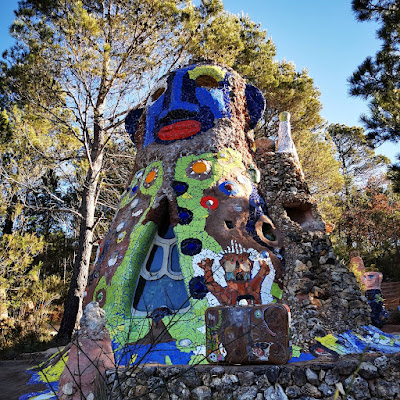
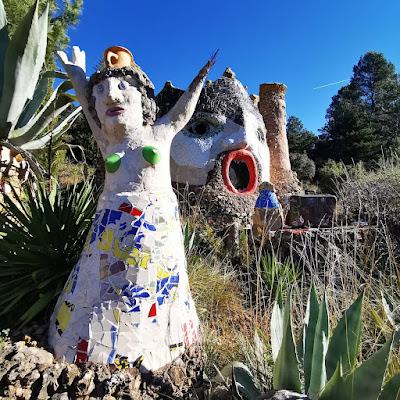
Showing posts with label garden with sculptures from concrete and mosaic. Show all posts

May 21, 2018

Oļģerts Miķelsons, Latvijas Antonio Gaudi / Antonio Gaudi of Latvia


decorations at the site of the Evangelic Lutheran Church 
in Čiekurkalna, Riga, Latvia 
this picture and the next one courtesy of Zane Butnare

Some who wrote about Oļģerts Mikelsons (1927-2019) and his creative work have called him the Latvian Gaudi, but he himself has never supported such statements, although he agreed that both found their inspiration in a similar way. 

Apart from this, with the creation of two art environments in succession, Mikelsons as a self-taught artist has done a great job, which until now has received little or no attention, especially outside Latvia.

Oļģerts Mikelsons at the premises of the church (2015)

Life and works

Mikelsons' biographical data are still far from complete. He was born on January 10, 1927, participated at age 18 as a Latvian soldier in the second World War (where he was imprisoned too), graduated in 1950 from a construction engineering school and got married in the same year. He found employment as a civil engineer.

In the 1970s, living in the Latvian town of Jürmala, he began creating his first art environment, an activity that lasted until the beginning of 1983. Then he divorced, moved to neighbouring Riga, where he remarried and began transforming the premises of a church into his second art environment.

He was a faithful Christian, proud of his country, he loved music and has composed songs for a choir. The last couple of years his health deteriorated and he lived in a social care center. In 2017, together with members of the church, he celebrated his 90th birthday. He died in 2019.

The art environment in Jürmala

this picture and the next five (2011): 
screen prints from the first video in the documentation
the apartment building in Jürmala 
with a blue decorated wall on the right side

Mikelsons and his wife lived in Jürmala in an apartment building on Rigas Iela nr 4. They hired a small apartment on the ground floor and first floor in the left corner of the building seen from the street. On its backside the building faces the river Lielupe.

ground floor of Mikelsons' apartment 

A characteristic of Mikelsons' first art environment is the use of pebbles as decorative material. One finds these pebbles in the entrance party of the apartment at the left side of the building. It includes a richly decorated staircase that leads to the first floor, as well as a decorated entrance at the ground floor with yellow doors (as pictured above).

pebble decorated structure, part of the mooring

Another structure decorated with pebbles is a mooring with a lantern pole in the river at the backside of the apartment building (picture above).

sculpture decorated with pebble

Mikelsons also made sculptures decorated with pebbles, such as the one in the picture above, which is inlaid with mosaics and portrays a lizard or salamander. Other pebble or mosaic decorated sculptures include portrayals of seagulls, a mermaid and a human couple.

blue decorations and pebbles
the inscriptions read RA SPUTNIKS and  JÜRMALA RIGA

Another characteristic of Mikelsons' art environment in Jürmala is the use of the color blue, as can be seen in the picture that shows the blue decorated outer wall along the street or in the pictures above and below which show a combination of pebbles and blue mosaic elements.

floor of pebbles with mosaic inlays

The house has served as a backdrop for a Russian detective film recorded in 1979. An article (December 2010) in Live Journal provides more information and also has a series of images of the decorations as far as present at that time.

The art environment in Čiekurkalna (Riga)

Early 1983 Mikelsons separated from his wife (a factor may have been that she was very outspoken in her dislike of his creative activities) and he moved to the Čiekurkalna quarter of Riga.

End May he remarried with a diacones of the local Evangelic Lutheran Church, a religious community Mikelsons had joined already in the 1970s and where he had met his new partner.

this picture and the next six courtesy of Zane Butnare

The church, which doesn't have the usual appearance of a Lutheran church, was built in 1928 and also included dwellings for disabled people and members of the congregation. 

Once settled in Čiekurkalna, Mikelsons soon became available as a volunteer to help with the maintenance of the building and the garden, which led him -in line with his creative activities in Jürmala- to start making creations too.

There are no reports about the sequence of his operations. Perhaps the access party of the church (as in the picture above) with its towery pebble decorated structure on top of the stairs and its mosaic decorated front facade, belongs to one of the first works, 


Mikelsons' predilection for pebble decorated items is also clearly visible in this second art environment, as demonstrated in the decorated wall depicted above and the sculpture below, part of the base of the bell tower, which also features a variety of inscriptions and green-tinted mosaics.


The decorative elements in the garden of the church include a large variety of multicolored mosaic, both on different parts of the ground floor, included a mosaic at the entrance of the site, and the also a variety of mosaics applied to structures and sculptures.

This art environment now also has smaller sculptures of animals, such as a cock and a cat with a mouse.


The most important structure, also seen from an ecclesiastical perspective, is the bell tower, as in the pictures below. This about seven meters high tower, decorated with a lot of green tinted mosaic and equipped with various inscriptions, was constructed in the 1990s.

Its base rests on a foundation that initially was part of a swimming pool which meanwhile had fallen into disuse.

Mikelsons seated in front of the tower

In April 2017 the ensemble of decorations got a protected status when it was included in the National list of protected cultural monuments as an art monument of local importance.

the bell tower seen from the backside

On April 4, 2019 Oļģerts Miķelsons passed away.

Situation of the site in 2022

The photo below, made by Tiramisu Bootfighter in September 2022, shows that the site at hat time still was in good condition.


Documentation
Rīgas Evaņģēliski luteriskā Misiones baznīca on Facebook
* On Live Journal (November 2010) an introductory article by Renate with pictures of the Jürmala decorations, followed by another article with more information and more pictures
* Also on Live Journal (November 2010) two articles by Renate with a description and a series of pictures of the decorations on the Čiekurkalna site, first article and second article
* And then on Live Journal (November 2011) a summary article by Renate about the two art environments, also with a lot of pictures
* Article (June 2016) on Latvian website IINUU about the Čiekurkalna art environment, with a series of pictures
* Article (undated) by Irina Mazurika on Baltic Travel Blog, with a series of pictures

Video
* Video entitled Schreyenbusch's Gaudi (YouTube, 2014, 8'31"), produced in the context of the Riga Summer School 2014, introducing Mikelsons and his creations at the site of the church


Oļģerts Miķelsons
Creations around house in Jürmala
Rigas Iela 4
Jürmala, Latvia
can be seen from the street
Creations around church in Čiekurkalna (Riga)
Čiekurkalna straat 1. līnija 78
Riga, Latvia
can be seen from the street 
streetview

September 12, 2017

Evelyne Dantel, Les petits jardins d'Eve / The small gardens of Eve

the decorated garden and the mosaic-decorated house in 2020
picture from Evelyne Dantel's Facebook page

The field of art environments in France has an interesting history with regard to self-taught artists who decorate their house and garden with mosaic, an history that involves various generations.

Before the second world war Ismaël and Guy Villéger were at its beginning when in 1937 they decorated the exterior of their restaurant. They were followed by Raymond Isidore (= Picassiette) who in 1938 began decorating his house. 

After the war and in the 1950s a postwar generation appeared with M. Dulong (1945 >), François Portrat (1945 >), Aldo Gandini (1950 >), Robert Vasseur (1952 >), Leopold Truc (1955 >) and Euclide da Costa Ferreira (1955 >).

The 1980s, 1990s and the early years 2000 saw another generation with Renée Bodin (aka Hurfane) (1980 >), Jean-Michel Chesné (1997 >) and Catherine Moreno (2002 >)

This post introduces Evelyne Dantel, who represents the contemporary generation.

view of the garden from the backside of the house
this picture and the next ones \
courtesy of Evelyne Dantel/Sophie Lepetit

Life and works

Born in 1964 in Nevers, France, Evelyne Dantel after primary education studied psychology at the Faculté de Dyon, in the Bourgogne region. She got a job as a clinical psychologist at a specialized hospital in La Charité-sur-Loire, a historical town of some 5000 inhabitants situated along the Loire river in Burgundy, France. 

Living in a small community in the rural area around La Charité, Evelyne's house has a fairly large garden. Around 2011 she began transforming house and garden into an art environment, both by adding mosaics to the various walls of the house and by embellishing the garden with a variety of sculptures, installations and other creative elements.

These creations were situated in various compartments of the garden which can be distinguished as petit jardins (small gardens), each with an own character.

the "jardin des têtes" (garden of the heads)

So at the left behind side of the garden one finds the jardin des têtes (the garden of the heads), a circular arrangement of heads, which was finished around August 2016.

garden gate

Another element is the garden gate with sides formed by wheels previously used in agriculture, all single-handedly welded together. This gate was finished May 2016.


On the picture on top of this post one also sees a couple of multicolored, winding snakes, which approach a blue wall, the mur aux seins (the breast wall), created in earlier years.

Decorated walls of the house


The walls of the living house have been decorated with colorful mosaic, such as above artwork, situated along a staircase on a corner of the building. The small pictures below show some details


These mosaics are made with pieces of tiles, broken crockery, shells, pebbles, pearls or buttons.


A dragon in a blue context on a wall is an impressive appearance.

Later additions to this art environment include the couple of  horses shown in the picture above, and the tree below (below left as it was early September 2017, below right as it was in October 2017 and further below as it was when completed in May 2018).


Evelyne Dantel's art environment has gradually become known via Facebook and in June 2016 for the first time the garden was open to the public on the occasion of a national open day of cultural sites organized by the French Ministry of Culture. In following years these open days would be repeated

recently created sculptures shed a glance over the breast wall

In 2018, Evelyne Dantel began to provide the still empty places of the walls of the house with mosaics. The photo below (from Facebook) shows the situation at the end of November 2018.


The next picture (from Facebook) shows the wall facing the garden as completed on December 10, 2018, a wonderful mosaic composition.


And the picture below (from Facebook) shows the side wall as completed in April 2019.


The downspout will still be painted in a suitable color. Evelyne's scaffolding is not high enough to reach the upper part and to provide this with mosaic.

And, as the photo below (from Facebook) shows, her work on expanding the decorative elements in the garden continues unabated.


In the spring of 2020 a new extension of the decorations in the garden was completed with a haphazard collection of colorful spheres, as well as a number of pillars rising approximately 1.70 m high, formed by stacked multicolored, mostly spherical items, the whole situated near the garden of the heads.


The photo above shows what the site looked like in December 2020.


And the above photo (from October 2021) shows a new creation, which once completed will act as a small pond for some aquatic plants!

Documentation
* Evelyne Dantel on Facebook
* Articles in Sophie Lepetit's weblog of May 31, 2017 and June 2, 2017 (details)
* Article (June 6, 2019) in regional journal Le Journal du Centre at the occasion of the open days early June 2019

Video
* Video by Pierre Semet Éclats collés/murmures de murs  (9'34", July 2019, YouTube), with close ups of mosaics and long shots (also by drone) of the site.


first published September 2017, last revised September 2023

Evelyne Dantel
Les petits jardins d’Eve
165 chemin des grands prés
58400 Chazué/Raveau, dept Nièvre, region Bourgogne/Franche-Comté, France
can be visited on open days, mostly in June

March 19, 2014

Peter Buch, Jardí de Peter / Peter's Garden


pictures are screenshots from the video by
Sergio Flaquer Carreras (Serflac) see documentation
 
Rather far away from the urban bustle, Peter's garden is situated on a dead end road past the small community of Pobla de Benifassá in the mountainous interior of Castellón, Spain, some fifty kilometers from the coast.

Begun in 1991, this art environment has evolved in the course of the years into a major setting of paths and ponds, colorful sculptures and imaginative constructions.

the two-leveled dragon's house

Life and works

Born in Germany in 1938, Buch grew up during World War II and the post-war years. He was glad to leave school at age fourteen and go to work as a gardener. but having the desire to become an artist, he went to the art school in Stuttgart. This proved unsuccessful, he was regarded as undisciplined and wasn't allowed to follow his own imagination.

mosaic decoration

So in 1960, at age 22, he left for Paris "to become a famous artist", a dream that wouldn't come true. He had to get by on small jobs and finally became a house painter. 

In 1964 he met a German young lady whom he would marry and with whom in 1967 he had a son. As so many young people would do these days, the couple traveled to Greece and Formentera, living there as hippies on a shoestring, enjoying beautiful, sunny areas.

In 1970 they finally settled on Formentera, where they lived in a simple, cheap house in the fields.


Buch, who all the while had continued making paintings, the next years had some expositions and succeeded in selling his art work. In the early eighties, apart form painting, he also began trying to work with materials such as wood, making sculptural creations.

Formentera gradually became too crowded to his sense and in 1985 Buch, who was divorced by now, visited Spain where he succeeded in finding a quite spot in the small community of Pobla de Benifassá.

With the money he had saved, he bought there a house, which he later substituted for another more quietly situated one at the outskirts of the village. He also bought a workshop and a large piece of land in a natural area just outside the village.

In the following years Buch would continue to stay in Paris and in Formentera, until in 2007 he settled permanently in Pobla de Benifassá.


Creating an art environment

In 1991 Buch began making creations to decorate the garden. He already had begun making sculptures, but now he also gave it a try to build structures.

He had no training in making constructions at all and his first creations collapsed. A friend introduced him to some principles of construction and so the site gradually became stocked with all kind of built structures such as a bar, pictured below, named la Papallana Felic, 


a high rising tower, pictured below, with a platform on top,


but also various monumental structures of people, such as the pregnant woman below,

structure representing a pregnant woman

and also a lot of stand-alone sculptures.


Along paths and ponds, often inlaid with mosaics, visitors can walk through the garden and eventually rest on decorated benches.


Buch can not be seen as a self-taught artist, neither does he belong to or is he interested in the world of mainstream art. In France and Italy he probably would be seen as belonging to the field of art singulier. 

He is familiar with the work of outsider artists such as Picassiette and facteur Cheval, and feels inspired by such creations as Bomarzo and the Tarot Garden.


Visitors are welcome. They are asked to pay a small donation Buch will use to buy materials to maintain the garden and make new creations.

The built structures have been made without any permit from the local authorities, which up to now has not yielded any problem. Indeed, it is not impossible the authorities see the garden's potential to attract tourists, which would contribute to the local economy.

Peter Buch's garden is probably the most extensive and comprehensive (outsider) art environment in Spain. In this regard it is significant that Trip Advisor's website mentions Peter's garden and has some positive reviews.

Situation in 2021


The picture above and the one below, made in December 2021 by Tiramisu Bootfighter, who traveled through Spain in the context of his project La Valise, Galerie Ambulante, show that the site at that time still was in good condition.


Documentation
* Peter Buch's website
* The garden got a scholarly review in: Jo Farb Hernandez, Singular Spaces. From the Eccentric to the Extraordinary in Spanish Art Environments, p. 336-351. Seattle (Raw Vision, SPACES, San José State University), 2013. ISBN 978-0-615-78565-3. An abridged version on SPACES website (added 2013). See also (a part of) her article about Peter Buch on Raw Vision (Spring 2022)

Videos
* The video South Spain Trip by Serflac (YouTube, March 2020) has scenes of the site, starts at 47'18"
* Video by Claus J. Barteczko (in two parts, 8'21" and  7'42", YouTube, uploaded January 2010)

part 1


part 2


first published March 2014, last revised April 2023

Peter Buch
Jardi de Peter
Pobla de Benifassá, Castellón, Valencia, Spain
visitors welcome

June 11, 2012

Isidre Castells, Catalunya en petit / Catalonia in miniature


pictures courtesy of Anna Fuster (Flickr, 2007)

The Carrer de Grau in the Sant Andreu quarter of Barcelona still has the atmosphere of past times, with its small houses and front gardens facing a street that has no car traffic.

The residents organize these gardens in various ways and one of them did this in a very special, creative manner. 

Life and works

Isidre Castells (1920-2005) at age seventeen was enlisted in the army to take part in the Spanish civil war. Struck by typhus, been imprisoned in a concentration camp and having lost his father and mother, his youth was troublesome and he had to find a way to face life after the war.

He got a job in a factory, worked in the weekends as a home painter, and settled in the Sant Andreu quarter of Barcelona. When in the 1980s the factory went bankrupt, Castells got an early retirement.

Not liking idly hanging around, he began working in the front garden, installing some concrete elements to curb the growth of weeds. This was the start, around 1985, of a project that he would continue for some twenty years.

With the format of big tiles in mind, Castells made two-dimensional replicas of well known architecture in Catalonia, like the Sagrada Familia and Montserrat.

All together, in the course of the years he has constructed some hundred representations of Catalonian monuments, churches, famous buildings, and so on.


Apart from the replicas on the wall, which give the site a museum-like character, the garden itself has been embellished with mosaic- and shell-decorated structures, like flowerpots, pillars and arcs.

People in Barcelona would be reminded of Gaudi.


Castells has been making sculptures too, one of these is a black, mosaic-decorated representation of his beloved dog, as in next picture. 


After Isidre Castells died in 2005, his widow Rosa Anglada, would maintain the garden and when she became to old (in 2018 she was at age 92) Josep Castells took care of the site, as reported in the journal El Periódico (see documentation)

Situation in 2021


The picture above, made in October 2021 by Tiramisu Bootfighter, who traveled through Spain in the context of his project La Valise, Galerie Ambulante, shows that the site at that time was still in good condition

Documentation
a website promoting the quarter of Sant Andreu has pictures of the garden and a text about Castells
* a series of photos (December 2013) by Raija Kallioinen on Facebook
* entry (November 2014) on Amaijak's weblog Mi Mundo, with a series of pictures
* article (January 2018) in local journal El Periódico

Video
* scenes of the site (2012) on the Barcelona trip video by Serflac (YouTube, starts at 19.46, cannot be embedded here)

first published June 2012, last revised October 2021

Isidre Castells
Catalunya en petit
56/58 Carrer de Grau
Sant Andreu, 
Barcelona, Catalunya, Spain
can be seen from the street
streetview