Showing posts with label garden with dolls. Show all posts

March 17, 2023

Vasily Petrovich Hlushkovskyi, Двір загублених іграшок / Yard of lost toys

pictures are screenprints from the video in the documentation

Introduction

The following post is about an art environment in Lviv, the sixth largest city in Ukraine, located in the west of the country near the border with Poland. With regard to art environments in Ukraine, 11 reviews have now been published in this weblog. This new article is the first to appear after Russia invaded Ukraine.

This weblog is not about politics, but an indication of the situation in the area where the site is located from he perspective of the ongoing war, is in my opinion indispensable. In this regard, a good source is a recent interview (end of February 2023) by Eurocities with the first deputy mayor of Lviv, Andriy Moskalenko, who is responsible for economic development.

One can read about the challenge of housing the hundreds of thousands of Ukrainians who had to leave their homes because of the war and ended up in Lviv. And one can also read about the attacks on the energy supply, which resulted in 40% less capacity being available. The article shows that the city's administrators are not giving up, as the title of the article says: We are finding a way to continue living.

The Yard of Lost Toys

It all began in 2009. 

Vasily Petrovich Hlushkovskyi, a bricklayer, born in the early 1960s and living in the old center of Lviv, found two dolls, which he placed in the yard behind a block of houses in the old center where he lived, assuming that the owner would find those dolls and take them back. 

However, that didn't happen.

At that time, the moment was approaching when Vasily would get a grandson. It occurred to him that he could turn the yard, which is open to the public, into a play area for that grandson, with a swing and, a sandbox. and a display of dolls, including lost ones.
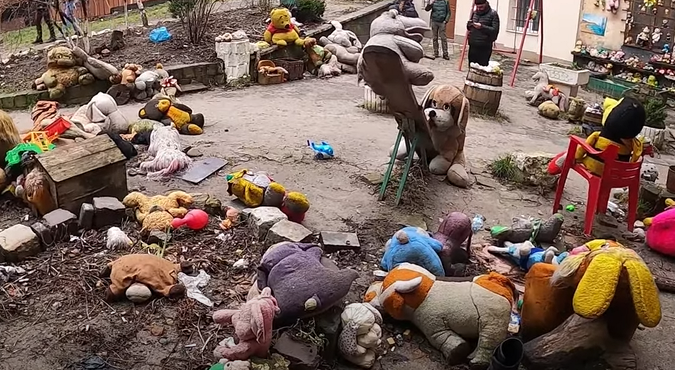


So Vasily Petrovich started collecting dolls, asking friends and acquaintances if they still had dolls that were no longer played with. His neighbors also contributed to the growth of a display of dolls.

As the site became more widely known, residents from other parts of the city also brought their superfluous dolls.

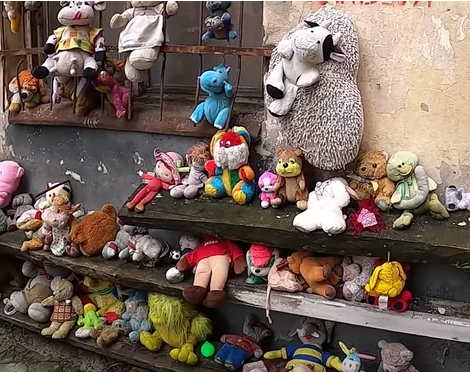
People also came to bring all kinds of other things, such as toy cars, a train to play with, children's stools, all kinds of portraits, a birdcage, a pair of boots, books, old musical instruments. They were given a place in the yard or in cupboards and on shelves along the walls all around.

Gradually, the display also became a place that attracted tourists, although the site was not mentioned in tourist guides.

Exhibiting dolls in the open carries the risk of them deteriorating and becoming a pitiful sight. 

The photos all around, from a video taken in the early months of 2020, show that the dolls are generally looking good. It has been reported that Vasily Petrovich regularly got up early to check the collection and if necessary remove decayed dolls or other broken props.

People who visited the Yard of lost toys could react very differently to what they saw. 

There are people who have a pleasant experience and find the site joyful. but there are also those who refer to the site as awesome, creepy and bizarre. For example, see the more than 3300 comments from visitors to the entry related to the site on Google Maps (see documentation)

In the course of 2020, the art environment came under siege. A commentary published in June 2020 said that local women threw all the toys in the trash. The site has since been closed.

Documentation
* Entry on website Camera Obscura
* Article on the website Bestportal, with some 50 photos 
* Article on the website of Ukrainska Pravda, with a series of photos

Video
Video (YouTube, 6'33", 2020)  by Z Kamerą W Plecaku (With Camera In Backpack)


Vasily Petrovich Hlushkovskyi
Yard of lost toys
Knyazya Leva street 3.
Lviv, Lviv Oblast, Ukraine
site doesn't exist anymore
on Google Maps the site has over 3300 reviews and over 4000 photos

September 28, 2020

Robert Bretin, Jardin avec sculptures grandeur nature de gens de paille / Garden with life-size representations of people of straw

all pictures (around 2017)
courtesy of Sophie Lepetit, from her weblog
 
An inhabitant of the community of Les Peintures, located in the south-west of France some 45 km east of Bordeaux, created an art environment in the capacity of a garden decorated with  life-size depictions of people in all kinds of situations in daily life.


Life and works

This garden, situated along the departmental road D674 that crosses Les Peintures, was begun in the early 1990s by Robert Bretin (1930 - 2021),  a retired mason, about whom the internet has only limited biographic information.


Bretin became inspired to make such creations because of a tradition that originated in the community of Campan, in the French Pyrenees, where life-size dolls -in Occitan called mounaques- were placed along the roads in the summer, a tradition that has now spread to many villages in the area of the Hautes-Pyrénées.

For example, in Boussan, a village of 200 inhabitants, three times in summer there is an exuberant display of groups of mounaques made by numerous residents. representing events with a daily or festive character, such as a baker at work or a family celebrating a wedding.

The bodies of these life size creations are traditionally made of straw and dressed with discarded garments. 


Bretin also made his creations from straw, dressing them with second hand clothes he regularly bought or was offered by acquaintances.

The accessories of the straw people would depend on the time of the year, taking into account days such as Easter, Halloween, the French National Day (Storming the Bastille) on July 14, Armistice Day (End of WWI) on November 11 and Christmas.

The faces of the creations Brein made partly looked like commercial masks, for another part they appeared to come from shop-window dolls from earlier times, especially those with hairdos. The available documentation doesn't have information about this.

Bretin arranged the creations in his garden in a cozy way. People could be seen sitting around a table enjoying a meal, a child was swinging, someone was catching a fish, people were talking or walking together....

Robert Bretin passed away on September 29, 2021, at the age of  91.

The future of the decorated garden is not clear. 

Documentation 
* Article (December 2011) in regional newspaper Sud Ouest
* Posts (March 20 and 21, 2018) on the weblog of Sophie Lepetit, general impression and detailed pictures

Robert Bretin
Sculpture garden
18 lieu dit Champ du Mil
33230 Les Peintures, dept Gironde, region Nouvelle-Aquitaine, France
the garden, located along the departmental road D674 that crosses
the village can be seen from the street


August 28, 2020

Lubomir Votava, Dům a zahrada zdobené panenkami / House and garden decorated with dolls


pictures courtesy of Justyna Orlovska from her website
"Off the Beaten Track"

In the field of art environments in Europe, there are some sites with a decoration mainly composed of dolls, such as those of Francis Barale (France), Daina Kučere (Latvia) and Margarita Travkina (Russia). This small group of creations can be complemented by a site in the Czech Republic curated by Lubomir Votava.

Life and works

Votava was born in the early 1960s in Havlíčkův Brod, a town in the Vysočina region of the Czech Republic.

Initially he worked as a tractor driver. In 1989 he attended a rally of the Republican Party, often referred to as extreme right and represented in the Czech parliament from 1992-1998. Votava joined that party, working his way up to become an advisor and bodyguard to the party's leader.

In that capacity Votava gained notoriety for some incidents, like he punched an opponent with his fists. Later he was convicted for being violent against a journalist, after which he left the world of politics and in 1998 retired to the small village of Rváčov, also located in the Vysočina region.


Votava settled in Rváčov in a simple house, built around 1870, initially inhabited by his grandparents and thereafter used by his parents as a summer home.

Rváčov was now in his late thirties and living on his own. Away from the urban hustle and bustle of Prague, Votava now focused on the quiet rural life in the village.

Especially pleased with the garden located between the cottage and the main road that crosses the village, he spent a lot of time maintaining it. He built a pond with his own hands and from ten kilometers away, in a wheelbarrow he carried  a large amount of stones into the garden, some of these stones being three feet high

As a result, in 2016 the garden was reviewed in the Czechian magazine Chatar Chalupář, a practice-oriented monthly magazine about housing and lifestyle.


But what would make him known, both in the village and beyond, was not the composition of garden, but the special way in which he provided house and garden with decorations.

From his early years a lover of old toys and discarded dolls, he started to decorate interior and exterior especially with dolls, which he obtained from people around who wanted to get rid of them, which he found in trash cans or which sometimes were just left behind by people, deposited at the garden's entrance.

About a thousand dolls cover the outer wall of the house and are attached to the branches of trees in the garden.

Varied reactions

His way of decorating house and garden, which is visible from the main road that runs through the village, has led to varied reactions among the residents, both appreciation and disgust or fear.

Votava has said he doesn't exhibit the dolls to scare passers-by. He wants to prevent them from ending up in the garbage and being destroyed. He has explained that for him dolls are a medium from which energy passes. Looking at some dolls he sees in their eyes the child that played with them many years ago.

This train of thought is reflected in most arrangements of the dolls, as demonstrated in the pictures above.


But an arrangement like the one in the photo above, in which dolls -partly without a head- are suspended from a rope around their necks, arouses less sweet associations.

So in presenting both the lovely and the harshness, this art environment shows an ambiguity. It is not clear if this ambiguity is intended or unintentional, but in any case it can confuse a potential visitor.

Documentation
* Article (November 2014) on the website of TN Nova, with a short video and a series of pictures
* Series of photos with explanation (December 2015) on website Off the Beaten Track, edited by Justyna Orlovska

Videos
* Detailed impression of the site in wintertime (November 2015, YouTube, 14'35")


* Video by Vladimír Havlíček (July 2019, YouTube, 3'57") with Votava talking about the collection


Lubomir Votava
House and garden decorated with dolls
Rváčov, Vysočina region, Czech Republic
can be seen from the road

May 06, 2018

Daina Kučere, Leļļu dārzs / Doll garden


this picture and the next two (around 2016) 
courtesy of Sabile's tourist information centre

Sabile is a small town of some 3000 inhabitants, located along the Abava River in the western part of Latvia. It attracts visitors because of its beautiful surroundings, its annual wine festival and its garden with dolls, a site which in the field of art environments in Europe is rather unique.

Life and works

This site was created by Daina Kučere, inhabitant of Sabile, born in the mid 1940s, a mother of four children and a grandmother of fourteen grandchildren. She had various jobs, such as waitress in a motel, and in 2007 she got retired.


It all started in 2005. To uplift the celebration of the midsummer night, a beloved night of  festivities in Latvia, one of Daina Kučere's daughters came up with the idea to make some life size dolls. It turned out to be a success and Daina, at that time in her early sixties, felt motivated to create more of such dolls.

Creating a doll garden

It became a a project that would keep her busy until the present day (2018). Already in the first years she made dozens of dolls, which got a spot on a grassy piece of land -in private property- along a main street of the town. Currently the site has some 300 dolls.

The site is open to the public throughout the year, even on cold winter days


To construct the dolls Daina uses the format her daughter had tried out. She starts with a wooden cross-shaped frame, on which a fabric base is attached which will be filled with straw. With a wooden post attached to the bottom of the frame, the doll, once dressed, is firmly anchored in the bottom to the place it gets in the site.

Simple and cheap materials are used for the basic structure of the dolls. For example, since Daina can get the straw for free from a friend, she only has to pay the costs of transport.

this picture and the next two (may 2012) from the
website maminuklubs.lvin agreement with the general permission
to republish content in informative weblogs as the present one
 
What one sees are scenes from everyday life: postmen and other local officials in uniform, a lady in a dress in Latvian colors, another lady sitting behind a sewing machine and many, many children.... in a circle holding each other's hands, two-by-two in a row also holding hands......


In the conceptualization of this art environment considerations of a historical nature have no role, neither was there apparently a need to represent certain nationally or regionally known events. It's all about activities close to home, in a nearby familiar environment

At the same time, observers have noted that the site can leave an impression of alienation or can be a bit unsettling. If so, this may have to do with the very sketchy applied facial expression and the presence of headgear on really every doll, which is probably needed to mask the effect of the internal frame.

In terms of outsider art environments, however, these elements just as well can be seen as charming aspects of the site.


Situation of the site in 2022 

The photo below, made by Tiramisu Bootfighter, shows that the site in September 2022 was still in a good condition


Documentation
* Entry in Atlas Obscura (undated)
* Interview (2007) with Daina Kučere by Zane Smildzina, published on website Delfi
* Article (September 2016, in English) by Robert Clay on website Citypaper

Daina Kučere 
Leļļu dārzs/Doll garden 
Riga street 17
Sabile, region Talsu, Latvia
can be visited freely, all year,
a donation is welcome
streetview 2012

February 22, 2017

Aleksey Ivanovich Shuvalov, С игрушками украшенной сад / Garden decorated with toys


pictures from the website surfingbird (under reconstruction)

In Nizhny Novgorod, the fifth largest city in Russia, an art environment can be found that is characterized by the many toys and dolls used to decorate the site. This is Aleksey Ivanovich Shuvalov's project.

Life and works

Shuvalov was born in 1942 or 1943 in the Russian community of Bol'shogo Boldina (Great Boldina), which is known from the family estate where Pushkin stayed in the 1830s. 

Shuvalov first worked at a farm and later went into forestry, where he was involved in the extraction of resin from pine and other conifers.

When retired, Shuvalov wanted to avoid boredom, so around 2002 he began to embellish the garden around his house, mainly using toys and dolls as decorative material.


He obtained this material from his family (he has two daughters and two granddaughters), but he also found it in the garbage or got it from friends or people who know about his activities.

In an interview with a local newspaper he said that he refers to his collection as the museum of the national disgrace of household waste.


Shuvalov's embellished garden is located at the end of a street in a relatively idyllic, wooded area of the old town, where one can enjoy views of the river Oka. The site is endowed with trees and shrubs that are used to attach toy animals, dolls and other decorations.

Apart from the toys the garden also has a lot of typical decorative elements -as shown left in below picture- consisting of circular discs from wood or other material, strung together and interspersed with oblong narrow strips. The items with the strips are made from aluminum (beer) cans. The top of such a can is removed and then the cylindrical middle part is cut into strips which are folded outwardly.

It's a simple but effective way of making decorations. These items can be seen everywhere in the garden and around the house.


The interior of the house is also packed with objects and the walls inside are completely filled with pictures and decorations.


Although one of the articles in the documentation describes the site and its author in disapproving terms and says that some neighbours had complained about the site, the other article portrays the author as a friendly person who likes to show visitors around and who will even share some time at the gazebo which offers views of the river Oka.

Documentation
* Article (May 26, 2012) in newspaper Pro Город
* Entry and large series of pictures by Станислав Казнов (June 1, 2014) on Live Journal 

Aleksey Ivanovich Shuvalov
Bolshaya Perekrestnaya Ul
Nizhny Novgorod, Russia
can be seen from the street

April 26, 2011

Cyril Roussel, Le jardin aux jouets / The toy garden


this picture and the next one courtesy of Melanie Menard, 
from her weblog 

Gravelines from old is a fortified city and fishing town in the far north of France, near Dunkirk.

Offshore, in 1588, the decisive battle of the English against the Spanish Armada was fought. Currently, the city has a charming old towncentre, a major seaport, extensive industrial areas and a large nuclear plant.

The toy garden

And it had an art environment: the Jardin aux jouets, the toy garden, located in an open area, somewhat outside the community, along a departmental road.

The author of this environment, Cyril Roussel (1938-?), lived there, together with his son, in a mobile home


I could not trace many biographical details. As far as I understand Roussel was born in Gravelines, had a job in a slaughterhouse, maybe was a truck-driver and he settled in the 1990s on the plot of land where the toy garden would be created. 

Without any preconceived concept, the collection of toys gradually grew into a lively exposition of all kinds of puppets, statues, toys and objets trouvés, some of them painted in bright colors or dressed up in fanciful clothes.

Once the inhabitants of Gravelines had learned about the site, they would visit it, bringing articles from their households they wanted to get rid of. Cyril Roussel, not inclined to refuse gifts, added all of these items to his collection.

view from the street
click on picture to enlarge

Although many people liked to visit this very special garden, as reported in August 2014 by a reader of this post, the Jardin aux jouets doesn't exist anymore (see comments).

Up to now I couldn't discover why this happened. Maybe some people looked upon this garden as a pile of garbage and actually succeeded in realizing its closure.

Documentation
* post  of Melanie Menard on her weblog Inner Worlds/Outer Space (30-1-2011)
* post of Jean-Michel Chesné on his weblog (27-10-2010)
* a set of pictures by Extase Coagulée (Facebook, February 2011)

Video
* video (4'11",  April 2010) by Harry Kampianne on Daily Motion


Cyril Roussel
Jardin aux jouets
(formerly) Rue du Pont de Pierre 
Gravelines, dept Nord, region Hauts-de-France, France
site doesn't exist anymore