Showing posts with label garden with wooden sculptures. Show all posts

May 09, 2025

Szczepan Mucha, Udekorowane wnętrze i zewnętrze / Decorated interior and exterior

all images courtesy of Andrzej Kwasiborski and Znalezienie

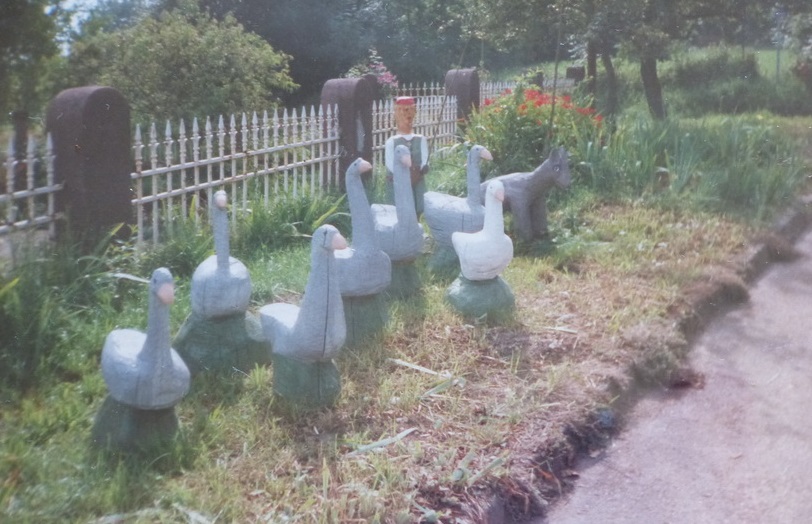
The row of wooden sculptures in the image above was for many years part of an art environment in a small village in the Sieradz region of Poland.

The site had an outdoor space enclosed by a series of interconnected wooden sculptures and an interior decorated with sculptures, a coherent creation that is now part of the regional ethnographic museum.

Life and works

This art environment was created by Szczepan Mucha (1908--1983), who was born in the Polish village of Stępień. 

Once grown up, he worked first as a woodcutter and later as a forest ranger's assistant. He lived in the small hamlet of Szale near Klonoa, in a farm-like house with a workshop and a large outdoor area.

While living there he had a painful experience that affected the way he dealt with the world. He was accused by neighbors of stealing wood, which led to an ordeal in which he was convicted and had to spend a time in prison.

Szczepan Mucha already liked to be alone and preferred working in the forest to being in the company of people, but after this profound experience he limited his contact with the outside world to a minimum

Later in life, in in the late 1950s when he was in his early 50s, he started making sculptures.

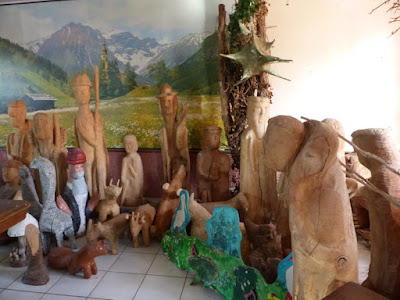
The surrounding images give an impression of the nature of his creations. 

Working with simple tools such as a saw, an axe, a knife and a self-made chisel, he mainly made small-scale depictions in dark colours, portraying all kinds of people.

In 1972 his work was discovered by Zofia Neymanowa, an art historian and museologist of the same generation as Mucha and director of a museum in Sieradz, the capital of the department where Mucha lived. 

The meeting with Zofia led to Mucha's development in the further 1970s into a valued folk artist. The recognition as an artist that Mucha received gave him great satisfaction and was proof to him that he was not the bad man as seen by his neighbors.

He now also went out, took part in competitions and exhibitions and sold his works to museums and private collections.

 A decorated fencing in the exterior

A special element of Mucha's art environment is the way in which the fencing of the outdoor space has taken shape.

The images below show that the top of each of the vertical planks that form the enclosure, has the shape of a human head.

It is not difficult to see that such a palisade also expresses a deep separation between Mucha's world and that of his unfriendly neighbours.

The period in which Szczepan Mucha actively came out with his creative work and was a valued non-professional artist was between 1972 and 1982.

He died in 1983.


In the museum world of the Polish city of Sieradz, interest had already arisen in safeguarding the artistic legacy of Szczepan Muscha. 

This idea was actually realized when an open-air museum was opened in the 1980s and between 1987 and 1991 the interior of Mucha's house and the processed planks of the fence of the outdoor area, were either rebuilt in or moved to the museum.


Documenation
* Entry on Facebook by Andrzej Kwasiborski, with a variety of photos
* Article on Polish website Pola Neis, with a variety of photos
* Series of photos on the Facebook account of Poland Presents

Video
* Video by Edward Konieczvy (2012, YouTube, 5'47") that shows footage of a visit to the open-air museum by members of the Department of Tourism and Ecology of the University of the Third Age in Ostrów, Poland


Szczepan Mucha
Decorated interior and exterior
Village of Szale, dept Sieradz, region Lodz, Poland

currently replaced to/replicated in:

Sieradz Ethnographic Park

Google Streetvie

September 27, 2024

Seppo Laatunen, Ateljee Pikhahovi / Atelier Pihkahovi


pictures are screenprints from the video mentioned in the documentation

Located in the department of Southern Finland, the community of Jaala was independent, with a population of around 1,900, until it was merged with five other communities to form the municipality of Kouvola, one of the larger municipalities in Finland with over 80,000 inhabitants.

The man with the chain saw in the image above, Seppo Laatusen, has an atelier in the area around Jaala where he creates wooden sculptures, which not only decorate the studio, but are also displayed in a 0,5 hectare large wooded area near his home.
 

Life and works

Seppo Laatunen, who was born in 1938, showed an artistic disposition in his early years, which was evident from all kinds of wooden objects that he made himself at a young age. 

His mother, who had a hobby of making all kinds of drawings, recognized his talent for artistic work and she and her husband would have liked him to follow an art education, but their financial situation did not allow this.

A  nice event in Seppo's early years reveals something of his way of doing things

At the age of ten young Seppo and his brother went to help their father with logging in a nearby forest. Father sawed and split, the brothers stacked.

Mother had been given them flour, a few litres of buttermilk and some plates for lunch. When it was time to eat, Seppo cut a big hole in a tree stump to mix flour and buttermilk in, causing his father who was watching, to burst out laughing.

After primary school Laatunen went to work as a contractor in areas such as earthmoving and forestry. He was involved in draining marshes and maintaining forests.

Once an adult, he moved out on his own and bought a house in a wooded area, located halfway between the hamlets of Siikava and Hartola, close to his childhood home.

Although Laatunen made creations during his working life, he was only able to fully realise his potential when he retired around the year 2000.  In 2008 he built a spacious studio near his home, named Ateljee Pihkakov. where he could exhibit his sculptures. He also bought a half-acre piece of green area from a neighbour to display his larger creations.


The hundreds of wooden sculptures that Laatunen has created, cover a variety of themes. 

There is an interesting collection of creations that depict public figures, such as the former Queen Elizabeth of the United Kingdom and the American politician Donald Trump, above. 

Public figures from Finland. such as 11th president Tarja Halonen, and Juha Mieto, Finland’s skiing legend, just as well known personalities from other countries have been depicted also.

In the green area one can see a number of high rising sculptures that depict all kinds of personalities. some around four meters high.

Other sculptures depict animals, such as animals that live in the forest, but also crocodiles.

Most of the sculptures are of people or animals, but a small shed on the property contains a self-made wooden replica of a red car with an open roof, large enough for someone to sit behind the wheel. A surprise for a visitor when the door of the small garage is opened.


Documentation
* Article (October 2021) in newspaper MT Metsä (includes a 2.24m video)
Article in a weblog about interesting spots in the community of Jaala
* Article on the website of the Finnish Association for Rural Culture and Education MSL
* Article on a regional edition of the Association MSL 

Seppo Laatunen
Ateljee Pikhahovi
Ahvenistontie 28, 
Hamlet Jaala, municipality of Kouvola, region Kymenlaakso, dept Southern Finland, Finland
visitors welcome
Google Streetview (with photos)

August 02, 2024

Albertas Žąsinas, Nesąmonių sodyba / Homestead of Nonsense

all images courtesy of Justyna Orlovska from her website
Off the Beaten Track


Stoniūnai is a small hamlet in the Svenciony Municipality in Vilnius County in eastern Latvia, near the border with Belarus. In 1970 the hamlet had about 50 inhabitants, but in 2021 it had fewer than ten. 

One of the current residents is Albertas Žąsinas who enriched the hamlet with an art environment.


Life and works

Žąsinas was born in 1934 or 1935 and he is currently 89 years old. 

He has been married twice but got divorced, and currently he lives alone in one of the six farms in the village.

Now retired, in his working life he was a veterinarian in a meat processing plant and he also worked as a teacher at a technical school. For a number of years he acted in an amateur theater.


In 1999, when he was just retired and living in the farm in Stoniūnai, he started making sculptures. 

The reason for this was that he had heard that the previous occupant of the farm house had provided it with a meanwhile disappeared wooden cross. So he decided to make such a characteristic creation in turn.

And then, as often happens in the field of art environments, once started making a creation, he could not stop.

Currently Žąsinas has created about seventy characters, which he situated in the spacious garden that belongs to the farm, an exposition that can be seen from a village road.


Made from ash tree trunks, many of his creations are two-dimensional in signature, as they are formed from wooden planks. If they have a three-dimensional appearance, the lower part of the creation is often a piece of tree trunk.

Žąsinas views life with a lot of irony. For example, when he portrays a witch, she gets the appearance of such a person, but then dressed in a skirt with all the colors of the rainbow. He also looks at his own work with that irony, because on one of the yellow information boards in the garden he indicates his art environment as Homestead of Nonsense.

His sculpture garden mainly includes human characters, here and there supplemented with depictions of animals, such as various birds and pigs in a trough. All creations are treated with special oil to make them more durable.


There is a wide variety of sculptures presenting human characters.

For example, there are several creations that depict female characters, including Ingrida Simonyte, who became Prime Minister of Lithuania in December 2020. There is also a sculpture of the woman of his dreams, but she is not entirely ideal because she smokes.,,,,,

Angels and devils are also exhibited and in this respect the good forces have the majority.

As for politicians, there is a group of three in which Lenin, Stalin and Hitler got a place, all with an accompanying symbolic item such as swastika or hammer and sickle.

The arrangement of the creations in the site seems a bit chaotic, but each character contributes in its own way to what Žąsinas wanted to convey. 


Documentation
* Article (July 2024) by Justyna Orlovska on her website Off the Beaten Track
* Article (December 2017) in Lithuanian newspaper newspaper 15min, with a video
* Article  (February 2022) in Lithuanian  newspaper Ukininko patarejas 

Video
* Video (6'09") in Lithuanian newspaper newspaper 15min


Albertas Žąsinas Homestead of Nonsense Hamlet of Stoniūnai in the municipality of  Svenciony, Vilnius province,  Lithuania

can be seen from the road

July 30, 2022

Edouard Erhart, Arrangements de sculptures en bois / Arrangements of wooden sculptures


all pictures courtesy of Sophie Lepetit, 
from her weblog

The scene with Snow White and the Seven Dwarfs was created by Edouard Erhart (1928-2009). who lived in Bruebach, a village of about 1,000 inhabitants in the south of the Alsace in France, near its border with Switzerland. 


Life and works

The photo above by Sophie Lepetit shows a portrait of Edouard Erhart that hangs on a wall in the house where his wife still lives. 

It's a portrait of a man with a determined character. Born as the eldest in a family with seven children  that struggled materially, he dreamed of acquiring his own paradise in Bruebach. So once an adult, he would not go on holiday for years to save money in order to buy plots of land.


Young Edouard was only sixteen years old when in 1945, after Germany had lost World War II, he enlisted in the French army, which was then a temporary occupying force in the part of Germany bordering France.

From 1947 to 1949 he had a job as an underground miner in the potash mines of Alsace, for which he had to cycle about 40 kilometers a day.

Then he learned the butcher trade from an uncle, and he would work for about forty years in butcher shops and slaughterhouses in France and, just across the border, in Switzerland,

Erhart married in September 1955 after he had built his own house and furnished it with chairs, tables and the like that he had also made himself. The couple would have three children.

Decorating home and garden

Building and furnishing his own house also marks the moment where the story begins of the various art environments Erhart created.

Once he had planted a garden with a pond around his house, the desire arose to provide this garden with self-made wooden sculptures.


Like so many non-professional sculptors, he could see in a log or similar piece of wood the character hidden there, which he just had to free from the wood, so to speak.


As the pictures in this post show, Erhart populated the garden with a significant number of sculptures, including many depictions of animals such as squirrels, lemurs, bears, owls, swans, crocodiles, goats, dogs, rhinoceroses, penguins, panthers, wolves, foxes, kangaroos and birds.

But he also portrayed princesses and dwarfs, all kinds of fairytale characters. famous people from Alsace, accordionists, a whole range indeed.

The creations were painted in appropriate colours. Not all of the many wooden sculptures Erhart installed in his garden have withstood the test of time, but many scenes have been captured on photos.


Creations in the interior

In the 1990s Erhart -who had retired in the mid 1980s- also began to furnish a spacious interior room with sculptures. 

There was a specific reason for that. A daughter of Erhart who had become a ceramist had made a nativity scene for the parish church in the village and, inspired by this, Erhart wanted to realize something similar indoors.

The nativity scene (no images available) includes the usual characters, such as the Virgin Mary, Joseph, the newly born Jesus, shepherds and the three wise men.

In addition to the Christmas scene, there are other characters, all together some forty sculptures.

Compared to the characters in the garden, the sculptures of the human characters in the interior room are made on a more human scale.


Sculptures on a site a little further away of the house


In addition to the plot of land on which he was to build his house, Erhart also bought plots of land elsewhere in Bruebach.

If I have understood correctly, the entrance to these plots was marked by two rather large, sturdy wooden sculptures, as if figuring as guards.

The surrounding images give an impression of such a plot of land, some distance from Erhart's house, as well as of the sculptures that (still) decorate the site.

The sculpture above left already shows signs of decay, which is not surprising for wooden sculptures that are outside and not maintained.

The image above right shows Little Red Riding Hood.


Documentation
* Article (July 2022) by Sophie Lepetit on her weblog

Edouard Erhart
Arrangements of wooden sculptures

Rue Principale 57 68440 Bruebach, dept Haut-Rhin, region Grand Est, France

sculptures in the garden of the house can be seen from the street


July 23, 2022

Pekka Lampinen, Puiset veistokset takapihalla / Wooden sculptures in the backyard

 
pictures are screenprints from the video below

The images in this post show some of the wooden sculptures in the sculpture garden of Pekka Lampinen, Finland, as they still stood there in 2022. At that time. more than a decade after Lampinen's death, many sculptures had deteriorated and those still in reasonable condition were taken to safety.

Life and works

Pekka Lampinen (1931-2011) had a busy job and only got the opportunity to pursue visual arts and woodworking at a later age, when he, in his early fifties, in 1983 joined the art circle in his hometown Aura, a community in the coastal area in the south-west of Finland.

Lampinen made various reliefs in wood and his favorite was a moving work entitled Viimeinen menettäminen (The last loss), in which he depicts his father in military uniform, saying goodbye to his two sons to join the Finnish army in the winter of 1939 in the war that Russia had started with Finland . 

His father would never return from that war and young Lampinen was orphaned before he was ten years old. 


Not all of Lampinen's works had that sad connotation. 

Certainly in the late 1990s, when Lampinen was retired, he took great pleasure in making dozens of wood sculptures and paintings. 

He built a barn in his backyard, where his paintings were displayed and the garden was transformed into an art environment with numerous wooden sculptures, often in the form of totems, but also sculptures of all kinds of animals and famous people from the village, such as a police officer, a pharmacist and a priest. 

It became a whole world of all together some 120 sculptures spread out in his garden, where visitors were warmly welcome to view the collection.


Lampinen became nationally known in Finland as an ITE artist after in the years 2002-2004 a research project took place into the occurrence of outsider art in the province of Varinais-Suomi.

His work was subsequently displayed in the Kiasma Museum in Helsinki and it could also be seen in 2006 in Paris at the exhibition Esprit de la Forêt (Spirit of the Forest) at the Halle Saint Pierre, where one could see a number of totems he had created.

After Lampinen passed away in 2011, the wooden sculptures in the backyard have been neglected for a number of years. The available documentation on the internet provides no background information in this regard.

Action was taken in the summer of 2022, when Pertti Riikonen and Teijo Monni from the Design Spot organization visited the site, when part of the creations in Lampinen's estate had been donated to this organization. 

Those creations that at that time were still in good condition, were recovered. On that occasion, the short video, which is included in the documentation below, was also made. Some screen prints from this video illustrate this article.


Documentation
Article about Pekka Lampinen by Teijo Monni and Pertti Riikonen on the website of Maaseudun Sivistysliitto MSL (Rural Culture Association MSL), Finland, with a number of photos.
* Article (2006) in newspaper Turun Sanomat about the exposition in Paris

Video
* Video (0'59", YouTube, 2022) by Pertti Riikonen and Teijo Monni 


Pekka Lampinen
Wooden sculptures in the backyard
Aura, province of Varsinais Suomen, Finland
site doesn't exist anymore

June 17, 2022

Denny Simonnet, Sculpteur des mers / Sculptor of the seas

this picture and the next ones
are screenprints from the video all below

Denny Simonnet's outsider art manifests itself in several places in his daily environment, not only in his garden and his house (Musée du recyclage des déchets/Waste Recycling Museum), but also on stretches of dune area and beach near his house.

His multiple art environment was created in the community of l'Herbaudiére, located at the extreme point of the island of Noirmoutier in France, in front of the French coast, facing the Atlantic Ocean.

Life and works

Denny Simonnet (May 28, 1965  - April 28, 2022) was born and grew up in l'Herbaudiére. 

After his primary education he went to a vocational training for fishermen in Nantes (Hydro Nantes), after which he could join the fishing by professionals as a lieutenant de pêche (fishing lieutenant).

He married and got a son and a daughter. 
  
this picture and the next ones (2016) courtesy of Sophie Lepetit,
from her weblog (unless indicated otherwise)

In 1995, when he was about 30 years old, he was struck by an illness, which prevented him from further practicing the profession of fisherman. He was declared unfit for work and had to give up his job as a fisherman and other professional activities.

In order to have a meaningful daytime activity, Simonnet started making creations from driftwood that could be found on the beach near his home. He became known as the sculptor of the sea,. Using simple tools and paint meant to maintain ships, he transformed the washed up chunks of wood into a variety of works of art.


Simonnet also collected all kinds of materials that he used to transform his house into a Waste Recycling Museum. And he created many drawings and paintings.

The images above and the drawing below give some impression of Simonnet's artistic activities in this vein.
a drawing by Simonnet of his house and garden 
amidst the living environment

Simonnet's sculptures

Due to their number, size and manner of processing and presentation, the sculptures made by Simonnet form an eye-catching part of his artistic activities.

The location where the sculptures are placed is also important. Simonnet's house is located at the end of a side street that ends at the beach and so there is an open connection between the area around he house and the beach. 

The sculptures  are displayed both in the garden of the house and in the area between the house and the sea.


The images in this post depict the sculptures mainly in a standing position, but Simonnet also made many sculptures that were placed in a lying shape. 

For example, an image (2013) on Streetview shows that in front of Simonnet's house a number of sculptures are just lying on the street.  

As above picture shows, the garden of the house as such, was not very orderly, but looked more like a workshop, with sculptures still in need of work, a way of presentation that is an extension of the presentation in the Waste Recycling Museum indoors.

The totems that adorn the toad to the beach (first image) have been worked with pruning shears and paint in such a way that, in particular, a man's head covered with a headgear appears on an otherwise unfinished pole.  

Due to the color scheme and the manner of arrangement the setup makes a heroic impression.

The four small-scale characters depicted around this text are also all of masculine character and have an appearance, with a piercing gaze and a specific look as if they were battered by life.


Simonnet also worked with textiles. He made colorful bags from washed up oyster bags, filling the holes with small objects found on the beach. 

He had also started embroidering scenes on a large cloth panel.

Simonnet's creations have not gone unnoticed by galleries along the French west coast. He had several exhibitions ranging from Saint Malo to La Rochelle. The first video below has scenes of an exposition in 2015.

this picture from Facebook 

Denny Simonnet passed away on April 28, 2022 at the age of 56. The news came to all who heard about it, much, much too soon....

Documentation
* Articles (December 2016/May 2023) on the weblog of Sophie Lepetit, with a variety of pictures. The article of May 2023 has a tribute to Simonnet by Jean-Francois Veillard 
Page  "Le sculpteur des mers" on Facebook, with a lot of pictures

Videos
* Video (0.37, Facebook) of an exposition in 2015 when Simonnet was an artist for 20 years (May 14-20, 2015, Salorges, Noirmoutoir-en-l'Ile), an impression of his paintings and sculptures


* Video (4-10 April, 2022) by Simonnet on Facebook


Denny Simonnet
Sculptor of the seas
8 impasse Jules Mésier
l' Herbaudiére, Isle de-Noirmoutier, region Pays de la Loire, France
can be seen in public space