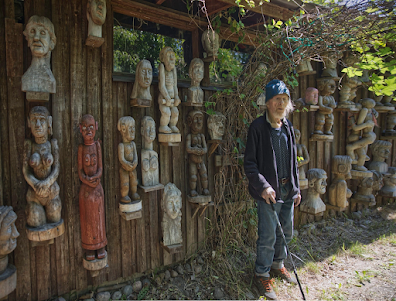
The image above shows the exterior of a studio of a non-professional visual artist, located in Vareilles, a commune with a little more than 200 inhabitants (2004) in the dapartment of Saône-et-Loire in France.
Life and works
The owner of the studio, Pascal Delphin, was born in 1959 or 1960 in Chassigny-sur-Dun, also a small community, about ten kilometers south of Vareilles.
this image and the next five as on Delphin;s Facebook
Little has been published about his life during the years before he grouped creations into art environments, except that he felt strongly drawn to making art.
Initially he focused on drawing, but as he grew older he found this too static an activity.
He began to develop a greater affinity with making sculptures, and more specifically making sculptures from recycled iron, where he was confronted with volume and movement and where he could rotate around the pieces being progressed.
In 2010, in his early 50s, he settled in Saint-André-d'Apchon, a commune in the Loire department with over 1,900 inhabitants (2022).
He had a house with a garden of approximately 1,500 m², which he gradually filled with iron sculptures, created by himself in his studio.
Drawing on the Japanese concept of gardens, he wanted to create a Zen space, the Ezen Garden, where visitors could wander freely.
He also attracted attention from the regional press, which described him as a highly original sculptor who, using ancient tools, could bring to life assemblages depicting Gallic warriors or metal samurai, unusual tractors, improbable boats and the like.
After living and working in Saint-André-d'Apchon for eight years, Delphin returned to his native region, moving into a vacant building in Verailles that would become his new studio and exhibition space.
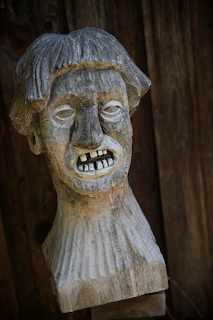
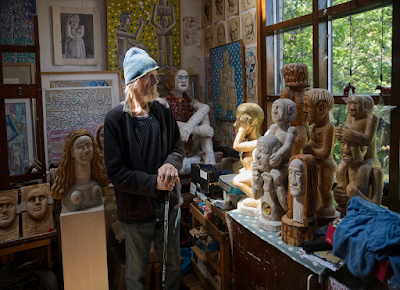
As can be seen in the very first image, the building is separated from the road by a green area, where several of his larger sculptures are displayed. Other sculptures, particularly the smaller ones, are also displayed in the spacious interior, which also serves as a studio
Here he continued his creative work, producing all kinds of iron sculptures as he had made in previous years, depicting people, means of transport, flower boxes, but also smaller models of animals.
The image below gives an impression of the studio/exhibition space.
all images are screenshots from the video in the documentation
The image above shows a shelter located near the Brwilno Nature Reserve in Płock, a city in central Poland.
This shelter, established in 1963, has been funded by church funds. It has a capacity of 140 residents and it primarily housed adults with intellectual disabilities and people unable to work, who came from all regions of Poland.
In 1998, the facility was publicly funded, the province became the owner and the shelter was renamed as the Social House. It appears to exude a welcoming, positive atmosphere, with many activities focused on the well-being of its residents.
In conjunction with such a heart-whole approach the Social House also has a sculpture workshop, where pieces of pine and lime wood are waiting to be transformed into creative works.
Life and works
Wlodzimierz Roston is a resident of the shelter who frequently uses the workshop..
Born in Warsaw in 1953, he has lived in the social house since 1975.
In the image above, one likely can see him working in his own room, which is adorned with all sorts of art objects.
Roston began his artistic activities in the 1980s, working with great intensity. Most of his creations incorporate a variety of colors, from dark tones to vibrant colors, as can be seen in the images.
He not only created paintings to decorate the interior of his room at the shelter, but he also made a lot of wooden sculptures, some of which are incorporated into the chapel of the Social House and many others were added to its exterior fencing.
These wooden sculptures are finished in a variety of different colors, in the personal, artistic style that Roslan gradually developed and for which he became known, even outside Poland.
Several of the wooden creations are made on round poles, which were available in the workshop of the House or which Roston collected himself in its green surroundings.
Some of these decorated poles were used to decorate the fence outside the Social House.
Individual pieces from his artistic output are included in various public and private collections in Poland, France, and the Czech Republic.
Włodzimierz Rosłon is one of three outsider artists who was launched in a project in 2021 aimed at raising awareness of the phenomenon of outsider art in Poland, a project with public events organized by Andrzej Kwasiborski and Radosław Łabarzewski.
Another artist in this project is Wacław Rędziński, whose work has previously been featured in an article on this blog..
Documentation
* Article(November 2021) by Radek Labarzewski on his website Znalezienie
* Article(October 2024) on Plock Weekly by Alina Szatkowska about the shelter, with a passage about Wlodzimierz Roston
Video
* Video ( YouTube , 6'49") subtitled in English, produced in 2021 and published on website Znalezienie
all images courtesy of Andrzej Kwasiborski and Znalezienie
The row of wooden sculptures in the image above was for many years part of an art environment in a small village in the Sieradz region of Poland.
The site had an outdoor space enclosed by a series of interconnected wooden sculptures and an interior decorated with sculptures, a coherent creation that is now part of the regional ethnographic museum.
Life and works
This art environment was created by Szczepan Mucha (1908--1983), who was born in the Polish village of Stępień.
Once grown up, he worked first as a woodcutter and later as a forest ranger's assistant. He lived in the small hamlet of Szale near Klonoa, in a farm-like house with a workshop and a large outdoor area.
While living there he had a painful experience that affected the way he dealt with the world. He was accused by neighbors of stealing wood, which led to an ordeal in which he was convicted and had to spend a time in prison.
Szczepan Mucha already liked to be alone and preferred working in the forest to being in the company of people, but after this profound experience he limited his contact with the outside world to a minimum
Later in life, in in the late 1950s when he was in his early 50s, he started making sculptures.
The surrounding images give an impression of the nature of his creations.
Working with simple tools such as a saw, an axe, a knife and a self-made chisel, he mainly made small-scale depictions in dark colours, portraying all kinds of people.
In 1972 his work was discovered by Zofia Neymanowa, an art historian and museologist of the same generation as Mucha and director of a museum in Sieradz, the capital of the department where Mucha lived.
The meeting with Zofia led to Mucha's development in the further 1970s into a valued folk artist. The recognition as an artist that Mucha received gave him great satisfaction and was proof to him that he was not the bad man as seen by his neighbors.
He now also went out, took part in competitions and exhibitions and sold his works to museums and private collections.
A decorated fencing in the exterior
A special element of Mucha's art environment is the way in which the fencing of the outdoor space has taken shape.
The images below show that the top of each of the vertical planks that form the enclosure, has the shape of a human head.
It is not difficult to see that such a palisade also expresses a deep separation between Mucha's world and that of his unfriendly neighbours.
The period in which Szczepan Mucha actively came out with his creative work and was a valued non-professional artist was between 1972 and 1982.
He died in 1983.
In the museum world of the Polish city of Sieradz, interest had already arisen in safeguarding the artistic legacy of Szczepan Muscha.
This idea was actually realized when an open-air museum was opened in the 1980s and between 1987 and 1991 the interior of Mucha's house and the processed planks of the fence of the outdoor area, were either rebuilt in or moved to the museum.
Documenation
* Entry on Facebook by Andrzej Kwasiborski, with a variety of photos
* Article on Polish website Pola Neis, with a variety of photos
* Video by Edward Konieczvy (2012, YouTube, 5'47") that shows footage of a visit to the open-air museum by members of the Department of Tourism and Ecology of the University of the Third Age in Ostrów, Poland
Szczepan Mucha
Decorated interior and exterior
Village of Szale, dept Sieradz, region Lodz, Poland
pictures are screenprints from the video mentioned in the documentation
Located in the department of Southern Finland, the community of Jaala was independent, with a population of around 1,900, until it was merged with five other communities to form the municipality of Kouvola, one of the larger municipalities in Finland with over 80,000 inhabitants.
The man with the chain saw in the image above, Seppo Laatusen, has an atelier in the area around Jaala where he creates wooden sculptures, which not only decorate the studio, but are also displayed in a 0,5 hectare large wooded area near his home.
Life and works
Seppo Laatunen, who was born in 1938, showed an artistic disposition in his early years, which was evident from all kinds of wooden objects that he made himself at a young age.
His mother, who had a hobby of making all kinds of drawings, recognized his talent for artistic work and she and her husband would have liked him to follow an art education, but their financial situation did not allow this.
A nice event in Seppo's early years reveals something of his way of doing things
At the age of ten young Seppo and his brother went to help their father with logging in a nearby forest. Father sawed and split, the brothers stacked.
Mother had been given them flour, a few litres of buttermilk and some plates for lunch. When it was time to eat, Seppo cut a big hole in a tree stump to mix flour and buttermilk in, causing his father who was watching, to burst out laughing.
After primary school Laatunen went to work as a contractor in areas such as earthmoving and forestry. He was involved in draining marshes and maintaining forests.
Once an adult, he moved out on his own and bought a house in a wooded area, located halfway between the hamlets of Siikava and Hartola, close to his childhood home.
Although Laatunen made creations during his working life, he was only able to fully realise his potential when he retired around the year 2000. In 2008 he built a spacious studio near his home, named Ateljee Pihkakov. where he could exhibit his sculptures. He also bought a half-acre piece of green area from a neighbour to display his larger creations.
The hundreds of wooden sculptures that Laatunen has created, cover a variety of themes.
There is an interesting collection of creations that depict public figures, such as the former Queen Elizabeth of the United Kingdom and the American politician Donald Trump, above.
Public figures from Finland. such as 11th president Tarja Halonen, and Juha Mieto, Finland’s skiing legend, just as well known personalities from other countries have been depicted also.
In the green area one can see a number of high rising sculptures that depict all kinds of personalities. some around four meters high.
Other sculptures depict animals, such as animals that live in the forest, but also crocodiles.
Most of the sculptures are of people or animals, but a small shed on the property contains a self-made wooden replica of a red car with an open roof, large enough for someone to sit behind the wheel. A surprise for a visitor when the door of the small garage is opened.
Documentation
* Article (October 2021) in newspaper MT Metsä (includes a 2.24m video)
* Article in a weblog about interesting spots in the community of Jaala
* Article on the website of the Finnish Association for Rural Culture and Education MSL
* Article on a regional edition of the AssociationMSL
Seppo Laatunen
Ateljee Pikhahovi
Ahvenistontie 28,
Hamlet Jaala, municipality of Kouvola, region Kymenlaakso, dept Southern Finland, Finland
images (by Veli Granö) published here in agreement with the Finnish Association for Rural Culture and Education (MSL)
Characterized by a large number of hand-made artistic items in both the interior and exterior, Heikki Merilainen's house is located in Hanko, a town with approximately 8,000 inhabitants on the south coast in the far west of Finland.
Life and works
Meriläinen, currently in his mid-80s, was born in 1938 on the other side of the country in Tuupovaara, a community in North Karelia in eastern Finland, near the border with Russia.
He grew up in a farming community, and because it was wartime, many young fathers had been drafted to serve in the military.
After primary school Meriläinen studied to become a construction draftsman and architect.
Once qualified, Meriläinen moved to the city of Hanko, where he started working as an architect.
The family lived in a house designed by Meriläinen and built with his own hands. It became a nice, light house with a studio, which he needed for his work. But not only that, he also had the studio because he had become interested in art and wanted to be creatively active. He had therefore previously taken a course by correspondence in art history and artistic design.
In his spare time he made sculptures, paintings and drawings.
Images in this article show some of the sculptures he made. All in all a considerable amount, not too large qua format, quite expressive and partly mounted on the wall of a shed near the house, a method of exhibition we see more often in Finland.
In his paintings and drawings he depicted Finnish landscapes that no longer exist in that capacity and also Finnish ways of life that are now lost, such as horses pulling sleds, however not in a nostalgic style, but rather with a timeless character.
Nowadays Meriläinen lives alone in his house.
Documentation
* Article by Heini Heikkilä on the website of the Finnish Association for rural culture
this photo and the next three (1981) courtesy of Francis David
as on the website Habitants-Paysagistes, Lille Art Museum
The image above takes us back to the 1980s, when the scene shown could be seen in Royan, a municipality in France, located on the right side of the Gironde River, where it flows into the Atlantic Ocean.
Life and works
The sculptures, that reside so casually on the lawn, were created by Frédéric Paranthoën (1902-1983) and were part of an art environment that for a large part also was displayed in Paranthen's house, located near the lawn.
This art environment has now disappeared and it is unclear whether there are any remains anywhere.
Paranthoën initially became a professional sailor, active in many countries around the world. Later he worked in sea fishing until his retirement in the mid-1960s.
As often happens with retirees, he now had time to focus on a hobby, which for him meant being actively involved in the creative field. He first focused on making small, often light-footed sculptures, made from all kinds of materials.
After some time he had produced about 400 creations, which were placed on various spots in his house.
Now that Paranthoën had found his purpose in making sculptures, he moved on to making larger creations from cement. As the image above shows, for this purpose Paranthoën had a well-equipped studio at his disposal.
He mainly created animals, such as small deer, chimpanzees, snakes, wild animals, antelopes, dogs and cats, but he also ventured into portraying women.
Although his house had a small garden, it does not appear that Paranthoën has provided it with a permanent display of sculptures. The lawn filled with sculptures in the first two images, looks like a public space, temporarily equipped with sculptures in 1981 for the purpose of making photos.
Paranthoën apparently preferred to keep his sculptures in indoor spaces.
The image below gives an impression of such an arrangement of sculptures indoors, perhaps in the garage belonging to the house. We see a large number sculptures of animals, and on the right some representations of ladies.
Paranthoën died in 1993 and it is now clear that his collection of sculptures no longer exists. The internet has no sources to tell what happened to them.
Documentation
* Entry about Paranthoën on the website Habitants-Paysagistes (Lille Art Museum), with photographs by Francis David
* Remarks about Paranthoën on the weblog of Bruno Montpied (In his book Les gazouillis des Éléphants, Paris, 2017, Montpied has devoted an article to this non-professional artist)
Frédéric Paranthoën
Sculptures in and near the house
Avenue du Maréchal Leclerc
Royan, dept Charente-Maritime, region Nouvelle-Aquitaine, France
Passing from the west the location signof the French municipality of La Roche-Guyon along the departmental road D913, one will see at the right the valley where the Seine River flows and on the left a large rock formation with several troglodyte houses.
One of these is the troglodyte studio of Christian Fournier, as depicted above. Behind the front there is a carved out space of 80 m².
this picture and the next ones courtesy of Jean-Pierre Simonin
Life and works
Fournier, who was born in 1953, at age 43 experienced a very special personal transformation in the mid 1990s. In brief: the personality he had until then disappeared and a new one emerged.
On the facade of his troglodyte studio this transformation is described as ma MORT ma deuxième Naissance (my death my second birth).
Before his transformation Fournier was a designer in an urban planning workshop, living in the municipality of Rueil-Malmaison, a suburb of Paris, located like La Roche-Guyon along the Seine River.
Being reborn, he had a studio in Rueil-Malmaison and when this studio in 2005 was no longer available, he found a new one, the troglodyte studio, in La Roche-Guyon, some 60 kilometers west. In 2019 the community had 479 inhabitants.
For Christian Fournier creating has become an existential element of life. In an interview he has said that he always feared falling into madness, that he constantly had to try to stay on his feet and that creating helps him in this regard.
His troglodyte studio should be a place dedicated to creation in the broadest sense, a refuge open to all arts, a place where visiting artists get inspired to shape what he or she has in mind. In short, an art environment that helps Fournier to create and also inspires others to do so.
Whether what is created should be something that is generally regarded as art is probably irrelevant to Fournier. His creative work always introduces a shift in reality and in this regard, he has the same attitude as the French painter and sculptor Marcel Duchamp (1887-1968).
Duchamp from 1913 turned the art world upside down with his bicycle wheel on a stool and later ready-mades, such as his well-known urinal. His name appears on the left side of the entrance to his studio, where an inscription says; Duchamp a tué sa mort (Duchamp has killed his death), a remarkable text, which could figuratively mean that Duchamp's death did not imply that he became unknown.
Apart from the many textual inscriptions that characterize this art environment and are mentioned in this article where appropriate, the main feature that distinguishes this art environment from others, is a large collection of books, many of which are used to decorate the walls of the studio and others are stored, sometimes in a specific manner.
Books as a decorative element
Fournier has understood that there are cultures where surplus books are not destroyed but buried.
The latter appeals to him very much and he has given the walls of his cave the status of a literary cemetery. Most books he collects by regularly going to a recycling center are hung there.
The arrangement of the books on the walls is based upon the author's nationality and faith. Symbols are used: a cross for Christianity, a Star of David for the Jewish faith and a crescent for Islam.
However, the books are not only preserved by attaching them to the walls, there are also other forms, such as the large box on the floor in a specific part of the studio that will be transformed into a chapel.
.
Iron objects
In addition to the books that are used as decoration, there are various iron creations that decorate the studio.
Collecting iron objects started when Fournier in his mid-40s picked up a piece of old iron from the street. With this gesture a new period in his life began: he started to collect all kinds of iron items, which he used as such as a decorative element, like the iron bench in the photo above, or transformed into something decorative as the same photo also shows.
The balustrade outside, above the entrance, has a variety of iron creations. One of these items is a radiant sun with a fan of gold-colored rays. Above the balustrade on the right there is a brown sign with the text: Maudits soient ceux qui s'assoient au banc des Rieurs (Cursed are those who sit among the laughers).
On the left side of the balustrade, on the white outer wall, difficult to distinguish in the image, there are two brown metal houses, which may have been intended as birdhouses.
Fournier also has acquired a second-hand fence decorated with Stars of David, which has been placed in his troglodyte studio, in addition to a variety of other iron items that decorate it's interior..
.
The chapel project
This project, which is under construction, started when Fournier managed to acquire a quantity of stones that were part of a former abbey. One of these stone elements has an inscription that reads Nous allons même quand mouvant vers la vie (We go even when moving towards life)
The stone elements are connected by a decorated iron fence, and behind the fence there is a large wooden box on the ground, which functions as a cemetery for a large number of books. On the short side of the box, farthest from the fence, there is behind a display of candles and similar attributes that are used in daily life to adorn a gravestone, the inscription La Littérature tue La Mort (Literature kills Death).
There is a space of a psychiatric nature with works by Freud, Jung and the like, and the intention is to arrange an installation in the form of a spiral staircase populated with persons such as Kafka and Nietzsche, who proclaim the Last Judgment.
It's the intention to illuminate the whole arrangement by a large sun, which can be compared with the sun that decorates the balustrade at the outside of the house.
The future of the site
To conclude this article, quoted below is the answer Fournier gave in the interview mentioned in the documentation when asked what will happen to the site when his project is completed. Referring to Paleolithic French cave paintings, he says: After me, I would like this house to become a place dedicated to creation of any kind. A refuge open to all arts, so that the guest artist can shape whatever he has in mind.
Documentation
* Article (undated) by Jean-Pierre Simonin, with a series of photos
* Article (May 2020) by Ariane Asaé on her weblog, with an interview with Christian Fournier
* Article (August 2020) about living and working in caves, including Fournier's, in Reporterre magazine
Video
* Video (2021, YouTube, 8'59") with Nanette, Odette and Valentina visiting the studio
Christian Fournier
Decorated troglodyte studio
rue de Gasny
La Roche-Guyon, dept Val-d’Oise, region ÎIe-de-France, France
this image and the next four by Marie Michélle, from her weblog
Montferrand du Périgord is an authentic old village with about 170 inhabitants, located in the south of the Dordogne region in France. There is a centuries-old castle and along the main street there are striking buildings, such as the town hall and a covered market hall.
Life and works
Nearby this market hall, along the main street, André Coudert (1928-2014) managed his village forge for thirty-three years, from 1956 to December 30,1989. He succeeded his father, Abel Coudert, who had taught him the blacksmith profession.
André Coudert was married and the couple had a daughter.
His forge worked in large part for the farmers in the area, who needed horseshoes for their horses, as well as all kinds of nuts and bolts for the stables. But residents of the village also had their wishes regarding fencing around gardens and similar facilities,
Coudert appears in this weblog because after his retirement he developed a special hobby, aimed at creating metal creations, mostly in the form of small characters, making use of the equipment in the forge that, also due to changed economic conditions, no longer had a business function.
He processed all kinds of metal elements he still had in stock or collected, such as lids, pans and cutlery, to make these characters, some examples of which are shown above.
All creations got a place in the forge and because Coudert preferred to keep what he created himself, this resulted in a colorful collection of a variety of characters, as can be seen in the very first image.
The collection became known locally as the Rintintins of the blacksmith.
In the early 20th century in France Rintintin was a popular name for young children's toy dolls. During the first World War, soldiers from the French army would wear small editions of these dolls as a mascot. Later in the 20th century, Rintintin became the name of a dog that played a role in American feature films.
Coudert considered the locomotive shown below to be the showpiece of the collection,
André Coudert passed away in 2014.
The image below, from Google Streetview, March 2021, gives an impression of the spot along the main street where the blacksmith shop was located. One gets the idea that seven years after Coudert's death, the situation around the forge with regard to the use of space was still the same.
The green fence, with metal decorations above and next to it, gives access to the courtyard where the forge was, and most likely still is located. A variety of metal decorations is also still present.
It could also be that the former forge still houses Coudert's metal sculptures, but nothing can be found about this on the internet.
Documentation
* Article (September 2010) Les rintintins du forgeron by Marie Michélle (mmf24) on French weblog Overblog
* Entry in the inventory of French art environments by Bruno Montpied, Le Gazouillis des Éléphants, Paris (Eds du Sandre), 2017
André Coudert
The rintintins of the blacksmith
Montferrand-du-Périgord, dept Dordogne, region Nouvelle-Aquitaine, France