Showing posts with label frescoe decorated exterior. Show all posts

November 28, 2025

Sylvain Corentin, Extérieur décoré / Decorated exterior


images are screenprints from the video in the documentation

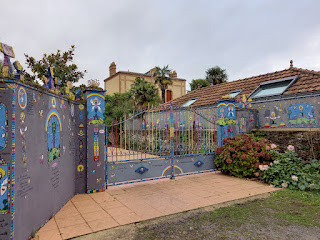
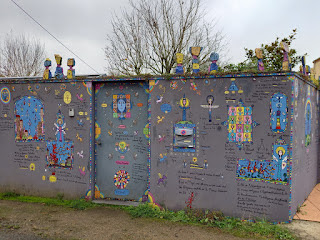
The image above shows part of a decorated exterior wall of a house in Prades-le-Lez, a commune of about 6,200 inhabitants located north of Montpellier, in the south of France.


These decorations were made by Sylvain Corentin, who was born in Montpellier on November 23, 1962, to a family with a somewhat controlling mother and a father who was a police officer.

As a child, Sylvain had a somewhat difficult time at school, which led him to withdraw into a fantasy world he depicted in drawings.

After his years at school, he went on to higher education, which was a liberating experience for him. 

He enjoyed musical groups and nevertheless managed to earn an art diploma.


After graduating, he worked in education and got married. The couple settled in Prades-le-Lez and had three children.

Corentin left teaching and, following his heart, became an artist.


In that capacity he initially made sketches on paper, but after some time he went in a completely different direction by beginning to investigate what it was like to make three-dimensional creations;

At some point he started focusing on creating all kinds of white tower-like structures, as depicted in the image below.

Sylvain Corentin explained his motivation for this: "I really want these towers to look like ephemeral dwellings. Ultimately, I don't like things that are too rigid. I love this hut-like look. Initially, humans integrated with nature by building ephemeral things, using what nature offered them".


Sylvain Corentin worked for several months at the International Museum of Modest Arts (MIAM) in Sète, which brought him into close contact with outsider art. He also met prominent artists in this field, such as Danielle Jacqui.

From that moment on, his work truly took off. 

He traveled to the United States, where he met a gallery owner in New York who specialized in American artists working in the field of outsider art. 

Since then, his work has been acquired by numerous American collections, and he has participated in exhibitions and art fairs throughout the United States.


His contacts with the world of outsider art most likely also led him to start decorating the outside walls of his house.

In any case, the style in which the decorations are applied to the outside wall of his house is such that a presentation of the decorated exterior in this weblog about outsider art environments seems appropriate,


Documentations
* Website of Sylvain Corentin
* Article (2025) on the weblog Tipeek
* Article  (2020) on the website Artistes de France, Occitanie
* Article (2019) on the website Hérault Tribune
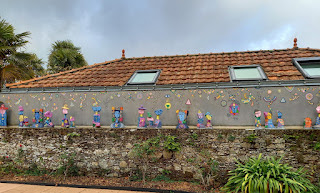
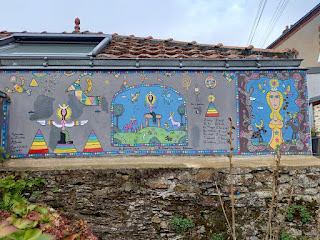
On her weblog (February 2026) Sophie Lepetit has a series of photographs of the decorations applied to the outside wall.

Video
* Video (9'58", 2023) on Facebook


Sylvain Corentin
Decorated exterior
76 rue du Puech-Marty, 
Prades-le-Lez, north of Montpellier, dept Herault, region Occitanie, France
decorations can be seen from the street

June 13, 2025

Joan Diaz, Casa Pratginestós / Pratginestós House.

all images (2014) by Marcel Albet, from his weblog, 
licensed under Creative Commons 3.0

The house pictured above, with its exterior walls full of decorations, is located in Llinars del Vallès, a municipality with some 9800 inhabitants (2018) in the province of Barcelona, ​​​​Spain, about forty kilometers north-east of the city of Barcelona. 

The house was designed by Joan Diaz, who moved in with his wife and two children, and in 1990 began a decorating project that he would continue for many years.


Life and works

Joan Diaz was born in 1941 in the French town of Montauban, at a time when his parents lived there as migrants, having fled from Spain because of the civil war. 

When the war officially ended in 1939, the family soon after his birth returned to Spain and so young Joan would grow up there.
From an early age Joan was attracted to art, he enjoyed painting and drawing, played the violin and the piano, sang in his school choir and played the organ in the local church at weddings.

However, he chose to study technical architecture and architectural drawing, but did not complete it, because he was able to get a job with the municipality of Granollers, which he would hold for 17 years, while at the same time he was working with his father in the family business of building grain silos.


In 1965, at the age of 24, he bought a plot of land in the municipality of Llinars del Vallès, which, like Granollers, was located northwest of Barcelona.

Joan Diaz had acquired sufficient knowledge during his studies in architecture to make the drawings of the design of his future house himself.

The top image in this post shows partly what he had in mind for the building to arise on the corner of three streets.


The front of the house with the main entrance is along the Carrer Carvantes. 

The right side of the house has a slightly receding side aisle, that faces the Carrar Jacint Verdagner and is separated from the street corner by a high wall, provided with a second entrance.

The left side of the house, not visible on the image on top of this post,  is decorated with a low transparent fence that runs from the main entrance to the second side street, the Passage Cervantes.

Behind this fence is an open area, separated from the Passage Cervantes by a stone wall as high as the iron fence, which continues up to the side wall of a neighboring house.

In 1969 the house was ready and Joan Díaz and Asunción Pantanigrós, whom he had married in the meantime, could move in there.

Although he undoubtedly thought about decorating the house, he was too busy in the first decades of his marriage to actually start doing so. The couple had two daughters and their upbringing required a lot of attention, as did the work he did for his father in addition to his own job at the municipality of Granollers

It was not until the end of the 1980s, when he was approaching the age of fifty, that he started taking steps in the direction of creating decorations by undertaking a pilot project. 

This worked out so well that he actually started decorating his house in the early 1990s, a project he continued at least until 2019, when he was approaching the age of eighty.


Joan Diaz created a series of increasingly complex and often large mosaic paintings on both the inside and outside of his house, an imaginative work with many trencadis and wrought iron elements, full of references to the landscapes of the region and to rural and traditional Catalan life.

His wife supported him in his creative activities and, not without reason, the neighbours and the municipality were also positive about it.

The website Artworks from Casa Pratginestós (see Documentation) provides an illustrated overview of what he created in the period 1990=2019.

Documentation
* Weblog (undated) Obras de Arte de Casa Pratginestós (Artworks from Casa Pratginestós) with 190 photos of the site selected by subject and yearof creation. 
* Article (2016) by Jo Farb Hernámdez on website SPACES Archive
* Article (2024) on website Rondaller
* Entry (2024) with a series of photos on the weblog of Marcel Albet
* Entry on the website of Tripadvisor wirh some 30 photos

Joan Diaz, 

Casa Pratginestós  .

Carrer Cervantes, 18, 

08450 Llinars del Vallès, dept Barcelona, region Catalonia, Spain

decorations can be seen from the street
interior is in general not open to visitors
Google Streetview: right side,of the property, left side of the property

March 08, 2024

Abbé Clovis Vannobel and anonymous workmen, Décoration du pavillon des Iris / Iris pavilion decoration

this image and the next two as on the website
Habitants-Paysagistes, published here in agreement with the
photographer Francis David

The facade decorated with a tree as shown above can be seen in a street in the municipality of Steenwerck, a little town with some 3400 inhabitants, located in North West France, near the border with Belgium. 

In the field of art environments the town is known for Arthur Vanabelle's La ferme aux avions (The airplane farm), a site located in the outskirts of the municipality until around 2015. The local Musée de la vie rurale (Museum of rural life) was donated a representative number of creations after Vanabelle's death.

The building with the decorated wall was built on the site of a hotel that was destroyed during the First World War. Subsequently, two breweries were built on the site, which went bankrupt during the Second World War. A director of one of the breweries had a country house there.

After the war, the complex was purchased by a social organization led by Abbot Clovis Vannobel, in order to establish there a rest home for women, initially only in the director's house, then also in one of the breweries after it had been renovated.

the abbot is depicted among the branches

The part of the rest home in the director's house was named Les Iris, referring to the numerous flowers of this species that bloomed in the nearby park-like grounds.

Restoring the facade

In the early 1970s, the facade of the Pavilion Les Iris was restored. Then it was given its characteristic decoration with a tree, an idea by Abbot Vannobel who saw the shape in his imagination.

Two workers, who did maintenance work for the rest home, helped realize the idea. The wall was treated with linseed oil and zinc white was used to make the wall nice and smooth. After the preparatory work, a sketch of the tree was drawn on the wall and colored in a dark shade against a light blue speckled background.

It turned out to be a successful project that is still present today.


After the rest home closed in 1976 due to financial problems, the municipality of Steenwerck became owner of the buildings. Some were converted into apartments and other accommodations. 

The Pavillon des Iris was completely restored and refurbished. Since 2010 it houses the regional tourist office.

Abbé Clovis Vannobel and anonymous workmen
Iris pavilion decoration
3 Grande Rue
Steenwerck, dept Nord, region Hauts-de-France, France
can be seen from the street


May 05, 2023

Henri Dalpez, Maison et jardin décorés / Decorated house and garden


photos of the site by Bouvet Hubert published here with
permission of the 
Inventaire général du patrimoine Hauts de France

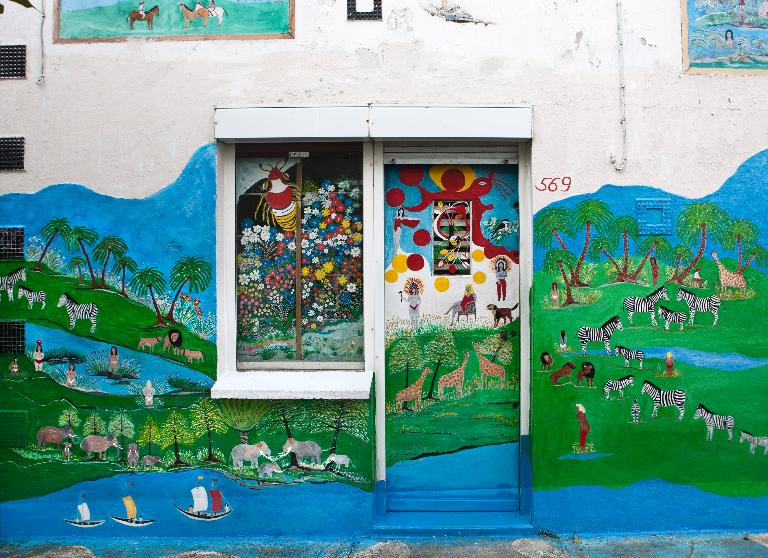
Henri Dalpez' decorated house and garden, depicted above, is located along a road just out Loos-en-Gohelle, a small town of some 7.000 inhabitants in the north of France, about 5 km north-west of the municipality of Lens, which has some 31.000 inhabitants.

The map below shows that Lens is located in the middle of an area referred to as Bassin Minier (Mining area) du Nord Pas-de-Calais.

screenshot from the video "le Bassin Minier Nord Pas de Calais
(YouTube, 2021, 5'13") by Lycée Saint-Cricq

The coal industry, begun in the 1850s, turned the landscape in this part of Northern France into an industrial area with many large buildings and installations of mining companies, many uniform residential areas set up to house miners and their families, and numerous high, hill-shaped mounds of industrial waste. 

In the 1980s coal mining was ended, which meant that the economy and employment of the area changed significantly and that many adjustments had to be made both on an individual and a collective level.

Life and works

Henri Delpaz was born in 1932. His parents had migrated from Spain to France, where his father had found work as an underground miner in Loos-en-Gohelle. The family lived in the house that Delpaz would later inherit and decorate.

In his early twenties Delpaz was drafted into military service to fight in France's war with Algeria (1954-1962). He then became an underground miner, and later established himself as an independent mason. 

It is not known in which years in particular he was in the military and worked as a bricklayer. But it has been reported that in 1959, when he was in his late twenties, he started decorating the house in Loos-en-Gohelle, where he meanwhile lived. It may be that at that age he was already working as a bricklayer.

the front side of the house, facing the street

Creating an art environment

The decorations in Dalpez' art environment include paintings on the exterior walls and small sculptures and other items in the area around the house.

The image above shows the entrance to the house, facing the street. The murals to the left and right of the window and the door show that Dalpez' work can be lighthearted, with pastoral scenes of animals in a green environment, probably in Africa, with zebras, lions and giraffes. The appearance of the lower part of the entrance door is in line with this.

The painting to the left of the door shows a tree trunk in front of a richly decorated shrub. 

It's a special feature of this art environment that the windows of the house became  part of Dalpez' creative project by filling these in with painted panels. In that way no one could see in, and vice versa, of course .....


The image above gives an impression of the decorations on the upper right side of the front wall of  the house. Compared to the other decorations on the front of the house, these are much less atmospheric and illustrative, especially the images of human characters.

The faces that Dalpez painted on the wall often have open mouths, which may be intended to express happiness or surprise. Near the faces are also some numbers, the meaning of which is unknown (a referral to addresses along the street where Dalpez lived?).

The image of a ship in choppy water, at the left, brings back something of the atmosphere that radiates from the front of the house.  Encased in a frame, it looks like a hung painting, but the image is painted directly onto the wall.


Another painted part of a side wall, as shown above, has because of the palms, the zebra and the foliage above, much more the atmosphere of the the lower part of the front wall at the entrance of the house.

The window in the middle is once more provided with a panel that closes the view. It is painted with two faces looking out through a grid of horizontal and vertical iron wires.

And once more there is a lady with an open mouth.


That open mouth, well, maybe Dalpez didn't have any explicit intention with it at all, maybe his way of designing was just how he saw people's faces.

This typical mouth is also present in a number of stand-alone sculptures which colorfully and rather expressive depict various personalities. With their lower bodies resting on a pole, they are arranged in the area around the house, one character guarding the mailbox.

Some sculptures have a number, but it is not known whether this refers to specific persons, just as there is no information available about who or what these sculptures could represent.


In June 2021, Sonia Terhzaz, a Paris-based author of a website with accounts of her visits and conversations with creators of art environments in France (see documentation) visited the site. 

Henri Dalpez, now 89 years old, said he had not maintained his creation for several years, and that in his opinion the paintwork was quite ugly as a result. He couldn't understand why someone would come all the way from Paris to see this work and have a conversation with him.

The view of Dalpez's house on Google streetview, dating from September 2022, at the bottom of this post, shows that the decorations have somewhat faded over the years, but that it is still possible to get an impression of the artworks.

An uncertain future

In correspondence with the Inventaire général du patrimoine, conducted in late April 2023, it is noted that Henri Dalpez's house is no longer inhabited. Searching the local press for more information on this unfortunately had no results.

There is also no mention of activities aimed at preserving the site. There is a good chance that the decorations and small sculptures will be lost.

Then all that remains is the memory of a colorful creation, as reflected for example in the image below.


Documentation
* Article (2021), with a report of her visit to the site and meeting with Dalpez, by Sonia Terhzaz on her website Cartographie des Rocamberlus, 
* Article in  l'Inventaire général du patrimoine des Hauts-de-France  (general inventory of Hauts-de-France heritage)

Henri Dalpez
Decorated house and garden  
569 Chemin des Croisettes
62750 Loos-en-Gohelle, dept Pas-de-Calais, region Hauts-de-France, France
can be seen from the street
Google streetview (September 2022)

April 15, 2022

Josep Amenós Felip, Parc de les rodes / Tire park

pictures are screenprints from the video by Turisme Urgell 

About 130 km west of Barcelona, Spain, is the village of Sant Marti de Maldá. Along with several other villages, since 1972 this community has been part of the municipality of Sant Martí de Riucorb, located in the Urgell region with Tàrrega as its capital.

Josep Amenós, an inhabitant of Sant Marti de Maldá, owned an area outside the town which he transformed into an art environment, that he recently donated to the community. Here is the story. 


Life and works

Josep Amenos Felip was born in 1934 into a farming family with a farm in or near Sant Martí de Maldà. He was the youngest of two sons, both of whom would remain unmarried and would continue to live on their parents' farm.

However, after his primary education, Amenós lived for some time in the town of Tàrrega, also located in the Urgell region, where he worked at a company that manufactured rabbit cages. Since he from an early age showed a certain artistic ability in making drawings, he took the opportunity to take drawing lessons at the School of Arts and Crafts in Tàrrega


However, a career as a professional artist wasn't in the offing, as it soon became obvious that his future lay in running his parents' farm together with his brother.

The Amenós brothers ran the family business successfully. They were willing to work hard and live frugally, what allowed them to expand their land holdings with excess income. One of those areas was a piece of land about 2 to 3 km north-west of Sant Marti de Maldá, which had previously been used as an orchard with almond trees, but meanwhile had become neglected and was used as an illegal waste dump.


In the late 1990s, this piece of land was to be transformed by Josep Amenós into an art environment. He was now 64 years old, probably retired, as well as his older brother. (His mother had died in 1993 and his father in 1994).

The project started with refurbishing the neglected grounds, then he went on to work on the decorative elements, which can be distinguished in wall drawings, sculptures and installations/structures.


With regard to structures and installations, first mention should be made of the old barn on the site, which Amenós converted into a chapel, richly decorated on the inside and with a large stone cross on the outside. The roof of the chapel is decorated with a car tire structure, two horizontal and one upright, as can be seen in the second image from above.

As is also apparent from the name by which the site is often referred to, Amenós made extensive use of old car tires. This not only as a decorative element, as in the chapel and in the picture below, but also functionally to create stairs to overcome height differences. The use of the many old car tires initially met with objections from environmental defenders, but later they realized that in using the tires, this waste had been properly disposed of.

As for the installations, an aircraft resting on a wall of bulky stones, stands out, as in one of the images above. The available documentation doesn't state why this aircraft is part of the decorations.


The park includes some sculptures, such as the character in the image above and a (two-dimensional) peasant couple located at the entrance of the park, but the largest number of decorations are drawings applied to the rock walls. 

Near the entrance of the site are a number of large stones in a circle, with numerous carved images, such as the Titanic and an airplane. The rock walls in the rest of this art environment are richly provided with all kinds of images that often refer to life in the countryside, depict biblical situations, or deal with all kinds of other themes.

The drawings are often executed in a black shade, which contrasts sharply against the yellowish color of the rocks.


In December 2018, Amenós donated the site with the art environment to the community of Sant Marti de Malda, this on the only condition that a rental income would be used for its maintenance. As related,  his father and mother died in the early 1990s. In 2015 his brother had died and there was no other family.

The municipality accepted the donation with approval and appreciation. Because there was still an ongoing lease contract, the village became the actual owner from 2021, but preparations were already made from 2018 to give the park more publicity, such as signage and expansion of bungalows and the like of the campsite near the park.

Amenós, who is now in his late eighties and has become less energetic, has ended further expansion of the art environment.

Documentation
* Article by Jo Farb Fernandez, "In northeastern Spain, a self-taught sculptor-architect has created an open-air, art-filled refuge", in Brutjournal (January 2022) (First published in September 2021, Brutjournal is a new web-magazine in the field of outsider art, with articles accessible to subscribers)
* Article (December 2018) in regional newspaper Segre Tàrrega
* Article (December 2018) in the newspaper of Urgell TV, with video
* Location of the site on Wikiloc

Videos
.* Video by Turisme Urgell on YouTube (undated)


Josep Amenós Felip
Parc de les rodes
Sant Martí de Maldà, county Urgell, region Lleida, Catalonia, Spain 
visitors welcome
streetview, with a variety of photos

January 14, 2022

Jean-Paul Baudoin, Maison décorée / Decorated house

pictures courtesy of Sophie Lepetit, from her weblog

Trentemoult is a small commune in France, located along the left bank of the Loire River, near the city of Nantes, which lies on the right bank. In a street in Trentemoult there is a house that has an exterior that is decorated with a variety of frescoes and sculptures.

Life and works

These decorations were added by Jean-Paul Baudoin, who lives in the house and has his workshop there.


Life and works

Baudoin was born in 1946. His father was a butcher who ran a shop on Place Delorme in Nantes, France.

After completing his primary education, Jean-Paul went to work in his father's business. He did so, although from a young age his heart went out to drawing and painting. Being active artistically was therefore an activity for the evening hours.


It is not known how long Baudoin combined his daily work in the butcher's shop and his evening creative activities, but at some point there was an intervention by a cousin who urged him to follow his heart, so actually entering the world of art and becoming a practicing artist.

Baudoin followed suit and probably in the late 1970s/early 1980s he began to manifest himself as a sculptor, painter and artisan potter.


As a potter, a craft he still practices, Baudoin focused on a style of work known as Old Quimper, creations of vases, cups and saucers decorated with hand-painted characters ("petit Bretons") in a style strongly influenced by traditional Brittany.

By working as potter he rediscovered the nature and meaning of the creative process: an  activity through which a living form springs from formless, inert clay.


In his fist period as an artist Baudoin also began making metal sculptures composed from pieces of iron or old tools welded together and finished with a cover in bright colors.

In 1987, when he was in his early 40s, the first exhibition of his artistic work took place from his home in Trentemoult.

From 1991 Baudoin also began making colorful images on cardboard and recycled paper, evoking, for example, a whole world dedicated to pagan female deities, such as Isis and Ishtar, but also fairies, mermaids and the heroes of the Arthurian legend.

Perhaps the early 1990s were also the time when he started to decorate the outside walls of his house (sources on the internet are inconclusive), because among the images several are dedicated to goddesses. 

These goddesses appear in the midst of an extensive arrangement of all kinds of colorful, mostly small-scale characters, captured in sculptures or frescoes. With his sometimes magical and kabbalistic-looking images, Baudoin is an artist who expresses the unusual in forms that nevertheless feel familiar.


Documentation

* Article (January 2022) on the weblog of Sophie Lepetit, with a variety of pictures

* Photographs (January 2019) by Corinne Grassy Photography on Facebook

* Photographs and article (October 2011) by Claude Joannis on Flickr


Jean-Paul Baudoin

Decorated house

rue des 7 Maries

Trentemoult. Rezé, dept Loire-Atlantique, region Pays de la Loire, France

can be seen from the street

streetview

June 17, 2021

Danuta Szudzińska, Dom z freskami wewnątrz i na zewnątrz / House with frescoes internally and externally

above picture has a view of the frontside of the house
via streetview; the other pictures are screenprints 
from the video referred to in the documentation

The picture above shows the frontside of a house in the small community of Łanięta -some 600 inhabitants- located in the centre of Poland.

This is the house where until recently Danuta Szudzińska (1946-2021) lived, a self-taught artist who has become known because of the fresco decorations she added both to the exterior and the interior walls of the house.
.
Although the very first image is not very clear, one can see that next to and below the windows on the left, geometric decorations have been applied, while under the decorated balcony at the right a scene with a person on horseback is situated. 

The two images above show some details of the scenes on the facade, left a fresco of a man and a woman, situated on the balcony behind the TV-receiving dish. 

The image on the right shows a scene with a man on horseback, followed by a woman, both dressed in an oriental manner, perhaps depicting Mary and Joseph's flight into Egypt. The image under the balcony itself, apart from this couple, also has two giraffes on the left and on the right a large animal standing on its hind legs, perhaps a bear.

The image above, made in May 2020, portrays Danuta Szudzińska in her mid seventies. Little or no information can be found on the internet about her life and work.  

Radek Labarzewski, who made he video referred to below and visited her in May 2020, said that she created  for herself and her loved ones. He noted that Danuta Szudzińska wasn't hurt by criticism, but that she was happy when someone appreciated her creations.

Because there is virtually no information available about her, comments and explanations on the frescoes she made, are also lacking in the public sphere.

So although the following images give a good impression of Danuta Szudzińska's way of paining the frescoes on the indoor walls, the accompanying texts contain a lot of assumptions.

Above a scene of probably a father with his daughters. The father, perhaps in a peasant smock, stands in the center, holding hands with two girls to the left and right, and these three stand in front of a portrait of two more girls.


The scene depicted above shows a winter landscape with a man in a sleigh, pulled by a horse, with farmhouses in the background.


The scene above, on the wall behind the ascending staircase, shows two people in a pleasant encounter, with a tree on the left and a structure that resembles a mill on the right.

Other women who decorated their interior with frescoes

In the field of art environments in Europe, there are some more examples of somewhat older women who added frescoes to the interior walls of their house, such as Polina Rayko (1928-2004) from Ukraine, Enni Id (1904-1992) from Finland and Bonaria Manca (1925-2020) from Italy. With regard to all three artists, after their deaths or prior to that, activities have been undertaken to give their house, including the works of art therein, a protected status, this in order to preserve the site for the future.

As for Danuta Szudzińska's art environment, it has been reported that the family is of the opinion that the decorations should be preserved for the future.

Documentation
No articles about Danuta Szudzinska's work or similar resources have been found on the internet

Video
* Video on Facebook (0'.14") compiled in June 2021 with photos taken in May 2020 by Radek Labarzewski 


Danuta Szudzińska
Łanięta, Lodz region, Poland
no information available about visits by he public
some decorations can be seen from the street