Showing posts with label exterior decorated with woodcarvings. Show all posts

August 13, 2022

Evgeny Smolik, Дом украшен резьбой по дереву / House decorated with wood carving


this photo and the next one (2019) 
from newspaper HKK (Oleg Kuzmin)

The image above offers a view of the house of Evgeny Smolik located in Irbeysky, a rural community with some 1100 inhabitants, one of 43 administrative units in the Krasnoyarsk region of the Asian part of Russia ¹. 

With its covered entrance and specific roof structure, the building resembles a small church or chapel, but if Smolik built his house himself, as is not unusual in the Russian countryside, this design can also be seen as an expression of his creative attitude.

decorated fence in front of the entrance of the house

Anyway, this attitude can be seen very clearly in the decorations Smolik has added to the fence around the house.

The image above shows the fence, probably a part on the backside, with a door leading to an entrance of the house, which has been decorated with a depiction of Adam, Eve and the serpent.

The image below shows another part of the fence, perhaps located along the street because of the decorated letterbox on the right. This fence is also richly decorated, including angel-like characters equipped with spears on the left and right of the door, guarding the decorated entrance. 

part of the decorated fence outside
photo from website account.travel

Life and works

As for Evgeny Dmitrievich Smolik, there is no orderly biography available on the internet. He was born  in a community in the Krasnoyarsk region, presumably in 1958.

After school, he completed his military service in Kamchatka in Russia's Far East, home to Russia's Pacific submarine fleet, before returning to his native region and settling in Irbeysky; where he had all kinds of jobs, such as electrician, concrete worker, but also photo reporter and graphic designer.

It isn't clear when it was, but at some moment Smolik came into contact with someone who worked wood in a creative way. This appealed to him and he started working as an autodidact sculptor himself. As a self-taught artist. he would devote further life to woodcarving
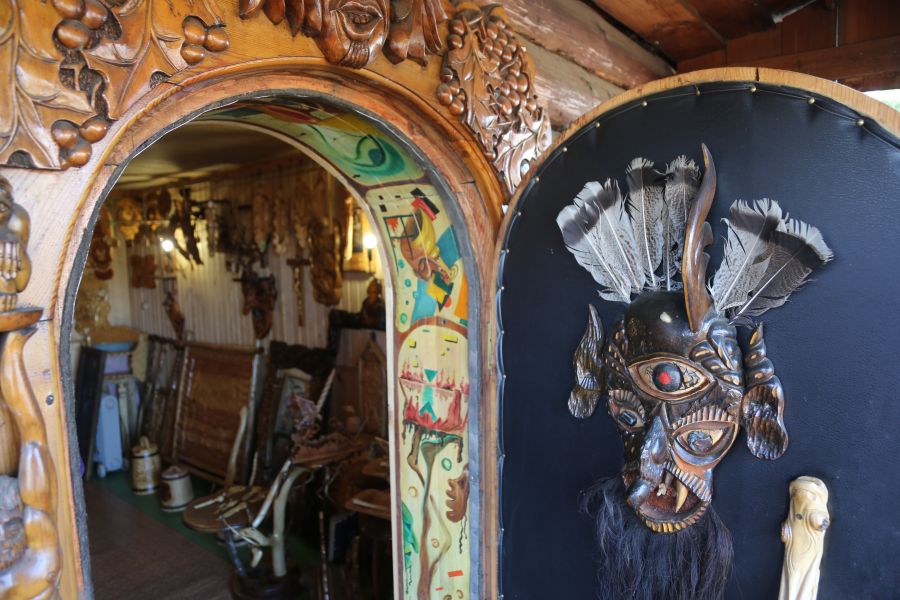
a decorated door and wall in the interior,
this photo also from newspaper HKK

He became an enthusiastic worker, taking care of everything that could be decorated with carvings. 

Not only the outside of his house was tackled, as already outlined above, nothing in the interior was also untouched.

There are large decorated panels, all kinds of decorated medallions and wooden sculptures, but also kitchen utensils and tables, chairs and cabinets were creatively worked.

this photo and the next three on artsphera

A clock on the wall in the bedroom is not just decorated with some motifs, but includes a carved portrait of Czar Peter the Great (1672-1725).


Smolik also had a personal sense of humour, what entailed for example that he made birdhouses with gloomy pirate faces, as in the examples above.

These and similar small-scale creations were intended for sale. For example, they were offered on the Artsphera website.


Other works of art by Smolik, intended for sale, had a more classical appearance, as can be seen in the above scene.

photo from livejournal
(museilesa-krks)

It is unclear to what extent Smolik's individual works of art have been included in an art museum. 

However, the chair as shown above, a luxurious wooden chair, carved from pine wood and decorated with intricate carvings, has been acquired by a museum, namely the Forest Museum in Krasnoyarsk, the capital of the region of the same name.

Documentation 
* Article (November 2019) in newspaper HKK 
* Article (March 2012) in Livejournal
* Article (May 2007) in newspaper Gazeta

note
¹ The reviews in this weblog relate to  art environments in Europe. Nevertheless, characteristic sites in the Asian part of the Russian Federation are also included, in order to give a balanced and coherent picture of the entire field of Russian art environments.

Evgeny Smolik
House decorated with wood carving
Irbeysky District, region Krasnoyarsk, Russia
exterior decorations can be seen from the street

September 23, 2017

Vitaliy Nikolaevich Cherepanov, Усадьба Черепанова / Cherepanov Manor


wooden ladies and the artist (2017)
this picture and the next two by Dmitry Moskvin

Three wooden sculptures of well-dressed ladies welcome visitors at Cherepanov's art environment which he began to create in 2001 when he got retired and settled with his wife in the community of Visim (Sverdlovsk region, Russia).

Life and works

Born in the late 1930s or early 1940s in Ilyinka in the Kirov region, Vitaliy Nikolaevich Cherepanov already at a young age showed a talent for creative as well as technical activities. Growing up in a rural environment in difficult times, as a young boy he for example made his own wooden toys.

As a young man he got a job as a tractor driver and mechanic in the agricultural sector, working there until he was conscripted in the military and for some four years was encamped in Kamchatka in the far east of Russia, where he was a mechanic on a submarine.


After military service Cherepanov settled in the 1960s in the city of Nizhny Tagil, an industrial center in the Middle Urals in the Sverdlovsk region. Here he got a job at a company in the field of metallurgy.

And here he also met his future wife, Nina Mikhailovna, who has an artistic talent in embroidery.


In his free time Cherepanov made wooden sculptures, paintings and decorations for the interior of his house. He also got some local fame by converting a normal Russian car (a Zaporozhets ) in a semi-sporty car of fairly modern design.

When Cherepanov got retired from work, the couple preferred to change the busy city for a more rural environment. So in 2001 they moved to the small community of Visim, some 50 km south-west of Nizhny Tagil (of which the village also is an administrative part).

Here Cherepanov found both the time and the space to fully express his creative talent. 

this picture and the next two from touristic website Go To Ural

Creating an art environment

Cheperanov's creative activities brought about a major transformation of his house and garden.

The elongated roof of the living house was fully decorated with a painting in pastel colors depicting a rural landscape.


The exterior walls of the house and the gazebo were decorated with a variety of sculpted woodwork.

There are illustrative scenes, such as in above picture the portrayal in high relief of a couple enjoying a drink, alternated with decorations with various geometric patterns, as often can be seen on old Russian farmhouses.

In front of one of the walls two life-size wooden warriors or guards with swords are posted.

a firebird

One aspect of Cherepanov's artistic activity gives this art environment its own specific signature: the series of life-sized wooden sculptures that are mainly derived from beloved Russian fairy tales.

So the various stories about the firebird, depicted above, often have to do with a hero leaving for a difficult quest after finding a beautiful feather of a bird.

this picture and the next two: edited screen prints
from the second video referred to in the documentation

And above pictured Pinocchio, originally a character in a book for children by the Italian author Carlo Collodi, published in 1883, also became a well known character, not least because of the Walt Disney movie that featured him.


Other wooden sculptures include personalities that mainly appear in Russian stories, such as the lady in above picture. With her purse and outdated hat she probably is the old lady Shapoklyak, a character in a story by Eduard Uspensky. Her name is derived from the French name for a specific hat: the chapeau claque.

The crocodile with the accordion probably refers to a fairy tale by Korney Chukovsky, published in Russia in 1919 with the title Приключения Крокодила Крокодиловича (The adventures of crocodile Crocodile).


Cherepanov's wooden personalities also include characters from daily life, such as in above picture, which might depict the local postman on his daily round.

Actual situation

Begun in 2001, the site currently has become an integral part of the local community. Cherepanov and his wife are respected inhabitants of the village and Cherepanov even was awarded the title of honorary citizen of the community.

The site attracts a lot of interested visitors, both from Russia and abroad, who often receive a warm welcome.

A museum ?

The village of Visim has touristic potential because of its history, its location near a nature reserve and its various sights. The community already has a house-museum, where the Russian author Dmitry Mamin-Sibiryak lived.

Local authorities have suggested that the manor could also become an official house-museum, but Cherepanov and his wife feared that this would oblige them too much and they rejected the proposal..

Documentation
* Article (November 2016) on touristic website Nash Ural
* Article (July 2016) on touristic website Ural Map, with a large series of pictures

Vitaliy Nikolaevich Cherepanov
Cherepanov Manor
Kalinina Street 64
Visim, Nizhny Tagil, Sverdlovsk region, Russia
visitors are welcome
images on Google Streetview

March 29, 2017

Vladimir F. Akulov, Дворец короля / Palace of the king


this picture and the next two from Russian social media
without any referral to the photographer(s)

In the small community of Klimovo in the Bryansk region of Russia -bordering Ukraine and Belarus- a modest house has been transformed into an art environment with so many baroque adornments that it was referred to as the Palace of the king or as the Bryansk Hermitage.

Life and works

This Palace is the life work of Vladimir Filippovich Akulov (around 1929-around 2012), who only had four years of primary education. 

Already as a young boy he felt attracted to wood carving and when he and his mother for some time stayed in Ukraine, he carved small wooden items such as toys, planes and cars, which he sold on the streets to earn a living.

Akulov was conscripted in the military, serving in the Sakhalin area in Russia's far east and after this time in the army he settled in the 1950s in Klimovo, where he got a job in a local cannery. 

Akulov's house in Klimovo
with woodcarvings on the exterior wall

Although Akulov in the 1950s and 60s continued making wood carvings and he probably also single handedly constructed furniture for his house, it was in the early 1970s, when he was around age 40, that he seriously began transforming the house into kind of a palace. 

In an interview published in 2003 he says that he began when he had seen woodcarving in the neighbouring town Novozybkov. However, in another interview in 2005 he said that one day when he was waiting for a train in the Kiev railway station in Moscow he was struck by the decorations on the walls and the ceiling of the building and felt inspired to do something similar at home.

Maybe both happenings inspired him, the first one may have encouraged him to make wood carvings to decorate the house and the second one to make "baroque" decorations on walls and ceilings.

Akulov in his workshop

How this may be, Akulov -using photographs in magazines as inspiration and example- went to work and started a project to decorate the various rooms in his house in a "baroque" style, or rather his own version of it. He would be working on this project for some 35 years.

Walls and ceilings of the rooms got decorative elements such as mirrors and paintings which were encased in gilded carvings. The paintings displayed on the walls and ceiling mostly haven't been made by Akulov, but by his father Filippa Artemovicha Akulova or his friend Victor Kurusya.

The furniture included consoles and many distinguished chairs, all richly decorated with gilded carvings.

The most important chair was a smaller copy of the throne of Catherine the Great, crowned with the double-headed eagle, main element of the coat of arms of the Russian Empire, abolished with the 1917 Revolution and restored in 1993 in the coat of arms of the Russian government.

this picture and the next three by Gennady Mikheev

Above picture shows Akulov seated in this chair with some regalia of Tsarists Russia: a crown, a scepter which symbolize authority and a small globe with a Christian cross on it which symbolizes the territory.

floor with inlays (and dogs)

The floors also contributed to the atmosphere of the house because of the inventively laid parquet, decorated with circularly arranged inlays.

It is not surprising that some dogs are seen in the picture above, because Akulov would take care of stray dogs, who sometimes stayed in the house with some ten at a time.

decoration on the exterior wall

The blue wooden exterior wall of the property was covered with a rider fighting a dragon. The wall also had prancing deer.

part of the decorations

In the early years of the 21st century, when the artwork was almost entirely completed, the site got nation wide publicity (see documentation). It became known and attracted visitors both from Russia and other countries.

Although his wife had left him because she didn't like that her husband opened the conjugal home for all types of visitors, due to all interest in his life's work, Akulov may have experienced the years between around 2003 and 2010 as a somewhat glorious period.

In the early 2010s Akulov's health deteriorated. He could no longer take care of the site and it's neglect began.

He died around 2012.

Akulov had a daughter and two sons and one of the sons took up residence in the house. After some years this son sold the property to a couple that renovated the neglected house.

Documentation
* The earliest review I found on the internet dates from January 25, 2003: T. Shubin, Filippych Pervyy (Filippovich First).
* Another review of early date (2005) is: Maria Chernitsyn, article in the journal Moskovsky Komsomolets, no 1515, February 26, 2005
* In 2016 the site got publicity on Russian social media. such as this post on Yaplakal.com, edited as if the artist was still alive

Vladimir Filippovich Akulov
Palace 
Klimovo, Bryansk region, Russia
actual situation unclear

August 20, 2013

Josef Mach, Machuv vcelin / Mach's apiary


all pictures courtesy of Pavel Konečný

The small community of Kruslov, south of Prague, in the South Bohemian area of the Czech Republic, houses a very special  art environment, with a colorful decorated exterior and an interior with a large variety of woodcarvings, all created by a self-taught artist.

Life and works

Josef Mach (1929-2009) decided to earn his living as a professional beekeeper, so in 1948 he built kind of a barn, an apiary, some 25 meters long, where he installed some 65 beehives.


Mach has provided these beehives, like all other buildings on the premises with colorful decorations, mainly in primary colors, depicting in a folk art, but rather personal style facades of houses, barns, and other elements of Czech social life and historical tradition.


The totality of these decorated beehives and other built structures on the property has become a festival of colors, which evokes and pays tribute to places of interest and landmarks of the Czech Republic.


Mach was a gifted wood carver too.

Related as he was to the world of bees, he produced a large collection of wood carved bees.

He supplied furniture in his house and tools in the workshop with wood carved decorations, but most of his sculpted legacy includes a large collection of stand-alone works of woodcarving, such as wooden sculptures of saints, wood carved shrines, various chairs and tables, frames of mirrors and photo displays, all located in the property's living area.

After Josef Mach died, probably there were no heirs who wanted to live in the house. 


In order to prevent that the interior and exterior collection of outsider art would fall into oblivion, an organisation of friends was formed which aims to preserve the site for the future. This association already has ensured the necessary repairs.

Documentation/more pictures
* Website of the association of friends
* Pavel Konečný and Šimon Kadlčák, Atlas spontánního umění (Atlas of spontaneous art), Prague, 2016 (ISBN 978-80-906599-1-9). p. 24-33

first published August 2013, last revised February 2020

Josef Mach
Machuv vcelin
Kruslov 24
38719 Cestice, Strakonice district, South Bohemian region, Czech Republic
can be visited in summer months, 10-18, except Monday