Showing posts with label shell decorated garden. Show all posts

October 17, 2025

José María Pérez Ruiz, La Casa Barco España / The house "Barco España"

this image and the next six courtesy of Jo Farb Hernandez
see Docementation 

Almuñécar is a Spanish city with some 27.000 inhabitants (2024), located along the Mediterranean sea, in the southwestern part of the coast of Granadina in the province of Granada.

This city was the hometown of José María Pérez Ruiz (1937-2025), also affectionately known as Pepe Pérez.

If you're wondering what the image of a ship has to do with where he lived.. .that ship was his home !

Life and works

Pepe Pérez' was conceived in 1937 when his father, who had a job as a barber, was on a short leave from military service during the Spanish Civil War.

At age twenty-two he joined the Merchant Marines, a choice that would have a major influence on the rest of his life.

In 1967, thirty years old, he married María del Carmen, who worked as a teacher, The couple would have two daughters and a son.

From his early years, Pérez was professionally connected with the shipping industry, a connection so strong indeed that it could be said that his heart lay in life at sea. 

His favorite saying was, “My ship is my treasure, my god is freedom, my law is strength and the wind, my only homeland is the sea.”

Pérez's dream was to build a house in Almuñécar that would always remind him of his connection to the sea..

He succeeded in realizing that dream, because in early 1970, with the help of a cousin, he began building a house. It was a unique construction in the shape of a 75-meter-long ship, full of nautical details, located along a road to the nearby popular beach of San Cristóbal.


The building is filled with maritime items, which Pérez bought here and there in ports, for example, when he heard that a ship was being scrapped. He acquired portholes, masts, ropes...... in short, all sorts of ship parts and instruments.

The interior of the ship that Pérez Ruiz constructed includes what you'd expect in a typical house: rooms, a kitchen, a bathroom, and so on.

It's not visible from the street, but behind the building there is a terrace with a swimming pool and a vegetable garden.

José Maria Pérez Ruiz passed away on January 9, 2025.


Documentation
* This art enviroment is introduced and analyzed in the book: Jo Farb Hernandez, Singular Spaces II: From the Eccentric to the Extraordinary in Spanish Art Environments. Milan: 5 Continents Editions, 2023 
* Article (January 2025) in Spanish newspaper Ideal
* Article (January 2025) in Spanish newspaper ABC de Granada

Video
* Video (2009, YouTube, 4'10#') by Canalsur, an interview with Pérez Ruiz


José María Pérez Ruiz
La Casa-Barco España 
Avenida del Mediterrano  34 
Almuñécar,  province of Granada, Spain
can be seen from the street

April 22, 2021

Shelleen, a shell decorated property

this photo and the next five by Richard Sutcliffe
licensed under Creative Commons

Of the five art environments in Scotland described in this weblog, included the one presented in this post, three are characterized by their proximity to the sea and their decorations with shells. 

In addition to Shelleen, reviewed here, the two other sites are a still existing house in Anstruther, decorated with shells by Alex Batchelor in the 1840s, and a site in Leven that has now disappeared except for a few decorated walls, made in the 1920s by William R. Bisset.  

The fourth site in Scotland is the Trail of wooden sculptures in the Cairngorms National Park, created by Frank Bruce, opened in November 2007, and the fifth is the house of Jim Donelly with an exterior decorated with protest signs.


The site named Shelleen is located in Clochan, a small community in Scotland, some 2.4 miles (3,8 km) south of the Moray Firth, an inlet of the North Sea.

Photos of this art environment -mainly presenting the decorated garden wall- are available on the internet, but reviews of the site are lacking so far. This implies that this post cannot mention who made this art environment. Thanks to a comment from someone who read this post, it is now known that decorating the site started in 1988.

There is a photo on the internet with a caption that assumes that the creation of the site began in 2000, but it is not clear what this is based on.

Anyway, the creation as such is impressive enough to appeal to a wide audience


Coming from the village of Clochan the site is to the left of the road, where a man-high wall is situated, for a part at right angles to the road, for another part parallel to the road.

Behind the wall are the garden with various shell decorated creations and the living house with accompanying sheds and work spaces.

The walls along the garden

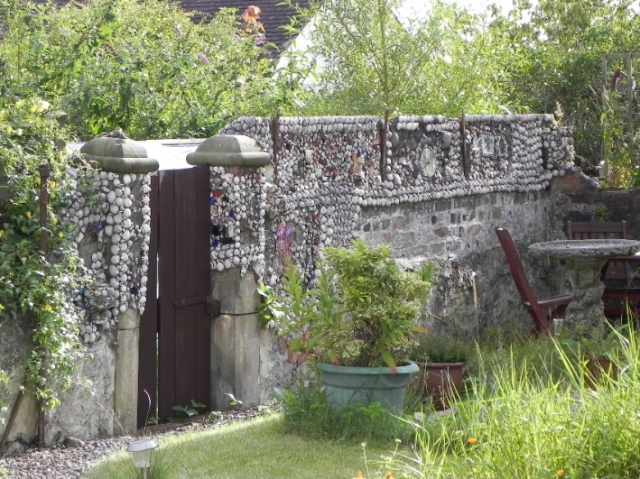
As can be seen in the very first photo, at the spot where the sides of the garden walls meet, a flattened piece of wall has -below some small-scale decorative items- the name of the site in blue letters: SHELLEEN. 

The top of this piece of wall is decorated with sculptures, a swan and two dolphins that are looking up at each other.


As can be seen in the picture above, the wall in front of the house at its left end has an entrance gate, which has been decorated with a variety of dinner plates and at the top there once more is a dolphin.

This wall as such is richly decorated with shells, including a large number of pink St Jacob shells.

There are also a number of specific decorations, as shown in the two detailed pictures below. 

a four-legged animal
a dolphin


On the left an image of what presumably once more is a dolphin, apparently a favorite item of the person who made these creations, and on the right a depiction of a four-legged animal, perhaps a horse.

The image below gives an another impression of the varied way the wall has been decorated.

this picture courtesy of Freya Pearce

The wall along the street is not decorated with shells. It's made of stone slabs and it turns into a wooden fence, which continues in a number of sheds at the rear of the house.

this picture (August 2011):
screenprint from Google Streetview

One of these side buildings is decorated with shells, as shown above.

The decorations in the garden

The internet only has a limited visual documentation of the creations in the garden. 

On Instagram (#shelleen) there is a series of photos, mainly of the decorations on the wall around the garden and a few of the decorations in the garden, such as a mill with four blades and a church with a spire.

this picture and the next one
courtesy of Freya Pearce

As can be seen in the picture above, this church is just behind the intersection of the two garden walls with the rising dolphins.


The image above depicts the church, constructed with a decorated gable roof, and both a spire and rear wall bearing a cross.

this picture (August 2011):
screenprint from Google Streetview

Although the photo above is not so clear, one can still see that the garden is enriched with an ensemble of houses and other buildings, all small scale, a kind of miniature village situated around a miniature lake, everything in the middle of a rich green decor of trees and plants

It's a pity that better images of the creations in the garden are not available, because it seems that this may mean that an interesting and nicely shaped part of this Scottish art environment will remain in the unknown.

Documentation
* Series of photos (2025) on the weblog of Sophie Lepetit
* Series of photos (2017) with explanation on weblog Last Alliance Studios (scroll all the way down)

Shelleen
Shell decorated property 
Clochan, Scotland, UK
can partly be seen from the street


January 24, 2020

Marsilio Raginni, Casa delle conchigli / Shell decorated house


unless otherwise indicated
the pictures (2017 and 2018) were published on Facebook 

Located along the coast of north-west Italy, the small community of Bellaria, part of the municipality of Bellaria-Igea Marina with some 17,000 inhabitants, is home to an art environment in the capacity of a shell-decorated garden. Like other places along this part of the coast facing the Adriatic Sea, Bellaria is a seaside resort, so using shells as decorative material is not surprising.

Life and works

The site was created Marsilio Raginni (1928-1996), who was a fruit and vegetable trader. He started the project in the early 1980s, when he was in his fifties. 

On the beach of Bellaria, especially if there had been a strong storm, he collected all kinds of shells, which he in particular used to decorated the exterior of his home. 


Above picture (via streetview) shows that the house is located on the corner of two streets  with a front and a side garden. These gardens are separated from the streets by a low fence, subdivided into numerous compartments, each with an arch full of shells on top. 

The access along the main street has a small building with a gable roof, which is also lavishly decorated with shells.


The garden itself has a variety of self-constructed objects, such as two water draw-wells, large flowerpots, statues of saints and representations of carts, pagodas, planes, coaches,.... all decorated with  shells, of course.


Along the tiled driveway to the garage Raginni has built an elongated covered exhibition space (picture above), where one can see a variety of replicas, in particular of religious buildings (Our Lady from Lourdes, Santa Rita da Cascia, Santuario Papa Giovanni) and houses, including the house where Raginni had spent his childhood.  


After Raginni passed away, his family took care of the site. In 2022 it was still in good condition, as seen from the street.

Documentation
* Article by Michols Mancini in local magazine Il Nuovo, November 2008, p. 10
* Beautifully illustrated entry about this art environment on website Costruttori di Babele, 

Marsilio Raginni
Casa delle Conchiglie
Via Nicolo Zeno 15
Bellaria, province of Rimini, region Emilia-Romagna  
can be seen from the street


September 21, 2015

Maria Rodriguez, El jardin / The garden

 
view from the beach

A house facing the beach in Guainos Bajos, part of Adra, a community of Almería in Andalucía, Spain, has a front garden which is fully decorated with structures embellished with seashells, shapely stones, plastic figures and various plates fitted with proverbs.

This is El Jardin, an art environment created by María Rodriguez (1936-2017).

Life and works

Her full name is María Ascensión Rodríguez Rodríguez. Born in 1936 she married in 1956 and had three children. All her life she was interested in art, which she gave way by collecting small sculpted items she bought in local shops.

 this picture and the next ones
by Eloy M. Muñoz Suarez

Around age 50, in the 1980's, this interest got a new twist when she began adding decorations to her garden, a plot of some 60 m² (646 square feet) that separates the house from the beach.

This garden became fully packed with Rodriguez' creations.


People who create shell decorated items in general use a cement mix to secure the shells. Maria Rodriguez prepared the cement herself by using sand from the beach mixed with cement powder and water. 

The base on which the shells and other elements were attached mostly had a pyramidal shape, which gave the collection its own characteristic appearance.


Rodriguez regularly patrolled the beach to collect additional decorative material, not looking for specific shells but just gathering what she encountered and what she liked..    

Plates with texts

Apart from a variety of self-collected sea-shells and other found items, Rodriguez` creation is characterized by plates that are provided with texts, such as proverbs, personal messages, warnings and other sayings.

Here are some examples:


No es mas sabio aquel que sabe muchas cosas 
sino aquel que hace muchas cosas con le poco que sabe 
The one who knows many things is not wiser 
then the one who does many things with the little he knows.


The text on the upper plate reads  

Pide a Dios que donde mires veas alegria
lo que toques sea amor
lo que sienta sea paz
y hacia donde camines sea la felicidad
Ask God that wherever you look you see joy
whatever you touch is love
whatever you feel is peace
and wherever you walk is happiness

The lower plate has a text that refers to a seat which is included in the structure: 

El que se siente en este sillon será bendecido por Dios
He who sits on this chair will be blessed by God

And finally this example


Mi felicidad consiste en que se apreciar lo que tengo 
y no deseo en exceso loque no tengo
My happiness is that I know to appreciate what I have 
and that I do not want  too much what I do not have

Maria Rodriguez passed away September 26, 2017. In the years that followed, family members maintained the garden.

Documentation
* Article by Jo Farb Hernandez  on SPACES website
* Article by Roberto Perez, "María Rodríguez: una escultura singular", in Bric-a-Brac (2018, nr 1)  
* Website of Spanish TV (August 2015) with video (cannot be embedded here)
* On the website of Sophie Lepetit a recent (October 2023) series of photos

Video
* Video by picon39 (4'13", YouTube, January 2008)


first published September 2015, last revised August 2024

Maria Rodriguez 
El Jardin
Guainos Bajos, Almería, Andalucía, Spain
can be seen from the beach

September 02, 2011

Sidney Dowdeswell, Mosaic and shell garden


picture (August 2005, Flickr
courtesy of Sally Lloyd

The small mosaic at the bottom of the tombstone, as in above picture, might be one of the few items left over from a lifetime of creative activity.

Life and works 

Sidney Dowdeswell (1884-1977), who lived in the small community of Hindlip, north of Worcester in England, UK, in 1921 began transforming the garden of his house into a mosaic and shell garden.

For around some forty years he has been active in decorating garden elements with shells and making various mosaic decorated items which he displayed in the garden. He would use all kinds of broken tiles, pieces of glass and shells.

In a comment on this post (May 2015, see below) the site has been described in this way:

"Peacocks, butterflies, birds of every colour all illustrated using tinted broken glass from bottles. Thousands upon thousands of sea shells, broken tile and household ceramic . This mosaic of material all set into a bed of mortar to form a forever work of art. Then there were fish ponds with a miniature bridge and water ways , hand made and painted garden gnomes and caricatures busily fishing. 

Arches and walkways, all splendidly patterned and illustrated beyond imagination. The remaining trunks of long dead trees brought to life with a shimmering cover of glass and shell while life-size storks observed through glass eyes the visitor exploring the tightest and most secret of the gardens corners. 

You walked pathway after pathway though this little slice of heaven and with each circuit found something new and unnoticed on a previous passing. This was all blended skillfully with a brilliant array of bedding plants and annuals". 

Indeed, in the English gardening tradition Dowdeswell also took care that the orderly arranged beds were full of blooming flowers and plants.

picture from UK newspaper Daily Herald (1962)


Since Dowdeswell's art environment hardly has been documented, just a few biographic details are available so far. In a comment on this post the information was shared that according to the 1911 U.K. census Dowdeswell worked as a house painter when aged 27 (More biographic information is very welcome !)

The artist and his garden have been portrayed in a small film news item (1962), which was archived on British Pathé and is available on their YouTube channel.

Sidney Dowdeswell died in 1977. He was 93 years old.

In the early 1980s the plot was re-developed by a project developer and the garden was demolished.

Old postcards traced (2015)

Above text was written in February 2011. In 2015 I found a couple of postcards, as republished below.


These picture postcards denote the depicted site as Harveydene gardens located in Droitwich Spa, so when I looked at these postcards for the first time, I thought they related to another art environment.


Further research, however, taught me that these postcards relate to Dowdeswell's garden. For example on the Pathé movie (link above) at 1'32" a butterfly mosaic appears that is similar to the one in the postcard below.


Droitwich Spa is a city that is located near the small community of Hindlip.

first published February 2011, last revised July 2017

Sidney Dowdeswell
Mosaic and shell garden
Hindlip, Worcestershire, West Midlands, UK
site doesn't exist anymore

May 13, 2010

Bill and Elisabeth Charge, The Watford Shell garden

pictures (around 1995) courtesy of Julia Elmore
Watford is a town of some 96.000 inhabitants in the county Hertfordshire, England, some 25 km Northwest of Central London. In the field of art environments it has become known because of the Watford Shell Garden, a creation by Bill and Elisabeth Charge.

Life and works

Bill Charge (1906-1987) was a baker in Watford. Around 1981, when he was at age 75 and retired, he and his wife Elisabeth began transforming the garden of their house into a shell decorated sculpture garden.

The couple decorated ornaments with shells and made sculptures by modelling these from concrete or by just covering dolls with plaster. These sculptures represented personalities like Humpty Dumpty, King Kong, Samson and such.


It has been reported that the couple created this art environment just to amuse the children in the neighbourhood. Visitors, especially children, were always welcome and invited to come in.

King Kong
After Bill Charge died (in 1987) Mrs. Charge has continued to take care of the garden. As the pictures, taken in 1995, demonstrate, in that year the garden still existed. 

The Raw Vision magazine of that time (issue #12) published an article about the site.

Mrs. Charge died afterwards and then the local housing authority, owner of the property, normalized (that is demolished) the garden soon after her death.

Watford remembers the site very well

There is a nice story associated with this art environment. End October 2016 the husband of a granddaughter of Bill and Elisabeth posted a message on the Watford Memories and History page on Facebook, asking -with a link to this post- if anyone remembered the decorated garden.

Well, thousands of people did and this resulted in over 6400 hits (in November 2021) of the post in the course of time.

first published May 2010, last revised November 2021

Bill and Elisabeth Charge
Watford Shell Garden 
Gammon's Lane 
County Hertfordshire, region East of England, UK
site doesn't exist anymore - but is in the memory of many Watford residents

November 11, 2009

François Bothorel, Maison des coquillages / Shell decorated house

pictures courtesy of the webmaster of the 
Plouescat heritage website (link not available anymore)

Plouescat is a seaside resort of some 3400 inhabitants along the coast of Finistère in Brittany, France.

Life and works

François Bothorel, who lives in this community,  has made something special of his house.


He has decorated its interior with shells he patiently collects on the local beaches. All walls have been decorated, but also many items that keep memories of local heritage alive.

For example, the shell decorated utensils on the picture above would be used in households to make butter: at the right there is kind of a centrifuge to separate milk and cream and at the left there is a device to transform the cream into the famous Breton butter (salted as preferred with salt from the salt cellar in between).

another exposition of utensils, a weighing machine, 
a wheel from a chariot and a ?
(it's a wheelbarrow...see comments) 

Bothorel also added shells to a number of machines that in former days were used on the farm, like the one in the next picture, a device to cut plants and other supplies to feed horses.


Update 2017

The first version of this post was published in November 2009. After that date, the internet had no new information about this site. 

picture (October 2017) by 
Tiramisu Bootfighter, Facebook

But then in October 2017 above photo was published on Facebook in the context of the project La Valise, a traveling gallery along France insolite, about which was reported on Facebook.

The picture shows a person seated at a table with a table top of Saint Jacob's shells. The bench has the same decoration. 

I automatically supposed the seated person was Bothorel, but Francis Davtd, who visited and wrote about many art environments in France, informed me that he recognized Pierre Darcel. also from Brittany.

Actual situation

So it turns out that in 2017 this art environment is still extant and it is likely that Bothorel by appointment still will welcome visitors who would like to take a look at his creations.

François Bothorel
14 lot Pont Ar Manach
29430 Plouescat, dept Finistère, region Brittany, France
can be visited on appointment

October 30, 2009

Pierre Clement, Maison Coquillages / Shell decorated house

pictures courtesy of Serge Passions, from his weblog  

Siouville-Hague is a small community on the Normandic coast in France. It boasts a very wide, sandy beach and in the 1970's French celebrities would stay there for a holiday. The beach is still there, but today's celebrities enjoy their fame elsewhere.

From an art environments point of view Siouville has kept its fame, because of a house and a garden decorated with shells that is located in the community.


Decorating the house and creating the sculptures in the garden was a project of Pierre Clément. He was a copper-smith in the region of Paris, who used the house as a holiday home. Currently Clément is retired.

Starting around 1997, the project took him about ten years.

Apart from Sophie Lepetit's weblog, which has a series of pictures (May 2010) of the site, there wasn't much information on the internet about this art environment.

first published October 2009, last revised January 2026

Pierre Clément
Maison des coquillages
11 rue des Frères Frémine
50340 Siouville, dept Manche, region Normandy, France

September 28, 2009

William R. Bisset, Shell decorated house

this postcard and the next two 
from Facebook (page Scottish Beach Find)

The above pictured shell decorated site, in the 1920s and 1930s a well-visited tourist attraction in the community of Leven, located along the east coast of Scotland, currently doesn't exist anymore.

Life and works 

William R. Bisset (1869-1964), an inhabitant of the community, in the 1920s began decorating his house and the ornaments in his garden with shells. He also installed a small menagerie with some monkeys and other small animals.

In 1927 the site was opened to the public and it was quite a success: every summer in the 1930s some 30.000 people visited it.


Bisset's son James, who continued the work of his father, got the idea to install a shell decorated old Leyland bus in the garden, probably as kind of a diner. (On Flickr there is a picture of the bus with a family in front of it).

After World War II, in the 1950s, the shell house and garden remained a tourist attraction.


The site has been removed

In 1978 James Bisset died. The inheritors wanted to sell the property, but there was no interest in buying a house with a shell garden, so the site was "normalized" and on the premises a bungalow was built.

The house itself, on the corner of Seagate, near the Promenade is still extant, but just with a limited number of decorations.

Here is a picture via streetview


And another one from a website about making walking trips:

picture from the website "The Airdrie Rambler"

So, apart from the few decorations which have been left, a full view of this art environment will be available only on postcards.

And it is still in the memory of older people who in their youth happened to visit the site.

Documentation
Except pictures on Pinterest etc, the internet hasn't links to articles or comparable documentation about this site

Video
* Video by Scottish Mudlarking (June 2020, 14'19", YouTube), mainly about gathering shells at the beach, but starting at 11'25" scenes of currently (2020) still existing shell decorations


first published September 2009, last revised July 2020

William R. Bisset
Shell house
Leven, Scotland, UK
site doesn't exist anymore