Showing posts with label memorial site. Show all posts

March 29, 2024

Dominique Zanardi, Musée de le Bataille de la Somme / Battle of the Somme Museum


this image from the Facebook-account of
Le Tommy, Café du Souvenir

At first glance, the building in the image above looks like an average café-restaurant, but upon closer inspection one sees that it not only bears the name Le Tommy, but is also referred to as Musée 1914-1918. 

The building is located in Poziéres, a village with a few hundred inhabitants in the Somme region in the north of France. More than a hundred years ago, this part of France was hit by the First World War, which in the Somme area was mainly a trench war. However, around Poziéres from 25 July to 7 August 1916 the war turned into a gigantic battle that led to many deaths and almost completely destroyed the village.

In the Somme area there are numerous memorial monuments and cemeteries dedicated to this war, Dominique Zanardi, owner of the café-restaurant, has made in his own way a special contribution to this series of places dedicated to memories of World War I.

a view of the area behind the cafe that was transformed in trenches
this image and the next six are screenprints from the 
first video in the documentation

Life and works

Zanardi was born in the early 1960s in Albert, a town located 7 km south-west of Poziéres. This city also houses an official Museum about the war in the Somme area.

At the age of twelve he started exploring the fields where the war had raged, in order to collect scraps of metal, which he sold to the local scrap dealer. That's how he got money to buy a nice moped.

On his trips through the former war zone he met visitors from England, who told him about the war that had raged there. They showed him the cemeteries and told him about the soldiers who belonged to their family. 

Young Dominique, who had learned some English at school, became increasingly proficient in speaking English and he got first-hand information about what had happened during those war years.


After his younger years he would continue to avidly collect items reminiscent of the war in the Somme region. Shovels, pieces of grenade, other ammunition, rifles, cannons, it became an extensive collection.

He went to work in the world of cafes and restaurants. The most important moment came in 1995. when he, around 35 years old, took over the Café de la Victoire, which had existed in Pozières since 1922.

Reopened in 1996 as Café-restaurant Le Tommy, this place, where visitors were welcome, offered him every opportunity to do something with his collection of memorabilia relating to the Somme war.


The indoor space became partly a museum about the war and the outdoor space was transformed into a faithful replica of a trench area.

The trench area

The four photos above and the three below give an impression of the outdoor area at the rear of the café-restaurant, where the world of the war is depicted on a life-size scale.


The image at the very top shows that the terrain is so extensive that the trenches, which include both those of Germany and those of the Allies, with no man's land in between, can be depicted realistically.

The next two images show a cannon and the collection of thousands of grenade casings, meticulously stacked together along a wall. The use of grenades during the battle in and around Pozières was very intense, sometimes 140 grenades fell in a single minute.

The next image of a soldier with a gun shows how much Zanardi was able to portray this person realistically. The barricades made of coils of iron wire in the following image also demonstrate this ability to express the reality of trench warfare.


Finally, the two images around give an impression of the way in which the trenches themselves are depicted. 

Here too, one is struck by the specific feelings of constriction that the creations convey.


The interior

The image below shows part of the interior of the museum attached to the cafe-restaurant. The walls are filled with gigantic black and white photos of soldiers and there are all kinds of weapons.

The bar in the the cafe-restaurant is standing on grenade casings.

Visitors from Australia

The group of Allied soldiers stationed near Pozieres during the Somme war, was part of the Australian army, which means that many of the visitors to the Café-restaurant/Museum are from Australia.

a view of the interior
image from the Facebook page of Le Tommy

Documentation
* Article (January 2018) in journal Ouest-France, with pictures of the site
* Article (February 2024) in journal France Bleu, also with pictures 
* Article on Wikipedia with details about the battle of Pozières
* Facebook account of Le Tommy, Café du Souvenir
* Tripadvisor has a series of photos of the café and the site 

Videos
* Video (2013, YouTube, 2'57") by Stuart Curry


* Another video (February 2024, YouTube, 4'25"), with recent scenes of the trenches


Dominique Zanardi
Musée de le Bataille de la Somme
91 Route d’Albert
80300 Pozières, dept Somme, region Hauts de France, France
visitors welcome

June 02, 2023

Restaurace a Veterán Muzeum, Tramvaj s figurínami / Tram with mannequins

all pictures thanks to Justyna Orlovska
from her website Off the beaten track

Valašské Meziříčí is a town with 22000 inhabitants in the west of the Czech Republic, near the border with Slovakia.

South of the municipality, along the main road nr 57, near a railway crossing, there is a complex comprising a microbrewery, a guest house and a museum-cum-restaurant (opened November 2015). 

On this complex, both outside and inside the buildings, a permanent exhibition of all kinds of vehicles and other items from earlier times has been arranged by the owners. The collection of vehicles includes two trams that were taken out of service after they for many years had run in the city of Ostrava, located some 60 km north-east of Valašské Meziříčí. 

Purchased in 2015, the two trams were transported by truck to the site, where they are now displayed as a prominent part of the overall exhibition. For the lover of trains and trams: these are trams of the type Tatra T3...

One of the two trams has something special: the rear vehicle is full of passengers, mainly mannequins that once filled clothing store windows and now, once again neatly dressed, occupy the seats of the tram.

It is a rather realistic scene. 

The very first image in this article in particular gives the strong impression that we see a tram with passengers, as they drive through a city every day. The degree of reality is greater than other doll sites in this weblog, for example Daina Kučere's garden with dolls in Sabile, Latvia, where the faces of the dolls are not as lifelike as those of the characters in the tram.

Visitors to the complex are not allowed to enter the rear tram, the front tram is accessible and photos of visitors sitting in the driver's seat can be seen on the internet.

The name of the person (or persons) who installed the figures in the tram and provided them with headgear and clothing are not available on the internet. There is also no information about the motives for decorating the tram with passengers. 


The same also applies to the question of what considerations led to the decoration of the site with sculptures of gods from earlier centuries

It seems that the most general consideration has to do with the desire to evoke memories of earlier times, for in addition to the decommissioned tram with mannequins, the complex offers many more exhibitions of such memories. 

For example, the restaurant is decorated with toys, bicycles, numerous models of motorcycles and cars from the past, all this accompanied by an inscription on the wall that says The Golden Sixties.

In an outdoor area is a stable with two horses composed of straw and three males, also made of straw, sitting on a bench, maybe an indication of the manpower and the horses that formerly were needed to to work the land belonging to a farm.


From the same point of view one can look at another feature of the complex, namely a collection of wooden sculptures. 

Probably professionally made, these sculptures represent characters from ancient times, such as Neptune, the god of the waves, Demeter, the goddess of the harvest, Hades, the god of the underworld, Artemis, the goddess of the hunt, and Ares, the god of the war.

The sculptures are displayed along the walls of the restaurant. Like the trams, these sculptures were probably bought somewhere; however, the internet has no information about this.


Documentation
* Article on the website of Justyna Orlovska, with a series of photos
* Article on the touristic website Turistika, with some 75 photos 

Restaurant and Veteran Museum
Tram with mannequins
Podlesi 547
75701 Valašské Meziříčí, district Vsetín. regio Zlín, Czech Republic
visitors welcome
Google Maps with more than 2000 photos of the site

August 05, 2022

Erkki Känkänen, Muistojen puisto / Park of Memories


except the picture of the church in Muolaa, all images are 
published here in accordance with Juho Haavisto, Association 
for Rural Culture and Education

The art environment Park of Memories, located in the south of Finland, includes numerous scenes that evoke memories of the time when the Karelian Peninsula was still part of Finland and of the experiences of all those people who lived there and had to evacuate because of the wars that started at the end of 1939.

Above pictured decorated wall, for example, refers to a war waging from 1939-1940, in Finland called the Winter War. It started at the end of November 1939, when Russia wanted to conquer the Karelian Peninsula, located in south-western Finland, bordering Russia. In March 1940 the combat actions ended in an armistice. 

However, on June 22, 1941, Germany launched an attack on the Soviet Union, which also led to Finland's war with Russia continuing on June 25, 1941, the so-called Continuation War. This war ended in a ceasefire in September 1944.

Peace negotiations started that resulted in a treaty in 1944, in which Finland had to cede large parts of its territory in he Karelian Peninsula to Russia and 440,000 Finns had to leave their homes.


Life and works

Among them was 16-year-old Erkki Känkänen (25-7-1927/7-7-2022), born in and living with his parents in Muolaa, a former Finnish municipality on the Karelian Peninsula in South Karelia. It was the second time the family was evacuated, because already in the 1930s, when the threat of war had increased, the Finnish government had ordered them to leave their residence.

After the first armistice in March 1940 the family, like many other.inhabitants, returned to Muolaa with the intention of resuming their former life and repairing the damage.Times were tough because of the Continuation War, with food shortages and rationing.The plan to restore the church of Muolaa, which was completely destroyed during the Winter War, came to nothing. 

In 1944 the inhabitants of Muolaa definitively had to leave their home and start a new life elsewhere in Finland. They first stayed in Sääksmäki, a village in Western Finland, but in 1948 moved to Forssa

the church in Muolaa before the Winter War
picture licensed under Wikimedia Commons

So it happened that in Forssa, a town of currently some 16.500 inhabitants in the Kanta-Häme region in the south of Finland, some 960 residents of Muolaa, the Känkänen family included, ended up and formed a close-knit community, currently still referred to as Pikku Muolaa (Small Muolaa).

In Forssa, the young Erkki Känkänen developed into a successful vegetable farmer. who introduced modern technology, such as cold stores. The farm was initially run by Känkänen and his wife Hilkka, also from Muolaa,  then his son Jari and his wife were in charge and now (2022) the third generation is at the head, Jari's son Essamati.


Känkänen was actively involved in the development of the local society, especially with regard to the position of the Karelian community

He was a member of Forssa's city council for 16 years, supported and did a lot of work for candidates for parliamentary elections and was active in the Karelian community, collecting stories and books about earlier times in Karelia.

In 1964 Känkänen was asked to organize a nationwide competition of a traditional Karelian outdoor game in the sphere of skittles (a game called kyykka), which would take place for more than 50 years.

From 1973, he was closely involved with Forssa's local Museum, which set up a particular space dedicated to Muolaa, including a large portion of rescued artifacts from Muoola's ruined church.

And then, in the early 1990s, when he was in his mid sixties, Känkänen decided to create a memory park in relation with his early years in Muolaa and the history and culture of Karelia.


Creating an art environment

Känkänen created his Park of Memories, an art environment full of artistic creations, emotion and information, on the site of his summer residence named Rajaranta, located in the community of Salkola near the Lake Salkolanjärvi, some 28 km south-west of Forssa in the Varsinais-Suomi region.

The images at the beginning of this article show a number of bungalow-style buildings. 

The art environment includes six of these structures, which were common in the Karelia of Känkänen's childhood. They are richly decorated with colorful scenes, offering a reminder of the former living environment to residents who had to evacuate.

replica of the former church in Muolaa

Among the first buildings Erkki Känkänen made for the memorial park is the iconic miniature version of the church in Muolaa, built from 1849-1852 and completely destroyed in the Winter War.

When constructing this replica, a project that took a year and a half, Känkänen flawlessly respected the proportions of the original. 

Twenty people can enter the replica of the church a the same time. Inside they can view photos of the ruins of the original church and other documentation, such as the sermons of Toivo Rapeli, the preacher attached to the church during Finland's war with Russia.


The images above and below show a horse and carriage in a stable. This ensemble symbolizes the journey the evacuees had to undertake, leaving their home and living environment behind, on their way to an uncertain future.

In the photo above there is also a kind of signpost on the right, indicating the distance from the site to towns and villages that were involved in the war in one way or another, such as the distance to Muolaa which is 371 km.


The horse pulling the wagon, as depicted above, was made by Kankänen himself and has a very realistic impression, which fits well with this scene depicting the journey of the evacuees.


This applies just as much to the person on the box, above left, who steers the horse and it certainly applies to the little luggage that could be carried, as in the image above right 


The red colored character in the image above is  a stylized Karelian cuckoo. 

Protected by an open wood and glass enclosure, the bird bears the coats of arms of all the municipalities that were part of Karelia ceded to Russia. It was quite a quest to find all those coats of arms, Känkänen is reported to have said.


The above image in all probability represents a memory of the Karelian lake Äyräpäänjärvi, because of the many birds that almost completely fill the sky above the lake. There are also numerous fish, swans and other animals present.

The lake, known for its rich bird life, borders the community of Muolaa where Känkänen was born.


Above picture portrays Känkänen seated on a bench in his Memory Park during in open day in July 2020.

Erkki Känkänen passed away on July 7, 2022, at age 94.

Documentation

* Article by Paula Susitaval, with images by Juho Haavisto. on the website ITE-taide in memory of Erkki Känkänen
Article (November 2009) on the page of Finnish broadcasting company Yle about Känkänen's first visit to his former home in Karelia
* Article (July 2022) on the Facebook-page of ITE-taide in memory of Erkki Känkänen
* Article (July 2020) on the Facebook-page of ITE-taide about an open day in July 2020 at the Memory Park, with a large series of pictures 
* Website Vihannestila Känkänen Oy of the vegetable farming business of the Känkänen family
Article by Eeva Suojanan (July 2007) in newspaper Turum Sanomat
Känkänen has written several books, mostly related to Karelia, such as: Karelianism the source of strength (2011), but also about his art environment: Rajaranta is the Karelia of Memories (2012)

Erkki Känkänen
Park of Memories
Salkola, region south west Finland, Finland
pending further notice about opening after Känkänen's death

July 07, 2022

Aleksander Alekseeva, Старый парк в Кабардинке / The old park in Kabardinka

the entrance of the site
this photo and the next ones, courtesy of Natalia Semchina 
from her page on the website tourister.ru

The old park is the original designation of an art environment that through numerous forms of architecture shows how much human culture is one and universal. This is manifested by the site, located in Kabardinka, Russia, on the coast of the Black Sea, which is filled with a variety of architectural items, all single-handedly created by Aleksander Alekseeva.

Life and works

Alexander Ivanovich Alekseeva saw himself as a writer from an early age and he already wrote adventure stories at the age of 10. After his primary schooling, he was trained as a gymnastics teacher, and, having completed his military service, he entered Rostov University, where he studied at the journalism faculty and became interested in philosophical literature.

After graduating in 1983, he was a journalist for several years, until in 1990 his parents asked him to assist them in the difficult time that perestroika brought them. In the village of Kabardinka where they lived, Alexander and his brother managed to set up a farm with a 20 ha site and gradually they overcame the problems.

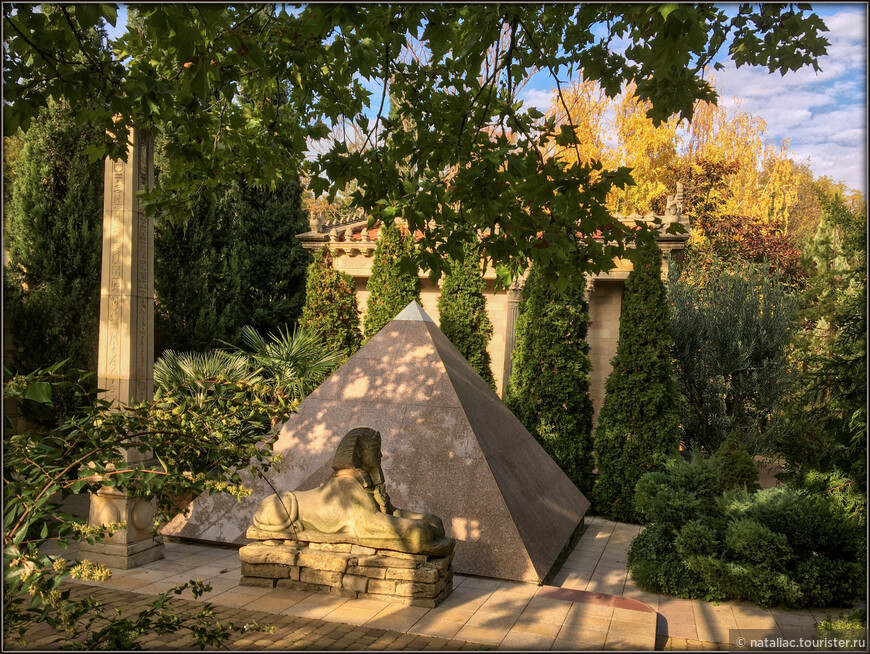
In 1994 Aleksander, using simple tools, processed a piece of marble into a sculpture of Voltaire, in this way entering a new, creative period. In the following years he made more sculptures and also a model of the pyramid of Cheops and a copy of the Sfynx.

scenes from classical Egypt

This was the beginning of the construction of a site presenting cultural traditions in various countries,  The Old Park, which would develop from around the year 1996 on a part of one hectare of the twenty hectares of land of his parents' farm.

Temple of Zeus
.
In 2004 the Temple of Zeus, as pictured above, with Aphrodite and Galatea, was built, completing the section dedicated to the classical antiquity of Egypt and Greece.

In 2006 the park was officially opened for the public


The period of the Middle Ages is manifested by a stone watchtower with a stone bridge, located over a pond that represents a moat.

The vantage point at the top can be reached via an internal spiral staircase.


Several other architectural creations followed, such as the House of the Caucasus (above left), which includes a museum that displays all kinds of things like weapons and hauberk. Another museum houses a large collection of paintings, collected by Alekseeva over the years.

Above right is an image of the chapel of Saint Nicolas, made in 2010.


There is also an ensemble focused on the Orient, with the House of the East, a Japanese corner and the aqueduct.

Part of it is the Indian fountain, pictured above. with four elephants, with their surf up, facing the four cardinal directions, holding a bowl of running water and a traditional Indian turret.
       

In 2013, Alekseeva for the first time had the idea to realize a theater. The project was started indeed and completed in 2017, an antique-style building with a 150-person theater hall, the first private theater in Russia, very suitable for small scale musical performances and plays.

And last but not least

In the above,  in a somewhat quick manner, a first impression has been given of a number of architectural creations that adorn the Old Park. Much had to be left unspoken, such as the lush growth of plants and flowers, which give the site a calm, beneficial atmosphere. 

And also, all kinds of details of the buildings were not discussed.

Hopefully the textual and visual information given in the article is sufficient to make clear what a special art environment this is, in terms of thematics, architectural design and perseverance of the non-professional artist who made all this.

And the plans for the future are already there. Alekseeva plans to add replicas of famous buildings from Russia. 
 
Selected documentation
* Article (January 2021) by Natalia Semchina, "The old park in Kabardinka - history, content and meaning", on website Tourister, with a series of photos
* Article (circa 2016) by Yuta Arbatskaya and Konstantin Vikhlyaev, with photos and a detailed description of the site
* Interview with Alexander Alekseev (October 2018) by Vladimir Nordvik on website RG.RU

Video
* Video (2019, 57'22", YouTube) with a detailed view of all parts of the park and Alexander Alekseev giving an explanation


Aleksander Alekseeva 
The Old Park 
Ul. Chernomorskaya 55
Kabardinka, region Krasnodarsky, Russia 
can be visited (entry fee)

August 29, 2021

Vangelis Vlepakis, Διακοσμημένες πέτρινες κατασκευές στον Κεφαλά / Decorated stone structures in Kefalas


the Monument of Kefalas
this picture and the next five
courtesy of Laura Piri from her weblog

Vangelis Vlepakis, an inhabitant of the community of Kefalas, located on the far east coast of the Greek island of Crete, as a non-professional artist has enriched the community with a number of shell and otherwise decorated stone structures, such as the Monument of Kefalas (as in above picture), a chapel dedicated to Agios Phaourios and a site named Love the forest. 

He also embellished the garden around his house with stone structures and other decorations.

Who is Vangelis?

The internet has just a few sources about these art environments and the non-professional artist who created them in general is just referred to as Vangelis. There is one source (on a geocaching website) which mentions a more complete name, which is Vangelis Vlepakis (O Erimitis). In this post the designation Vangelis will be used.

Born in Kefalas, in his younger years Vangelis lived for ten years in a cave by the sea, which he had furnished as living quarters with his own hands. He then lived and worked in Athens and returned to Kefalas around 1990.

Vangelis then began making creations from locally available natural stones and after a visit to Barcelona, where he saw Gaudi's work, he started decorating his own creations with all kinds of colorful elements

Vangelis is the curator of a museum located in the center of Kefala named Politistiki Estia Kefala (Kefala Cultural Center).

This museum, housed in an old building in the center of the village, displays all kinds of items donated by the villagers, such as photographs, examples of textile art and objects of daily life from a bygone era, that give and impression of life in the village in former times.

In an outbuilding farm implements and various tools are on display.

The Monumento Kefalas

This creation by Vangelis is located just outside the built-up area of Kefalas, along the road to Vamos. Texts on the structure welcome visitors to Kefalas, and because many tourists drive along this road, the Monument is relatively well known and many photos are taken.

The art environment includes a number of more or less triangular vertical stone structures, resembling facades of small chapels. These facades are provided with recesses in which smaller decorations can find a place.


The facades have drawings of stars and various inscriptions. One of these inscriptions mentions the year 1999, which could be the year in which the Monument was completed.

The art environment is not one whole, but it has different parts, each of which has been given a specific shape, such as the structure in the image below, which is composed of a number of tower-like parts.

In addition to the decoration with shells that is characteristic of the entire site, what is striking about this part of the creation is the decoration with blue pots, a decoration that also can be seen in other areas of the site.


The house of stone creations

The House of Stone Creations in Kefalas. where Vangelis lives with his wife Jan. is a special place.

this image and the next one screenprints
from the video in the documentation

The house was built in 1995 and over the next ten years the exterior around the house has been transformed into in art environment, full of stone structures with the same characteristic as the Monumento Kefalas

The house is also referred to as Villa Jan.


The video in the documentation -at the bottom of this post- gives an impression of the spacious design of the art environment, and the many elements that indicate that this is a site in the garden of a house.

Chapel dedicated to Agios Phanourios

this image and the next one by Kreizweh from
the website Geocaching (see documentation)

An open air chapel, created by Vangelis in his characteristic style, is dedicated to Saint Agios Phanourios, who lived in Crete around 1400. About him has been said that he saved many inhabitants of Crete from death when the Ottomans invaded the isle.

An inscription on the creation says it is 700 meters away from Vangelis' residence.

Love the Forest


The stone structure Love the Forest is the most recent of all creations made by Vangelis. The characteristic way in which the artist gives shape to his creations is once again clearly recognizable.

Exact locations of this site, the Chapel of Saint Agios and the House of Stone Creations are not known.

Documentation
* Website Piristys by Laura Piri 
* Article about Kefalas on the touristic website Kreta Griekenland 
* Website of the Greek Branch of the Mediterranean Garden Society, with a referral to Vangelis' garden
* Entry about the House of Stone Creations on website Geocaching
* Entry about the Chapel dedicated to Agios Phanourios on website Geocaching
* Entry about the stone structure Love the Forest on website Geocaching
* Article in Wikipedia

Video
Video (May 2016, 3'42", YouTube) by Martin Preedy


Vangelis Vlepakis
Decorated stone structures in Kefalas
The creation Monumento Kefalas is 
located just outside the village on the route to Vamos
About the locations of the other creations no information is available
Kefalas, Crete, Greece

April 10, 2020

Pavel Gilev, Музей под открытым небом/Open-air museum


the open-air museum (around 2017) as seen via streetview

Sulem is a small village of less than a hundred inhabitants, located on the right bank of the Chusovaya River in the Sverdlovsk region of Russia. The village was founded in 1735 for the transit of products from the since 1701 existing ironworks in Nevyansk, transportation that now goes by train. 

Various elements of the centuries-long involvement of the village with the river and the transport of iron are expressed in an art environment in the capacity of an open-air museum. created by Pavel Ivanovich Gilev.

Life and works

Pavel Gilev was born in Sulem on June 20, 1933. After his primary school he went at age 17 to a craft school in Yekaterinburg, where he in 1952 graduated as a mechanic. Then he would work in industrial companies as a mechanic and as a laboratory employee.

In 1983, at the age of fifty, he retired and returned to his native region.

this picture and the next five courtesy of  Pavel Raspopov, 
from the article on his website Uraloved

From an early age Gilev was very interested in the history of this region. In 1964 he produced a book on this subject, based on his own observations and data collection, a book that probably was single-handedly manufactured on a typewriter. The local authorities and the Sulem village council received a copy, as did the Museum in the nearby town of Nizhny-Tagil.

Once retired, in 1984 Gilev started another project with historical aspects. Realized in the 1980s and 1990s, he developed an open-air museum of mainly iron creations that evoke memories of earlier times, when the river was still navigated by ships that transported iron products. Located in a green hilly landscape near the village and along the Chusovaya River, this open-air museum can be seen from afar.

Main elements of the Museum

The most striking and image-defining element of this site is the iron structure, as in below image.


At the top of the iron frame is a boat with rowers. This symbolizes the village. In one top corner of the scaffolding an iron plate with the inscription Sulem 1705–1985 is mounted, in the other corner there is a plate with carved silhouettes of a scythe, a fir and an ax.

Very specific parts of the scaffolding are the heavy iron blocks with protrusions.


In local shipping these blocks were thrown overboard on chains to limit the speed of the ship if the river flowed dangerously fast, an item reminiscent of events that must be in the memory of all who once sailed the river. 

Another sizable item is a boat made with iconic elements of old Russian and Viking ships, complemented by all kinds of old machines from the early and mid-20th century.


The construction has inscriptions (not visible on the picture) that deal with the collapse of the USSR, expressing that the initial hopes of better times turned into disappointment during the Yeltsin period

The site has more creations with texts. For example, there is an iron structure that says People! Sow well on earth! 

And what about the structure depicted in the next photo?


It's a monument in homage to the mothers of large families of Sulem, among whom Gilev's own mother. 

In 1988 he added a structure that reminds of the three mothers who had received a municipal title: in 1947 Gilev's own mother Gileva Irina Savvateevna, who got 10 children, then in 1965 Koryukova Evdokia Egorovna, mother of 12 children, and in 1966 Patrakova Anna Vasilievna, mother of 10 children. 


In addition to the large iron structures, this art environment includes various smaller items that evoke the memory of the area's earlier times, while one creation is mainly made of wood, the sculpture depicted above, referred to as Sophia Svoyak.

Documentation
* Article in Wikipedia
* Article (undated) with biographic information  on  website Proza.ru by Sergey Vitalievich Gilev, a nephew of Pavel Gilev
Article (December 2015) by Mikhail Latyshev on the website of Azimut Publishing House, Yekaterinburg
* Article (September 2018) by Pavel Raspopov on website Uraloved

Pavel Gilev
Open-air museum
Village of Sulem, Sverdlovsk region, Russia
can be seen from the road