this image and the next six are (2021) screenprints from the video in the documentations, published here in agreement with MSL
Life and works
Jori Tapio Kaliola was born in 1968 in the town of Rauma, which is located in south-west Finland, near the Gulf of Bothnia.
At the age of seventeen, in 1985, he entered the music world as a self-taught singer and musician, performing as a soloist in various groups and bands.
He moved to Helsinki, where he got a job as a park warden. He married and the family had two children.
Life in the big city didn't suit him very much, and when he was in his mid-forties, he moved with his family to Hanko, a small town of about 7,700 inhabitants, located near the Baltic Sea in the south-westernmost tip of Finland.
While renovating his new home there, some of the tree trunks he had used for this purpose, remained. This gave him the idea to make wooden sculptures from those stumps.
So he not only loved making music, but developped also a passion for making wooden sculptures as a self-taught artist, occasionally at a rate of one a day. He felt at home there, also because this activity allowed him to protest injustice, a treatment that had already touched him emotionally in his youth.
When making sculptures he discovered that in the world of art no one dictates you anything, so if you wamt to create sculptures that cry out against injustice, a theme that occupied him from his youth, nobody can stop you..
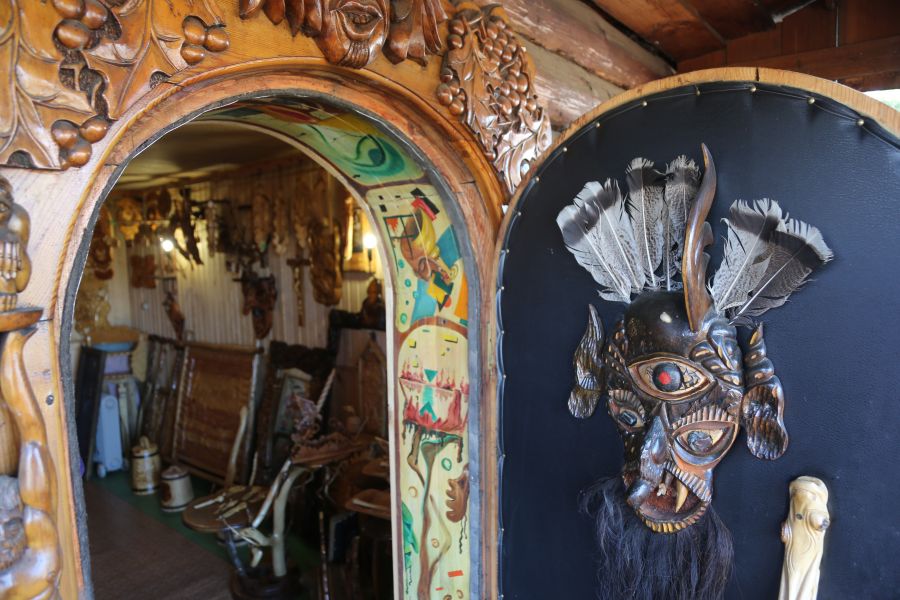
The surrounding images show the sculptures that fill his studio in large numbers. They reveal that many of Kalliola's sculptures have a tree trunk as their base.
Apart from tree trunks Kalliola uses recycled materials in his work, such as old stage walls, cupboard doors and scrap metal. The paint he uses comes from hardware stores.
Taking all this into account, it can be concluded that he is an artist is in the field of outsider art. His studio is so richly filled with sculptures, that it can be considered an art environment in the category of decorated interiors.
His work as an outsider artist was nationally recognized in Finland in 2021 by Maaseudun Sivistysliitto.(MSL), the Rural Education Association in Finland, who chose him as Artist of the Year.
An article on the association's website about this appointment (see documentation below) states that Kalliola wants to use his artwork to denounce the greed and the pursuit of power in the power structures in society, politics, religion and the economy.
The wooden heads of the sculptures cry out, protesting injustice in society.
Kalliola's artwork has been shown in numerous exhibitions in Finland and abroad since 1999.
It was also featured in Middle of Nowhere. a project discussed earlier in this blog. that focuses primarily on raising awareness of artists in the field of outsider art.
The Middle of Nowhere website notes that in Kalliola's work a tree trunk is transformed into a work of art, that reflects the artist's vision of the tragicomic nature of life. The website says that Kalliola "delights in the carnivalization of life. In his works, the faces of the wooden figures are white as clowns. These characters view the world with wide eyes and open mouths."
Kalliola's creations are also included in the collections of the Finnish Rural Education Association.
And then, as the image below shows, his studio is also richly filled with his creations.
Kalliola in his atelier (2021) in Hanko_ above image by Veli Grano as on the article on the website of MSL in the documentation, published here in agreement with MSL
In 2023 Kalliola returned to live in his hometown Rauma.
Initially he worked there in a temporary studio, but after some time he had a permanent studio, of which the image below gives an impression.
an impression of Kalliola's atelier in Rauma this image courtesy of Kalliola
Doucmentation
* Website by Jori Tapio Kalliola, with references to newspaper articles, a photo gallery of his sculptures, photos of his musical activities and information about exhibitions of his creations
* Article on the website of MSL on the occasion of Kalliola's election as artist of the year, with a photo by Veli Grano of Kalliola standing in his studio amidst his artistic works
Video
* Video (2021, YouTube, 3'52") by the Finnish Rural Education Association
Jori Tapio Kalliola
Decorated interior
Rauma. region Satakunta, Finland
can be visited on appointment (jorikalliola@gmail.com)
this image and the next three are screenshots from the movie in the documentation
The image above shows the front of a nursing home in Miszewo Murowany, a communityin Poland, not far from the city of Plock. It also shows a person approaching the building with some kind of cargo.
The cargo in the cart includes several pieces of wood and the person pulling the cart is Władysław Szymczyk.
Life and works
Szymczyk was born in 1943 to a farming family in Tasto, Poland.
From a young age, he had to live with the disability of being deaf, which also meant that he didn't learn to read or write and that he couldn't express himself properly.
This led to his admission in 1964 to a nursing home in Miszewo Murowany, near Płock, when he was in his early twenties.
For many years Władysław Szymczyk worked on a farm managed by the nursing home.
However, in 1996, in his early fifties, he began working with wood, an activity he was likely able to undertake when the nursing home for the benefit of the residents had set up a working space with the necessary equipment.
The surrounding images give an impression of how Szymczyk worked with wood.
Before he starts working on a piece of wood, he makes a drawing, as shown in the image above, which gives a general idea of what the creation should look like.
His wooden creations are usually left unpainted and they are lightly sanded to give the wood even more expressiveness.
The the constituent parts of the creations are very realistic.
For example, when Szymczyk makes a vehicle, its wheels can always turn; and if he makes a bus, the wooden equivalent will be equipped with doors that can open and close, and also with a double row of seats, visible by lifting the roof.
this image and the next three from the website Znalezienie
Active as a woodworker since the 1990s, Władysław Szymczyk must have amassed a substantial collection of small-scale wooden creations.
If this collection has a place in the nursing home, it can be considered as an art environment in the category of interior decorated with woodcarvings.
And if that's not the case, then Władysław Szymczyk still deserves an article in this blog, because he is one of the three main characters in the film series The Others. Art Is Where No One Looks
The films were shot in the summer of 2021 and their presentation took place on December 10, 2021 in a cinema in Płock.
In addition to Wladuslaw Szymczyk, the triumvirate includes Wlodzimierz Roston and WacławRędziński, who have already been described in previous posts.
Documentation
* Article by Radek Labarzewski on his website Znalezienie
Video
* Video (realized in 2021, YouTube, 6'57") on the channel of Znalezienie (subtitled in French)
Władysław Szymczyk Interior decorated with wooden creations
Nursing home in Miszewo Murowany, near Plock, dept Mazowieckie, Poland
The image above offers a view of the house of Evgeny Smolik located in Irbeysky, a rural community with some 1100 inhabitants, one of 43 administrative units in the Krasnoyarsk region of the Asian part of Russia ¹.
With its covered entrance and specific roof structure, the building resembles a small church or chapel, but if Smolik built his house himself, as is not unusual in the Russian countryside, this design can also be seen as an expression of his creative attitude.
decorated fence in front of the entrance of the house
Anyway, this attitude can be seen very clearly in the decorations Smolik has added to the fence around the house.
The image above shows the fence, probably a part on the backside, with a door leading to an entrance of the house, which has been decorated with a depiction of Adam, Eve and the serpent.
The image below shows another part of the fence, perhaps located along the street because of the decorated letterbox on the right. This fence is also richly decorated, including angel-like characters equipped with spears on the left and right of the door, guarding the decorated entrance.
part of the decorated fence outside photo from website account.travel
Life and works
As for Evgeny Dmitrievich Smolik, there is no orderly biography available on the internet. He was born in a community in the Krasnoyarsk region, presumably in 1958.
After school, he completed his military service in Kamchatka in Russia's Far East, home to Russia's Pacific submarine fleet, before returning to his native region and settling in Irbeysky; where he had all kinds of jobs, such as electrician, concrete worker, but also photo reporter and graphic designer.
It isn't clear when it was, but at some moment Smolik came into contact with someone who worked wood in a creative way. This appealed to him and he started working as an autodidact sculptor himself. As a self-taught artist. he would devote further life to woodcarving
a decorated door and wall in the interior, this photo also from newspaper HKK
He became an enthusiastic worker, taking care of everything that could be decorated with carvings.
Not only the outside of his house was tackled, as already outlined above, nothing in the interior was also untouched.
There are large decorated panels, all kinds of decorated medallions and wooden sculptures, but also kitchen utensils and tables, chairs and cabinets were creatively worked.
It is unclear to what extent Smolik's individual works of art have been included in an art museum.
However, the chair as shown above, a luxurious wooden chair, carved from pine wood and decorated with intricate carvings, has been acquired by a museum, namely the Forest Museum in Krasnoyarsk, the capital of the region of the same name.
¹ The reviews in this weblog relate to art environments in Europe. Nevertheless, characteristic sites in the Asian part of the Russian Federation are also included, in order to give a balanced and coherent picture of the entire field of Russian art environments.
pictures are screenprints from a video that was included in the documentation, but is not available anymore
Stavropol is an industrial town in the south of Russia, in the midst of the northern Caucasus mountain range. One of its around 350.000 inhabitants has transformed the interior of his house into an art environment by decorating it with a large variety of wood carving and wooden sculptures.
Pjotr Muzalev at work (2014)
Life and works
Pjotr Grigorievich Muzalev was born in Rostov, a port city in the south of Russia on the river Don, not far from where this river flows into the Sea of Azov.
Already at a very young age Muzalev showed a great talent in the field of drawing, but instead of going to an art academy, he got a technical education in the construction industry.
Muzalev would become the head of the department of technical aesthetics at the power generation plant in Stavropol (Stavropolskaya GRES), a job that included overviewing the work of professional artists and also required artistic competence because of the design of images of the production process in advertising, coins and souvenirs for visiting delegations.
In the years that Russia was still the USSR, Muzalev made wooden bas-reliefs of Lenin for the district committee of the Communist party, as he also decorated the interior of the company's management buildings with wood carvings.
In the 1990's Muzalev and his wife moved to another house with seven (in general small) rooms. So many empty rooms meant just as many challenges to provide these rooms with wood carvings and other wooden creations.
Muzalev went to work, adding all kinds of woodwork to the interior, giving every room a specific character. Once retired, he could spend even more time decorating the house.
Currently the interior is fully decorated with woodwork. One can see mirrors in carved frames, chandeliers and clocks in old style. Heads of animals, encased in carved frame, are attached to the walls, monkeys make grimaces, an animal (a dog?) as pictured below rests on a pedestal.....
It seems that no place in the house has remained without decoration.
The location of Muzalev's house is unknown, but it has been reported that from the outside nothing indicates that its interior has been decorated so exuberantly. This may have contributed to the fact that this art environment has remained virtually unknown. It only had some publicity, just an article (2011) in a regional newspaper and a video (2014) on YouTube.
Documentation
* Article (October 2011) in local newspaper Krestianin
Hidden behind a big tree, Asalache's house when seen from the outside is an ordinary house in an ordinary South London street. The inside, however, is a little gem of woodcarving.
Khadambi Asalache (1935-2006) was born in Kaimesie, Kenya. Already as a youngster he showed great interest in literary and artistic aspects of life. So after his primary education he studied architecture in Nairobi and then -in the 1950s- he left for Europe, residing in Rome, Geneva and Vienna, where he studied fine arts.
In 1960 he settled in London, to live there for the rest of his life.
In London Asalache earned his income by teaching Swahili and working for the BBC Africa service. He also did some architectural and landscaping projects, wrote poetry and worked on a book, that was published in 1967, entitled A Calabash of Life.
In 1970 he got a masters of philosophy in the field of philosophy of mathematics and he was appointed as a civil servant at the Treasury, the UK department of finance, a job he would perform for many subsequent years.
In 1981 he bought the house on 575 Wandsworth Road in South London, an old house built in 1810, with five rooms, which had been squatted and needed repair.
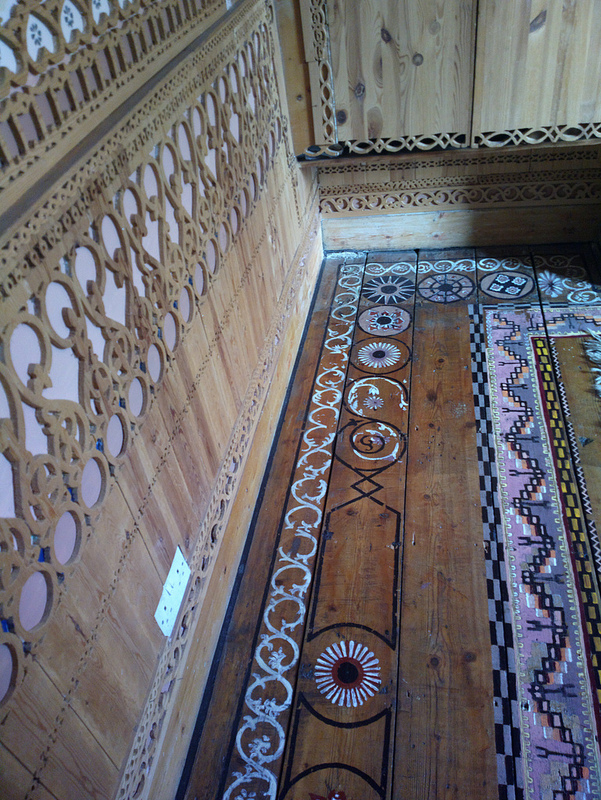
Asalache made some repairs with old floor boards, but was not happy with the heavy effect, so he decided to add some decorative ornaments.
This triggered him in such a way that he decided to make a project of decorating the interior of his house. As is the case with many artists listed in this blog, it became a lifetime project, that Asalache continued for some twenty years, almost until his death in 2006.
Working in the evening and in his free weekends, he decorated all rooms with fretwork shelves, arches, architraves and friezes, using birds, dancers, flowers, leaves and geometric patterns as motifs.
Beside these decorations, he also embellished the interior with 19th century English pottery he had collected in the course of the years.
Asalache himself has said that he was inspired by the mosque in Cordoba, the Alhambra in Granada, doors of houses in Zanzibar, interiors in Damascus and wooden houses in Istanbul.
In his hands the old house has become a beautiful art environment.
The legacy is cared for by the National Trust
Asalache bequeathed his house to the National Trust, which accepted the bequest in 2010. Meanwhile a first part of maintenance work has taken place, but more funds are needed to complete the works.
The house can be visited on appointment, but the size of the house only allows groups of six at a time.
Domenico Brizi, spring 2013 all pictures by Pavel Konečný
Piansano is a community in the Viterbo area in Italy with slightly over 2000 inhabitants.
Life and works
Domenico Brizi (1925-2021), who lived in this community, worked in agriculture and had a job in Rome, some 90 km south of Piansano.
He had a house in the center of the community and owned a vegetable garden at its outskirts.
The story says, that one day when working in his garden Brizi was overcome by a big rainstorm and had to take refuge in the storage of his gardening tools, kind of a cave with tuve walls.
To kill time Brizi made a decoration in a wall which resulted in a depiction of a donkey.
The story doesn't say in what year this happened, but I suppose it took place when Brizi was already retired, so probably in the late 1980s, early 1990s.
In any case, this event encouraged him to continue this creative activities, which he manifested in various ways.
Brizi made constructions such as a small fountain decorated with shells and blue enamel, equipped with a crocodile that produced a stream of water. And there also was a mermaid enjoying this stream.
Sort of a little story..... an approach that also can be found in his multicolored frescoes: Bacchus pours wine, drunk by a beautiful lady....
Brizi has been making polychrome wooden sculptures too, as in above picture.
In the course of the years the number of creations greatly increased and the cave became crowded with his artworks. It's state however was fragile, because of dripping water and works on the nearby main road.
Brizi passed away in 2021 and the area that encompassed his art environment now looks lost.
Documentation * Article (in Italian) on Canino Info, portale culturale della Tuscia (undated, around 2003?) * Entry on website Costruttori di Babele
Domenico Brizi Il grottino Piansano, Viterbo, Lazio, Italy
The small community of Kruslov, south of Prague, in the South Bohemian area of the Czech Republic, houses a very special art environment, with a colorful decorated exterior and an interior with a large variety of woodcarvings, all created by a self-taught artist.
Life and works Josef Mach (1929-2009) decided to earn his living as a professional beekeeper, so in 1948 he built kind of a barn, an apiary, some 25 meters long, where he installed some 65 beehives.
Mach has provided these beehives, like all other buildings on the premises with colorful decorations, mainly in primary colors, depicting in a folk art, but rather personal style facades of houses, barns, and other elements of Czech social life and historical tradition.
The totality of these decorated beehives and other built structures on the property has become a festival of colors, which evokes and pays tribute to places of interest and landmarks of the Czech Republic.
Mach was a gifted wood carver too.
Related as he was to the world of bees, he produced a large collection of wood carved bees.
He supplied furniture in his house and tools in the workshop with wood carved decorations, but most of his sculpted legacy includes a large collection of stand-alone works of woodcarving, such as wooden sculptures of saints, wood carved shrines, various chairs and tables, frames of mirrors and photo displays, all located in the property's living area.
After Josef Mach died, probably there were no heirs who wanted to live in the house.
In order to prevent that the interior and exterior collection of outsider art would fall into oblivion, an organisation of friends was formed which aims to preserve the site for the future. This association already has ensured the necessary repairs.