images are screenprints from the video in the documentation
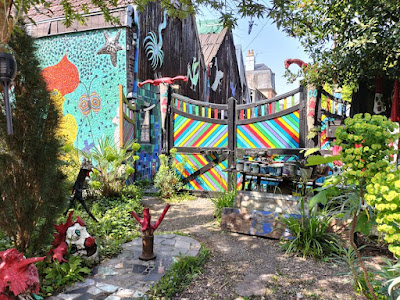
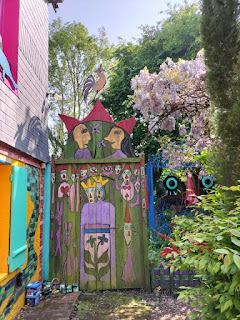
The mages in this post represent the decorations applied to the walls and the courtyard of a farmhouse with outbuildings in Den Ilp, a small community in the polder-rich rural area north of Amsterdam.
Life and works
It is the village where Anton Heyboer (1924-2005) went to live in 1961, where he subsequently in the 1960s and 70s became a well known Dutch painter, in 1984 severed all his ties with the established art world and in 2005 died in his sleep.
A lively, in the 1940s traumatic life as a young man
Anton Heyboer was born in Sabang in Indonesia on 9 February 1924, after five months the family moved to Haarlem, in 1925 to Delft, in 1929 to Voorburg, all locations in the Netherlands.
From 1933 to 1938 the family lived in Curaçao, then for some time in New York and before 1940 they moved to Haarlem again.
When in 1940 the German army invaded the Netherlands, the young Anton Heyboer was sixteen years old. Around that time he followed a training as a mechanical engineer.
However, in 1943 he was arrested by the Germans and taken to Germany to work there as a forced laborer, a traumatic experience. He managed to escape and went into hiding in Vinkeveen, a small village south of Amsterdam.
After the Second World War
When the Second World War was over, Heyboer settled in a village in the east of the Netherlands. Here he began to focus on making paintings in a traditional style, which led to his first exhibition in 1946 in another village in the east of the Netherlands.
In 1948 he married and had a son, but his wife divorced him in 1953.
In 1948 he also met the painter Jan Kagie with whom he wandered through France for several months, drawing and painting.
In 1951, Heyboer for a while was voluntarily admitted to a psychiatric hospital, this to find assistance in a process of self-realization which had to do with the war trauma he had acquired when staying in Germany.
In 1956 he married Erna Kramer with whom he was together for seven years and had a daughter.
In 1960 when he was 36, Heyboer met 19 year old Maria, who became the first of the five so-called brides who would join him in living in the art gallery in the community of Den Ilp.
The period of his stay in Den Ilp
In 1961 Heyboer settled in the small community of Den Ilp, where he had bought a piece of land with a cowshed, a terrain he expanded with a variety of other outbuildings.
The community of Den Ilp is situated north of Amsterdam in a rural area, richly provided with meadows. For him such a rural location was a considerably better location to live and work than the big city.
Over the years, apart from Maria, four more women ("brides") came to live with Heyboer in his gallery in Den Ilp, all of them interesting, intelligent women, who liked to be together with Anton Heyboer.
The 1960s and 70s would be the period in which he became quite well known as an artist who produced sought-after paintings. His work was purchased by the Museum of Modern Art in New York, was exhibited at the Documenta in Kassel, and he had major exhibitions at the Municipal Museum in Den Haag and the Municipal Museum in Amsterdam (1975).
It was also the period in which he transformed the gallery into an art environment. The images in this post give an impression of the colorful decorations that were not only applied to all the walls of the various buildings, but also adorned the spacious courtyard.
In 1984 Heyboer severed all his ties with the established art world. He continued to work in seclusion in his house in Den Ilp.
In doing so, he also distanced himself in a certain way from the works with which he had previously achieved success, and thus, for example, he repainted almost all of the works that had been exhibited in the Municipal Museum in Amsterdam in 1975.
Anton Heyboer died in his sleep on April 9, 2005 at the age of 81 in his still colourfully decorated home in Den Ilp and was buried in a nearby cemetery in a rural area.
Artistic legacy
The Anton Heyboer Foundation, managed by the Museum van de Geest (Museum of the Mind)in Haarlem, is committed to preserving the legacy of Anton Heyboer.
all images courtesy of Sophie Lepetit, from her weblog
The image above, as well as the others in this post, show an interior decorated with a composition of all sorts of different small piles or hung objects, which can be seen as colorful spaces inside that together give shape to an art environment.
Life and works
This style of decoration is characteristic of the house of Christina Fayon, who was born in 1956 in Paris, where her parents worked as leather workers in a suburb.
Inspired by her parents, Christine started working with leather at a very young age. She was only three years old when she began making small creations, initially of course very simple ones, such as small leather bags that could carry her dolls.
As she grew older she also started making her own clothes.
Her preference for making her own clothes speaks to her need to live her life as she sees fit.
For example, in 1979, when she was in her early twenties, she decided to travel to Central America, knowing when she would leave, but not setting a date for her return to France.
She loved this freedom to come and go, to meet the unknown and herself.
And then, during that first trip she experienced a great need in herself to feel and absorb everything around her, habits, encounters, experiences, colors. This experience would also become the basis from which her artistry would develop.
And so it may very well be that this experience also made her decide to continue her life as an artist.
In any case, when she went to live independently, she made sure that the house she moved into in the Aveyron department in the south of France, also offered the opportunity to set up a studio.
When furnishing her own home, another special characteristic emerged. She turned out to be a master in the art of collecting all kinds of things with which she could surround herself and express her artistic nature.
Gradually, the interior of her home not only became a multi-coloured collection of various independent ensembles composed of all kinds of objects. Beautiful to look at, these small universes also inspired her to make new creations and guided her in her further career.
That career went well.
In her creations of textile paintings and textile jewellery, but also dolls, travel booklets, and postal art, she arranged a multitude of colourful fabrics in such a way that a coherent, inspiring composition emerged, a way of working that she gradually refined more and more.
During twenty years she also made a varied collection of leather bags.
The video below, made in 2020, shows Christine Fayon creatively active when she was in her early 60s and could look back on a life in which she travelled to areas in Asia and India and participated in many exhibitions of her creations, especially in France but also in Morocco.
A beautiful basis for further developments.
Documentation
* Article (March 2025) on the weblog of Sophie Lepetit, with a variety of images
* WeblogImbroglios textiles (Textile Tangles) by Christina Fayon (includes an overview of exhibitions in which she participated)
all images courtesy of Sophie Lepetit, from her website
Honfleur is a commune in France with over 6,700 inhabitants (January 2021), located on the south side of the river Seine where it flows into the Channel.
Situated in the middle of a block of houses in the old city center, accessible via a side street through a gate in the rue de la Foulerie, there is a building that once housed a forge, a building whose interior and exterior these days have been transformed into an art environment.
The image above shows, seen from the side of the decorated garden, the entrance gate at the end of the side street.
Life and works
This art environment is an impressive creation by Florence Marie, who was born on April 17, 1946 in Le Havre, a commune also located at the mouth of the Seine, but then on the north side, diagonally opposite Honfleur.
At a young age Florence loved reading literature and after her school years in Le Havre, she went to Paris to study philosophy and theatre.
She was active in writing and painting and had a house with a small studio on the Place Saint-Georges in Montmartre.
In 1994, in her late 40s, she moved to Honfleur, where she had found new accommodation in the former forge building which, in addition to a large outdoor space, included a 400 m2 workshop and a house with several floors.
Here Florence Marie would realise her major project, in which, after renovating a messy wall in the outside space into a large fresco, she added all kinds of colourful creations to the exterior, as well asto the walls of the rooms of the residential building.
The images above and around give an impression of the various creations
.
Florence Marie, who did not have an art education, does not consider herself an art brut artist too.
She prefers to see herself as an adventurer, but an adventurer who has the books of writers such as Novalis, Virginia Woolf and Flaubert in her luggage, an adventurer who loves kings and queens, angels and symbols.
The decorations she made are certainly not small-scale, on the contrary, the creations that adorn the walls are often man-sized.
In the 2000 m² space outside there are even very large creations, mostly made of recycled material, such as the depiction of an angel of the apocalypse, provided with silver wings, announcing to a black Virgin the birth of a star child.
And there is also a life-size giraffe hanging from the roof on a chimney, partly replacing it.
The interior of the house is also filled with a lot of fascinating creative work. The whole is a work of art in itself.
There are all kinds of sculptures, mosaic creations, stained glass cabinets, colorful furniture, painted carpets......
In one of the relatively spacious rooms inside, various events are organized nowadays, where music is alternated with dance, storytelling and the like. These are announced on Florence Marie's Facebook page.
An association Les Amis de la Forge has also been founded, which develops all kinds of activities to support and further develop Florence Marie's project.
pictures courtesy of Sophie Lepetit, from her weblog
Loriol-sur-Drôme is a commune of around 6,600 inhabitants, situated in the Rhône valley in the south of France, between Valence and Montélimar.
In a street in the centre of this commune, not far from the town hall, there is a house with a large number of rooms, of which more than ten are lavishly decorated, as shown in the images around.
Life and works
The house named Musée de l'insolite was inhabited and provided with a unique exhibition by Max Manent (1925-2023), who was born in Montélimar, a little over twenty km south of Loriol-sur-Drôme.
Max Manent grew up in a family where the father was a nougat manufacturer and apparently a quite open-minded person, because at the age of 15 the boy was allowed to travel through France, something that was quite unusual at the time.
However, for the young man it was a pleasure to explore the world, and once he was an adult he lived abroad for a while and then he stayed in Paris, where he met many people, among whom a number of artists.
He became a painter, and he focused on only one subject: women…. Whether he followed a training course of several years to be a painter is not known.
In 1979, when Manent was in his mid-50s, he moved to Loriol, where he took up residence in the spacious house along the Grand Rue.
Settling in this house, Manent must have felt that this was his final destination, because he began to decorate the rooms he did not use for living, with all that he had collected during the previous many years
He would indeed stay there for more than 40 years, time enough to transform the interior into a special indoor art environment.
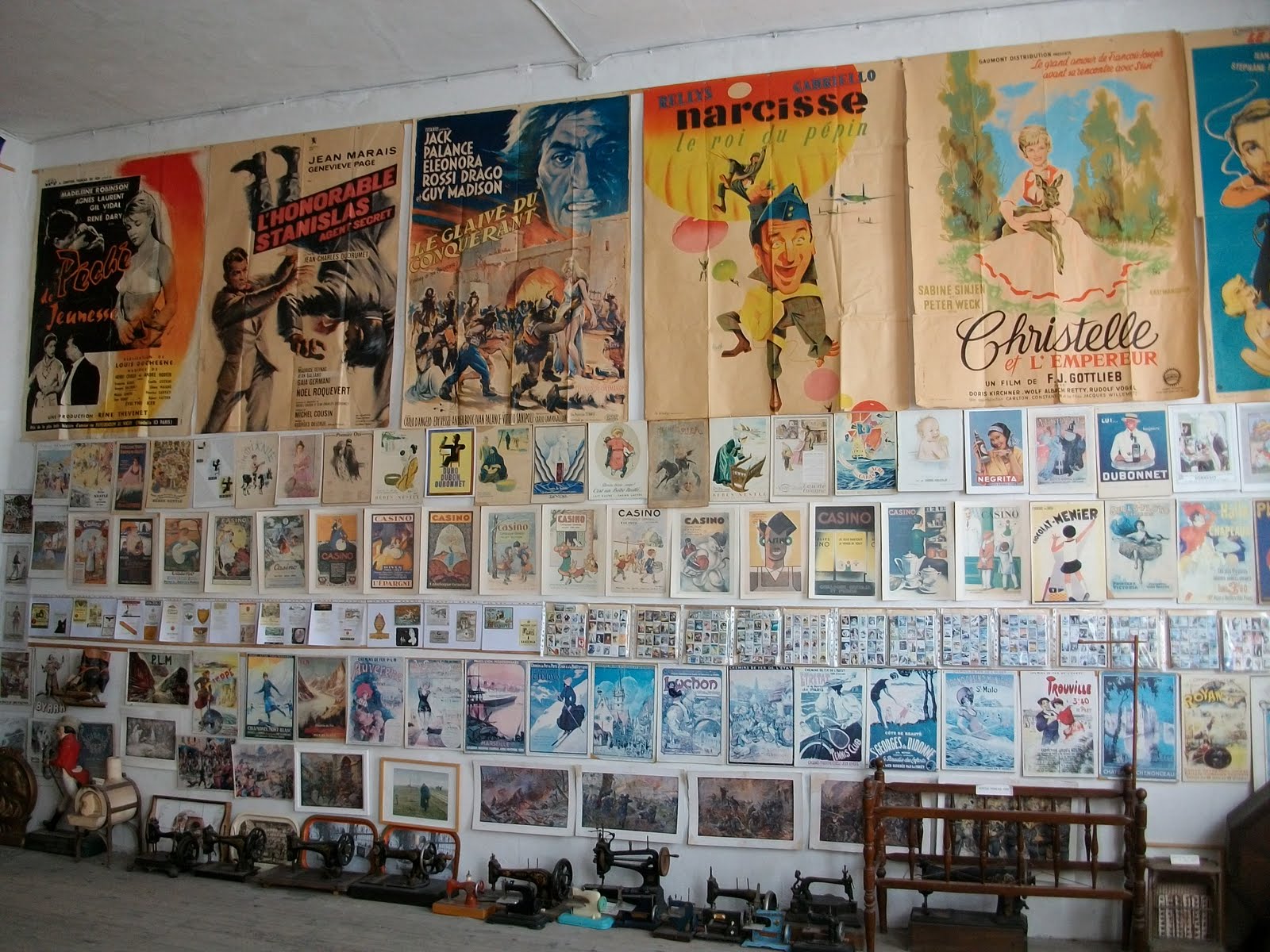
The more than ten rooms are filled with a variety of objects such as the hundreds of crucifixes in the very first image, a wall completely covered with all kinds of colorful drawings and posters, as in the image above, but also a collection of ten to twelve thousand cigar bands with special images, rare musical instruments, matchboxes, African art .....
Manent also used a wall to exhibit some of his his own paintings
In some rooms children were not allowed, because what was shown there was not suitable for them. Manet had his own ideas about the unusual and the unexpected
A very special exhibit is the wooden coffin in which he could be carried to his grave, a coffin decorated with silhouettes of women.
Max Manent passed away on October 30, 2023 at the age of 97.
Whether the coffin he had prepared was actually used at his funeral is not clear, like there also is no information about what's going to happen with the collection.
The decorated hedge pictured above could be seen in Saint-Berthevin, a municipality with around 7400 inhabitants, in the Mayenne department in France, bordering the large city of Laval on the west side.
This hedge was part of a larger art environment, created by the resident of the house behind the hedge, Guy Souhard (1932-2020).
Life and works
Guy Souhard. born in this area, after primary school became a carpenter, working in Laval.
He retired in 1992 and a few years later, in 1997 when he was 65 years old, he started decorating the front garden of the house in Saint-Berthevin where he and his wife were now living. Their house was located on a corner where two streets intersected.
As the images above show, it's a special feature of Souhard's creation that he provided the semi-circular cedar hedge around the house with bas-reliefs. This is a way of decoration that has not yet appeared in this weblog and also in France such a decoration occurs very rarely.
Souhard initially performed the operations with a hand scissor, later he used an electric tool.
The front garden, which could be reached via a gate in the hedge, was decorated with colorful creations, many of which depict all kinds of personalities known in France. such as Serge Gainsbourg and Brigitte Bardot, but there are also international characters, such as Charlie Chaplin and Laurel and Hardy.
There was also a meters-high giraffe, made entirely of aluminum. And the ostrich in the image below was made from 1,200 individual feathers, a creation that took 240 hours of work.
There were two horses made of metal, dolls in trees and a monkey climbing on a deer.
the ostrich
The interior was also full of all kinds of things, mostly from flea markets or found somewhere by chance.
All kinds of items were gathered together on shelves and on the furniture, such as dolls, toys, a collection of telephones and cameras, and so on......
In 2018, when the art environment had been a familiar phenomenon in the municipality for some twenty years, a representative of the city council reported that a complaint had been received about the hedge
The rules had been checked and Souhard was asked to reduce the height of the hedge to 1.60 meters as permitted in the regulations. Since that would mean that most of the greenery would be lost and mainly the wooden trunks would remain, Souhard decided with a heavy heart to remove the hedge.
Souhard himself was too old to do such a job, but his son and grandson offered a helping hand. The hedge was removed and (with the cooperation of the municipality) a white fence replaced it.
Rather shortly after all this, on November 28, 2020, Guy Souhard passed away, aged 88.
Documentation
* Article (November 2012) in newspaper Ouest-France
* Article (April 2015) and an update (April 2018) on the weblog of Sophie Lepetit
Guy Souhard
Creations on the hedge, in the front garden and indoors
rue Madame de Sévigné, corner avenue du Maréchal Leclerc
53940 Saint-Berthevin, dept. Mayenne, region Pays de la Loire, France
pictures are screenprints from the first video in the documentation, published here in agreement with the maker Sirkka Turkki
On the southern coast of Finland in the Uusimaa region, about 35 kilometers east of Helsinki. there is the municipality of Porvoo. It is the second oldest city in Finland, currently with around 50.000 inhabitants, about a third of whom have Swedish as their mother tongue.
The information panel shown above, installed along the Sillvikintie road, in the outskirts of the municipality, indicates that there is an art environment at that location.
Life and works
This art environment, referred to as RuusulinnaTaidepuisto (Art Park Rose Castle) was developed from the early 2000s by Sirkka Turkki, who was born in the mid-1940s.
After primary and secondary school, she studied at the University of Helsinki and at the JAMK University of Applied Science in Jyvaskyla in Central Finland, where she became familiar with applied arts.
Equipped with this knowledge, she was able to become a teacher in areas such as art education and creative activities, but she was also active in the field of physiotherapy. In addition to her professional work, she was also active as a poet, a painter and a ceramist.
In the early 2000s, while looking for a summer home, she found the spot where the art environment has now emerged, an outdoor area that also included a country house that had been unused for years and needed major renovation.
The two-hectare area which exudes a pleasant wooded atmosphere, now also houses a guest house and there are four different outbuildings, which are now full with a variety of creations. made by Sirkka Turkki over the course of her life.
As the image above shows, there is a large miniature city filled with a large number of handmade wooden houses, which is set up in the living room of the country house. All these buildings were made from pieces of wood from a wooden wall near an old farm.
There is also a collection of masks, as shown above left, which fills a section of the wall of one of the buildings.
The images above and below right show parts of the extensive collection of ceramics that SirkkaTurkki has produced over the years.
Finally, the image at the bottom left shows the collection of marionettes and glove puppets, hanging on a wall.
Indoors, the walls are decorated with drawings and paintings made by Sirkka Turkki, in short, a large number of forms of artistic expression are generously represented in this art environment.
Below, to conclude the variety of indoor creations, is another image of a sculpture of a lady, who looks a bit like Sirka Turkki.
The two images below give an impression of the creative constructions that adorn the outdoor space, first a collection of bird heads on sticks, and then an arrangement of arches, axes and other decorations on trees.
In the outdoor area there are also spatial works of art that depict world religions, fairy tales and myths.
Sirkka Turkki, now in her late seventies, so far had a varied and versatile life. For example, she gave more than two hundred readings of the poetry she wrote.
Another noteworthy activity of hers is that she volunteered at an orphanage in Nepal, where, during a trip through the area, she took the opportunity to free young girls from the slavery in which they had ended up. They were admitted to the orphanage, now have an independent existence and Sirkka Turkki is still in contact with some of them.
Documentation
* Article(June 2022) on the website of newspaper Itäväylä
* Article by Heini Heikkilä on the website of MSL. the Finnish National Cultural Association
* Another entry on the MSL website, with some photos of the art environment
unless indicated otherwise pictures are screenshots from the video in the documentation
The house pictured above, with a three-headed snake on the roof, is located in the village of Durasovo, in Russia's Yaroslavl region, about 250 km north of Moscow.
Life and works
This snake is a creation of Nikolai Anatolyevich Krylov, who - as far as could be determined - was born in the late 1950s.
As a young man Krylov dreamed of becoming an artist, but for practical reasons he became a carpenter. But then, a carpenter with a lot of imagination.....
He married and in 1980 he bought the house in Durasovo. During the first years that he and his wife lived in this house, he paid a lot of attention to furnish it with all kinds of self-made or self-decorated furniture, such as tables, chairs and sofas.
But he also took a more creative path by, for example, providing the headboards of the beds with decorative wood carvings, and presumably also the rooms of the daughter and the three sons the couple had over the years.
He also made a side table with a top surface designed in such a way that it could be used to play a game of chess.
The outdoor area also got Krylov's attention.
This space was surrounded by a beautiful fence and a special hand-made fountain, as in above image, gave the garden in front of the house a special allure.
Not only was the facade painted in a vibrant sunny shade of yellow, also carved wooden decorations were applied around the windows and on the rest of the facade.
But the decorations on the roof were the items that attracted the most attention from passers-by.
To start, the image above shows a weather vane decorated with a rooster carved from sheet iron.
And then there is a hand-made rotating viewing dome, pictured below, with an interior decorated with fairy-tale characters. This dome is located at a height of about 15 meters, from where one has a panoramic view of the surroundings of the house.
But what most attracts the attention of passers-by is the three-headed snake that, as can be seen in the very first images, views the world from a trypan in the facade.
This creation was completed in 2011, after Krylov had worked on it for two years. He made the snake from driftwood he found in a nearby forest and he selected the parts in such a way that he had to sharpen them as little as possible. Krylov's snake is covered with pieces of sheet metal and has eyes in each head consisting of photocells, which shine in the darkness and occasionally flash red.
In Russia this snake is a well-known (fairytale) character called Zmey Gorynych, which means Snake of the Mountains. It usually has three heads, sometimes seven or nine, and can talk and breathe smoke and fire.
On the image below there is a second snake, also a large one, which has been installed on the part of the roof at the rear of the house, not visible from the street. The available documentation about this art environment says that this creation is based on a fairy tale about Mowgli.
This probably has to do with Mowgli and the snake Kaa, characters that initially appeared in Rudyard Kipling's Jungle Book, a 1994 film in which Kaa is a friendly character. However, in later videos from other producers, Kaa was presented as the villain. It is not clear to which Kaa Krylov referred.