Showing posts with label shell decorated exterior. Show all posts

January 09, 2026

Francisco Palma Jimenez, Casa decorada con conchas / House decorated with shells

all pictures in this post are screenprints from the
video in the documentation 

The shell-decorated house in this post is located in Albuñuelas, a small village of around 800 inhabitants (2024) in the province of Granada, situated near the coast in southern Spain. 

These decorations were created by Francisco Palma Jimenez. born in 1933.

Life and works

The village's economy is primarily focused on citrus fruit cultivation, and young Francisco quickly became involved with the locals working in this branch of agriculture. 

As a result, his time at school was limited to just a few months, and he had to learn to read and write largely on his own.

Francisco married a neighbour girl, and the couple would have three children. 

He was an enterprising man and built his own house on a plot of land next to his parents' house. 

That turned into a project that took about 32 years. He worked on the construction when he wasn't working seasonally, successively during the olive harvest, the tomato season, and the grape harvest, for which he went to France.


But the project's duration was also influenced by his intention to decorate the house with shells, both inside and out. 

He searched for them on the nearby beaches along the Mediterranean Sea, where he collected over two million shells, while he also collectid fossils found around Albuñuelas.


There was, of course, a practical reason for covering the house walls with shells, as it eliminated the need to re-whitewash them every year. 

But more than this practical consideration, there was Francisco's artistic need to decorate his house beautifully.


Like he made his own planters decorated with cement flowers, and he made a collection of various tools and carved stone heads, while thousands of pumpkins adorn the ceilings of various rooms.


Hundreds of objects he made from esparto grass hang from the kitchen ceiling, ranging from a complete donkey to small baskets, saddlebags, coasters, mats, several bull heads, and even bras made from this material. 

On one wall, he has another unusual collection: forty walking sticks made of wild olive wood.


Francisco Palma Jimenez, who was in his early 90s at the time of publication of this article, is a friendly man who is happy to give visitors a tour of the house and garden.


Documentation 
*  Article (2025) by Miguek Angek MolinePalma
Article (2015) by Jo Farb Hernandez on the website Spaces Archives, with a variety of pictures
Article  on the website of the Town Hall of the municipality of Durcal 
Article (September 2006) on the website of newspaper Granada

Video
* Video (2022) by Serflac, the scenes of the shell decorated house starts at 13.20


Francisco Palma Jimenez
House decorated with shells
8 Calle Morales   
Albuñuelas, Granada Province, Spain
visitors welcome


May 02, 2025

Anonymous couple, Maison aux Coquillages / Shell House

this image as on a leaflet from the municipality
announcing the sale of the house

Port-Joinville is a small town of about 2000 inhabitants on the north side of the French island of Ile d'Yeu, situated opposite the French west coast and part of the department of Vendée. 

It has the most important port of the island, also because most ferries arrive or depart there. 

The Shell House

In this port town, located along the rue de la Plage, a road leading to the beach, there is a house decorated with shells, as pictured above.

The house was built after the First World War, a time when the island, particularly for its beaches, was beginning to develop as a tourist destination and seaside resort. 

The shells and pebbles were attached to the walls by the couple who occupied the newly built house at the time. Their name is not mentioned in the available documentation. However, their nickname has become known, namely les Gugus, a term used in French to indicate characters considered as grotesque or comic.

his photo (May 2021) by Didier B as on
Google Streetview
Recent developments 

In early 2021, when the municipality was considering renovating the area near the house, including the construction of a parking lot for beach visitors, residents of Port-Joinville feared that the house, still decorated with shells and pebbles, would have to disappear.

However, this was not the case. On the contrary, the municipality, now owner of the building which was empty at the time, renovated it and in early 2025 put it up for sale.

Documentation
* Article (February 2022) in newspaper Ouest-France
* Article (December 2023) in newspaper le Courier Vendéen

Anonymous couple
Maison aux coquillages

32 rue de la Plage.

Port-Joinville, l'Ile-d'Yeu, dept Vendée,, region Pays de la Loire, France

can be seen from the street

Google Streetview


April 11, 2025

Paul Roger, Maison en coquille / Shell house

image as on Google Streetview

Along the northern French west coast, directly south of the large port of Boulogne-sur-Mer, lies Le Portel, a municipality with approximately 8,800 inhabitants (January 2022).

South of the city, parallel to the coast, there is the Rue de Cap, a rural street with at number 36 a house that has a special allure, because it has been abundantly decorated with shells, both inside and outside.

As can be seen in the image above, the house is separated from the road by an elongated shell decorated wall.

image as on website waymarking

Life and works

The shell decorations were added by Paul Roger (1923-2020), when he was a resident of the house. The project began in 1984, when he had just retired.

That year he got a visit from a brother-in-law. When they were walking on the beach they saw all kinds of shells lying around and his brother-in-law suggested that Roger could do something with these items in terms of decorating his home.

Roger thought that this was a bit crazy, but still worth a try, and so he got to work.

image as on Google Streetview

Crazy or not, the project would take ten years. It was also quite a job because Paul Roger sorted the tens of thousands shells by size and by color, pink, gray, or white. The large shells formed the frames and the small ones were glued inside the frames.

Various parts of the interior of the house have been also decorated with shells. This article does not have any images of the interior, but the video below includes views of various places inside the house.

After Paul Roger died in 2020 the house was sold. The new owners kept the decorations on the outside walls, but probably removed the decorations in the interior.
 
Documentation
* Article (undated) on website Waymarking
*Article (August 2014) in French magazine France Infor, includes a video (2 minutes)

Video
* Video (2014) in magazine France Info referred above


Paul Roger

Maison en coquillages

36 rue du Cap

62480 Le Portel, dept Pas-de-Calais, region Hauts-de-France, France

can be seen from the street

February 28, 2025

Auguste Léger, Maison aux coquillages / House of shells

 
this picture and the next three courtesy of Tipeek Photos

The shell-decorated house pictured above is located in Gravigny, a municipality of about 4,000 inhabitants in the Normandy region of France.

The house is situated on its own grounds on a corner at the end of a street, which ends at a roundabout, and this specific location means that not only the front along the street can be seen, but also the sides to the left and right. 

These two sides are also decorated, in a design that is comparable to the decorations on the street side.

Readers who know a bit about Google Streetview can see this for themselves


The shell decorations were applied by Auguste Léger, about whom no biographical information can be found on the internet.

Some information about the period in which the decorations were applied can be obtained via the website Habitants-Paysagistes of the Lille Art Museum, where three photos of the house can be seen, made in 1983 by Francis David.

These photos radiate a certain naturalness, as if the decorations have been adorning the house for years.

This would mean that the shells were applied at least forty years ago and probably date from the 1970s.


Documentation
* Short article (1983) on website Habitants-Paysagistes, with photos by Francis David
* Short article (undated) on the website of the municipality of Gravigny, with the remark that the  house  currently is private property
* Article (September 2024) on Tipeek Photos with a series of recent photos

Auguste Léger, 
Maison aux coquillages
7 Rue du 23 Août 1944
Gravigny, dept Eure, region Normandie, France
can be seen from the street

November 25, 2022

Lucy Dorrrieu-Smith, Shell House in Tresco Abbey Garden


photo by Colin Park (July 2011)
licensed under Creative Commons ShareAlike 2.0 

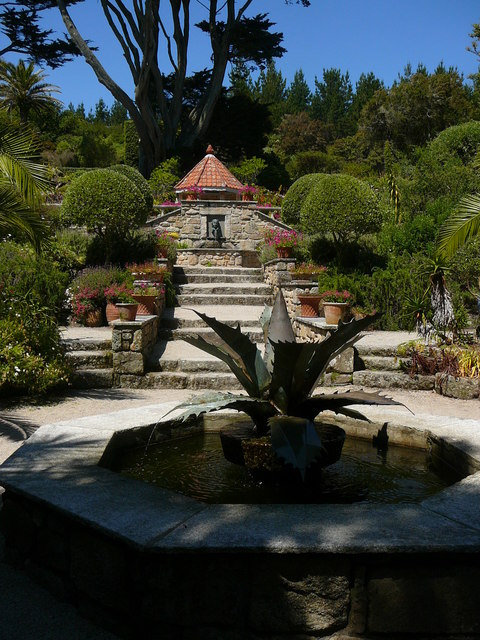
About 28 miles west of Lands End, the most south-westerly area of England, is the small island of Tresco (about 3,5 by 1,75 kms),  part of a small group of islands called the Isles of Scilly.

Tresco Island is home to a 40-acre (16 hectares) horticular garden called Abbey Garden, constructed in 1834 by Augustus Smith on and around the ruins of a 12th century Benedictine priory, using the large amount of stones in the ruins of the old priory to make decorative gates and walls.

The garden has thousands of species of plants and flowers from the southern hemisphere and the subtropics, which is almost unbelievable given the island's location in the Atlantic Ocean,

And then, it also includes a Shell House. situated on a hill at the end of the stairway, as portrayed in the above image.

photo by Stephen McKay (May 2019)
licensed under Creative Commons Share Alike 2.0

Lucy Dorrieu-Smith and her creation

This Shell House, a hexagonal structure with a gabled roof and open front, as pictured above, was created by Lucy Dorrieu-Smith 

She is the wife of Robert Smith, descendant of the previously mentioned  August Smith, a wealthy banker who in 1930 obtained the island on a long-term lease from the Duchy of Cornwall, who owns Tresco in private status.. 

The couple lives on the island in their Tresco Abbey home and takes care of the maintenance of the nearby Abbey Gardens.

photo by Oliver Dixon (April 2011)
licensed under Creative Commons Share Alike 2.0

In 1987 a storm destroyed much of Abbey Garden. In the context of its restoration, Lucy Dorrieu-Smith came up with the idea of providing the garden with a shell decoration situated in a structure on the hill. 

She asked the renowned shell artist Mrs Blott Kerr-Wilson for advice and then single-handedly covered the walls of the structure she had designed herself, with colorful frescoes composed of shells found on the isles of  Scilly, a project that was completed in 1994.

As the pictures show, the wall decoration shows in particular a triptych of vases richly filled with flowers, a large one in the middle and two smaller ones that flank the large one. The entire artwork consists of five panels, each of which is provided with two letters on the top, the initials of the first names of Lucy Dorrieu-Smith's children

photo by John Rostron (2010)
licensed under Creative Commons 
Share Alike 2.0

Compared to other European countries, the United Kingdom and Ireland, surrounded by seas and an ocean as they are, have many art environments composed of shells. Lucy Dorrieu-Smith's creation bears  resemblance to the Curraghmore shell house in Ireland, decorated in the 1750s by Catherine de la Poer, part of a wealthy family.

Documentation
* Article  (October 2019) by Karen Ivy on her website 
* Article ( August 2019) by Rich Edwards on his weblog
* Article (August 2013) by Bonny Bonafilla on her weblog

Videos
YouTube has some videos portraying the Tresco Abbey Gardens, but the Shell House generally only gets a few shots

Lucy Dorrieu-Smith
Shell House in Tresco Abbey Garden
Island of Tresco, Scilly Isles, UK
visitors welcome (entrance fee)

April 22, 2021

Shelleen, a shell decorated property

this photo and the next five by Richard Sutcliffe
licensed under Creative Commons

Of the five art environments in Scotland described in this weblog, included the one presented in this post, three are characterized by their proximity to the sea and their decorations with shells. 

In addition to Shelleen, reviewed here, the two other sites are a still existing house in Anstruther, decorated with shells by Alex Batchelor in the 1840s, and a site in Leven that has now disappeared except for a few decorated walls, made in the 1920s by William R. Bisset.  

The fourth site in Scotland is the Trail of wooden sculptures in the Cairngorms National Park, created by Frank Bruce, opened in November 2007, and the fifth is the house of Jim Donelly with an exterior decorated with protest signs.


The site named Shelleen is located in Clochan, a small community in Scotland, some 2.4 miles (3,8 km) south of the Moray Firth, an inlet of the North Sea.

Photos of this art environment -mainly presenting the decorated garden wall- are available on the internet, but reviews of the site are lacking so far. This implies that this post cannot mention who made this art environment. Thanks to a comment from someone who read this post, it is now known that decorating the site started in 1988.

There is a photo on the internet with a caption that assumes that the creation of the site began in 2000, but it is not clear what this is based on.

Anyway, the creation as such is impressive enough to appeal to a wide audience


Coming from the village of Clochan the site is to the left of the road, where a man-high wall is situated, for a part at right angles to the road, for another part parallel to the road.

Behind the wall are the garden with various shell decorated creations and the living house with accompanying sheds and work spaces.

The walls along the garden

As can be seen in the very first photo, at the spot where the sides of the garden walls meet, a flattened piece of wall has -below some small-scale decorative items- the name of the site in blue letters: SHELLEEN. 

The top of this piece of wall is decorated with sculptures, a swan and two dolphins that are looking up at each other.


As can be seen in the picture above, the wall in front of the house at its left end has an entrance gate, which has been decorated with a variety of dinner plates and at the top there once more is a dolphin.

This wall as such is richly decorated with shells, including a large number of pink St Jacob shells.

There are also a number of specific decorations, as shown in the two detailed pictures below. 

a four-legged animal
a dolphin


On the left an image of what presumably once more is a dolphin, apparently a favorite item of the person who made these creations, and on the right a depiction of a four-legged animal, perhaps a horse.

The image below gives an another impression of the varied way the wall has been decorated.

this picture courtesy of Freya Pearce

The wall along the street is not decorated with shells. It's made of stone slabs and it turns into a wooden fence, which continues in a number of sheds at the rear of the house.

this picture (August 2011):
screenprint from Google Streetview

One of these side buildings is decorated with shells, as shown above.

The decorations in the garden

The internet only has a limited visual documentation of the creations in the garden. 

On Instagram (#shelleen) there is a series of photos, mainly of the decorations on the wall around the garden and a few of the decorations in the garden, such as a mill with four blades and a church with a spire.

this picture and the next one
courtesy of Freya Pearce

As can be seen in the picture above, this church is just behind the intersection of the two garden walls with the rising dolphins.


The image above depicts the church, constructed with a decorated gable roof, and both a spire and rear wall bearing a cross.

this picture (August 2011):
screenprint from Google Streetview

Although the photo above is not so clear, one can still see that the garden is enriched with an ensemble of houses and other buildings, all small scale, a kind of miniature village situated around a miniature lake, everything in the middle of a rich green decor of trees and plants

It's a pity that better images of the creations in the garden are not available, because it seems that this may mean that an interesting and nicely shaped part of this Scottish art environment will remain in the unknown.

Documentation
* Series of photos (2025) on the weblog of Sophie Lepetit
* Series of photos (2017) with explanation on weblog Last Alliance Studios (scroll all the way down)

Shelleen
Shell decorated property 
Clochan, Scotland, UK
can partly be seen from the street


February 12, 2020

Alfonso Rinaldi, Casa delle conchiglie / Shell decorated house


all pictures courtesy of Francesco Galli

Snow White and the seven dwarfs have found a place at the foot of a wall decorated with shells, part of a house  that is completely covered with shells in San Giuliano a Mare, a hamlet of the municipality of Rimini on the northwest coast of Italy, facing the Adriatic sea.

Life and works

Alfonso Rinaldi (1901-1983), who was a taxi driver, in the 1960s, when he himself was in his early sixties, decided to realize an artistic dream of decorating his house.

His house is a few minutes' walk from the nearest beach and the availability of shells there makes his choice of shells as the most important decoration material obvious. 


It became a major project that would eventually include all the walls of the house and various smaller objects around it. Rinaldi mainly used shells of mussels and clams, but also a large quantity of scallops. 

As the project progressed, it became more and more sympathetic to people from the area, who started helping with collecting shells. Also owners of restaurants in the tourist town that is Rimini contributed shells, presumably mainly the scallops, which are largely part of the decoration.

It has been said in newspapers that Rinaldi has processed around 14.000 shells and that he has worked on the project for about six years.


The detailed photos around give a good impression of the pattern Rinaldi used to locate the shells on the substrate. On large surfaces he made long lines, horizontally, vertically, obliquely. depending on the status of the respective wall.

On small objects, such as garden pots (right above), this linearity has apparently disappeared, but looking closely a mixture of horizontal and oblique lines appears.

Also striking is the color scheme of the cement that Rinaldi used to attach the shells, with pink, yellow and light blue shades, for which he made special mortar blends.


The line patterns on the walls are broken by windows, and to a very limited extent by small decorations, such as the shrine (?) left above and the fish in the image below.

Considering that the decorations were made in the years 1960/70, it is remarkable how good they look even after some fifty years.


After Rinaldi died in 1983, his daughter inherited the property. In consultation with local authorities it was decided to leave the house in the state as created by Rinaldi.

As the documentation shows, in recent years various news media have paid attention to this art environment, often with similar content. 

In these article some foreign examples of creations with shells were often cited, but strangely not the shell decorated property of Marsilio Raggini in Bellaria, some 13 km north of the city of Rimini,

Documentation
Articles (undated) by Giada Carraro on the websites of Costruttori di Babele and SPACES
* Article (February 2018) in local newspaper Rimini 2.0 with a variety of pictures
Article  (april 2018)  on website Daily Best
* Article (June 2016) newspaper La Stampa
Article (undated) on website Zingarate
* Article (undated) on website Atlas Obscura

Video
* Video by Teleromagna (1'34", undated, YouTube)


Alfonso Rinaldi
Casa delle Conchiglie
via del Fante 40.
47921 San Giuliano a Mare, Rimini, region Emilia-Romagna, Italy
no visits, can be seen from the street
streetview


December 30, 2019

Miguel Torres Ortega, Hostal Restaurante Las Conchas


front view of the hotel-restaurant "Las Conchas"
from their website

It could be assumed that houses decorated with shells are located close to the sea, and indeed that is often the case But there are exceptions. 

Some of such creations are located remote from the sea, such as above pictured hotel-restaurant Las Conchas (The Shells), which is located in the community of Azuaga, Spain, some 240 km remote from the nearest beach.

Life and works

The internet has virtually no biographical information about Miguel Torres Ortega (? - around 1986), who decorated exterior and interior of his hotel-restaurant with loads of shells. 

It is not clear when and where he was born. In fact, it is only known that he became the owner of the hotel in 1965, and in 1967 decided to decorate the building inside and outside with shells.

decorations in the interior 
picture (2013) by Lu de Di on website Foursquare

In her short contribution to the book Escultecturas margivagantes (2006), compiled by Antonio Ramirez, Maria del Mar Lozano Bartolozzi reports that in 1967 a party of people consumed a meal with many shellfish in the restaurant and that Miguel Torres then thought it was better not to throw away remaining shells, but to use these to decorate the property.

So he began a project that would keep him active until the early 1980s.

an old postcard with the shell decorated restaurant room 

The meals of the guests of the hotel and the visitors of the restaurant did not nearly produce enough shells to decorate the many pillars and pieces of wall, inside and outside. 

So there had to be collected by the sea. And thus it became customary to travel during the weekends -after closing time of the restaurant around midnight- to the city of Huelva with its kilometers of sandy beaches to collect shells there, a trip back and forth of about 480 km.

In making these trips, Torres was often accompanied by family members and friends.

The decorations in the interior are mainly present in the large restaurant room, which in addition to the buffet has many pillars.

the name of the site on a wall
picture (2012) from weblog Rutas Culturales

On the outside, the building, situated on the corner of two streets, has a fairly large wall surface that is completely covered with shells.

Both inside and outside the shells are basically arranged in a calm single-color pattern, supplemented with the name of the site (Las Conchas), repeating geometric arrangements (such as circles) or some  representations that have to do with the sea (such as fishes or ships).

one of the ships on the decorations of the exterior wall
(screenprint from streetview)

Torres died around 1986. 

His son Manuel took over the operation of hotel and restaurant and the care of the maintenance of the decorations

decorations around the entrance
picture (2013) by Rayko Lorenzo on website Foursquare

Documentation
Maria del Mar Lozano Bartolozzi, "Epidermis marinera ornamental Casa de Azuaga (Badajoz)", in: Juan Antonio Ramirez, red, Escultecturas margivagantes: la arquitectura fantástica en España,  Madrid (Siruela), 2006. -p 331
Website about Extremadura with a page about hotels in Azuaga with a description of Las Conchas and the story about the trips to the beach to collect shells.

Miguel Torres Ortega
Hostal Restaurant Las Conchas
Avenida de Extremadura 31
(on the corner of Avenida Estación)
06920 Azuaga, dept Badajoz, region Extremadura, Spain
exterior can be seen from the street