Showing posts with label collection of specific stones. Show all posts

September 12, 2025

Roland Mousquès, Créations de pierres empilées / Creations of stacked stones

this image, probably made by Roland Mousqués, as published
on Facebook

Vialas is a municipality with currently some 500 inhabitants, located in the Cevennes area in the Lozère department in southern France. 

Unlike in earlier timess, most municipalities in the Cevennes area no longer have a declining population. Also in Vialas, the number of inhabitants, permanent residents and owners of a single-family home, is fairly stable.

A special feature of Vialas, seen from the perspective of this weblog, is that walls along the public road have been decorated with creations as those depicted in the surrounding images.

this image and the next four, in all probabilty made by 
Roland Mousques,as published on Facebook by Mimi San

Life and works

These decorations were made by Roland Mousquès (1940-2018), who was born and grew up in Paris. 

In May 1968, during the student revolt, he fled Paris and went to live in the Cévennes, initially in a hippie community in Polimies, but soon he found his own home in a former farmhouse in Figuerolles, a hamlet in the Vialas region.

Once settled in Figuerolles, he began a career as a mason. He found work restoring old farmhouses, and, interested as he was in old traditions and heritage, he treated them with care. 

Practicing this profession, he also became involved in the restoration of the old Bonijol mill in Figuerolles.

Around 1970 he also began to engage himself in the sphere of artistic activities.

He had a passion for a very specific form of art, namaley stacking stones in such a way that an artistic creation emerged.

The artworks formed by stacked stones, resulting in walls with, for example, undulating granite snakes, all kinds of heads, rising pillars, as seen in the images around, attracted the attention of passers-by and motorists.


Mousques is not only one of several French specialists in drywall-construction, he is also one of the founders of the Association ABPS (Association des Bâtisseurs en Pierre Sèche), France's drywall association, founded in the early 2000s.

Drywall construction is a technique for stacking irregular stones without using any binding agent, such as cement.

The revival of this approach in the Cévennes in the 1970s and 1980s, was a significant contribution to preserving and beautifying the landscape.


Roland Mousqués passed away on November 14, 2018.

Documentations
* Website of the association ABPS
* Article (2013) about Roland Mesquès on the website Stine-Ideas, with a series of images
* Article (2018) at the occasion of the death of Roland Mesquès

Other French sites with stacked stones in this weblog
* Michel Rousseau, The lost stone garden
* René Morice, Alignments of stone strctures
* Auguste Bourgoin, Public ruins end of the century

Roland Mousques

Creations of stacked stones

Figueirolles, 48220 Vialas, dept Lozère, region Occitanie, France.

creations can be seen from the road


December 22, 2023

Michel Nivon, Jardin aux alignements de pierres expressives / Garden with alignments of expressive stones

 
images courtesy of Sonia Terhzaz, from her website

Montchenu is a small community with about 450 inhabitants (1999) in southern France.

The village is located some ten kilometers south of Hauterives, where the well-known Palais Idéal of facteur Cheval is located. Montchenu also has an art environment, but this one is hardly known.

Life and works

The site was created by Michel Nivon (1944-2022), who was a farmer. He was not married and lived with his sister, who was also unmarried, on the family farm where they had both grown up. The farm was located on a dead end road in Montchenu.

Probably partly due to the strict upbringing he had, Nivon was a modest man, who had no worldly desires and generally stayed near the farm. As a result, it is not clear whether he ever visited Cheval's Ideal Palace. He must have heard of it, because references to this creation can be found in the space around the farm that he was going to decorate in his own way.


Nivon started his creative project in September 1989 when he was 45 years old. 

As the images show, he placed on the plot of land rows of interconnected wooden posts, which marked the lines along which expressive stones were situated, on the ground, on the posts or on the beams connecting the posts.

In terms of design, this is a way of arranging the stone decorations that, as far as I know, has not previously been used in the field of art environments.

It may be assumed that the set of alignments has gradually increased in size over the years, as Nivon succeeded in finding  in the fields in the vicinity of Montchenu what he considered to be characteristic stones. The available documentation states that the exhibited stones depict shapes such as a seated figure, a smiling head or a minaret.

The concept of stone must be taken broadly, because flower pots were also eligible to be included in the alignments, sometimes provided with pieces of glass or inscriptions.


In recent years, Nivon has no longer been involved in expanding the site, but only carried out maintenance. He died in April 2022, his sister died the following month of May.

Since they have no children, inheritance is problematic, because it must be determined whether any members of the family are still alive. It is not known whether the local government wants to focus on preserving the site. For now, it must be assumed that Nivon's creation will be lost along the way.

Documentation
* Article (2022) by Sonia Terhzaz on her website Cartographie des Rocamberlus
* Article (2008)  by Bruno Montpied on his weblog Le Poignard Subtil (Nivon's art environment also has a review in Bruno Montpied's inventory Le gazouillis des éléphants, 2017)

Michel Nivon
Garden with alignments of expressive stones
Montchenu, dept Drôme, region Auvergne-Rhône-Alpes, France
can be seen from the street

April 22, 2022

Henryk Sawko, Kamienny park / Stone park


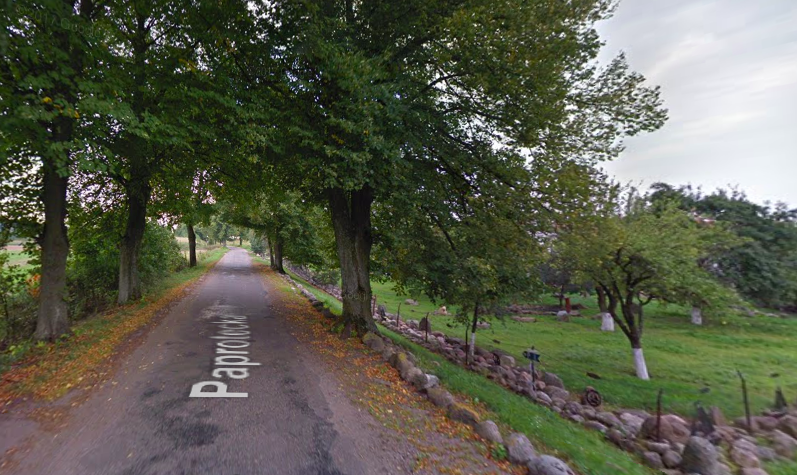
near the entrance of the park (streetview)

The Paprotecka country road leading to the entrance of Henryk Sawko's Kamienny Park (Stone Park) in Poland, on one side is richly lined by rocky stones, as can be seen in the photo above and also on Google Streetview.

The visitor to the park thus gets a foretaste of an art environment that is largely formed by an exposition of stones, both those arranged in various geometric shapes and those transformed into sculptures.

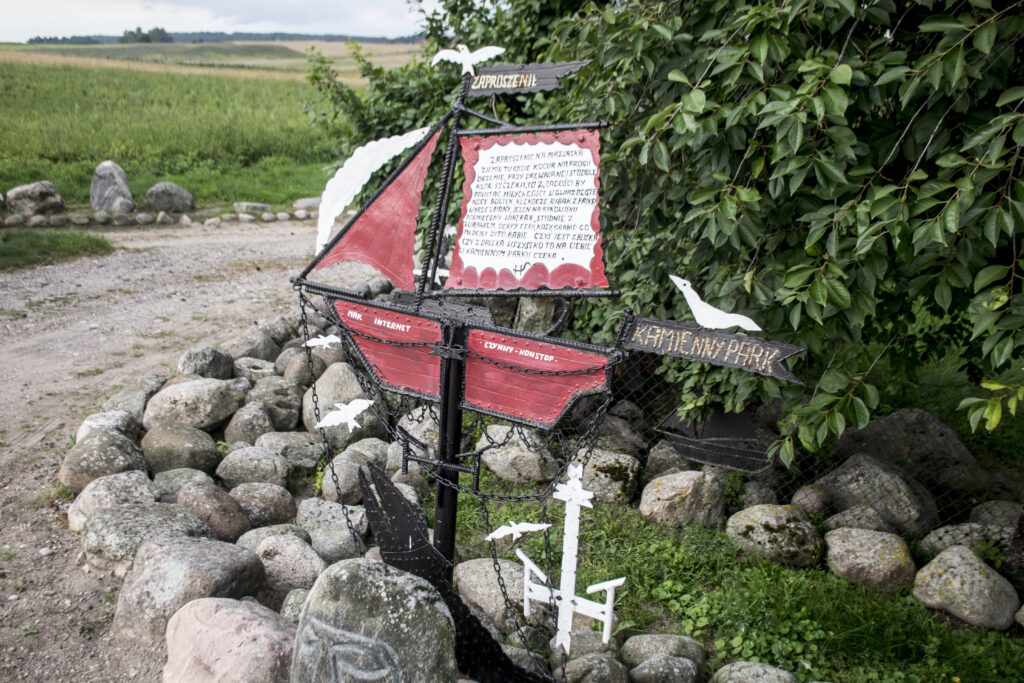
the entrance of the park
this picture and the next one (2017) courtesy
of Radek Łabarzewski from his  weblog Znalezienie
Life and works

In the late 1990s Henryk Sawko came up with the idea of building a stone memorial to mark the turn of the century, a project that in the early decades of the new century would evolve into a major art environment called Kamienny Park.

Sawko was born in 1950. In his younger years he was trained as a locksmith and he also liked to go out with his motorcycle to discover Poland. These travels convinced him that his native region of Mazuria was the most beautiful in all of Poland

He did not go to work as a locksmith, but became a farmer on a farm in the village of Rydzewo, which is part of the municipality of Miłki, in the Giżycki district of the Warmia/Mazuria region in the north-east of Poland. 

Sawko got married and the couple had children.

Sawko seated on the monument to the turn of the century

When in the late 1990s Sawko came up with the idea of making a memorial to the centenary, he was approaching the age of fifty. 

His children had left home, farming became less and less profitable, so once the memorial was completed it was a small step to feel inspired to use the stones that abounded on his farmland, to create a park with an exposition of stones and stone sculptures.

this picture and the next three screenprints from the 
first video below, in agreement with Kamil Pietrowiak

Construction  began on a hill in the land behind the farm. A striking self-built windmill was added to the hill, and was surrounded by an arrangement of stones. 

From the hill towards the house/farm, alignments of stones were laid that are reminiscent of the Neolithic arrangements as in Carnage, Brittany.

The photo below gives an impression of the way the stones are arranged, and the website Mazury 24 has aerial photos that very clearly depict the alignments of stones.

The alignments of stones are generally composed of quite large boulders, collected in the thousands by Sawko from the surrounding farmland. 

These lines are regularly interrupted by somewhat larger, upright stones that portray specific characters or from a Neolithic point of view could be compared to menhirs. 


These larger stones are often worked and transformed into human characters or animals. Other stones, flatter in shape, can serve as a background for texts.


Around the home

In addition to the rows of stones that creatively shape a large part of the area behind the former farm, the yard near the house and the associated barns are also part of the art environment. 

First of all, there is a collection of tools and implements that give a picture of farming as it was practiced on Masurian farms in former times.

this picture and the next one (2017) courtesy
of Radek Łabarzewski

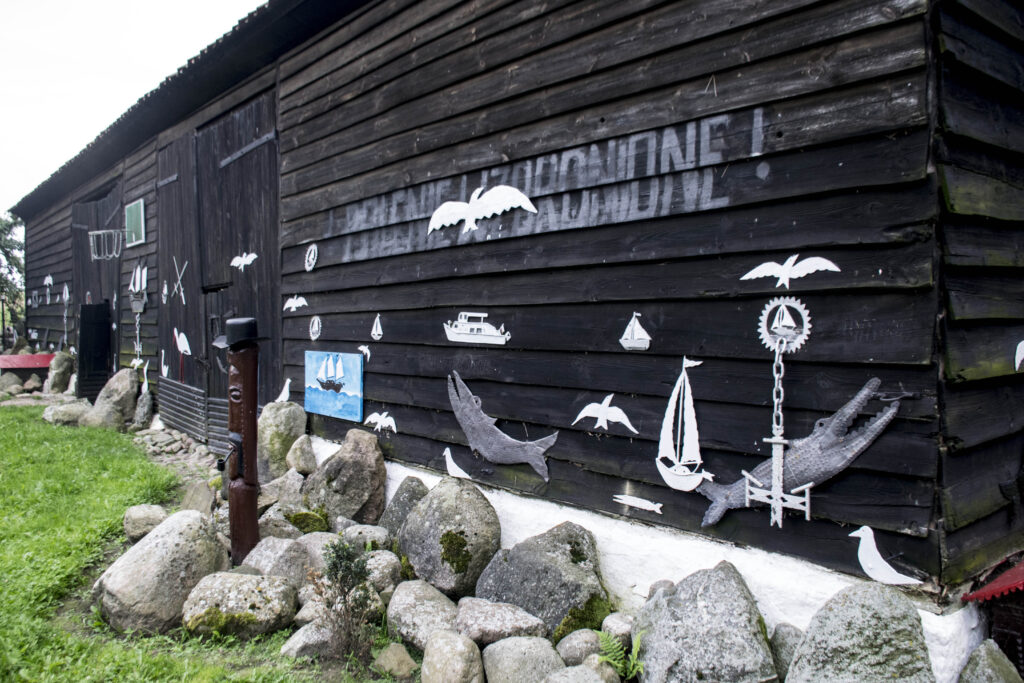
In addition, Sawko has put his own hand-made decorations on the walls of buildings around the yard.

He decorated a whitewashed wall with black images, cut from metal, such as birds and other animals, but also sailing ships
 

Documentation
* Article on website Mazury 24 with among other things, aerial photos of the alignments of stones
* Article by Radek Łabarzewski (March 2022) on weblog Znalezienie
* Article by Kamil Pietrowiak, "O sztuce, która niejedno ma imię. Przypadek Henryka Sawki, twórcy Kamiennego Parku w Rydzewie" (About art with many names. The case of Henryk Sawko, the creator of the Stone Park in Rydzewo)
Pietrowiak also wrote a thesis (defended in 2011) on Henryk Sawko and his creations: Mazurski malarz krajobrazu. O życiu i dziele Henryka Sawko, twórcy Kamiennego Parku w Rydzewie (Masurian landscape painter. About the life and work of Henryk Sawko, creator of the stone park in Rydzewo) 
 A large variety of photos collected by Pietrowiak and presented in a video (YouTube, 2013, 32'14")
 
Videos
A video by Pietrowiak, made in the context of his dissertation (YouTube, 12'02", 2013)


* A video by Mazury24eu (YouTube, undated, 1.15'47")


Henryk Sawko
Kamienny Park
Paprotecka 2, 11-513 Rydzewo, dept Mazuria, region Warmia/Mazuria, Poland
visitors welcome

April 08, 2022

Roland Vincent, Jardin avec têtes de granit sculptées / Garden with carved granite heads

unless indicated otherwise, the pictures are 
courtesy of Sophie Lepetit, from her weblog
Sardent is a small community with about 800 inhabitants in the French department of Creuse in the Nouvelle-Aquitaine region. North-west of this community is a hamlet called Mont de Sardent (Hill of Sardent), surrounded by a wooded, hilly landscape, with many rock formations, as can be seen in a series of photos on the All Trails website

Roland Vincent in his garden (2021)
Life and works

This is the region where Roland Vincent (1948-2024) was born. Like his father and grandfather, he became a bricklayer.

In the early 1980s, when he was in his early thirties, he came up with the idea of collecting and processing the blocks of granite abundant in the environment.


For Vincent this processing of the found stones was mainly a matter of intuition. 

Characteristic of such an approach is that when considering a collected stone, the artist already envisions in his mind what would emerge from the material after processing. So it is not the artist who assigns the form to the stone, but rather the qualification of the stone that determines the final form.


The surrounding images show that each of the dozens of sculptures has its own appearance and that no two resemble each other. Some have hats on, but differ on other aspects, each sculpture has its own look in the eyes, some have the hands depicted, there are smaller and larger versions.....and so on.....

  
Working in this way, Vincent gradually created an extensive collection of sculptures, all of which got a pitch in the garden near his house.

Babòias

Around 1995, Roland Vincent started to create a completely different type of sculptures, which didn't get a place in the garden, but were collected in the garage of the house.

These sculptures were generally small in shape and were made by attaching grit and ancillary items to an infrastructure made of a variety of scrap materials, shaped into the appearance of the character envisioned.

The sculptures, which Vincent referred to as Babòias, look very different from the creations in the garden, as can be seen in the photo below by Bruno Montpied.

Some characters, in certain attire, look comical, others more homely, especially when fitted with domestic attributes, and still others are terrifying, especially those made almost entirely of granite. 

In the exhibitions to which Roland Vincent was invited (in 2013 at the town hall of Saint-Éloi and in 2018 at the Cécile Sabourdy museum in Vicq-sur-Breuilh) in addition to a single creation as included in the garden, mainly the Babòias were shown.

And then, a meeting that Jean-Bernard Philippot (of the theater company Nomades) had in 2010 with Ronald Vincent, during which Jean-Bernard saw the Babòias, resulted in a play Le petit peuple de pierre (The little stone people) in which these sculptures filled the stage (performed for the first time in 2011).

 picture (2005) by Bruno Montpied, from his weblog\
 
Roland Vincent passed away on April 26, 2024, at age 77.

Documentation
* article (July 2009) by Bruno Montpied on his weblog
article (2018) reviewing Vincent's creations at the exhibition in Vicq-sur-Breuilh
* article (around 2011) by Jean-Bernard Philippot about the creation of the theatre play Le petit peuple de pierre  (The little stone people)
* article (July 2012) in regional journal La Montagne about the theater project with the Babòias
* article (March 2022) with a variety of photos by Sophie Lepetit on her weblog

Roland Vincent

Garden with carved granite heads

Le Mont-de-Sardent 

23250 Sardent, dept Creuse, region Nouvelle-Aquitaine, France


April 08, 2010

Luigi Lineri, El santuario dei sassi / The sanctuary of stones

all pictures (2010) courtesy of Figlio Tucano

Stones, stones, stones..... Luigi Lineri has been collecting stones since 1964.

Life and works

Born in 1937 in the small community of Albaro, Italy, Lineri currently lives in the nearby community of Zevio, in the neighbourhood of Verona. He had a job in a shoe store and until 1985 he worked as an assistant in the hospital in Verona. 

The commune of Zevio is located on the Adige river, that runs parallel with the Po river through northern Italy. On the banks of this Adige river Lineri liked to wander and look for stones.


Around 1970 he began arranging these stones according to common characteristics as present in the stones. But it's just a way of looking, for example one could discern a face in a stone and combine all facial stones.

Lineri's passion for the stones has to do with the association he has through these stones with cultures from long ago, how these people lived, what there ideas were and their ways of looking at life, how they used stones....

Arranging the stones is done in associative and intuitive way, it is a creative and artistic, not a scientific enterprise.


Some groups of stones have been arranged in ziggurat-like piles.

The  collection is displayed on the walls and floors of two rooms of the house and an adjacent barn. It has no specific name. Calling it a sanctuary probably is a good approach, but cathedral would be a striking name too.

In terms of collecting stones Lineri is a non-professional, the only people who do this kind of collecting by profession probably will be those archaeologists who are unearthing flints from the neolithic era.

Luigi Lineri is an artist, who is related to the art singulier group that is active in southern France. He has been writing poetry and has made paintings and ceramics. Most art singulier artists are self-taught.

Award 2012

In May 2013 it was announced that Lineri won the first prize in a competition held in 2012 entitled European Award for Lifelong Passions, La Secunda Luna

Documentation
* Entry on website Costruttori di Babele
* A most complete website entitled "Luigi Lineri" (in Italian and in English), with a biography, a bibliography. an interview with Lineri, a number of reviews and descriptions of his collection of stones. This website also has examples of  Lineri's poetry and his sculpting.
* Series of photographs (2011) on Francesco Galli's website
* Article by Giada Carraro on her website Bric-a-Brac Italia

Videos
* YouTube has a number of videos of this site, for example
---Enrico Ranzanici, I mysteri dei sassi, Luigi Lineri e l'Ádige (2007, 10')
---Marco Giovanni Ferrari, Qui si può passare (2002, 22')
---Sara Pigozzo and Enrico Meneghelli, Outsiders (2014, 2'24"). a video that portrays some people who have a close relation with the Adige river, among whom Luigi Lineri
* A video in a new series of videos by Costruttori di Babele, started in July 2018, features Lineri: Luigi Lineri e la sua cattedrale di sassi (YouTube, July 2018, 12' 08)


* Video The Mysteries of Pebbles made by Paolo Mucciarelli and Enrico Ranzanici (4’27”,
YouTube, February 2019). This video was the winner in the short film competition organized by Raw Vision magazine early 2019.


Expositions

Pictures by Rodolfo Hernandez of Lineri's collection of stones in an exposition Costruttori di Babele in the Museo Carlo Bilotti in Rome (October 2012)

No public visiting

There are no arrangements for the general public to visit this site. 

Luigi Lineri
El santuario dei sassi
Zevio, Verona, Veneto region, Italy
no public visits

first published April 2010, last revised September 2024