Showing posts with label interior decorated with frescoes/murals. Show all posts

August 30, 2024

Jean-Claude Villot, Intérieur décoré et jardin de sculptures / Decorated interior and sculpture garden

all pictures courtesy of Sonia Terhzaz

The scene above with sporty characters is set in an art environment in Baron, a small commune with around 1200 inhabitants (January 2021) in the Gironde area in the south of France. about thirty kilometers east of Bordeaux.

Life and works

This art environment is a creation of Jean-Claude Villot, who was born in the early 1960s, initially was a carpenter, later worked in a factory and nowadays is retired.

The art environment consists of two completely different types of creations, on the one hand a large field of sculptures situated in the exterior, as can be seen in the very first image, and on the other hand a number of decorated walls in the interior of the house whose occupants own the decorated field.

The pictures around give an idea of the decorated interior.


The house, that was occupied for many years by Villot's meanwhile deceased mother, is now the home of his sister and her husband, who inherited it.

Villot began decorating the walls around 2010.

His decorations have a light-hearted character, generally depicting events from everyday life, such as someone making a walk, a stream of water with fish swimming around or a dog being walked.


The field of sculptures

Around 2015 Villot began making sculptures from wooden pallets he collected at the local dump.

In agreement with his sister and her husband, these sculptures got a spot on the field they owned, located next to the house in which they now lived. 

It's a field with a generous size that can accommodate a large number of creations.


Because he mainly used pallets Villot's creations are predominantly two-dimensional. They have no artistic pretensions, but they are distinctly amusing to look at

Like the murals inside, they are made by Villot to depict an everyday event and to provide commentary on it, if that's convenient.
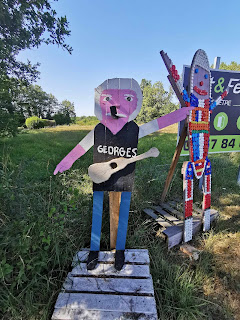


These current events can include anything, such as activities of all kinds of political figures, but also of wearers of yellow vests, a common wear in France in recent years for people demonstrating.

Sport does have its own place in his creative work, especially rugby. When in 2023 the rugby championships were held in France, Villot paid a lot of attention to this event by making a sculpture of Antoine Dupont, who is captain of the France national rugby team.

The 2024 Olympic Games in Paris also got a lot of attention.


There are also comic characters. 

Above we already encountered Tintin, and below on the left one can see Mickey Mouse.

The designation Ponpon le Cheval (Ponpon the horse) in the image below right is a tribute to a horse that helped in a vineyard in the French Languedoc area.

The sculpture garden is located north-west of the centre of the commune of Baron, along the departmental route D936, opposite the company Aquitaine Matériaux.


Documentation
* Article (August 2023) in newspaper France Bleu
* Article (September 2025) on Facebook by Martin Besnard, with a series of recent pictures

Jean-Claude Villot
Decorated interior and sculpture garden
32 Route de Branne (also D936)
33750 Baron, dept Gironde, region Nouvelle-Aquitaine, France
the sculpture garden can be seen from the road

March 31, 2023

David Parr, Decorated interior

pictures are screenprints from the videos in the documentation

ALLELUIA. That is written in the wall decoration, pictured above. This decoration, made in the late 19th or early 20th century, part of an extensive decorative project, is located in a humble two-bedroom terrace house in the city of Cambridge in England, UK. 

The decorations have been miraculously preserved and are now part of a small museum in which the house was converted in the years 2010.


Life and work

The decorations are the work of David Parr (1854-1927) who was born in Chesterton, a suburb in the northeast of the city of Cambridge.

Little is known about his early years, except that his mother died of tuberculosis in 1860.

In 1871 at age 17 David went to work for FR Leach & Sons, a company known at the time for carrying out large decorative works of Art & Crafts and Gothic Revival projects in buildings and private homes in Cambridge. 

Ferdinand Richard Leach (1837-1904), son of an artist, developed into an artist-craftsman and established a showroom in Cambridge in the 1860s as his work expanded and he was given more and more commissions, such as the decoration of the interior of St Clement's Church in Cambridge.

It is mentioned that David Parr initially was working in the showroom. There he must have become familiar with the world of the then developing Arts and Craft movement

He came into contact with many artists from that world, became acquainted with the techniques prevailing there and was also involved in painting large houses and churches based on designs produced by famous representatives of the Arts and Crafts movement.


When David Parr at age 32, in 1886, bought the small terraced house that now has the decorations, he  got help from his employer F.R. Leach. 

David and his wife Mary Jane, who got three children, would live all their life in this relatively small house with two bedrooms.

Soon after David Parr moved into the house, he began decorating the walls and other elements of the house, a project that would continue for some forty years. In those years the house hadn't gas and/or electricity, and Parr, who usually worked in the evening or at night, was lit by candles.


The Arts & Crafts movement, which inspired him, was a reaction to the industrialization, the growth of big business and the mechanization that occurred in England in the second half of the 19th century. The decorations were meant to reconnect people with the places where they lived and worked. 

The pronounced decorative approach emphasized the homely, although this type of art can often be found in churches and large houses of the wealthy. That's why David Parr's tiny house, set in an unassuming location, is so special.


After David Parr died in 1927, Elsie Palmer, a granddaughter of David and Mary Jane, came to care for David's wife. Elsie would continue to live in the house after Mary Jane passed away and during all the years she lived there, she changed almost nothing about the furnishings and hardly let anyone in.

In 2009 Tamsin Wimhurst, a social historian, was tipped off about the decorations in the house. She went to visit, was extremely surprised by what she found and decided to take action to save the house, this al the more because Elsie Palmer meanwhile was in her early 90s.


In 2013 she and her husband Mike bought the house from the family. They set up a David Parr House Trust, that in 2017 got support from a lottery fund and other financiers to renovate the house, which by then had some structural problems, like a leaking roof.

Meanwhile Elsie had moved to a nursing home, where she died in 2014 at the age of 97.

The house/museum was opened to the public in 2019. To protect the decorations and the interior, the number of visitors is limited to 2000 per year and photography is not allowed. A group of volunteers is available to do daily maintenance, administration and to receive visitors.

Documentation
* Website of the David Parr House
* Facebook pages of the museum
* Article by Nick Carvell on website INIGO, with photos by Chris Herwood
* Article (March 2019) by Donna Ferguson in newspaper The Guardian
(there is a variety of other publications available on the internet) 

Videos
* Video by James Murray-White (2018. Vimeo, 6'27")

* Another video by David Parr House entitled Virtual Tours Promo  (Vimeo, 2'13")

David Parr, Decorated interior
186 Gwydir Street 
Cambridge CB1 2LW, county Cambridgeshire, region East of England, England, UK
can be visited on appointment

June 10, 2022

Yuri Antonov, Музей Храм Гомера / Museum the Temple of Homer


pictures (2021) courtesy of Mary Artamonova 

In Vyritsa, an urban community of some 12.000 inhabitants in Russia, some 60 km south of Saint Petersburg, a rather special art environment is located, referred to as Museum "Temple of Homer".

Life and works

This art environment includes the fully decorated interior of Yuri Antonov's apartment. 

Antonov was born in 1947 in Vyritsa and after a relevant study and education he became a chemist by profession. 


Although this is not mentioned in the available documentation, it is likely that he practiced this profession in Saint Petersburg, also until 1991 called Leningrad. 

Clues to this are that it has been reported that Antonov spend a lot of time in the Hermitage library and that he befriended Nikolai "Kolya" Vasin (1945-2018), a native of Leningrad who became a big fan of the Beatles in the 1960s/70s.

Vasin collected many records and memorabilia, which he displayed in his apartment, that became kind of a museum named the John Lennon Temple of Love, Peace and Music. 

Antonov had an artistic streak. He played music, wrote poems and in 1992, when he was already 45. he started making paintings, which soon got exhibitions in galleries.


In 2001 Antonov moved into an apartment in his hometown Vyritsa. Following the example of his friend Vasin, he transformed the two rooms of the apartment into a museum space by decorating all the walls and ceilings with frescoes and paintings he created himself. 

Because of his great interest in the Greek classical ages, he named the museum Temple of Herod.

The images in this post give an impression of the way the walls are completely filled with mostly small-scale paintings, which often include references to paradise and the history of ancient Greece. 

The ceilings are also decorated, for example with aliens and the god Hermes.

The documentation below has a reference to an article by Alena Bobrovich from October 2021, which includes a large number of images both of individual paintings by Antonov, as well as of the decorations of the walls and, in particular, the ceilings.

Documentation
* Entry on Facebook (December 2021) by Mary Artamonova
* Article (October 2021) in regional newspaper Metro by Alena Bobrovitsj
* The same article also in newspaper Bezformata

Video
* Video by с орода  (July 2018, YouTube, 1'31")

с орода


Yuri Antonov
Museum the Temple of Homer
Vyritsa, dept Gatchinsky, region Leningrad, Russia
visitors welcome on appointment

June 17, 2021

Danuta Szudzińska, Dom z freskami wewnątrz i na zewnątrz / House with frescoes internally and externally

above picture has a view of the frontside of the house
via streetview; the other pictures are screenprints 
from the video referred to in the documentation

The picture above shows the frontside of a house in the small community of Łanięta -some 600 inhabitants- located in the centre of Poland.

This is the house where until recently Danuta Szudzińska (1946-2021) lived, a self-taught artist who has become known because of the fresco decorations she added both to the exterior and the interior walls of the house.
.
Although the very first image is not very clear, one can see that next to and below the windows on the left, geometric decorations have been applied, while under the decorated balcony at the right a scene with a person on horseback is situated. 

The two images above show some details of the scenes on the facade, left a fresco of a man and a woman, situated on the balcony behind the TV-receiving dish. 

The image on the right shows a scene with a man on horseback, followed by a woman, both dressed in an oriental manner, perhaps depicting Mary and Joseph's flight into Egypt. The image under the balcony itself, apart from this couple, also has two giraffes on the left and on the right a large animal standing on its hind legs, perhaps a bear.

The image above, made in May 2020, portrays Danuta Szudzińska in her mid seventies. Little or no information can be found on the internet about her life and work.  

Radek Labarzewski, who made he video referred to below and visited her in May 2020, said that she created  for herself and her loved ones. He noted that Danuta Szudzińska wasn't hurt by criticism, but that she was happy when someone appreciated her creations.

Because there is virtually no information available about her, comments and explanations on the frescoes she made, are also lacking in the public sphere.

So although the following images give a good impression of Danuta Szudzińska's way of paining the frescoes on the indoor walls, the accompanying texts contain a lot of assumptions.

Above a scene of probably a father with his daughters. The father, perhaps in a peasant smock, stands in the center, holding hands with two girls to the left and right, and these three stand in front of a portrait of two more girls.


The scene depicted above shows a winter landscape with a man in a sleigh, pulled by a horse, with farmhouses in the background.


The scene above, on the wall behind the ascending staircase, shows two people in a pleasant encounter, with a tree on the left and a structure that resembles a mill on the right.

Other women who decorated their interior with frescoes

In the field of art environments in Europe, there are some more examples of somewhat older women who added frescoes to the interior walls of their house, such as Polina Rayko (1928-2004) from Ukraine, Enni Id (1904-1992) from Finland and Bonaria Manca (1925-2020) from Italy. With regard to all three artists, after their deaths or prior to that, activities have been undertaken to give their house, including the works of art therein, a protected status, this in order to preserve the site for the future.

As for Danuta Szudzińska's art environment, it has been reported that the family is of the opinion that the decorations should be preserved for the future.

Documentation
No articles about Danuta Szudzinska's work or similar resources have been found on the internet

Video
* Video on Facebook (0'.14") compiled in June 2021 with photos taken in May 2020 by Radek Labarzewski 


Danuta Szudzińska
Łanięta, Lodz region, Poland
no information available about visits by he public
some decorations can be seen from the street
 

January 29, 2020

Ron Gittins, Roman Villa, decorated interior


murals and painted ceiling
all pictures courtesy of  "The Caravan Gallery"

Oxton Village, in earlier years a rural hamlet in England, currently is a suburb of the town of Birkenhead, which is located on the left bank of the mouth of the river Mersey, opposite Liverpool. 

In January 2020, a Liverpool newspaper reported on the discovery of a rented Victorian ground floor in this community with an interior fully decorated with paintings on walls and ceilings, and fireplaces surrounded by life-size sculptural creations, all this without the neighbors or even the artist's family knowing anything about it. 


Life and works

This art environment is the life's work of Ron Gittins (1939-2019).

As a young boy he was rather creative, which became clear when he for example made plasticine toy soldiers executed with astonishing details. So it was obvious that after his primary education he went to the Laird School of Art in Birkenhead, the first public school of art outside of London, opened in 1871.

He also studied drama at a local college where he developed his ability to deliver speeches -very loudly- and he taught others to do the same.


After this schooling Ron had a variety of jobs, such as cutting rubber letters at a printing firm, working in soft furnishings in a department store, inspecting goods in a factory, but he wasn't the person to like being told what to do and usually his jobs ended up leaving because of disagreements.

Ron also tried to work as a self employed artist, painting murals and portraits, and for that he set up Minstrel Enterprises, a project that in professional sense had only limited success. However, in 1975 he did receive recognition in the Liverpool Echo and on television for turning his bedroom in his parents' (rented) house into a Roman villa !

A very flamboyant personality, seeking attention when out on the street, Ron often dressed in extraordinary outfits of his own creation. He would tell people that he was working for the Secret Service.

In the eyes of the residents in the area where he lived, he was somewhat eccentric. They saw him walking around in these self-made outfits, sometimes with a cart with a life-sized papier-mache model he had made of the Egyptian queen Cleopatra, or transporting a large bag filled with cement he needed to make sculptures.

Ron's social-political views were rather conservative, unlike those of his sister Pat Williams, a few years older, who had joined the Liberal Democrats and was a councilor (1987-2016) and mayor (in 2002) of the Metropolitan Borough Council of Wirral, in which Birkenhead is located

murals in the bathroom

This difference of opinion and Ron's dramatic personality, and frequently outlandish and inappropriate behaviour, wouldn't facilitate the exchange of ideas between Ron and his family, nor encourage relatives to regularly visit Ron at home. In addition, Ron himself was very protective of his private domain. 

But the relationship between Ron and the family as such remained good, and the family also knew about Ron's activities with regard to the decorations in his house, albeit that they had no idea of the nature and certainly not of the size thereof. 

In particular when Ron's decorations started to cover almost all walls and ceilings, he became  extremely reluctant to welcome visitors, except maybe some special friends, afraid as he was that his landlord would hear of his wall decorations and that he would be expelled from his house.

But this reluctance to receive visitors also meant that his broken gas heater could not be repaired. 

In the last years of his life he lived alone, without heating, preparing food on a camping gas appliance, living amidst his decorations and the more than ordinary number of  things he had collected in the course of the years.


Gittins' art environment

It is not clear when Ron started working on his art environment. He may have been making paintings or working with art in a different way all the years he lived in the house. However, creating the decorations that currently form the art environment, must have been a project of many years.

The images above give an impression of the paintings that have been applied to the walls and the ceilings of almost all rooms in the house, including the bathroom.

There are historical figures such as French emperor Napoleon, British admiral Lord Nelson and his mistress lady Emma Hamilton. A warrior with a shield and sword is given a place on a ceiling.

The murals in the bathroom show a variety of fishes. 


The art environment also includes a number of impressive sculptures.

A chimney has been shaped like a giant bull's head (image left above) and there is a fireplace with a lion's head, three meters tall (image top right).


In the kitchen, which hasn't been provided with frescoes, there is a sculpture that looks like a temple.

Taken together, all these decorations exude a classical atmosphere and evoke associations with ancient Rome, Egypt and Greece.

Action to save the site

After Ron Gittins died in September 2019, the family for the very first time got acquainted with the decorations and sculptures in the house. That was a great, very special discovery.

Also because some family members are active in the art world, it was soon established that Gittin's legacy included a special work of art. In the last months of 2019 various experts, who were asked to visit the site and take a look at the decorations, agreed that this was a very interesting ensemble in the field of outsider art.

The social landlord Salisbury Management Services was also approached, and this organization appeared willing to conclude a contract aimed at keeping the house in its current state during the coming period.

In the course of January 2020, the local newspaper Liverpool Echo was approached. This journal published a large article about the discovery of the site, and this news subsequently was taken over by many other British newspapers.

All these activities were mainly undertaken by Jan Williams and her partner Chris Teasdale (Jan is a daughter of Pat Williams, Ron's sister. Jan and Chris together manage their art project The Caravan Gallery)

A crowdfunding campaign to save the site was successfully completed in February 2020. However, in order to consolidate plans to continue Ron's Place, a new campaign has been launched through Patreon to recruit people who want to sponsor the project as patrons.

A suddenly announced auction of Ron's' Place has ended well

Early 2023 the owner of the property announced that the house would be auctioned on March 1, 2023. This was for the group who were committed to preserving the site and did not have the resources to make the purchase. an unexpected and problematic message.

At the last minute, the day of the auction, word came that a charitable trust, led by social historian Tamsin Wimhurst and her husband Mike Muller, wanted to give a loan to purchase the property.

The auction went without a price increase and the purchase was made. Ron's Place is saved for the future !

A protected status

On April 5, 2024 it was reported on the website of Ron's Place that the UK Department of Culture, Media and Sport has decided that the creation has a protected status Grade II as “an example of large-scale Outsider Art”.

Documentation
* The official website Ron's Place, with a virtual tour of the decorations in the various rooms
On the website The Keepers Project (2020) a variety of pictures and an interview of David Clegg with Jan Williams and Chris Teasdale, keepers of the site
* Article (January 25, 2020) about the discovery of the site in newspaper Liverpool Echo
* A series of pictures of the site on Liverpool Echo

Videos
* News item (1'00", January 29, 2020) by BBC North-West (video as published on Facebook by Claire Jones)


* Video by Chris Teasdale (March 2021, 2'54", YouTube) to promote the action to become a patron of Ron's Place


Ron Gittins
Roman Villa (decorated interior)
Oxton, Birkenhead, Metropolitan Borough of Wirral, Merseyside, North-west England, UK

first published January 2020, last revised April 2024


April 26, 2018

Diana Keys, Frescoe decorated interior


pictures are screenprints 
from the first video in the documentation

Above picture depicts Diana Keys' sitting room in the house where she lived until her death. She rented this house from the municipal housing company of Hemel Hempstead, a town of some 80.000 inhabitants in the United Kingdom, just north-west of London.

Like other rooms in the house, the walls and the ceiling of this room have been decorated with frescoes she created single-handedly.

Life and works

Diana Keys (1947-2018) began this project around 1977 as a therapy to curb mental health problems she experienced.


Using her own fingers in stead of brushes, she painted colorful, naturalistic scenes, depicting in particular many horses, but also other animals such as panthers, tigers and birds. And then she also depicted characters such as young ladies, saints and angels. A life-size mermaid is depicted on the wall of the bathroom.

On the whole, Diana Keys' frescoes decorated interior got a quiet, peace-loving appearance.


In the many decades that she was painting, she remained out of publicity, but in late 2017 she came out with her project, which led to a one-off avalanche of publicity with photographs and articles in a variety of English news media (Daily Mail, BBC, The Mirror and many more).

In interviews Diana has said that she wanted to end her project now she is seventy years old.

Living in a rented house, she also said that she realized that all walls and ceilings might be whitened if she no longer lives there.


Diana Keys passed away on March 23, 2018.

It is not known whether the murals in the rented flat still exist or meanwhile have been removed.

To my knowledge Diana Keys' art environment so far has not yet been documented in any British medium in the field of outsider art.

Documentation
As said this art environment in November 2017 got a lot of publicity in news media in the United Kingdom, all with almost the same descriptions and photographs.So just one referral will do:

* Article (November 10, 2017) in Mail Online

Video
* Video by Fresh News Channel (1'38", YouTube, November 10, 2017)


Diana Keys
Frescoe decorated interior
Hemel Hempstead, Hertfordshire, United Kingdom
it is not known whether the murals in the rented flat still exist

first published April 2018, last revised May 2019

April 13, 2018

Valery Ermakov, Скульпту а саду та інтер'єру з картинами та скульптурами / Sculpture garden and interior with paintings and sculptures


pictures and video screenshots published here 
with permission of the website Ukrainer.net

In the field of art environments, it happens occasionally that for years a site is only known to the nearest neighbors and remains unnoticed by the general public. And then it can happen that at some moment a creation comes in the range of the radar, as with this art environment in Ukraine.

ensemble with Vakula, a character in a story by Gogol

Life and works

Valery Ermakov, the creator of this art environment, was born in 1938. Already as a youngster he was interested in creative activities, like he -after some instructions of his mother- at age five already decorated bird whistles made from clay. 

However, there was no professional artistic career ahead of him. All his life he has been working as a design engineer. He got married in the 1980s and the couple settled in Poltava, a town of some 300.000 inhabitants in the north-east of Ukraine, located some 340 km east of Kiev.

Greek God Pan

In addition to his job, Ermakov in his free time developed into a self-taught artist, this with the support and encouragement of his wife. He made paintings and sculptures, but, perhaps too impatient to keep up, he attended just a few meetings of a course for amateurs. Eventually he got his information about art from magazines and tutorials.

Ermakov participated in the fair in Sorochinskyi, a famous market in his region and one of the largest in Ukraine with a lot of attention for cultural matters, but he was not inclined to sell his work at a price which, in his opinion, was too low. On the other hand, he would donate his creations to local schools and churches.

In 2007, after Ermakov retired, he and his wife moved to the  community of Panasivka, a very small village with just a couple of houses and without shops.

a goddess (?) with blue hair

Here Ermakov had space and time to create sculptures and paintings and his wife could enjoy her hobby of gardening.

To make sculptures, Ermakov glues small pieces of styrofoam together and processes the raw material just with a knife. He finds his inspiration in the works of the author Nikolai Gogol (who by the way was born in a village in the Poltava region) and also in Greek and Roman mythology. 


Artworks outdoors

The outdoor artworks are partly grouped in a modest sculpture garden on the side of the house (picture above). 

As the other pictures above show, this part includes a sculpture that represents Vakula, a character from a story by Gogol, another one that depicts the Greek mythological character Pan and a third one that depicts a female nude with blue hair, kind of a Greek goddess or a nymph, about whom Ermakov says that he doesn't know who she is....  

Another part of the outdoor creations includes decorations on the front wall of the living house, especially a radiant yellow sun and a half moon (as in the first picture of this post). There is also a sculpture of a female nude sitting on a pedestal, placed just close to an outside wall of the house.


Artworks indoors

 Above picture gives an impression of the artworks in the living room, a mixture of paintings and sculptures, set up amidst a large number of green plants, which keep alive the memory of his wife who tragically died in 2015.

The character with the bow and the arrow in the corner of the room as in above picture probably is a Cupido, as well as the one in the picture below.


A rather interesting feature of the indoor collection is the sculpture of a lady dressed in a red robe.

Life-size depicted, the woman is at ease in front of a window, in such a way that it seems as if she is part of the household. To my knowledge, in the field of art environments there is only one other self-taught artist with a similar connotation, namely Bogdan Ziętek from Poland.


The Ukraïner project and the trip to Greece

As said, the art environment created by Ermakov from 2007 would have remained unknown if not a specific event had occurred. In his case, it concerned the activities of Ukraïner, a media project by a group of young Ukrainians led by Bogdan Logyvenko to share curious stories about the most distant corners, people, art, and food of Ukraine in order to offer information to the general public to get to know their country better.

A team of Ukraïner visited Ermakov and reported about him in January 2018. Recognizing his great interest in Greece, they started a crowd funding action to offer him a trip to that country. The campaign was successful and in March 2018 the trip took place.

Documentation
* Article Without models (January 20, 2018, in English) on website Ukrainer
* Report about the trip to Greece, with a variety of photos

Video
* Video by Ukraïner (YouTube, 4'52", December 2017), subtitled in English, some nude sculptures, so the video can only seen on YouTube)

Valery Ermakov
Sculpture garden and interior with paintings and sculptures
Panasivka, Poltava region, Ukraine
sculpture garden can be seen from the road