Showing posts with label recycle art. Show all posts

November 04, 2022

Bartłomiej Kolbusz, Dekoracje w i wokół "Bury Mis" / Decorations in and around "Bury Mis"


pictures (2017) courtesy of Justyna Orlovska, from her 
website "step off the beaten track"

Bury Mis is the name of a café-restaurant in Bukowina Tatrzanska, a village of some 3000 inhabitants in southern Poland, near the border with Slovakia. Owned by Ewa and Bartłomiej Kolbusz, this site has become known because of the large variety of items that decorate it's exterior and interior.


Life and works

Bartłomiej Kolbusz, who added the various items, included the ones he created himself, was born on January 10, 1977. He got a training as a physiotherapist, but he was much more attracted to work as a visual artist. 

In particular he was interested in making works of art from all kinds of remnants of metal and iron. So in 1999, when he was 22, he founded a sculpture workshop focusing on that artistic genre. The studio was called Mała Manufaktura Radykalna Metalmorfozy Złomu (Small manufacture of radical metal- morphosis of scrap).


His artistic production includes a large variety of creations, mostly made from scrap metal. He made small items such as metal jewelry (rings, brooches), but also larger ones such as chairs and sofas, and creations in which various remnants of metal are combined to, for example, an artwork that can be recognized as an animal on legs, but then without reference to an in reality occurring living creature.

The larger creations he made sometimes have Latin names, such as a bull referred to as Taurus Peculiaris Bioindustrialis or a six-seater bench in a park called Ampulum Situlum.

Also, some large creations have mainly a utilitarian quality, such as a machine to remove 120 capsules from a  series of beer bottles in a few seconds, a device he made for an international meeting of employees of the Dutch beer company Grolsch.


Transforming the café-restaurant into an art environment

In 2002 Kolbusz and his wife took over the café-restaurant that for 25 years was run by Kolbusz' parents under the name Miś. The property was completely redesigned based upon Kolbusz' artistic insights. In December 2002 it was reopened under the name Bury Miś (The addition Bury is a reference to Kolbusz' nickname).

Ewa Kolbusz mainly focused on managing the café-restaurant and Bartlomiej Kolbusz continued his artistic activities.


The photo above shows the workshop that Kolbusz set up as soon as he and his wife became the owners of Bury Miś

The various images in this post give an impression of the way in which Kolbusz shaped the decorations of the café-restaurant.

The image of the decorated outer wall, at the very top of this article is followed by a Buddha meditating among the grass, a fairytale character (?) and a character with a cap, a gas mask and horns. 


The pictures around this part of the text show creations that reside in the interior of the cafe-restaurant: top left a creation that somewhat resembles an animal head, next to it a bespectacled male, and below once again an animal head, this one flanked by an old radio and some clocks or measuring instruments.


In the same vein as these creations, the interior of the café-restaurant has metal chairs and strange lamps on the tables that create a very specific atmosphere. A wall is covered with metal tools such as large saws and other carpentry tools.

There are several old radios, a teddy bear sitting in a box mounted on a wall, a dog-like creature with two heads and there is a wooden sculpture depicting an old woman with glass eyes, a pitchfork on the head and behind her a grave cross.

A panoramic, movable series of photos shows the entourage of the interior better than words, which especially goes for the color scheme of the walls and ceilings.


The grounds outside the café-restaurant are dominated by a 14 meter high metal lighthouse, named Iluminaris Marinaris Bukowina,
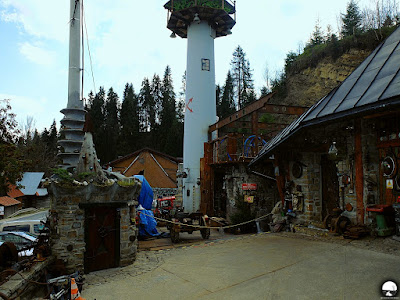
The tower is topped by a glass structure from which a light is switched on every hour. There is a plan to use the lighthouse as an industrial climbing wall by adding external forms of handholds.


Documentation
* Website of Bartlomiej Kolbusz with a series of photos that give an impression of his artistic production
* Website of the cafe-restaurant Bury Mir, with scenes of the interior
* Website Off the beaten track (April 2017) by Justyna Orlovska with an article and various photos of the site
* Article entitled Bury Miś-the taste of positive madness, with a variety of interesting photos, on          website Kolory Zycia

Videos
* Video  (undated (2013?), 2'16", YouTube) presenting Bartlomiej Kolbusz interviewed by Szalona Zuzia


* Video by Kinior (undated, 5'26", YouTube) with shots of Kolbusz' metal creations 


Bartłomiej Kolbusz
Bury Mis
Duga Street 154,
34-530 Bukowina Tatrzańska, Tatra County, Lesser Poland region, Poland
visitors (of the café-restaurant) welcome


January 08, 2021

Ritva Nurmi, Navetta Galleria / Navetta Gallery


this picture and the next two from the
FB page of the Kyyhkylä hotel
(name of photographer not mentioned)

Interior and exterior of a barn on the premises of a rural hotel in Finland together form a rather special art environment, comprising a rich collection of handcrafted recycle art. 

Welcome to the Navetta Gallery, a site created by Ritva Nurmi.

Life and work

Ritva Nurmi was born in 1942. Her twin sister and her brother both became professional artists. and although Ritva also had a feeling for making art, she did not attend an art academy, a bit uncertain as she was about making art as a profession, 

Only in the 1980s, when she was already in her forties, did she -as a self-taught artist- start making paintings. Because of this she got to know the use of colors and shapes, and she also gained more self-confidence with regard to being artistically engaged.

Partly thanks to this development, she decided in 1998 to make a new choice regarding her artistic work and she decided to switch to the special genre of recycle art, making all kind of creations from discarded materials.

 this picture depicts "Mop-Mimmi", a creation
made of a cleaning mop, plastic bottles and doll legs.

At that time Ritva Nurmi lived in Kirkkonummi, a town near Helsinki. She had been married and had children, but now divorced, she had all the freedom to do art in her own way. 

Due to reorganization, in 2001 she was fired from her job at the emergency center of the fire brigade. Since at that she moment was almost 60 years old, she probably received a (pre) pension.

In the same year she moved from Kirkkonummi to the community of Mikkeli, a few hundred kilometers to the north, where, through the intermediary of a mutual good friend, she was given an exhibition space and housing at Kyyhkylä Manor. 

an imaginatively dressed young musician
plays a (real) accordion

Built in 1630, this estate over the centuries has undergone many changes, like it served in the 1920s as a rehabilitation center for soldiers who had become disabled during the Finnish war of independence in  1918. 

Today it houses, among other facilities, a modern hotel. Ritva Nurmi's workshop and art gallery is situated in a barn belonging to the hotel. 

exterior of the barn
this picture and the next four screenprints
from the video in the documentation

The picture above gives an impression of the exterior of the barn. It can be seen that a number of Ritva's creations have been given a place around the building.

The picture below shows the facade of the barn, with a sloping deck leading to the entrance.

To the left is a person sitting on a bench under the gallery's nameplate, a painting and one of the first creations from recycled items Ritva made. Mainly using a pair of old gloves, she depicted a cow.

entrance of the gallery

The gallery, which opened to the public in 2003, includes Ritva's paintings made before 1998, as well as the large collection of recycled art she made in the following years.

The gallery is open to visitors all year round. There is no entrance fee and Ritva does not sell her work.

interior of the gallery

In Ritva's view the gallery should offer an atmosphere of happiness, joy and beautiful experiences. The energy of money should not be given a place there.

In the years leading up to the Covid pandemic, she was in the habit of welcoming visitors with a hug.

When making creations, Ritva also sees herself more as an intermediary, like she says that when busy with a new creation, beforehand she does not fully controls what comes about. It seems the ideas come from elsewhere, and she is often surprised at what she achieves.

Ritva Nurmi showing a homemade handbag

Besides the clothes for the various creations, Ritva also makes her own clothes and other personal gadgets, such as a purse or beret

The red-colored garment she's wearing in the photo above is reminiscent of the clothes worn by Sue Kreizman, the self-taught artist who lavishly decorated the interior of her home in East London.

The photo above also shows a bird in the bottom right corner. This one was made from a former handheld vacuum cleaner.

Likewise, Ritva has used all kinds of household appliances and garden tools for her creations, as well as bicycle helmets, boots and all kinds of clothing, just whatever was available ...

The space outside in front of the barn also has several decorations. For example, there is a path towards the entrance that is made of old CD discs, lined with all kinds of small structures, with a tree made of wellies at the end.

The grounds outside also feature some life-size creations, such as a blue-robed warrior with a shield


Ritva hopes that when she becomes too old to take care of the gallery, or if she has passed away, the city of Mikkeli will provide this care.

Documentation
* Article by Minna Tuuva on website ITE-net
Article (September 2019) by Tiina Suomalainen on Finnish website Seura, with some informative photos
Article (January 2019) by Päivi Vento on Finnish website Suomenma, also with some photos
* The website of the hotel has a short referral to the gallery, with a photo of Ritva Nurmi with one of her life-size creations
Video
Video by Artenomedia Oy (2017, YouTube, 2'29")


Ritva Nurmi
Navetta Gallery
Kyyhkyläntie 6, 50100 Mikkeli, Southern Savonia, Finland
the site can be visited all year, 
no entrance fee

July 17, 2019

Carmelo Librizzi, Parco d’Arte Bum Bum Gà / Art park Bum Bum Gà


this picture from Facebook

The art park of Carmelo Librizzi located in Montevarchi, Italy, not yet known in the field of art environments, has recently been spotted by Francesco Galli and described on his website.

Life and works

Carmelo Librizzi was born in 1949 in Petralia Sottana, Sicily. In the 1950s the family migrated northward to Tuscany, where they settled in Montevarchi, a city of around 24.000 inhabitants, located some 50 kms south-east of Florence.

this picture and the next one: screenprints 
from the video by Roberto Polimeno in the documentation

Librizzi grew up in a very musical family, so already as a child music got his great interest and he started making music. playing a clarinet in particular. Living in Montevarchi, he was able to further develop his musical qualities by playing in the Corpo Musicale “G. Puccini". This popular local orchestra, in the period 1946-1963 conducted by Maestro Ugo Canocchi, also includes a music school where youngsters can study music.

In later decades Librizzi, who meanwhile had exchanged the clarinet for a saxophone, participated in various Italian bands. He was very interested in free jazz and experimental music and also acted as an arranger.


Librizzi had a wide interest in art. He also loved poetry and sculpture and after studying precision mechanics he also studied processing metal, stone and wood. Along this way he came to actually making sculptures himself.

this picture and the next three 
courtesy of  Francesco Galli

His sculptures, in wood, stone and metal, partly have a reminiscence with an "archaic" way of working and partly have a modern, conceptual and recycling-based approach.

In 1979, when he was around thirty years old, Librizzi came up with the idea of opening an art park where he could not only display the sculptures he meanwhile had created, but where also artistic happenings could take place, such as exhibitions and music performances. 

The park was realized on a plot of land of some 10.000 m² outside of Montevarchi. Librizzi planted trees that became large oaks, he sawed pine nuts that currently are big pines, and there are fruit trees.


The site got a name Librizzi loved because of its attractive rhythmic connotation: Bum Bum Gà, derived from the name of a small railway station in Australia as present in a 1972 movie by Alberto Sordi.

In addition to the large size of Librizzi's artistic work, the arrangement of the works in this art environment also shows its diversity, both in terms of the varied use of materials, the style of work and the themes. Librizzi expresses himself equally easily in a figurative, realistic as in a conceptual way, and the visitor sometimes has to give an interpretation of the artwork himself.

For example, the heap of old bicycles maybe expresses Librizzi's message about the need of recycling and may invite to think about our modern lifestyle and the world in which we live, but at the same time it can been seen as a tribute to the cycling sport and evoke thoughts to the famous Italian rival cyclists Gino Bartali and Fausto Coppi.


Initially, the public expressed little interest in the art park, although Librizzi tried to involve the residents in the area with flyers and leaflets, but over the years, especially in the summer months, the site became a lively meeting place, with expositions, theatrical performances, concerts of groups of young people, meetings of owners of vintage cars, and so on.


40th anniversary of the Art Park

In 2019 Librizi's Art Park existed for forty years, which was celebrated in July with a festive gathering.

The video below (from Facebook) shows a moment of musical pleasure


Documentation

* The Parco d'Arte Bum Bum Gá on Facebook
Antonella Fineschi & Carmelo Librizzi,  "Ma quanto costa il pane? ("But How Much is the Bread?"), biography of Carmelo Librizzi (available at the Park)
* Interview with Librizzi (June 2016) in Italian webzine Backstage Press
* Francesco Galli, "Bum Bum Gà, La passione del fare", article (July 2019) with photos on his website
* Article (2025) by Giada Carraro on her website Bric-á-Brac Italia

Videos
In addition to the videos presented below, YouTube also has a video made in 2012 in which Librizzi  talks about his work (in Italian)
* Video by Roberto Polimeno (September 2011, 1'52", You Tube)


* Video by Claudia Maffei (February 2012, 10'03", YouTube)   


Carmelo Librizzi
Parco d'Arte Bum Bum Gà
Via Borrolungo Campagna
52025 Montevarchi, province of Arezzo, region Tuscany, Italy
can be visited all year, 9-18 hrs

September 16, 2009

Martti Hömppi, Veistospiha / Sculpture garden


picture by Veli Grano

Above trio of musicians in Finnish is named Trio Pönttöpäät, what means something like Trio of Empty Heads, and as far I understand this sculpture implies a critique on some Finnish politicians.

Life and works

Martti Hömppi (1935-2013) was born in a rural area in Finland and the memory of his youthful experience of the countryside has been an important aspect of his work.

He had various jobs during his active working life, including being a wrestler. After he got retired he began creating sculptures, using a variety of wooden planks and recycling leftover materials.

Other creations have been made by manipulating large wooden tree-stomps with a big chain-saw.

In this way Hömppi created sculptures of all kind of animals and personalities, a number of these with an implicit, sometimes explicit social critique, in general with a humorist approach. His way of working has given him some fame in Finland and earned him the nickname woodshed Picasso.

Hömppi (2003), as in Finnish TV-film
ITE: Itse thetyä elämää

Martti Hömppi passed away February 15, 2013. 

His artistic legacy has been donated to the Union for Rural Culture and the works are safely stored in the ITE museum in Kokkola.

Documentation
* Article on ITE-taide website

first published September 2009, last revised September 2023

Martti Hömppi
Veistospiha/Sculpture garden
37200 Siuro, Pirkanmaa, Western and Central Finland
the works have been transferred from the garden
around his house to the ITE-collection in Kokkola

August 20, 2009

Juha Vanhanen, Armohuvilla / Villa of Grace


picture courtesy of Minna Haveri

Juha Vanhanen (1957-2021) was born in Alavus, Finland. He began making white painted creative structures by using parts of agricultural and other machines, when he got kind of a religious vision, saying that recycling old materials and presenting them could be a good factor in evangelizing Christian belief.

Recycling, art, evangelizing, these three have guided Vanhanen in making his constructions.

It's not clear when he started making creations, but when this text was first published (2009), he obviously had been doing this for many years. 

Vanhanen has become known in Finland and his creations have been exposed in a number of expositions (like next picture is from an outdoor exposition of Finnish sculptures)


His white painted creations and structures were displayed around the house in Myllymaki where he lived, together with a collection of Mercedes automobiles.

Mercedes originally is a Spanish name, referring to the Virgin Mary, Maria de las Mercedes or Mother of Mercies. In Finnish mercy or grace is armo and so this environment is called armohuvilla (villa of grace).

 this picture and the next one courtesy of Sophie Lepetit

The photo above and the one below give an impression of how the white painted agricultural tools were positioned near the house


The next picture shows a creation made by Juha Vanhanen, that is not part of the art environment around his house.

It is an installation in Sweden that shows an ensemble of white painted plowshares, which refer to souls that fly to heaven.

this picture (October 2005) courtesy of Mats Karlsson

This creation is situated on a field in Västerkvarn, in the surroundings of the city of Halstahammer (on the road from Strömsholm to Kolbäck), where Vanhanen happened to live for some time. The installation is a gift by Vanhanen to the people of Halstahammer.

Here is a quote from a comment Alberto Oliver made about this ensemble: 
"The installation of the plowshares is superb. As a matter of fact, it needs no explanation to understand its feeling, a feeling of freedom, liberation and detachment, detachment from prison, after all, since from a religious point of view, the soul inhabits nothing but a prison of flesh".

Vanhanen made a comparable installation, this one exposed in Finland. It can be seen on the premises of the Finnish folk art museum in the community of Kaustinen.

picture from the Hungarian website csatolna egyesület

Juha Vanhanen passed away in November 2021.

Documentation
Article by Erkki Pirtola on  the website ITE-taide 
* Article and a series of photos (November 2018) on the weblog of Sophie Lepetit
* Memorial article by Minna Haveri on the MSL website
 
Juha Vanhanen
Armohuvilla
Myllymäki, Alavus, Southern Ostrobothnia, Western and Central Finland