pictures are screenprints from the video referred to in the documentation
The Hungarian city of Keszthely with about 20,000 inhabitants is located on the western tip of the large, elongated Lake Balato, located southwest of Budapest.
It is a city that attracts holidaymakers and includes various cultural attractions, such as one of the largest puppet museums in Eastern Europe-
Life and works
This museum was founded by Tibor Türk Túri, who was born in Budapest in May 1954.
He studied at the university in Nyíregyháza and then worked first as a business engineer and later as a teacher and tutor. He loved drawing and painting and was very interested in ethnography.
In the 1980s he entered the field of sculpture, creating a variety of all kinds of sculptures.
His interest in ethnography led him to put together a collection of various dolls in specific costumes, which in turn led to the establishment of the Doll Museum for Traditional Costume.
The museum, which opened in 1999, was housed in a building in Keszthely that used to be a granary and already existed in the middle of the 19th century.
The building contains larch beams with a length of 14 meters, which are even older and possibly date from the time of the Rákóczi, the first war of independence (1703-1711) that was fought in Hungary against the Habsburg rule.
The walls of the building also include unplastered parts of the walls of an old castle in Hungary dating from the time of Roman rule.
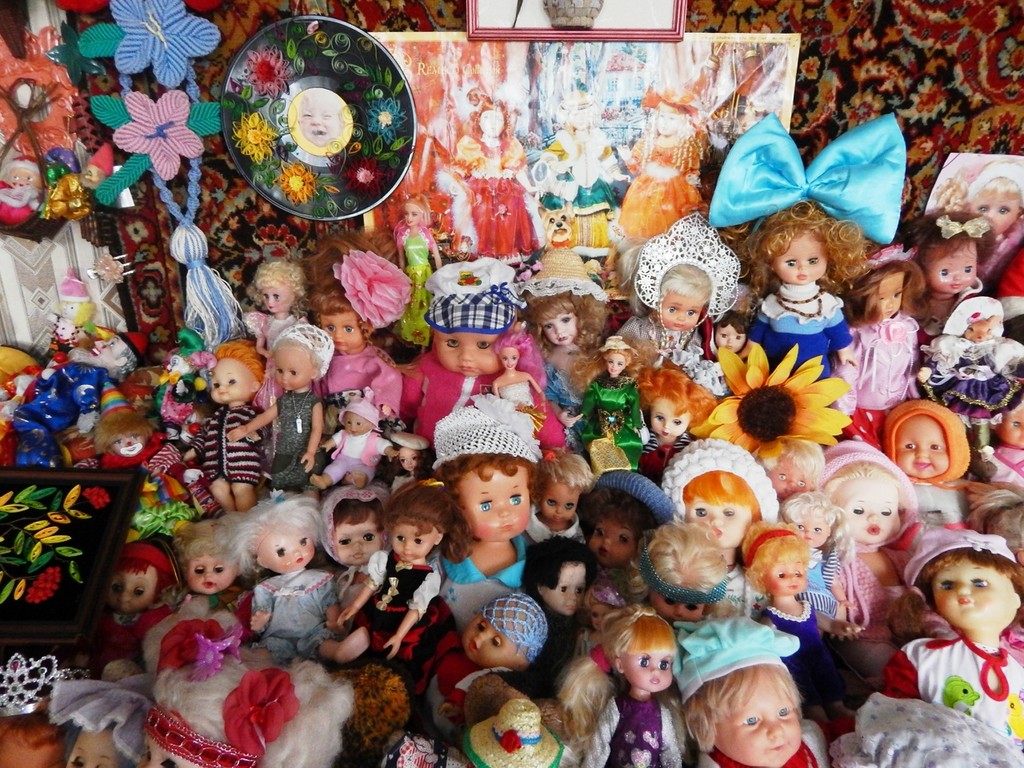
The main collection of the museum includes about five hundred dolls showing the traditional costumes worn by the bourgeois inhabitants of Hungary in the past.
There is also a collection of 120 dolls with Transylvanian costumes displayed in two separate showcases.
The heads, hands and feet of the dolls are usually made of ceramic, the rest is made of textile.
The museum management is actively pursuing a policy of adding dolls to the collection.
This applies, for example, to the collection from Transylvania, which was formed by organising a competition via a children's magazine to see who could send in the most beautiful regional costumes.
This action led to a very good result, as very valuable material was received, which was assessed by a jury of ethnographers.
Since in Hungary folk traditions are also gradually disappearing, the museum is just in time to develop activities that will help preserve dolls in traditional clothing by including them in the museum framework.
So, the museum is also undertaking similar actions in collecting dolls, aimed at other areas of Hungary.
The museum does not only contain dolls with traditional costumes that are related to the bourgeoisie.
A contribution was also received from a family that includes all kinds of everyday clothing made of old linen and hemp, about 150 years old.
For example, the clothing of a cleaning woman wearing small wooden slippers and carrying a bucket with a mop. Or a grandmother sitting in front of the stove dressed in simple, poor clothing.
The third floor of the museum includes replicas of various famous buildings in Hungary.
A special creation is a replica of the Hungarian Parliament building, the so-called Snail Parliament, made by Ilona Miskei, born in 1920, who from 1975 onwards incorporated 4.5 million seasnail shells into the building over a period of 14 years.
In Sibiu, a city of some 137,000 inhabitants (2011) in the Transylvania region in the center of Romania, there is a house that as of 2020 has been transformed into a museum of dolls .
Life and works
The collection came into existence around 2000, when the couple Maria and Mircea Drăgan, living in the town of Agnita in Transylvania and working as a mathematics teacher and a Romanian teacher respectively, decided to collect folk costumes from the surrounding countryside.
That countryside around Agnita is known as the Hârtibaci Valley, also referred to as Green Valley, an area with lots of wild nature and historical buildings such as churches and castles.
Folk costumes also contribute to the unique character of the area and the couple Drăgan decided to collect them. Maria Drăgan in particular visited all the 46 villages in the valley and collected examples of folk costumes, often as worn by dolls, and all kinds of decorative and craft objects.
Mircea Drăgan, who was particularly interested in the history and customs of the inhabitants of the villages in the valley, conducted research on this subject, which was published in three volumes.
Maria not only collected all kinds of dolls dressed in traditional costumes, she also bought dolls at the market or got them from neighbors and friends.
For these dolls she made suitable costumes herself.
Eventually her collection would include about three hundred dolls. In the couple's home in Agnita, this collection of dolls was brought together in an exhibition.
this image and the next two are screenshots from the video mentioned in the documentation
However, in order to be closer to their children and grandchildren, Maria and Mircea Drăgan left Agnita in 2020 and moved to Sibiu.
There they settled in a house along Calea Gușteriței, near the Cibin River., which they once more transformed into a museum where all the dolls they had collected got a place.
Some of those dolls looked out of the window at passers-by, but most were exhibited as can be seen in the images around.
The approximately 300 dolls on display are dressed exactly like the inhabitants of the Hârtibaci Valley,
The museum has also all kinds of attributes such as old furniture, carpets and cutlery that give visitors who are familiar with the traditions of the Valley, the feeling of being in a Hărtibacă household.
To give an idea of that feeling, here is a commentary Maria Drăgan gave on the first doll in the collection for whom she made a traditional costume, as was customary in her native village in the Valley: "We call her 'woman with a veil', a covering worn by married women".
The lady doll wears a jacket with a puff above the elbow and ruffled sleeves, a hat, a chevtar and a skirt with tassels. On her shoulder she wears a pair of sandals with a mătăuz in them. This is a bunch of basil that the bride threw at her in-laws' house on her wedding day. Whoever caught it was rewarded with a big drink.
So there you have it. It is not for nothing that the collection of dolls on display is formally called an ethnographic museum.
Documentation
* Article (March 2024) in newspaper Strada Cetatii
* Article (undated) on the website Zig Zag prin România
* Article (October 2018) on the website of newspaper Observer, with a short video
On the facade of the house with the balcony it is stated in capital letters that the Doll's Art Gallery is located here. Below this English mention there are the indications in smaller letters: Galeria Papasilor and Babamuzeum, which is respectively Romanian and Polish for Doll Gallery and Doll Museum.
The doll's art gallery, that includes the house with the balcony and the one next to it on the left, is located in the center of the city of Târgu Secuiesc, a municipality with some 16.000 inhabitants (2021), situated in the center of Romania.
this image and the next eight as on Google Streetview, submitted by various photographers
Life and works
This museum is a project undertaken by Ibolya Nagy, who is married to Tilhamer Nagy, a couple living in the city of Târgu Secuiesc.
At some point in her life she came into possession of six porcelain dolls, dressed in gowns from earlier times.
She was so delighted with them that she passionately started collecting more of these dolls, which got a place in the house where she lived with her husband.
When her collection had grown to 175 dolls, she came up with the idea to exhibit them in a doll gallery, an idea that became reality in 2010. In 2011 there was a first exposition, and in 2017 the gallery opened permanently to the public.
Ibolya Nagy was able to realize her dream thanks to her husband who was the heir of a historical house in the center of Târgu Secuiesc, built in 1910 by his great-grandfather, who was a renowned merchant at the time.
The communist government that came to power in Romania after World War II had confiscated the house, but Tilhamer Nagy managed to regain ownership in 2008.
Arrangement of the dolls in the gallery
Currently, the collection comprises some 1500 dolls, and until now, every year some 100 to 200 dolls have been added to the collection.. .
Because the gallery is housed in what traditionally is a residential building, the dolls are distributed over the various rooms and spaces that the building comprises.
The Porcelain Room is a place of honor for the very first six dolls with which Nagy Iboly started her collection.
Then there is the Green Room, where the oldest dolls in the collection are exhibited.
These are dolls from the period between the 1920s and the year 1960. The oldest doll, dating from 1927, depicts a Chinese woman.
The so-called Style Room is about dolls that portray all kinds of princes and princesses, mostly related to (European) royal houses and often going back to times long past.
Then there is the Nostalgia Room, which brings back memories of visitors' youth and the dolls they played with, but also their early school years and the children's books that shaped their lives during their younger years.
Finally, there is a space designated as the Great Hall.
This area has shelves along the walls with -among other items- dolls depicting celebrities such as Audrey Hepburn, Kate Middleton and Prince William. Many of these dolls come from Germany and France.
The Great Hall is also referred to as the Olga Gallery, with the name Olga being a tribute to Nagy Ibolya's mother-in-law..
Documentation
* Article on the Anapedia-Travel website with an extensive series of images.
* Article (2017) by Mihaela Aionesei in newspaper Mesagerul de Covasna
* Article (November 2024) by Gina Artenie on the website Covasna 45, also richly illustrated
this photo and the next one by the Bannalec town hall
Bannalec is a French community with around 5700 inhabitants (2021), located in the department of Finistère in the region Brittany.
Life and works
In this community, in an ordinary house in an ordinary street, there is an extraordinary collection of more than a thousand dolls, decoratively arranged in most rooms of the house. The collection was assembled by Annie André and is open to visitors on certain days and by appointment.
Annie André grew up on a farm on the edge of the town of Bannalec, where her father bred horses. As an adult, she would work in a nursing home for the elderly. Currently she is retired.
It all started when she was thirty years old and somehow came into possession of a doll. She was apparently so impressed by this, that she started collecting dolls. She looked around at flea markets and thrift stores, and bought dolls there for little money. Once her new hobby had become known, dolls were also donated by families whose children had grown up.
Where necessary, Annie herself made new clothes for the dolls. And so, over the years the collection grew and grew, with a place of honor for her very first acquisition.
Around 2004, Annie André came to live in the house in the rue de la Gare. In 2008, she opened the house to visitors, some of whom became regulars and assisted her..
The collection gradually became better known, through the website of the municipality and also through articles in the local and regional press.
Collections of dolls elsewhere
In the field of art environments in Europe there are more sites filled with a large collection of dolls, such as in France the (now disappeared) decorated facade of the house of Francis Barale in the Bouches-du-Rhône.
pictures courtesy of Sophie Lepetit, from her weblog
Non-resident motorists driving the D1203 departmental route just north of the French community of Charvonnex tend to slow down to get a better view of the colorfully decorated house that stands along the road.
Life and works
This Maison colorée was created by Nadine Mehly. who was born in Nancy in 1957, where she also got her primary and secondary education. After that, she worked mostly at retail companies, such as she was a sales woman at a large department store in Grenoble for over ten years.
When she got married she settled with her husband in Charvonnex in the house in question along the departmental road.
Charvonnex is a small community of about 1400 inhabitants in the east of France, close to the French Alps and the border with Switzerland.
a wall with multi-colored painted stones
Initially, there were no indications that Nadine would embark on such an artistic project.
Living in Charvonnex, she had a job as a cashier at a supermarket in a nearby community. When this company was closed, she became unemployed. Later she would receive a disability pension.
multicolored items on the ground along the fence
However, in 2003, when she was in her mid-forties, it so happened that her husband went on a motorcycle tour. At home alone, Nadine felt inspired to paint the front door of the house and she liked this so much that she also started to decorate the façade.
As she said: "Je devais just peindre et j'ai pas pu retenir la main ni le pinceau. Quand il est revenu, il n'a pas reconnu sa maison" (I just had to paint and I couldn't hold my hand or the brush. When he came back, he didn't recognize his house. -This quote from the article in Le Messager, see documentation).
Her husband left her and she has lived alone ever since, although still formally married and meeting him occasionally.
a close up photo of a number of masks
Currently the site includes over 1200 painted stones that are part of the outer walls of the living house. They were painted on the spot, to a height as far as Nadine could reach.
As the picture above shows, Nadine also added a large number of smaller painted items, such as all kinds of masks, each shaped and colored in different ways. These masks are mainly attached to the railing of the front porch of the house.
The site also has been decorated with a variety of skulls,which one also encounters in the interior, together with various dolls and all kinds of other items, which almost completely fill the available space.
Inside there also a lot of decorations with masks and skulls. These date from earlier years, before she started with the current decorations and were made to lavishly decorate the house during Halloween with masks and other terrifying objects, which children found so scary that they steered clear of the candy. In 2004 Nadine Mehly stopped celebrating Halloween.
a text on a wall
The lavishly decorated exterior wall on the ground floor has been provided with a text in colorful capital letters, as can be seen in above picture.
This text reads: "Faut rien regretter. Revendique tes conneries. Elles sont à toi. Et surtout vis à fond. On viellit bien trop vite. La sagesse ça sera pour quand on sera dans le troux" (You shouldn't regret anything. Claim your bullshit. It’s yours. And above all live thoroughly. We get old way too quickly. Wisdom will be for when we're in the hole).
This leaves nothing to be desired in terms of clarity ....
Architecturally, the site has seen some changes since the beginning of the decorations.
For example, in 2011 a hexagonal wooden summer house was placed along the side wall, a kind of gazebo, which is somewhat separate and does not seem to be part of the decorative whole.
The most significant change has to do with the fence.
Initially the house was not fitted with a structure separating the outdoor space from the street, but around 2015 a partition was added, surrounding front and left side of the house, made by linking wooden pallets as used by transport companies.
This low fence, of course very colorfully decorated, contributes greatly to the visibility and spatial character of this art environment.
In addition, the fence offers space for some essential elements of a house, namely a name plate, a house number and a very special letterbox in the capacity of two boots, as shown in the picture topright.
Whether the site will survive if Nadine Mehly can no longer take care of the decorations, for her is nothing to worry about. She takes into account that the colors and various decorations of her Maison Colorée then might disappear.
Documentation
* Entry (April, 2019) by Sophie Lepetit on her weblog, with a series of pictures
* Article (May 2018) on the website of France 3 TV (Alpes), with a video
* Article (April 2018) on regional newspaper l'Essor Savoyard
* Article (April 2018) on regional magazine Le Messager (on p 40)
* Article about the site by Sonia Terhzaz on her website Cartographie des Rocamberlus (environments d'art singulier), reporting the visit she paid in December 2022
first published January 2021, last revised April 2023
Nadine Mehly
Colorful house
1324 route d’Annecy (D1203)
74062 Charvonnex, dept Haute-Savoie, region Auvergne-Rhône-Alpes region
pictures courtesy of Justyna Orlovska from her website
"Off the Beaten Track"
In the field of art environments in Europe, there are some sites with a decoration mainly composed of dolls, such as those of Francis Barale (France), Daina Kučere (Latvia) and Margarita Travkina (Russia). This small group of creations can be complemented by a site in the Czech Republic curated by Lubomir Votava.
Life and works
Votava was born in the early 1960s in Havlíčkův Brod, a town in the Vysočina region of the Czech Republic.
Initially he worked as a tractor driver. In 1989 he attended a rally of the Republican Party, often referred to as extreme right and represented in the Czech parliament from 1992-1998. Votava joined that party, working his way up to become an advisor and bodyguard to the party's leader.
In that capacity Votava gained notoriety for some incidents, like he punched an opponent with his fists. Later he was convicted for being violent against a journalist, after which he left the world of politics and in 1998 retired to the small village of Rváčov, also located in the Vysočina region.
Votava settled in Rváčov in a simple house, built around 1870, initially inhabited by his grandparents and thereafter used by his parents as a summer home.
Rváčov was now in his late thirties and living on his own. Away from the urban hustle and bustle of Prague, Votava now focused on the quiet rural life in the village.
Especially pleased with the garden located between the cottage and the main road that crosses the village, he spent a lot of time maintaining it. He built a pond with his own hands and from ten kilometers away, in a wheelbarrow he carried a large amount of stones into the garden, some of these stones being three feet high
As a result, in 2016 the garden was reviewed in the Czechian magazineChatar Chalupář, a practice-oriented monthly magazine about housing and lifestyle.
But what would make him known, both in the village and beyond, was not the composition of garden, but the special way in which he provided house and garden with decorations.
From his early years a lover of old toys and discarded dolls, he started to decorate interior and exterior especially with dolls, which he obtained from people around who wanted to get rid of them, which he found in trash cans or which sometimes were just left behind by people, deposited at the garden's entrance.
About a thousand dolls cover the outer wall of the house and are attached to the branches of trees in the garden.
Varied reactions
His way of decorating house and garden, which is visible from the main road that runs through the village, has led to varied reactions among the residents, both appreciation and disgust or fear.
Votava has said he doesn't exhibit the dolls to scare passers-by. He wants to prevent them from ending up in the garbage and being destroyed. He has explained that for him dolls are a medium from which energy passes. Looking at some dolls he sees in their eyes the child that played with them many years ago.
This train of thought is reflected in most arrangements of the dolls, as demonstrated in the pictures above.
But an arrangement like the one in the photo above, in which dolls -partly without a head- are suspended from a rope around their necks, arouses less sweet associations.
So in presenting both the lovely and the harshness, this art environment shows an ambiguity. It is not clear if this ambiguity is intended or unintentional, but in any case it can confuse a potential visitor.
Documentation
* Article (November 2014) on the website of TN Nova, with a short video and a series of pictures * Series of photos with explanation (December 2015) on website Off the Beaten Track, editedby Justyna Orlovska
Videos * Detailed impression of the site in wintertime (November 2015, YouTube, 14'35")
* Video by Vladimír Havlíček (July 2019, YouTube, 3'57") with Votava talking about the collection
Lubomir Votava
House and garden decorated with dolls Rváčov, Vysočina region, Czech Republic can be seen from the road
The doll-decorated front of a shed, as depicted above and below, can be seen in Kolomna, an old city in the Moscow region, Russia, about 110 kilometers southeast of the capital.
Life and works
The dolls attached to the barn are only a small part of the collection of dolls assembled by Margarita Leonidovna Travkina, who was born in the early 1940s.
It all started in 2005 when she walked past a lot of rubbish and noticed that there was a discarded doll in that garbage. She took the doll home, washed and restored her dirty doll clothes, repaired damaged parts and gave her a nice spot in her house.
At that time Margarita Travinka was in her mid-sixties, she lived with her husband after her two sons got married and had left home. She was artistically gifted, loved embroidery and also made small paintings of special material, as in the composition below, where the basic material consists of processed shoe leather.
Repairing the rescued doll probably inspired Margarita Travinka to continue this kind of activity and so she asked friends and neighbors if they had old, disused dolls available. And indeed, they had......
It was the start of a project to which she would spend all her time in the coming years and that resulted in a collection that now includes 13,000 dolls.
Indoors, the dolls are arranged side by side on chairs, benches, tables and other furniture.
They are all nicely dressed, their hair is cut, some wear hats. If female dolls have nails, these are provided with nail polish.
Margarita Travkina creates the beautiful and often richly decorated clothing of the dolls herself on the sewing machine. One garment takes about four hours to make, so this activity requires a large part of her daily time. This besides the time needed to clean the set up of the collection and keep it in order.
Her house has a modest size and includes only a couple of rooms, which means that almost all available interior space is occupied by the collection. After her husband died some time ago, Margarita Travkina lives alone in the house.
Unknown in which year, but probably in an early phase of the project, a small part of the collection of dolls has been attached to the front of the barn outside. These are generally smaller ones, made of rubber or plastic. The facade has also been decorated with a number of clocks.
Documentation
* Article (November 2015) in news website Vittasim (IiveJournal)
* Article by Diana Strazin(July 2017) on website 360tv.ru
Video
* Video (30'47'. 2017) by Life Новости (Life News) as published on Facebook
Margarita Leonidovna Travkina
House with dolls Ulitsa Posadskaya 50 Kolomna, Moscow region, Russia exterior decorations can be seen from the street streetview
pictures from the website surfingbird (under reconstruction)
In Nizhny Novgorod, the fifth largest city in Russia, an art environment can be found that is characterized by the many toys and dolls used to decorate the site. This is Aleksey Ivanovich Shuvalov's project.
Life and works
Shuvalov was born in 1942 or 1943 in the Russian community of Bol'shogo Boldina (Great Boldina), which is known from the family estate where Pushkin stayed in the 1830s.
Shuvalov first worked at a farm and later went into forestry, where he was involved in the extraction of resin from pine and other conifers.
When retired, Shuvalov wanted to avoid boredom, so around 2002 he began to embellish the garden around his house, mainly using toys and dolls as decorative material.
He obtained this material from his family (he has two daughters and two granddaughters), but he also found it in the garbage or got it from friends or people who know about his activities.
In an interview with a local newspaper he said that he refers to his collection as the museum of the national disgrace of household waste.
Shuvalov's embellished garden is located at the end of a street in a relatively idyllic, wooded area of the old town, where one can enjoy views of the river Oka. The site is endowed with trees and shrubs that are used to attach toy animals, dolls and other decorations.
Apart from the toys the garden also has a lot of typical decorative elements -as shown left in below picture- consisting of circular discs from wood or other material, strung together and interspersed with oblong narrow strips. The items with the strips are made from aluminum (beer) cans. The top of such a can is removed and then the cylindrical middle part is cut into strips which are folded outwardly.
It's a simple but effective way of making decorations. These items can be seen everywhere in the garden and around the house.
The interior of the house is also packed with objects and the walls inside are completely filled with pictures and decorations.
Although one of the articles in the documentation describes the site and its author in disapproving terms and says that some neighbours had complained about the site, the other article portrays the author as a friendly person who likes to show visitors around and who will even share some time at the gazebo which offers views of the river Oka.