August 30, 2024

Jean-Claude Villot, Intérieur décoré et jardin de sculptures / Decorated interior and sculpture garden

all pictures courtesy of Sonia Terhzaz

The scene above with sporty characters is set in an art environment in Baron, a small commune with around 1200 inhabitants (January 2021) in the Gironde area in the south of France. about thirty kilometers east of Bordeaux.

Life and works

This art environment is a creation of Jean-Claude Villot, who was born in the early 1960s, initially was a carpenter, later worked in a factory and nowadays is retired.

The art environment consists of two completely different types of creations, on the one hand a large field of sculptures situated in the exterior, as can be seen in the very first image, and on the other hand a number of decorated walls in the interior of the house whose occupants own the decorated field.

The pictures around give an idea of the decorated interior.


The house, that was occupied for many years by Villot's meanwhile deceased mother, is now the home of his sister and her husband, who inherited it.

Villot began decorating the walls around 2010.

His decorations have a light-hearted character, generally depicting events from everyday life, such as someone making a walk, a stream of water with fish swimming around or a dog being walked.


The field of sculptures

Around 2015 Villot began making sculptures from wooden pallets he collected at the local dump.

In agreement with his sister and her husband, these sculptures got a spot on the field they owned, located next to the house in which they now lived. 

It's a field with a generous size that can accommodate a large number of creations.


Because he mainly used pallets Villot's creations are predominantly two-dimensional. They have no artistic pretensions, but they are distinctly amusing to look at

Like the murals inside, they are made by Villot to depict an everyday event and to provide commentary on it, if that's convenient.
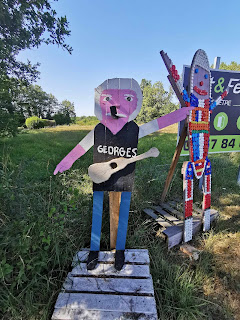


These current events can include anything, such as activities of all kinds of political figures, but also of wearers of yellow vests, a common wear in France in recent years for people demonstrating.

Sport does have its own place in his creative work, especially rugby. When in 2023 the rugby championships were held in France, Villot paid a lot of attention to this event by making a sculpture of Antoine Dupont, who is captain of the France national rugby team.

The 2024 Olympic Games in Paris also got a lot of attention.


There are also comic characters. 

Above we already encountered Tintin, and below on the left one can see Mickey Mouse.

The designation Ponpon le Cheval (Ponpon the horse) in the image below right is a tribute to a horse that helped in a vineyard in the French Languedoc area.

The sculpture garden is located north-west of the centre of the commune of Baron, along the departmental route D936, opposite the company Aquitaine Matériaux.


Documentation
* Article (August 2023) in newspaper France Bleu
* Article (September 2025) on Facebook by Martin Besnard, with a series of recent pictures

Jean-Claude Villot
Decorated interior and sculpture garden
32 Route de Branne (also D936)
33750 Baron, dept Gironde, region Nouvelle-Aquitaine, France
the sculpture garden can be seen from the road

August 23, 2024

Miroslav Stránský, Sochy v lese a výtvory podél pohádkového potoka / Sculptures in a forest and creations along a fairy stream


this picture and the next five courtesy of Pavel Konečný 

Havlíčkova Borová is a picturesque village with 950 inhabitants, located in the center of the Czech Republic in the border area of ​​the Bohemian-Moravian Highlands.

Life and works:

In this village lives Miroslav Stránský, who has become known because he created a rather special art environment. 

He was born in 1949 and trained as a bricklayer, but worked as a forest worker for most of his working life.

Once retired he had a lot of free time, which he mainly filled with making wooden sculptures. Around  2020 he made a special creation along a stream with moving mini-sculptures.


The wooden sculptures he makes are not placed near his home, but are situated in the forests and meadows near the village and many creations have also found a place in the gardens of inhabitants of the village.

The surrounding images give a good impression of what the creations look like. They are about as tall as adult humans and are made from pieces of wooden planks, tree trunks and other wooden material that is  suitable for being transformed into a creation.

Stránský doesn't paint his sculptures once ready, nor are they treated with a protective liquid. So they are rather vulnerable and will eventually be lost, as happened for example with the wooden sculptures of Frank Bruce in Scotland.


The image above shows one of the last sculptures made by Stránský. It is a creation in memory of his best friend, the hunting warden Pepík Smejkal. 

Local hunters consider this work as a memorial monument that can also be used to commemorate others and so they feel free to add their names. 

A wooden statue of a woodcutter stands to the right of the monument. The person on the left is Miroslav Stránský.


Pohádkový potůček / A fairy stream

Around 2020 Stránský started a new, special project. On a spot north of Havlíčkova Borová, where a stream is flowing along a local road, he added  to the stream's banks several miniature scenes with a fairy-tale character.

this image and the next three courtesy of Justyna Orlovska, 
from her website Off the Beaten Track

The miniature wooden houses are inhabited by miniature characters that can be associated with all sorts of Czech fairy tale figures.

A surprising feature of these figures is that they can make movements, which is realized by means of a paddle wheel hanging in the flowing stream.


Due to the fragile nature of the mobile creation, Stránský pays a lot of attention to regular maintenance. 

Scenes with all kinds of characters moving on flowing water are rare in the field of art environments. In this weblog there is an article about Vincent Navratil, who made such a creation in the community of Vir, also located in the Czech Republic


Documentation
* Article (April 2024) by Justyna Orlovska about the fairy stream, on her website Off the Beaten Track,
with a variety of photos
* Article (July 2024) about the memorial sculpture, in the magazine  of  radio Český rozhlas Vysočina
* Article (June 2024) about the creations along the fairy stream, in  the magazine of Rádio Střední Čechy, with a variety of photos
* Photo series (2023/2024) of the fairy stream, on the website Mapy.CZ

Video
Video (April 2024, YouTube, 3'08") by Justyna Orlovska showing the moving parts of  the creation


Miroslav Stránský
Sculptures in a forest and creations along a fairy stream
Havlíčkova Borová, region Vysočina, Czech Republic
all elements of this art environment are situated 
in the open air, accessible to visitors

August 16, 2024

Alpo Jaakola, Patsaspuisto / Sculpture park

all pictures courtesy of Sophie Lepetit from her weblog

The sculpture park reviewed in this post is located in Karhula, a hamlet that is part of Loimaa, a municipality of about 15.000 inhabitants in south-western Finland. 

The park is situated near the E63 highway, approximately 8 km southwest of the built-up area of ​​Loimaa.


Life and works

The park was created by Alpo Jaakola (1-4-1929/7-2-1997) who was born in Loimaa. 

At an early age he showed an artistic talent and in 1951 he enrolled at a drawing school, where he stayed for only a few months because the teachers recognized his talent and felt that their lessons should not influence his further development. So Jaakola established himself as an independent visual artist, but wthout a formal art education.

He married Seija Nykänen, but this marriage did not last and ended in divorce. His second marriage, to a gallery owner, did survive and both Alpo Jaakola and Marja Jaakola, who passed away in 2012, now have a grave on the grounds of the sculpture park reviewed in this post.

 
Creating a sculpture park

In 1953, when he was 24, Jaakola took an important step.

In the wooded area in the hamlet of Karhula, where the sculpture park now is located, he built a forest hut from wooden planks, a construction  that would serve as a home to live in. 

This was the beginning of the transformation of the piece of forest into a sculpture park, a project that would take place over the next more than 25 years.


In making artistic creations to decorate the park, Jaakola focused mainly on sculptures, but he also produced all kinds of paintings, which were presented in accommodations built in the park.

In the first years of working on the collection, Jaakola must have had to improvise, because a studio only became available in the early 1960s, after he had built such a facility himself.

In the 1960s other facilities became available, such as a disused mortuary located in a nearby village, which could serve as a storage facility in the park. 


As for the sculptures, the park would eventually be decorated with about fifty large sculptures, largely made of cement, to a lesser extent of wood or iron. 

The images in this post give an idea of ​​the character of these creations.

The sculptures show something of Jaakola's style of creating, which testifies to a certain mysticism and primal power.


In 1972, a major event occurred, providing direction for the further development of the park at that time.

The local road near the park was converted into the E63 highway, which for Jaakola and his family meant that they were faced with a lot of traffic noise, but also with many curious motorists who wanted to take a look at the meanwhile well-known site. 


Jaakola was not focused on exploiting the park and he kept it closed to the public. 

He built a fence and posted signs prohibiting entry into the area. This did not limit public interest. the public kept coming and on a nice summer day as many as 200 people would stop to try to visit the sculptures.

As a result of all this, Jaakola lost his peace of mind and even indicated in an interview in 1974 that he was about to hate his sculptures.


He looked around for another accommodation and found it in a recently closed public school in the village of Torkkala in the eastern part of the municipality of Loimaa. In 1979 Jaakola and his wife Marja moved there.

Jaakola made new sculptures, together with Marja he planted hundreds of trees around the school and the former classrooms were used for exhibitions and numerous concerts. These activities led to Jaakola, who was also seen by some as a shaman of the region, being appointed professor (honoris causa in all probability) in 1985, which to my knowledge is unique in the European field of art environments by non-professionals.

After Alpo Jaakola's death in 1997, his wife continued to live in the former school and after she died in 2012, the accommodation was run by the couple's daughter Minni Nummila.


After Jaakola and family left the park in 1979, the accommodations and creations were left behind as they were, perhaps occasionally cared for by Jaakola. 

And then, in the early 1990s, the municipality of Loimaa had the idea of ​​purchasing the park as a tourist attraction, so in consultation with Jaakola a trial opening was organized in 1992. This was so successful that in 1993 the municipality decided to purchase the park and today the sculpture garden is an indispensable tourist attraction in Loimaa.

In the year 2000, a restoration project was carried out, largely financed by the European Union.


Documentation
* Website of the city of Loimaa with information about the museums in the city, including the park
Website of the association of friends of Jaakola, with a lot of information and a variety of photos
* Facebook-account of the park, with recent information
* Weblog of Sophie Lepetit (February 2021). with a variety of photos

* Video
* Video (August 2020, YouTube, 1'22") by Rajala


Alpo Jaakola
Sculpture park
Aura-Pirkkatie 84, 
32300 Loimaa, dept Western Finland, region  Southwest Finland.  Finland
visitors welcome
Google Streetview with over 700 photos

August 09, 2024

Franco Ferrari, Casa tipo castello autocostruita / Self-built castle-like house

this image and the next one from Google Streetview

The image above shows a special house located in an ordinary street in the city of Colombaro in Italy. The special character is at first sight mainly expressed in the donjon-like roof structure, but the construction has numerous other elements that support the unusual character.

Life and works

The house was built by Franco Ferrari (1923–2009), a mason by profession, who started the project in the late 1950s when he was in his mid-thirties.


Working primarily with cement and wood, it would take him around ten years to complete the three-storey building, which, in addition to the donjon-like roof structure, also includes a more rectangular tower on the roof, as seen in the image above, which shows the creation from a different angle.

In addition to the elements added to the roof, the hand-built house features all sorts of battlements and capitals, several arches, and a staircase running up an outer wall.

After Ferrari died in 2009, the house remained in the hands of the family, who maintained it with care.

Documentation
Entry on the Italian website Costruttori di Babele, with a series of photos that give a good impression of the creation as a whole and also in terms of details

Franco Ferrari
Self-built castle-like house
Via Tito Speri 17
25040 Colombaro, Brescia, Lombardia, Italy
can be seen from the road


August 02, 2024

Albertas Žąsinas, Nesąmonių sodyba / Homestead of Nonsense

all images courtesy of Justyna Orlovska from her website
Off the Beaten Track


Stoniūnai is a small hamlet in the Svenciony Municipality in Vilnius County in eastern Latvia, near the border with Belarus. In 1970 the hamlet had about 50 inhabitants, but in 2021 it had fewer than ten. 

One of the current residents is Albertas Žąsinas who enriched the hamlet with an art environment.


Life and works

Žąsinas was born in 1934 or 1935 and he is currently 89 years old. 

He has been married twice but got divorced, and currently he lives alone in one of the six farms in the village.

Now retired, in his working life he was a veterinarian in a meat processing plant and he also worked as a teacher at a technical school. For a number of years he acted in an amateur theater.


In 1999, when he was just retired and living in the farm in Stoniūnai, he started making sculptures. 

The reason for this was that he had heard that the previous occupant of the farm house had provided it with a meanwhile disappeared wooden cross. So he decided to make such a characteristic creation in turn.

And then, as often happens in the field of art environments, once started making a creation, he could not stop.

Currently Žąsinas has created about seventy characters, which he situated in the spacious garden that belongs to the farm, an exposition that can be seen from a village road.


Made from ash tree trunks, many of his creations are two-dimensional in signature, as they are formed from wooden planks. If they have a three-dimensional appearance, the lower part of the creation is often a piece of tree trunk.

Žąsinas views life with a lot of irony. For example, when he portrays a witch, she gets the appearance of such a person, but then dressed in a skirt with all the colors of the rainbow. He also looks at his own work with that irony, because on one of the yellow information boards in the garden he indicates his art environment as Homestead of Nonsense.

His sculpture garden mainly includes human characters, here and there supplemented with depictions of animals, such as various birds and pigs in a trough. All creations are treated with special oil to make them more durable.


There is a wide variety of sculptures presenting human characters.

For example, there are several creations that depict female characters, including Ingrida Simonyte, who became Prime Minister of Lithuania in December 2020. There is also a sculpture of the woman of his dreams, but she is not entirely ideal because she smokes.,,,,,

Angels and devils are also exhibited and in this respect the good forces have the majority.

As for politicians, there is a group of three in which Lenin, Stalin and Hitler got a place, all with an accompanying symbolic item such as swastika or hammer and sickle.

The arrangement of the creations in the site seems a bit chaotic, but each character contributes in its own way to what Žąsinas wanted to convey. 


Documentation
* Article (July 2024) by Justyna Orlovska on her website Off the Beaten Track
* Article (December 2017) in Lithuanian newspaper newspaper 15min, with a video
* Article  (February 2022) in Lithuanian  newspaper Ukininko patarejas 

Video
* Video (6'09") in Lithuanian newspaper newspaper 15min


Albertas Žąsinas Homestead of Nonsense Hamlet of Stoniūnai in the municipality of  Svenciony, Vilnius province,  Lithuania

can be seen from the road