June 27, 2025

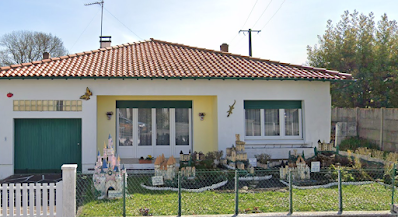
Guy Chalvignac, Jardin décoré de châteaux miniatures / Garden decorated with miniature castles

front of the house and wall along the garden
in 2021 as on Google Streetview

The house pictured above is located in Chaillevette. a commune with some 1600 inhabitants in south-west France, situated on the left bank of the Seudre river in an area with many salt marshes, where oysters are cultivated and traded via the local, picturesque harbour along the Seudre river.

at the right: Château de Beauregard 
this photo (2024) and the next three (2025) \
published here in agremeent with Georges Fontaine
Life and works

The front of the house is provided with a modestly sized art environment, predominantly presenting miniature castles, created by Guy Chalvignac.

Born in 1929 or 1930 in the French area Périgord, Guy Chalvignac settled in the Charente-Maritime department in the early 1950s, first in the Royan area and then in Chaillevette.

He married and had descendants, was a plasterer by trade and retired in 1988.

Château des Milandes

As a child, Chalvignac was already active in doing odd jobs and making all kinds of things.

For example, at a young age he made all kinds of windmills and he also put together a truck, which he could pull with a rope.

He also enjoyed painting, an activity he would pursue throughout his life, also when he was creating the art environment in the front yard. 

That yard has a concrete wall on the right side (seen from the street), which is still unpainted on Google Streetview in March 2021, but in the video below, made in 2024, is provided with colorfully painted scenes

left: Château le Val

From the images of the front garden on Google Streetview, it appears also that the decoration of the front garden with miniature castles must have started after 2013.

This means that Calvignac undertook creatng the ccllection of miniature castles at a later age, when he was already in his eighties.

Working with concrete, he decorated the front garden of his house mainly with replicas in miniature of a variety of French castles. He was a meticulous worker who strove to reproduce architecture of the castles as faithfully as possible

His first project was a replica of the Château de Hautefort, located in the Dordogne. 

Another miniature depicts a castle that, located near where Chalvignac lived was called the Château de Beauregard and is shown on the far right in the second image from the top. 

It was known as the “castle with the six towers” ​​and dominated all the buildings in the area. Legend has it that it was once a refuge for pirates who attacked ships, but the castle is now destroyed.

not identified

Other miniatures of castles created by Chalvignac are the Château de Milandes, the Château de Commarque, both located in the Dordogne, and the Château de Val in de Haute Corrèze.

To conclude this overview, below is an image of the art environment made by Michel Leroux, as it looked in 2019. 

The building in the foreground is Walt Disney's Cinderella Castle, an amusement park in the shape of a castle, located east of Paris.


this image (2019) courtesy of Michel Leroux

In the interior of Chalvignac's house there are also creations he made, in particular a collection of about fifteen models of sailing ships, such as Le Protecteur with 500 pulleys and 64 guns, a ship of the French Navy, designed in 1740 to face the English Navy.

Documentation
* Entry (2022) on the website of Patrimoine et Inventaire de Nouvelle-Aquitaine
* Article (May 2025) in regional newspaper Le Littoral (10% of the text, the full text is copied on Facebook)

Video
* Reel (December 2024) by Karine Bellet, granddaughter of Guy Chalvignac, on Facebook


Guy Chalvignac
Garden decorated with miniature castles

9 rue de la Mairie

17890 Chaillevette, dept Charente-Maritime, region Nouvelle-Aquitaine, France

can be seen from the street

June 20, 2025

Robuste Odin & Erolf Totort, La Robustinie. Jardin sauvage et d'art / Wlld and artistic garden

all pictures courtesy of Sophie Lepetit
as on Facebook

La Robustinie is a rather special garden in the commune of Pont Audemer in France, which is cared for and includes creations by sculptor and visual artist Robuste Odin and engraver and painter Erolf Totort. 

Both are artists by profession, but they act from their own perspective and way of working, independent of prevailing trends in the art world, an approach similar to that of Chomo in France and Karl Junker in Germany.

The art environment is situated near a building, as shown in the image above. 

This building was in the past a modest farm, which guarded the access to a former tannery, a company that used to dump its waste in a pond in the water-rich area located in the western part of the city of Pont Audemer.

This form of industry has now disappeared and has been replaced by an area with many houses near a variety of lakes and ponds.


In the early years of the 21st century the former farm was taken into use by Robuste Odin, who set up a studio in one of the rooms in the interior.

From the beginning, the development of the terrain near the former farm also had his attention. He was assisted in this by the female engraver and painter Erolf Totort, who lived in Paris.


Robuste Odin was born in Paris in 1964, and studied at the University of Rouen in Normandy. If he studied at an art academy is unclear, but anyhow he developed into a sculptor and metalworker, who as he himself once said "makes strange things with strange things". 

Using all kinds of leftover material from the metal industry, he makes garden furniture for sale and also colorful sculptures, which are placed in the terrain near the house to be further shaped by nature.

Over the years, this area has grown into an extensive, colorful art environment.

In this development of the area near hus house Robuste Odin was assisted by Erolf Totort. who lives in Paris and travels regularly to Pont Audemer.

Born in Paris, Erolf Totort is a pure Parisienne, a child of the left bank of the Seine, an activist who creates decorative work as an engraver, with a passion for prehistory. She studied at the École nationale supérieure des arts d;ecoratives and art science at the Université Paris VIII.

Robuste and Erolf have invested a lot of time and energy in the design of the art environment near the former farm. 

They focus not only on enriching the site with sculptures, but also pay a lot of attention to sowing and maintaining all kinds of plants that have a beautiful bloom, and also plants that have medicinal properties.

They themselves say that they cannot be surpassed when it comes to giving names to plants that itch or even make you sick.

Over the past twenty years, La Robustinie has grown into an atypical sculpture park that is popular with walkers, school classes, children's classes and lovers of water features in the nearby landscape.

Open days where visitors are welcome  are regularly organised.


Documentation
* Article (May 2025) in French newspaper l'Éveil, focussing on the open days in June 2025
* Publication (May 2025) entitled Fête de la Nature, with a series of images of the art environment
* A series of photos by Sophie Lepetit on Facebook.

Robuste Odin & Erolf Totort
La Robustinie
Chemin de Haut-Ëtui
27500 Pont Audemer, dept Eure, region Normandy, France
can be visited during open days 

June 13, 2025

Joan Diaz, Casa Pratginestós / Pratginestós House.

all images (2014) by Marcel Albet, from his weblog, 
licensed under Creative Commons 3.0

The house pictured above, with its exterior walls full of decorations, is located in Llinars del Vallès, a municipality with some 9800 inhabitants (2018) in the province of Barcelona, ​​​​Spain, about forty kilometers north-east of the city of Barcelona. 

The house was designed by Joan Diaz, who moved in with his wife and two children, and in 1990 began a decorating project that he would continue for many years.


Life and works

Joan Diaz was born in 1941 in the French town of Montauban, at a time when his parents lived there as migrants, having fled from Spain because of the civil war. 

When the war officially ended in 1939, the family soon after his birth returned to Spain and so young Joan would grow up there.
From an early age Joan was attracted to art, he enjoyed painting and drawing, played the violin and the piano, sang in his school choir and played the organ in the local church at weddings.

However, he chose to study technical architecture and architectural drawing, but did not complete it, because he was able to get a job with the municipality of Granollers, which he would hold for 17 years, while at the same time he was working with his father in the family business of building grain silos.


In 1965, at the age of 24, he bought a plot of land in the municipality of Llinars del Vallès, which, like Granollers, was located northwest of Barcelona.

Joan Diaz had acquired sufficient knowledge during his studies in architecture to make the drawings of the design of his future house himself.

The top image in this post shows partly what he had in mind for the building to arise on the corner of three streets.


The front of the house with the main entrance is along the Carrer Carvantes. 

The right side of the house has a slightly receding side aisle, that faces the Carrar Jacint Verdagner and is separated from the street corner by a high wall, provided with a second entrance.

The left side of the house, not visible on the image on top of this post,  is decorated with a low transparent fence that runs from the main entrance to the second side street, the Passage Cervantes.

Behind this fence is an open area, separated from the Passage Cervantes by a stone wall as high as the iron fence, which continues up to the side wall of a neighboring house.

In 1969 the house was ready and Joan Díaz and Asunción Pantanigrós, whom he had married in the meantime, could move in there.

Although he undoubtedly thought about decorating the house, he was too busy in the first decades of his marriage to actually start doing so. The couple had two daughters and their upbringing required a lot of attention, as did the work he did for his father in addition to his own job at the municipality of Granollers

It was not until the end of the 1980s, when he was approaching the age of fifty, that he started taking steps in the direction of creating decorations by undertaking a pilot project. 

This worked out so well that he actually started decorating his house in the early 1990s, a project he continued at least until 2019, when he was approaching the age of eighty.


Joan Diaz created a series of increasingly complex and often large mosaic paintings on both the inside and outside of his house, an imaginative work with many trencadis and wrought iron elements, full of references to the landscapes of the region and to rural and traditional Catalan life.

His wife supported him in his creative activities and, not without reason, the neighbours and the municipality were also positive about it.

The website Artworks from Casa Pratginestós (see Documentation) provides an illustrated overview of what he created in the period 1990=2019.

Documentation
* Weblog (undated) Obras de Arte de Casa Pratginestós (Artworks from Casa Pratginestós) with 190 photos of the site selected by subject and yearof creation. 
* Article (2016) by Jo Farb Hernámdez on website SPACES Archive
* Article (2024) on website Rondaller
* Entry (2024) with a series of photos on the weblog of Marcel Albet
* Entry on the website of Tripadvisor wirh some 30 photos

Joan Diaz, 

Casa Pratginestós  .

Carrer Cervantes, 18, 

08450 Llinars del Vallès, dept Barcelona, region Catalonia, Spain

decorations can be seen from the street
interior is in general not open to visitors
Google Streetview: right side,of the property, left side of the property

June 06, 2025

Anton Heyboer, Kleurrijk gedecoreerde galerie / Colorfully decorated gallery

images are screenprints from the video in the documentation

The mages in this post represent the decorations applied to the walls and the courtyard of a farmhouse with outbuildings in Den Ilp, a small community in the polder-rich rural area north of Amsterdam.

Life and works

It is the village where Anton Heyboer (1924-2005) went to live in 1961, where he subsequently in the 1960s and 70s became a well known Dutch painter, in 1984 severed all his ties with the established art world and in 2005 died in his sleep.

A lively, in the 1940s traumatic life as a young man

Anton Heyboer was born in Sabang in Indonesia on 9 February 1924, after five months the family moved to Haarlem, in 1925 to Delft, in 1929 to Voorburg, all locations in the Netherlands.

From 1933 to 1938 the family lived in Curaçao, then for some time in New York and before 1940 they moved to Haarlem again.

When in 1940 the German army invaded the Netherlands, the young Anton Heyboer was sixteen years old. Around that time he followed a training as a mechanical engineer.

However, in 1943 he was arrested by the Germans and taken to Germany to work there as a forced laborer, a traumatic experience. He managed to escape and went into hiding in Vinkeveen, a small village south of Amsterdam.


After the Second World War

When the Second World War was over, Heyboer settled in a village in the east of the Netherlands. Here he began to focus on making paintings in a traditional style, which led to his first exhibition in 1946 in another village in the east of the Netherlands.

In 1948 he married and had a son, but his wife divorced him in 1953.

In 1948 he also met the painter Jan Kagie with whom he wandered through France for several months, drawing and painting.

In 1951, Heyboer for a while was voluntarily admitted to a psychiatric hospital, this to find assistance in a process of self-realization which had to do with the war trauma he had acquired when staying in  Germany.

In 1956 he married Erna Kramer with whom he was together for seven years and had a daughter.

In 1960 when he was 36, Heyboer met 19 year old Maria, who became the first of the five so-called brides who would join him in living in the art gallery in the community of Den Ilp.


The period of his stay in Den Ilp

In 1961 Heyboer settled in the small community of Den Ilp, where he had bought a piece of land with a cowshed, a terrain he expanded with a variety of other outbuildings. 

The community of Den Ilp is situated north of Amsterdam in a rural area, richly provided with meadows. For him such a rural location was a considerably better location to live and work than the big city.

Over the years, apart from Maria, four more women ("brides") came to live with Heyboer in his gallery in Den Ilp, all of them interesting, intelligent women, who liked to be together with Anton Heyboer.

The 1960s and 70s would be the period in which he became quite well known as an artist who produced sought-after paintings. His work was purchased by the Museum of Modern Art in New York, was exhibited at the Documenta in Kassel, and he had major exhibitions at the Municipal Museum in Den Haag and the Municipal Museum in Amsterdam (1975).

It was also the period in which he transformed the gallery into an art environment. The images in this post give an impression of the colorful decorations that were not only applied to all the walls of the various buildings, but also adorned the spacious courtyard.


In 1984 Heyboer severed all his ties with the established art world. He continued to work in seclusion in his house in Den Ilp.

In doing so, he also distanced himself in a certain way from the works with which he had previously achieved success, and thus, for example, he repainted almost all of the works that had been exhibited in the Municipal Museum in Amsterdam in 1975.

Anton Heyboer died in his sleep on April 9, 2005 at the age of 81 in his still colourfully decorated home in Den Ilp and was buried in a nearby cemetery in a rural area.


Artistic legacy

The Anton Heyboer Foundation, managed by the Museum van de Geest (Museum of the Mind) in Haarlem, is committed to preserving the legacy of Anton Heyboer. 

Documentation
* Website about Heyboer with many angles
* Website of the Anton Heyboer Society with much info, such as a list of publications about Heyboer
* Article (2025) in regional journal Rodi.nl/Purmerend, with a retrospective of Heyboer's life in Den Ilp
* Article  (2024) by Museum Jan, a Dutch museum that had a lot of contact with Heyboer 
* Article (undated) by the Anton Heyboer Foundation

Videos
* Video by iwiws 1951 (2013, YouTube, 4'40")


Anton Heyboer
Colorfully decorated art gallaey
Den Ilp 63
1127 PE Den Ilp, province North Holland, Netherlands
can be seen from the road
Google Streetview, with a varietyof pictures