April 25, 2016

Henk Olthof, Achterhoeks planetarium / Planetarium in the Achterhoek


pictures courtesy of Hans Leony Geijtenbeek
from his series on Flickr; see also his website

The Dutch text on the portal reads:

ACHTERHOEKS PLANETARIUM 
voor al uw kosmische waarnemingen 

which is to say in English, that this planetarium in the Achterhoek is available for all your cosmic observations.

The Achterhoek is a centuries old area east of the Oude IJssel river in the Netherlands. Although in the 20th century industrialization took place (textile industry), the region has kept much of its original rural character shaped by centuries of small-scale agriculture and administration by the nobility.

Life and works

Henk Olthof (1938-2010), a carpenter, mason and contractor, had a house in the outlying area of the small community of Toldijk.

In his early 30s, in 1972, in a very special way he began to give shape to his interest in astronomy by making astronomical instruments such as a telescope, by building structures such as large scale planetariums and a bell tower and by creating installations, such as a sundial.

All built creations got a place in the backyard of the house.

replica of the Eiffel tower, bell tower, 
planetarium and CN Tower

Among the three planetariums built by Olthof, one is inspired by Eise Eisinga's planetarium in Franeker, Friesland, created between 1774 and 1781. Olthof could use Eisinga's calculations in order to construct the gear wheels, but in Eisinga's time Uranus, Neptune and Pluto hadn't been discovered, so for these celestial bodies (Pluto formally isn't a planet any more) Olthof had to make his own calculations.

Another planetarium shows the sky as it can be seen in the southern hemisphere. In this building the audience -a limited number of people of course- can see the stars in motion. One can also see a solar eclipse and a projection of Jupiter with its four moons, first seen by Galileo in 1610 and a proof that Copernicus was right when he said that not the earth but the sun is the center of our universe.
one of the planetariums 
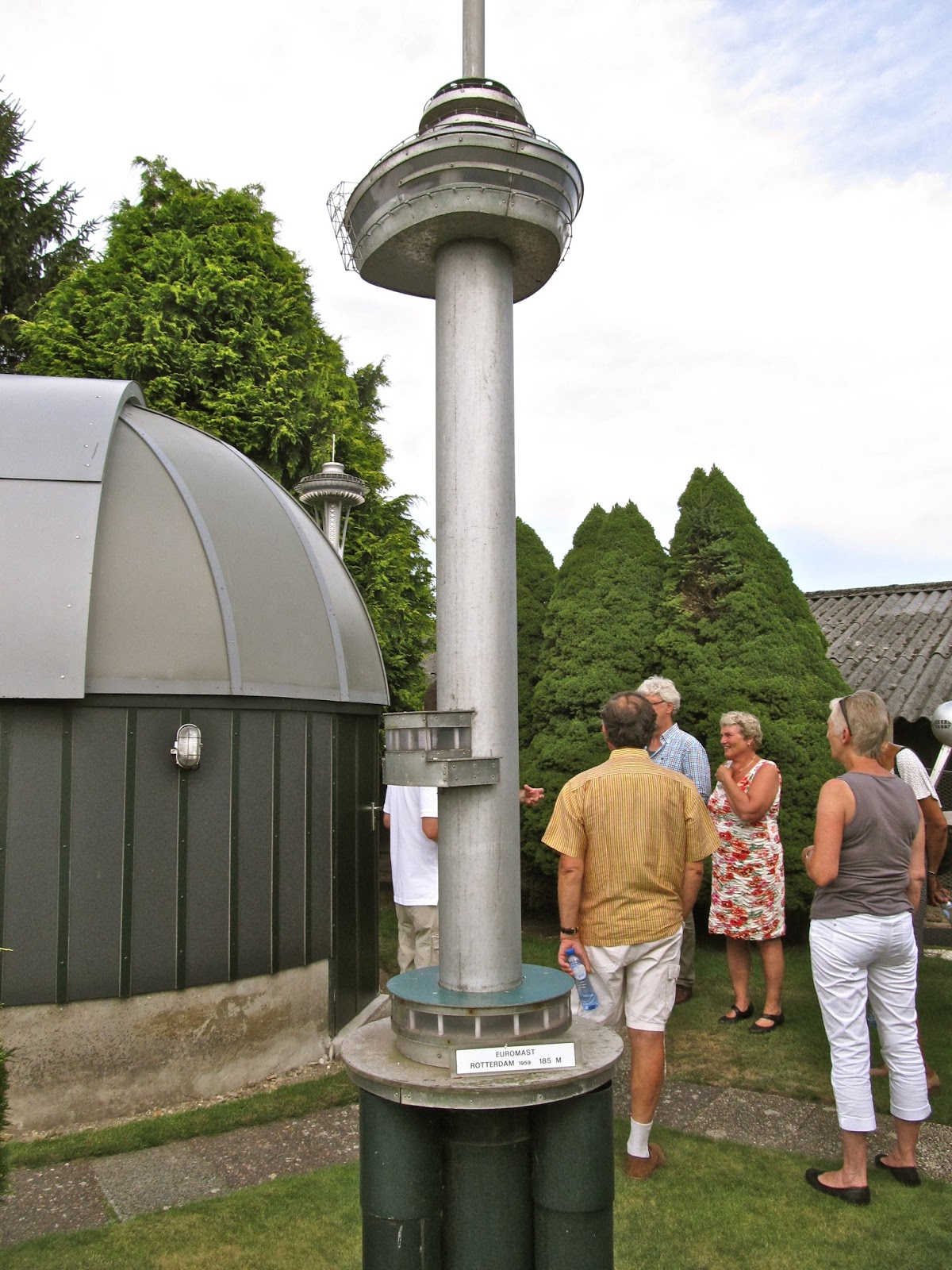
and a replica of the Euro-mast

Then there is a planetarium/stellarium with a diameter of 5 meters and a spherical roof on which some 2844 stars of the northern and southern hemisphere can be projected. Since the sphere can turn, once in action it demonstrates how the stars apparently rotate around the polar star.

Singular architecture

In the 1990s Olthof began making replicas of famous buildings, all in scale 1:60 and all exhibiting a good resemblance with the original.

Next picture shows the Atomium in Brussels, made for the 1958 World Exhibition, which was added in 1992. It is a table top model of 1,7 m high. On the picture, in the distance, the Space Needle in Seattle, USA, added in 1998, 3 m high.

replica of the Atomium, 
in the distance the Space Needle 

The replica of the Leaning Tower in Pisa was added in 2005. It is 0,9 m high and stands on a table top.


On the pictures above one can also see a replica of the Euro mast (added 1995), a tower erected in 1960 in Rotterdam, Netherlands, on the occasion of the horticultural exposition Floriade.

As in so many art environments in Europe, the Eiffel Tower, Paris (added 1992) is also present. Some 5,3 m high it is one of the first added replicas.

A special feature of the construction implies that the tower can tilt over one side, which is useful in terms of maintenance. The video by Carien Stemerding (1'04', YouTube, March 2012) shows how it works:


Other replicas include the CN Tower in Toronto, Canada, built in 1976 on behalf of the Canadian National Railway (added 1993, 9 m high, on the still of the video above) and the Spaceship Earth, a building in Orlando, USA at the entrance of Disney World (added 2005, 0,9 m high).

Actual situation

Olthof died in 2010. When in 1972 he began creating the site, this was just for his own pleasure, but after some time he noted that other people showed interest in what he was making, so in 1982 he decided to open the Achterhoeks Planetarium as he named the site, for the general public.

Consequently the Planetarium became a place which interested people and groups such as school classes liked to visit.

After Olthof had passed away, a group of friends of the site in consultation with the family has formed a foundation which keeps the maintenance of the site, while the site as such remains the property of the family

Currently, Achterhoeks Planetarium can be visited by groups on appointment and private persons can subscribe to participate in a public evening organized once a month (see website for detailed info)

 Documentation
* official website of Achterhoeks Planetarium (in Dutch)
* article in Wikiwand (in Dutch)

first publsihed April 2016, last revised November 2025

Henk Olthof
Achterhoeks Planetarium
Hoogstraat 29
7227 NE Toldijk 
Bronckhorst, Netherlands
streetview
group visits on appointment only
private persons can register for a tour/demonstration 
which is organized once a month


April 17, 2016

Henri Travert, Tour Travert / Travert's Tower


picture (2011) via Google Streetview

Replicas of the Eiffel Tower in Paris, more or less corresponding with the original, are favourite items in the field of art environments, especially in France.  

One can see a lot of such replicas in small scale versions in decorated gardens and on decorated walls, but there are also some large scale versions, such as Jaan Alliksoo's replica in Estonia (31,4 m high) and the one by Pierre Avezard, currently in the Fabuloserie, Dicy, France (23 m high). 

Life and works

The creation presented in this post is 16,5 meters high. It is a stand alone construction, situated in the front yard of a modest farm along a rural road in the Pays de la Loire in France. 

The tower was made by Henri Travert, about whom just a few biographical data are available. He was a mason by profession, was born in the early 1930s and passed away April 2021 at age 89.

In 1978 he began constructing the tower, by soldering some 7500 horseshoes together. It must have been quite an undertaking to collect such a number of horseshoes. (As far as I know Travert not just approached farriers in the region, but also military units with horses).

In 1982 the tower was ready. It's inauguration on November 7 was attended by 3000 interested people. Originally painted in a yellow color, in 1989 -on the occasion of the bicentenary of the French revolution- the tower was repainted in the French national colors red/white/blue.

Afterwards not much has happened around the tower, in any case no activities that resulted in publications on the web and it seems this creation has fallen into oblivion.

Documentation
* In the field of art brut, art singulier, etc in France this creations hasn't got much attention, except the weblog Le Poignard subtil by Bruno Montpied which has a number of referrals to the site.
* A section in the book by Raphael Julian, Histoires insolites des monuments français. (City Editions), 2013, deals with Merveilleux artistes fous (Wonderful crazy artists), viz Picassiette, Facteur Cheval, Abbé Fouré, Bertrand Chenu, Henri Travert, Jacques Warminski and Joël Barthes. The short text about Travert is available via this link.
Article about the site by Sonia Terhzaz on her website Cartographie des Rocamberlus (environments d'art singulier), reporting the visit she paid in June 2017

Henri Travert
Tour Travert
Rue de Montigué
l'Aunay des Vignes
49150 Fougeré, dept Vendee, region Pays de la Loire, France
can be seen from the road
streetview (2011)

April 04, 2016

Félix Gresset, Musée Félix Gresset / Félix Gresset's Museum


a crocodile sipping water 
this picture and the next one from Gazogène

In former times many small communities in the French countryside had a public lavoir, a usually roofed basin supplied with water generally of a natural origin, available for the inhabitants to rinse the laundry after washing ¹.

Since such facilities currently are no longer needed, they may take another use, such as the lavoir in Chantegrue, France, which currently houses a small scale outsider art museum with woodworks, created by Félix Gresset (1917-1993).

Life and works

Gresset was a small farmer who lived in Chantegrue. Later in life, to meet the ends, he became employed by the municipality as a road mender, a job that also took him into the local forests.

One of his tasks in this capacity included cleaning the roads from fallen branches.

Engaged in this activity, he recognized in some of these branches an animal or a person, which fascinated him in such a way that he began to collect wooden items that appealed to him.

By processing them somewhat, he could bring out their specific character, such as the bonhomme (good guy) in next picture.

a "bonhomme" (good guy)

Over the years the collection grew and eventually the front of his farmhouse, where Gresset put the items on display, became a sizable menagerie.

Apart from the picture below that might depict a scene from Gresset's front garden, to my knowledge the internet has no pictures that show how this art environment looked like when situated in front of the farmhouse.

The picture is a reprint from the catalogue  of the 1997/98 exposition Art brut Collection de l'Aracine in the LaM Museum in Lille. Five creations by Gresset (depicting two persons, a monkey and two nameless items) are part of the collection de l'Aracine, which was donated to the museum.

The picture below might also depict these five items in a museum arrangement, but anyhow, it gives an idea of the possible appearance of Gresset's art environment.

picture from the weblog 
Le poignard subtil (Bruno Montpied)

After Gresset died in 1993, the family decided to bequeath the collection to the community. It was installed as Musée Félix Gresset in the no longer used lavoir.

The exposition shows some 200 creations, arranged around the water basins, placed in vitrines or attached to the walls.

picture from website "La route des communes"
portal des communes de Franche-Comté

Documentation
* Article in Gazogène  
* Article in l'Est Républicain (august 2015) with pictures
* Entry on weblog The Beret Project (february 2016)
* Referrals (February 2016) in weblog Le poignard subtil (Bruno Montpied)

note
¹ A lavoir often has an interesting architecture. See the article by Rita van den Boogert, "Monumental lavoirs and fontaines  in France" (published by the Folly Fellowship, February 2017)

Félix Gresset
Musée Félix Gresset
Hameau de Chantegrue, dept Doubs, region Bourgogne/Franche-Comte, France
visitors welcome for a free visit