October 31, 2017

Spartak Kudukhov, Дом украшен фресками / House decorated with frescoes


this picture and the next four courtesy of Alyona Zuevskaya

In above picture it looks as if the framed paintings as such were attached to the outer walls of the house, but the opposite is true: the paintings were painted directly on the walls and later the frames were added.

This house, decorated by Spartak Kudukhov¹ has become a landmark in the Russian city of Borovichi, located about halfway between Moscow and St. Petersburg.


Life and works

Kudukhov was born on March 8, 1951 in a rather small village in Georgia in an area not far from South Ossetia. Already at a young age he felt he had to become a visual artist and although his father didn't agree at all with such a prospect, the young man persevered and earned enough money to enter the Art College in Tskhinvali, the capital of South Ossetia, currently an independent republic recognized by Russia.

After his studies, Kudukhov got a job as a drawing teacher.

Later on he moved to Vladikavkaz, the capital of Northern Ossetia-Alania, a large, industrious city at the foothills of the Caucasus Mountains, where he worked in a factory. 


Then, in 1979, when Kudukhov was in his late twenties, together with his sister he moved north, to settle in Leningrad (from 1991 on St. Petersburg).

Here he probably manifested himself as a visual artist, because his artistic qualities gave him a job as restorer of paintings at the Hermitage Museum.

One source says this happened in 1988. Since Kudukhov in 1995 moved to Borovichi, in that case he worked seven years at the Hermitage. Other sources say he worked some sixteen years at the Hermitage, which would mean that he began this job soon after his arrival in St. Petersburg.

Whatever the case may be, as he stayed longer in St Petersburg, he wanted to be more independent, he sought rest and he wanted more time to make paintings.

So in 1995 Kudukhov left his room in St Petersburg and moved to Borovichi, a town with some 54.000 inhabitants, where he didn't know anyone and had no relatives or friends.


The house he had bought was fairly dilapidated, so he first had to restore it, a big job he took care of himself.

Kudukhov was a man of art, he liked to read and to write, to make poems and create visual art. Working with daily problems he considered a waste of time. But it so happened that he actually was confronted with the daily reality, when up to three times thieves evaded his paintings and furnishings

These events inspired him to add his paintings to the outer walls of the house in such a way that theft would no longer be possible. 

Gradually Kudukhov's house on Sergeya Lazo street was transformed into an art environment. His paintings generally show images of landscapes such as those found in the vicinity of Borovichi.


Today, Kudukhov's decorated house is generally seen as an enrichment of the city. Around 2005 local and regional news media began to write about the site and its creator.

In recent years Kudukhov has become fully established in Borovichi. He worked as an artist for various firms and companies and he was a teacher at a local high school. Currently (2017) in his late sixties he is retired, but he is still active in artistic terms, like he became involved in the restoration of the old paintings in the Trinity Cathedral in Bologoye, a town some 80 km south of Borovichi.

Exposition

In the spring of 2017 Kudukhov had an exposition entitled Talent is always a joy in the museum of local history of the city of Khvoyninsky, a town some 80 km north-west of Borovichi. About thirty of his paintings, mainly showing landscapes, were exposed.

Documentation
* Elena Ziminova, Article (august 2015) Бывший реставратор Эрмитажа поселился в Боровичах и превратил свой дом в произведение искусства (The former Hermitage restorer settled in Borovichi and transformed his house into a work of art), on website vnovgorodnews

Video
* Video (2'01", YouTube, downloaded September 2016) published by the Douglas Group (a Russian
company producing videos for TV)


note
¹ Although Kudukhov was educated as an artist, in my opinion his decorated house deserves to be included in this inventory, because he is an artist by nature, whose way of creating an art environment fully fits in the way of working of those self taught artists presented in this weblog (passionate, without assistents, non-commercially)

Spartak Kudukhov
House decorated with frescoes
7, Ulitza Sergeya Lazo
Borovichi, Novgorod Oblast, Russia
can be seen from the street
streetview (2013)


October 24, 2017

Giancarlo Debertol, Casa La Floriana / The house of Saint Florian


this picture and the next six courtesy of Lena GM
click on pictures to enlarge

Canazei is a community of some 1800 inhabitants in the mountaineous area of the Dolomites in  northern Italy. Currently a busy ski resort, in earlier times it was a rural village inhabited by farmers and workers, among whom house painters who also decorated facades of local houses of which there are still good examples in the village.

Currently the most impressively decorated house is that of self taught artist Giancarlo Debertol ¹

the side of the house facing the Piazza S Floriano

Life and works

Born in 1950 in Canazei and grown up there, Debertol as a young boy already showed his artistic qualities, like at age nine he decorated an interior wall of the parental home with a landscape including Snow White and the seven dwarfs.

Once grown up, decorating the house became a project of decades, which resulted in an abundantly decorated  house, both inside and outside. At the outside the exterior walls are fully covered with frescoes, woodcarvings and wooden sculptures.

The project is dedicated to Saint Florian, the patron of the community.


On above picture the saint can be seen, standing front center, just below the overhanging roof, on the upper balcony at the side of the building facing the Saint Florian Square.

Saint Florian is widely venerated in central Europe as the saint who protects houses from fire.

In  Devertol's wooden sculpture he is depicted while giving water from a can.


The picture above gives an impression of the facade as a whole.

It has a rich decoration with woodcarvings, but also a larger number of frescoes which are also applied to the underside of the overhanging part of the roof.


Mostly encircled with floral motives, the many frescoes that decorate the exterior walls depict religious themes, dolomite landscapes, flowers, birds or churches located in the region.


The village of Canazei is located in a northern area of Italy that borders Austria. The traditional buildings in the community, in former times mostly used as farmhouses or workshops, have an architecture that corresponds with the architecture of farmhouses in western rural Austria.


Characteristic for these buildings are a stone base, a wooden superstructure and a steep, pointed and overhanging wooden roof that is suitable to carry and discharge large loads of snow.

As far as I understand Debertol's house formerly was a mill, which he himself converted into a house, both to inhabit and to use for other activities, such as Debertol's studio, a therapeutic practice of his daughter Gladia Debertol and a shop with souvenirs and regional products.

two guardians
picture (2016, Facebook) by Antonele Giubbini 

As can be seen in above picture, the short side of the house, farthest from the village center, has a small patio and an entrance flanked by two characteristic wooden sculptures, evidently made of logs.  

Debertol regards these as the guardians of the property.

the small garden with miniature constructions
picture (2012, Facebook) by Gladia Debertol 

Not visible from the street is a small garden on one side of the house, which includes a number of miniature buildings made by Debertol.

exposition 2016
picture (2016, Facebook) by Debertol's partner Mirtha Largher

Exposition

Apart from decorating interior and exterior of his house, Debertol likes making paintings on canvas, including painting landscapes such as those found in the area. Another favourite activity is decorating eggs or egg-shaped models.

Above picture shows a selection of his visual art as shown on a local exposition in 2016 in the context of Canazei's yearly festivity Te anter i tobié (In the middle of the barns, The name of the festivity is in Ladino, the language spoken by the people of the Roman Empire, crossed to the north via roman soldiers and currently still used in Canazei in daily routine).

Documentation
* articles by Giada Carraro on websites Costruttori di Babele and SPACESand also on the webzine Bric-a-Brac, nr 4 (spring 2021), p 37-45
* Facebook page edited by Gladia Debertol Casa decorata "La Floriana" nel centro storico di Canazei (the pictures credited in this post as derived from Facebook are on this page)

note
¹ The internet mainly has short (touristic) referrals to this art environment. Only Giada Carraro published a more detailed description of the creation (see documentation) and I would like to acknowledge that some factual information in this post is based upon Giada's work.

Giancarlo Debertol
"La Floriana"
Canazei, Trentino, Italy
see exact location on Mapio.net
can be seen from the street
streetview

October 11, 2017

Józef Chelmowski, Muzeum na świeżym powietrzu / Open air museum


all pictures (2012) courtesy of Albin Marciniak (club Podróżników)

Poland has a vivid array of artists and institutions in the field of folk art, and it also has a number of art environments, like Chelmowski's site, referred to as an open air museum in Poland.

Life and works

Józef Chełmowski (1934-2013) was born in a family of farmers in Brusy Jagli, a small community in the north-west of Poland. He grew up in the tradition and values ​​transmitted in his family from generation to generation and all his life in his daily conversation he would speak Kashubian, the language of old in the area in northern Poland where he lived.

Already as a young boy at school he liked painting and sculpting. The teacher let him do this. He gave me freedom, so I worked and painted. Nobody taught me, the teacher was not capable of teaching me. I had to discover it all by myself, Chelmowski says in the video with English subtitles in the documentation below.

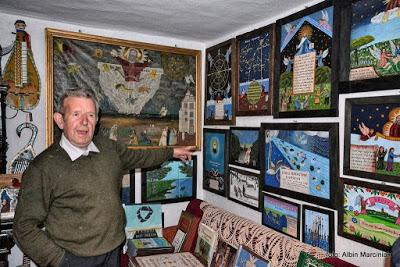
Chelmowski amidst the paintings in his house

He completed his primary education, but could not pursue further studies because of illness and the need to assist his parents in running the farm.

Chelmowski later had a variety of jobs, such as ticket controller in a cinema, porter, lab technician or bee-keeper.

But throughout all these years, as a self-taught artist, he remained active in painting and sculpting, mainly creating works on religious, philosophical, moral or patriotic themes.

He became a versatile artist, who not only designed visual art, but also wrote a number of books and constructed installations, such as a machine for capturing the elements.


In 1972, when he was in his late thirties, he decided to share his work with the outside world and submitted it to the competition folk sculpture of Northern Poland. His work was appreciated and since then he has participated in all major events in the field of folk art in Poland.

Chelmowski's fame as a folk artist grew.

Currently various Polish regional museums have his work in their collection, such as the Ethnographic Museum in Toruń, the Western-Kashubian Museum in Bytow and the Leon Wyczółkowski Regional Museum in Bydgoszcz, which has the largest collection (some 500 works), including Chelmowski's imposing creation the Apocalypse, a 55 meter long and one meter high painting depicting scenes of John's biblical story.

Creating an art environment

In the late 1970s Chelmowski transformed the garden on the backside of the parental home into an art environment. In the mid 1990s, when Chelmowski's fame was widely spread throughout Poland, the site attracted visitors, initially from Poland, but later also from Germany and Scandinavian countries.


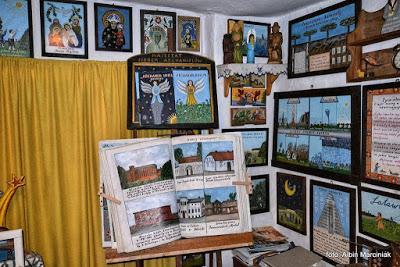
A number of walls of the interior spaces gradually got fully filled with his paintings. In the interior one also finds his illustrated books.


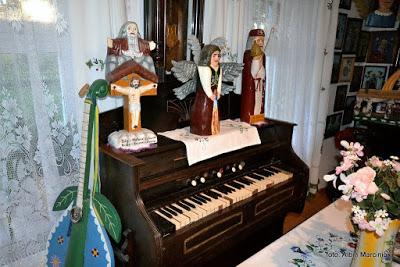
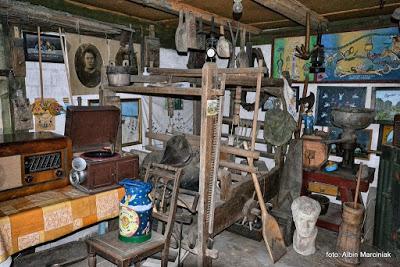
In some rooms all sorts of tools and household items were gathered that had to do with daily life in former days, such as old radios, telephones and gramophones, farm equipment, but also old-fashioned billboards.


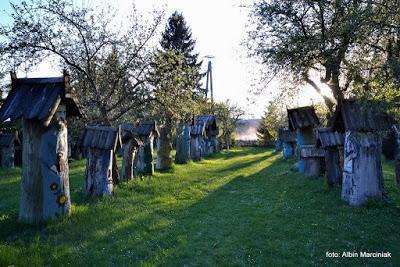
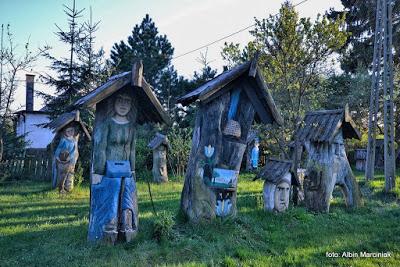
The garden at the backside of the house includes a large collection of Chelmowski's woodwork.
Very prominent are the small road chapels, arranged in parallel rows.

These are a well known and widespread phenomenon in Poland. Chelmowski has delivered many of such little chapels on order, but it is very satisfying that in the garden a large number of these creations have met.


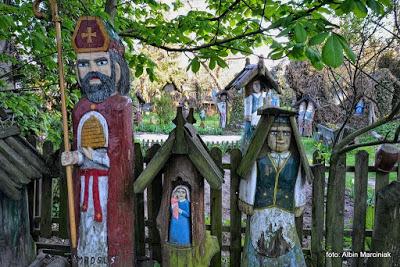
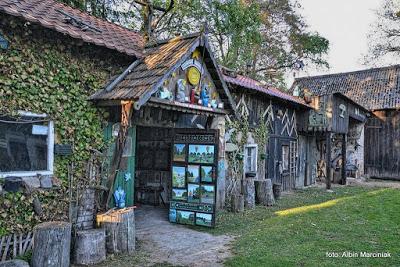
The garden also includes beehives and a variety of sculptures depicting saints, angels. farmers, robbers. The exterior walls of the house and the outbuildings are decorated with frescoes. One of these frescoes has the inscription Światło Czas Duch włada życie which as far as I understand means Light, Time, Spirit, its life....


The entrance to the house is decorated with paintings and carvings. The tympan above the door contains sculptures of Pythagoras, Copernicus and Archimedes ..

In 2006 Chelmowski was honored with a Polish cultural award, the silver medal of Gloria Artis.

Chelmowski passed away in 2013

After Chelmowski died in 2013 his widow Jadwiga Chelmowski, assisted by other members of the family, took care of the open air museum.

A heavy storm in August 2017 caused damage

In the night of August 11, 2017, house and garden were hit by a heavy storm that caused damage to the house and fences. The works of art have been spared for a significant part, but it has been shown how vulnerable they are.

A crowdfunding action has been initiated to perform the necessary repairs and provide a basis for systematic care of the creations

First steps towards renovation

In the autumn of 2017 first activities started of a project of the family, the Western Kashubian Museum and a number of volunteers to renovate the art environment in time. A first action included the moving of the most vulnerable sculptures and wooden constructions to a covered area on the site, where they can safely survive the winter

Documentation
* Official website
* The open air museum on Facebook
* Urszula Usakowska-Wolff, "Jozef Chelmowski und seine Welt voller Engel" (Jozef Chelmowski and his world full of angels), article (in German) in Kunstdunst Magazin Berlin, 2013
* Article (October 2017) in Znalezienie blogspot

Videos
* Video by the Muzeum Nardodowe w Gdansku (8'02", YouTube, uploaded march 2011)


* Video by ostanceprobs 3'28",YouTube, march 2011


Józef Chełmowski
Open air museum
Główna 15, 17
89-632 Brusy-Jaglie (Czyczkowy), Pommern, Poland
visitors welcome