November 27, 2010

Ger Leegwater, Nederlands Kremlin / Kremlin in the Netherlands


pictures (april 2011) by Inky van Swelm\

It is not a replica, the building in the image above, it's just a fantasy structure with decorative elements which evoke a Russian basilica. 

Life and works

This building is part of art environment created by Ger Leegwater (b. 1945), known as the Kremlin in the Netherlands. It arises in the rather large backyard of his house at the outskirts of the small community of Winkel in the green, grassy area of  the province of North-Holland, Netherlands.

A sheet metal worker, not trained in architecture or construction works, Leegwater began this project around 1989/1990 using all kinds of excess and demolition materials. Over 25 years later he is still going strong and creating new structures. Currently (2017) in his early seventies, he once said that in case he might be not so fit anymore at older age, he always could do mosaics..... 

Before Leegwater began his project he had made holiday trips to Italy and like other builders of castle-like structures he became fascinated by Roman architecture and the classics.


The main structure, the Basilica, covers an area of 14 x 16 m and is 10 m high. It is flanked by a number of smaller structures, like corridors, arches, walls and a chapel (which also is available for marriage ceremonies).


The site has a variety of sculptures made from sheet metal, such as a scene of Saint George and the Dragon, a statue of the archangel Michael and a sculpture of Orpheus (above).

Around 2015 a new large structure was completed, the Neptune Fountain, which is decorated with sculptures of Neptune, Pegasus and a Triton.

constructing the Campanile (August 2016)
picture from Facebook (Nederlands Kremlin) 

Then Leegwater started a new project, the Campanile, a structure shaped like a tower, built on sloping columns, with an oculus (a circular window) on top and Atlants (columns in the form of a man) at the four corners at the outside. This project was completed in 2017.

Constructing the structures of this art environment began without any formal building permit, but the local authorities, convinced of its safety and importance, have decided to legalize it.

On appointment Leegwater will host groups of interested people and school classes, which he informs about classic tales, mythology, the art of building and architecture.

Documentation
* Leegwater's website (started 2016) Kunsttuin Nederlands Kremlin (Art garden Kremlin in the Netherlands)
* Facebook
* Article (2012) on SPACES website   
* Article (June 2007) in the bulletin of the Folly Fellowship 

Videos
* In a video on YouTube (December 2009), in two parts, Leegwater talks about his project (in Sutch).
A transcript in English of this presentation is available on OEE texts.


first published November 2010, last revised February 2020

Ger Leegwater
Nederlands Kremlin
Limmerschouw 51
1731 NJ Winkel, Netherlands 
open on Saturdays and Sundays. 11-16.30, (entrance fee)
groups (7 persons or more) on appointment (see website)

November 21, 2010

Péter Császár, Failakok és tornyok / Treehouses and wooden towers


picture (Failak 2001) by József Rosta

 How many young people didn't dream of building a hut in a tree? And how many of them actually did this?

Life and works

Peter Császár (b. 1974) built tree-huts indeed, not just one, but lots of them, altogether some thirty tree huts and a number of wooden towers.

Born in Budapest, the capital of Hungary, at age ten he began experimenting with the construction of a tree-hut, at an altitude of some four or five meters. In 1989, at age fifteen, he actually made his first tree-house, at an altitude of some fifteen meters. 

Following his passion, Peter Császár in the 1990s constructed some thirty tree-houses in the woods around Budapest. Once his talent had been noticed, he also made tree-houses on commission, like one on behalf of the Bárka Theatre which was realized in the Orczy Garden, a park in Budapest.

picture (1999) by Eva Bársony

His constructions are rather robust, like the one in the picture above, which has a surface of 5 x 5 m, walls and a roof and is situated at an altitude of 12 meters. It is rather a house then a cabin..

this picture and the next one from a webpage by Császár
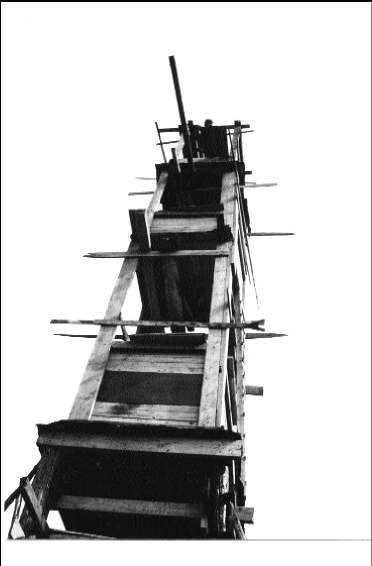
tower 15 m high, constructed 1990/91, 
meanwhile demolished by unknown people

In the same period Peter Császár also constructed wooden towers, but up to now I could not trace information about the whereabouts of these constructions.

another tower, 25 m high, constructed 1994/96, 
burnt down by unknown people

Császár had a great respect for nature. In the interview with Agnes Veronika Tóth (see documentation) he says: "The proximity of the tree calms me. When I build, I still ensure that the trees remain intact (....) What I do is rooted in a great love of nature. The natural environment always has attracted me very much, it is no coincidence that I long for the forest, (to be) between the trees"..

What happened to the tree houses and the towers?

Local authorities were not amused to discover illegally built wooden structures in the public area and  destroyed them. The structures also have been vandalized by unknown people. So most constructions have disappeared and Császár's creations mainly survive via pictures

The one in the Orczy Garden however, as far as I know, is currently still extant.

From autodidact to professional artist

As a young man Császár had no training in construction work or making art (he studied communication sciences). His artistic talent was noticed by a friend of the family when he was in his early twenties and in this way he got the opportunity to follow art classes and to join (in 2002) the Hungarian union of sculptors.

As far as I know, currently Császár is active in making visual art. 

Expositions

 * Császár's wooden structures got attention in some expositions, like Unframed Landscapes (Dunaújváros, Zagreb, London, 2004) 
* An exposition (Székesfehérvár, June 2008) was reported on the freshwindow weblog (which however is not available anymore on the internet)

picture courtesy of the Hungarian freshwindow weblog
(not available anymore)

Documentation
* Interview (in Hungarian) with Péter Császár by Agnes Veronika Tóth on Balkon website

Péter Császár
Treehouses and wooden towers
around Budapest, Hungary
most constructions have been demolished

November 05, 2010

Antonio Aguilera Rueda, La Casa de la Piedra / The House of Stone


pictures from Rueda's book, 
republished in the deporcuna website

This singular architecture is a creative statement in stone. All parts of the house have been made from stone, not just the walls and the floors, but also the ceilings, the doors, the beds, the tables and the chairs.

The house has been constructed single-handedly by one man, with the permanent help of his mule and the occasional assistance of his two sons.

Life and works

Antonio Aguilera Rueda (1896-1980) was born in the community of Porcuna, east of Córdoba in the Andalucía area of Spain. 

As a youngster he grew up in the Paseo de Jesús and, as he said in a book he wrote in 1975, he had ideas about building his own house, just to have an accommodation to live in when being old.

In the early 1930s Rueda, who had a job as a stone cutter, could become owner of a piece of land near where he lived. On this plot, in 1931 he began constructing his house.

Using stones from the local quarries in the constructing of houses was an age old tradition in the community, but what Rueda undertook was rather exceptional. His idea was to create a castle-like house, with a facade, three storeys, patios and towers, using just stone as material.

It took him almost 30 years to complete the project.

In his book, published in 1975,  Rueda describes in a sober way the hard work he had to perform, the setbacks he had to experience and the critical and sometimes derisive comments he got from bystanders. 

However, he persevered and on May 11th 1960 the project was formally declared completed.
 

Apart from the doors and ceilings of stone, a very spectacular item of the house is the table, that is situated in one of the patios. The tabletop is a stone slab 7 m long, 2 m wide, and 10 cm thick. The slab, fastened to trolleys, was transported from the quarry by manpower delivered by neighbours and friends who pulled the ropes.  

The table sits the host and twelve guests, in stone chairs of course.

Rueda had some twenty years to enjoy living in this creative construction. He died in 1980.

The house has become a museum 

Currently the house is a local museum, which attracts a lot of visitors.

Documentation
* Antonio Aguilera Rueda, Historias de un loco Andaluz, artifice de la casa de la piedra, 1975 (extracts, in Spanish, on the website deporcuna.com)
* The site got a scholarly review in: Jo Farb Hernandez, Singular Spaces. From the Eccentric to the Extraordinary in Spanish Art Environments, Seattle (Raw Vision, SPACES, San José State University), 2013. ISBN 978-0-615-78565-3. An abridged version on SPACES website.

Antonio Aguilera Rueda
La Casa de la Piedra
Paseo de Jesús
Porcuna, Andalucía, Spain
open for the public, daily 9.30-13.30 and 16-19.30

November 02, 2010

Yves Floc'h, Girouettes / Wind vanes

pictures courtesy of Art Insolite Amis

Girouettes....... wind vanes.....  devices that will turn around in the wind......I like how these are named in French, because of the association the word girouette has with "rotating", but that is an incorrect association, because etymologically girouette comes from Anglo-Norman wire-wite.

Whatever.

A nice collection of homemade rotating devices could be seen from the street in  the small community of Bosgouet in Normandy, France.

Life and work

These girouettes and other rotating devices have been constructed by Yves Floc'h (born around 1938) who had various jobs in the blacksmith profession and later in his life worked as a fireman (experiencing a gas explosion in 1963) and as an operator in an enterprise.


Floc'h began making his kinetic constructions in 1995, probably when he became retired. There is a story that says he wanted to do something so as not to get bored.

He used all kinds of recycled material, old parts of  lawn mowers, bicycles, cars, accessories of machines that are used in and around the house, and so on, all painted in bright colors.

Like other bâtisseurs de l'imaginaire Floc'h began by constructing a windmill, but in the course of time he developed his own personal style in transforming the front of his house into a colorful ensemble of rotating devices.

The site doesn't exist anymore

According to Francis David, who in 2012 made photo's of the site, all elements of the ensemble had disappeared in 2017. 

Documentation
* Pascale Lemare, Normandie Insolite, (Ed Bonneton), 2005
Weblog of Pascal Levaillant (May 2011) with pictures

Video
* This video (2009, 1'29" on YouTube is a fragment from the TV-movie Un monde modeste (France, 2009, 54') made by Stéphane Sinde for Arte TV


first published November 2010, last revised July 2021

Yves Floc'h
Girouettes
4 cité du Beau Soleil
27310 Bosgouet, dept Eure, region Normandy, France
the ensemble doesn't exist anymore