The doll-decorated front of a shed, as depicted above and below, can be seen in Kolomna, an old city in the Moscow region, Russia, about 110 kilometers southeast of the capital.
Life and works
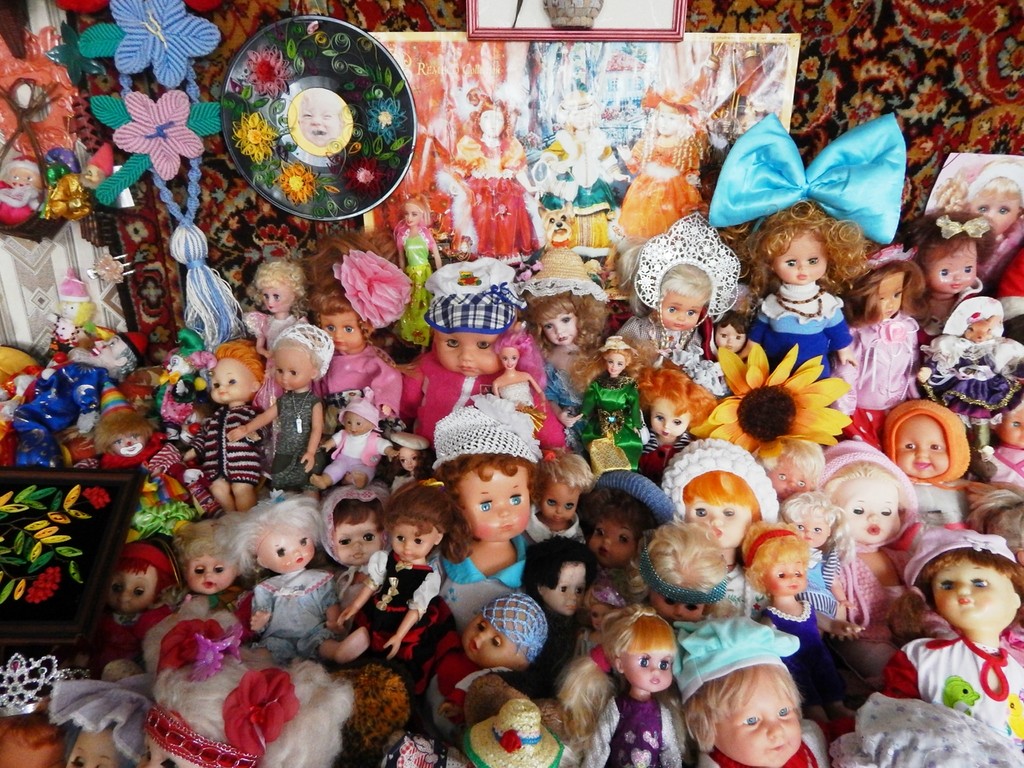
The dolls attached to the barn are only a small part of the collection of dolls assembled by Margarita Leonidovna Travkina, who was born in the early 1940s.
It all started in 2005 when she walked past a lot of rubbish and noticed that there was a discarded doll in that garbage. She took the doll home, washed and restored her dirty doll clothes, repaired damaged parts and gave her a nice spot in her house.
At that time Margarita Travinka was in her mid-sixties, she lived with her husband after her two sons got married and had left home. She was artistically gifted, loved embroidery and also made small paintings of special material, as in the composition below, where the basic material consists of processed shoe leather.
Repairing the rescued doll probably inspired Margarita Travinka to continue this kind of activity and so she asked friends and neighbors if they had old, disused dolls available. And indeed, they had......
It was the start of a project to which she would spend all her time in the coming years and that resulted in a collection that now includes 13,000 dolls.
Indoors, the dolls are arranged side by side on chairs, benches, tables and other furniture.
They are all nicely dressed, their hair is cut, some wear hats. If female dolls have nails, these are provided with nail polish.
Margarita Travkina creates the beautiful and often richly decorated clothing of the dolls herself on the sewing machine. One garment takes about four hours to make, so this activity requires a large part of her daily time. This besides the time needed to clean the set up of the collection and keep it in order.
Her house has a modest size and includes only a couple of rooms, which means that almost all available interior space is occupied by the collection. After her husband died some time ago, Margarita Travkina lives alone in the house.
Unknown in which year, but probably in an early phase of the project, a small part of the collection of dolls has been attached to the front of the barn outside. These are generally smaller ones, made of rubber or plastic. The facade has also been decorated with a number of clocks.
Documentation
* Article (November 2015) in news website Vittasim (IiveJournal)
* Article by Diana Strazin(July 2017) on website 360tv.ru
Video
* Video (30'47'. 2017) by Life Новости (Life News) as published on Facebook
Margarita Leonidovna Travkina
House with dolls Ulitsa Posadskaya 50 Kolomna, Moscow region, Russia exterior decorations can be seen from the street streetview
decorations at the site of the Evangelic Lutheran Church
in Čiekurkalna, Riga, Latvia
this picture and the next one courtesy of Zane Butnare
Some who wrote about Oļģerts Mikelsons (1927-2019) and his creative work have called him the Latvian Gaudi, but he himself has never supported such statements, although he agreed that both found their inspiration in a similar way.
Apart from this, with the creation of two art environments in succession, Mikelsons as a self-taught artist has done a great job, which until now has received little or no attention, especially outside Latvia.
Oļģerts Mikelsons at the premises of the church (2015)
Life and works
Mikelsons' biographical data are still far from complete. He was born on January 10, 1927, participated at age 18 as a Latvian soldier in the second World War (where he was imprisoned too), graduated in 1950 from a construction engineering school and got married in the same year. He found employment as a civil engineer.
In the 1970s, living in the Latvian town of Jürmala, he began creating his first art environment, an activity that lasted until the beginning of 1983. Then he divorced, moved to neighbouring Riga, where he remarried and began transforming the premises of a church into his second art environment.
He was a faithful Christian, proud of his country, he loved music and has composed songs for a choir. The last couple of years his health deteriorated and he lived in a social care center. In 2017, together with members of the church, he celebrated his 90th birthday. He died in 2019.
The art environment in Jürmala
this picture and the next five (2011):
screen prints from the first video in the documentation
the apartment building in Jürmala
with a blue decorated wall on the right side
Mikelsons and his wife lived in Jürmala in an apartment building on Rigas Iela nr 4. They hired a small apartment on the ground floor and first floor in the left corner of the building seen from the street. On its backside the building faces the river Lielupe.
ground floor of Mikelsons' apartment
A characteristic of Mikelsons' first art environment is the use of pebbles as decorative material. One finds these pebbles in the entrance party of the apartment at the left side of the building. It includes a richly decorated staircase that leads to the first floor, as well as a decorated entrance at the ground floor with yellow doors (as pictured above).
pebble decorated structure, part of the mooring
Another structure decorated with pebbles is a mooring with a lantern pole in the river at the backside of the apartment building (picture above).
sculpture decorated with pebble
Mikelsons also made sculptures decorated with pebbles, such as the one in the picture above, which is inlaid with mosaics and portrays a lizard or salamander. Other pebble or mosaic decorated sculptures include portrayals of seagulls, a mermaid and a human couple.
blue decorations and pebbles the inscriptions read RA SPUTNIKS and JÜRMALA RIGA
Another characteristic of Mikelsons' art environment in Jürmala is the use of the color blue, as can be seen in the picture that shows the blue decorated outer wall along the street or in the pictures above and below which show a combination of pebbles and blue mosaic elements.
floor of pebbles with mosaic inlays
The house has served as a backdrop for a Russian detective film recorded in 1979. An article (December 2010) in Live Journal provides more information and also has a series of images of the decorations as far as present at that time.
The art environment in Čiekurkalna (Riga)
Early 1983 Mikelsons separated from his wife (a factor may have been that she was very outspoken in her dislike of his creative activities) and he moved to the Čiekurkalna quarter of Riga.
End May he remarried with a diacones of the local Evangelic Lutheran Church, a religious community Mikelsons had joined already in the 1970s and where he had met his new partner.
this picture and the next six courtesy of Zane Butnare
The church, which doesn't have the usual appearance of a Lutheran church, was built in 1928 and also included dwellings for disabled people and members of the congregation.
Once settled in Čiekurkalna, Mikelsons soon became available as a volunteer to help with the maintenance of the building and the garden, which led him -in line with his creative activities in Jürmala- to start making creations too.
There are no reports about the sequence of his operations. Perhaps the access party of the church (as in the picture above) with its towery pebble decorated structure on top of the stairs and its mosaic decorated front facade, belongs to one of the first works,
Mikelsons' predilection for pebble decorated items is also clearly visible in this second art environment, as demonstrated in the decorated wall depicted above and the sculpture below, part of the base of the bell tower, which also features a variety of inscriptions and green-tinted mosaics.
The decorative elements in the garden of the church include a large variety of multicolored mosaic, both on different parts of the ground floor, included a mosaic at the entrance of the site, and the also a variety of mosaics applied to structures and sculptures.
This art environment now also has smaller sculptures of animals, such as a cock and a cat with a mouse.
The most important structure, also seen from an ecclesiastical perspective, is the bell tower, as in the pictures below. This about seven meters high tower, decorated with a lot of green tinted mosaic and equipped with various inscriptions, was constructed in the 1990s.
Its base rests on a foundation that initially was part of a swimming pool which meanwhile had fallen into disuse.
Mikelsons seated in front of the tower
In April 2017 the ensemble of decorations got a protected status when it was included in the National list of protected cultural monuments as an art monument of local importance.
the bell tower seen from the backside
On April 4, 2019 Oļģerts Miķelsons passed away.
Situation of the site in 2022
The photo below, made by Tiramisu Bootfighter in September 2022, shows that the site at hat time still was in good condition.
Documentation
* Rīgas Evaņģēliski luteriskā Misiones baznīca on Facebook
* On Live Journal (November 2010) an introductory article by Renate with pictures of the Jürmala decorations, followed by another article with more information and more pictures
* Also on Live Journal (November 2010) two articles by Renate with a description and a series of pictures of the decorations on the Čiekurkalna site, first article and second article
* And then on Live Journal (November 2011) a summary article by Renate about the two art environments, also with a lot of pictures
* Article (June 2016) on Latvian website IINUU about the Čiekurkalna art environment, with a series of pictures
* Article (undated) by Irina Mazurika on Baltic Travel Blog, with a series of pictures
Video
* Video entitled Schreyenbusch's Gaudi (YouTube, 2014, 8'31"), produced in the context of the Riga Summer School 2014, introducing Mikelsons and his creations at the site of the church
Oļģerts Miķelsons
Creations around house in Jürmala Rigas Iela 4 Jürmala, Latvia can be seen from the street Creations around church in Čiekurkalna (Riga) Čiekurkalna straat 1. līnija 78 Riga, Latvia can be seen from the street streetview
Sabile is a small town of some 3000 inhabitants, located along the Abava River in the western part of Latvia. It attracts visitors because of its beautiful surroundings, its annual wine festival and its garden with dolls, a site which in the field of art environments in Europe is rather unique.
Life and works
This site was created by Daina Kučere, inhabitant of Sabile, born in the mid 1940s, a mother of four children and a grandmother of fourteen grandchildren. She had various jobs, such as waitress in a motel, and in 2007 she got retired.
It all started in 2005. To uplift the celebration of the midsummer night, a beloved night of festivities in Latvia, one of Daina Kučere's daughters came up with the idea to make some life size dolls. It turned out to be a success and Daina, at that time in her early sixties, felt motivated to create more of such dolls.
Creating a doll garden
It became a a project that would keep her busy until the present day (2018). Already in the first years she made dozens of dolls, which got a spot on a grassy piece of land -in private property- along a main street of the town. Currently the site has some 300 dolls.
The site is open to the public throughout the year, even on cold winter days
To construct the dolls Daina uses the format her daughter had tried out. She starts with a wooden cross-shaped frame, on which a fabric base is attached which will be filled with straw. With a wooden post attached to the bottom of the frame, the doll, once dressed, is firmly anchored in the bottom to the place it gets in the site.
Simple and cheap materials are used for the basic structure of the dolls. For example, since Daina can get the straw for free from a friend, she only has to pay the costs of transport.
to republish content in informative weblogs as the present one
What one sees are scenes from everyday life: postmen and other local officials in uniform, a lady in a dress in Latvian colors, another lady sitting behind a sewing machine and many, many children.... in a circle holding each other's hands, two-by-two in a row also holding hands......
In the conceptualization of this art environment considerations of a historical nature have no role, neither was there apparently a need to represent certain nationally or regionally known events. It's all about activities close to home, in a nearby familiar environment
At the same time, observers have noted that the site can leave an impression of alienation or can be a bit unsettling. If so, this may have to do with the very sketchy applied facial expression and the presence of headgear on really every doll, which is probably needed to mask the effect of the internal frame.
In terms of outsider art environments, however, these elements just as well can be seen as charming aspects of the site.
Situation of the site in 2022
The photo below, made by Tiramisu Bootfighter, shows that the site in September 2022 was still in a good condition