January 28, 2022

Fabrice and Marylise Klisowska, Curieux Jardin / Curious Garden


all pictures from the Facebook-page of the site

Fresnay-les-Chaumes is a small community in France of less than 60 inhabitants (2015), located 75 km south of Paris. In a side street at the eastern end of the departmental road D927 that runs through the village, one of the most remarkable art environments in France is located.

A curious garden

This art environment, named Curious Garden, was created from the mid 1990s by Fabrice Klisowska, together with his wife Marylise. 

Fabrice, born in the early 1950s, had a job at the Directorate of Equipment of the Loiret department and he is now retired. Marylise is in particular involved in a company that rents clothing, the association Croisade et animation (Crusade and animation) The company was founded by the couple in the 1990s and is located in their home, that has a basement with some 5000 clothes and disguises.


The front of the house is along the rue de Paradis and its right-hand side is adjacent to a parking space, meaning that the garden, seen from the outside, manifests itself both to the front and to the side. The part of the garden on the side extends far to the rear.

Those interested in visiting the garden are greeted with the sign shown above, on which Fabrice clearly explains what can be seen and experienced in the 1000 m² space that comprises the garden.

The text reads as follows: 

Enter this atypical space; that of passion, to discover the originality of a work that is offered to you. Not necessarily pretty, this garden seeks to surprise you by exploiting every nook and cranny to awaken your moods of  "fear, joy, astonishment".
This curious garden is the witness of a generation that is leaving, with glazing already forgotten, and for that, we have used a whole recycling of materials and objects that team up to create scenes (the revolution, Noah's ark, etc.). Each character has his reason for being.
The garden also exhibits by Facebook, "curious garden" and maybe thanks to you, if you make it known.
HAVE A GOOD VISIT 

Over the years, the garden has grown into an extensive art environment, now characterized by a large number of sculptural representations of all kinds of personalities (currently some 350), some specific scenes (such as a ship, a cafe, a puppet theater), all kinds of textual accompaniment and a decorative flora of about fifty different types of flowers.

Hundreds of personalities

An important factor in the development of the decorated garden has been that in 1990 the couple received mask supports from the Saumur-based company Cesar, which specializes in making beautiful disguises. 

This allows Klisowska to shape the facial expressions of the personalities displayed in the garden.


As above image shows, the sculptures of the persons are loosely arranged along the paths, often in the exuberant greenery and flower arrangement that adorns the garden. 

Their faces are shaped by the mask they wear,  but the facial expression can be quite realistic, as can be seen in the image above where Donald Trump greets visitors

The hundreds of characters are dressed in a manner befitting their capacity, a toga, a uniform or some form of everyday attire.

The images around give some impression of what the sculptures look like when viewed up close.

Left above 
- a policeman, the guarantor of the curious garden
- in the middle a a representative of the French judiciary
- and on the right a sculpture expressing that in the curious garden old age is not a weakness.

Below left
- a sculpture of Marianne, a symbolic character referring to France as a nation after the overthrow of the monarchy in 1789, erected here because of the November 2015 attacks in Paris
- in the middle a depiction of Alain, who once again announces that old age is not a weakness in this garden 
- and at the right a depiction of François Mitterrand, deceased on January 8, 1996, who is concerned about the position of his party ("wiped out" according to the sculpture comment).

The site also features a number of sculptures of government leaders, such as de GaulleSarkozy and Mitterrand from France, Bush, Obama and the Clintons from the United States and Yeltsin from Russia.

Then there are pop stars such as Madonna or Whoopi Goldberg and actors such as Charlie Chaplin and the in France famous stage comedian and cinema actor Coluche, who is pictured below sitting on the remains of his motorcycle.

Coluche

A few times, the exhibition of a person led to problems with spectators, as happened for example with the American film and TV actor Mister T, who hanging from the facade, for the taste of some people showed too liberally intimate parts. 

This was often solved with the intervention of a mediator, or even a police officer. Klisowska has said that this is the price to pay for originality. Today, with regard to such matters, the situation around the site is calm. However, part of the site was recently vandalized.

Some scenes included in the garden

The garden also houses a number of scenes, formed by a set in which a group of people depict a situation or an event, which may or may not be realistic. 

Here are some examples of such scenes.


The above scene is situated on the roof of a shed in the garden. It shows the moon being picked up by the Curious Garden, this with the intention to set up creations there. 

A non-realistic, but funny event indeed.


And then, pictured above is a realistic situation, the terrace of a café, with visitors clearly having a good time there. 

Cheers ! There is still one seat available....


Noah's Ark, depicted above, is partially buried in the ground and equipped with oars. At the back of the boat is a person in a yellow jacket at the helm. A little further back is someone who is angling a raised rod.

There are no animal depictions to be seen, except near the fore-deck where there is a sculpture of a fish leaping out of the water.


The marionette theatre, pictured above, can also be considered a scene. Presented as a THÉATRE, École de marionnettes (Theater, school for puppets) it is indeed all about a puppet show.

The front actor wears a mouth cap, which refers to the troublesome times with lock-downs and other restrictive measures France and most other countries experienced from early 2020 until 2022 because of Covid.

The garden is dotted with all kinds of texts

All over the garden texts are placed, on billboards, on placards on the paths, as exclamations of a person as in a comic book. Other sites may show some explanatory information, but not to the extent and certainly not as bold or challenging as in the Curieux Jardin

Just a few examples: 


- A first example is the gardener above left, photographed in September 2021. 

Equipped with a body made from large pieces of plastic cutlery, he shows a bucket in which visitors can deposit waste and a cart with a text that reads: My garden repels evil spells. Maybe it needs sponsors. Its tributes deserve a better salvation, will considering the transmanual be able to save him from a cruel end?

On Facebook, where the picture is published, there is a comment on the suggestion to consider the transmural (that is: initiate changes), saying: To transform time, to re-animate is for the Curious Garden a story of yesteryear.....

- The other example is the man with a suitcase, top right. 

This suitcase has on its outside a description of what's inside, such as (briefly) a pajama set, a book even though he can't see anything, a pack of cigarettes even though there is no smoking down there, stationery for dire news, a bottle of perfume which he will need .....

Freely translated the enumeration ends with  I took life. My pancreatic cancer won't heal. Goodbye my love, goodbye.

To conclude

All things considered, it can be concluded that the Curieux Garden provides a candid, sometimes challenging picture of the developments of Western society in the decades from the illustrious 1960s to the early decennials of the 21st century. 

This is mainly done by presenting a large variety of specific characters, that mark a political, cultural or other social development or situation,  all this supported with a large number of explanatory or commentary text boards.

In addition, it seems that behind the entirety of presentations lies the idea that the generation of the 1960s has had its day. The garden just looks back, not forward. Belonging to that generation myself, I think that's a good approach.

To my knowledge there is no other site in the field of art environments in Europe that manifests itself in this way. The garden is not only curious, it is also unique.

Documentation
* Facebook account of the Curieux Jardin
Article (April 2025) on the website Tipeek Photos
* Article (May 2015) in regional newspaper La République du Centre
* Another article (March 2017) in regional newspaper La République du Centre

Videos
* A video on Facebook shows the garden's planting spraying


* Another video (June 2024, YouTube, 3'59") by France 3 Centre


Fabrice and Marylise Klisowska
Curieux Jardin
11 rue de Paradis
Fresnay-les-Chaumes, dept Loiret, region Centre-Val de Loire, France
visitors welcome
can be visited freely

January 21, 2022

Atom Grigoryan, Коллекция реплик знаменитых башен / A collection of replicas of famous towers

this colored picture and the next ones from website Tutu Art 2021,
that reports about a competition among non-professional
artists organised by the Tutu travel organisation

The highway A-119 from Moscow to the north of Russia crosses the Vologda region and in this area, about 560 km north of Moscow, near the village of Nefedova, there is an art environment along the highway that manifests itself as a row of more than man-sized replicas of famous towers.

Life and works

This arrangement of towers was created by the businessman Atom Grigoryan, who lives in Nefedova and for some years has been running a cafe along the A-119 highway near the village.

Wanting to make the area around the cafe attractive to passing tourist travelers and long-distance truck drivers, Grigoryan made plans to expand the site with an electric car charging station, a hotel and a variety of attractive features, including a series of towers. 

He had borrowed the idea of erecting towers from a cafe in a nearby region, which was decorated by a small version of the Eiffel tower.


Grigoryan had experience in the field of construction and was not afraid to take on the creation of the towers himself, and this in a more than man-sized version. 

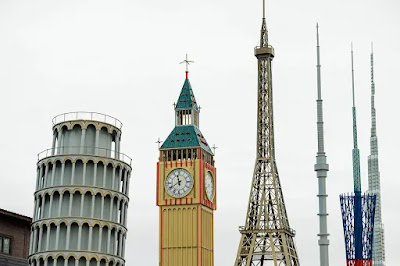
His first tower, constructed in a workshop on the cafe's grounds, was a replica of the Eiffel-tower, a 17.5 meter tall construction made of scraps of surplus iron that he could get virtually for free from nearby farms.

Then, using an old chimney as a base, Grigoryan made a replica with a height of 7 meters of the Leaning Tower of Pisa, which became 55 meters high. The replica's angle of heel corresponds to the one in Pisa, i.e. 3,54 degrees.

The pictures below left and right, from News Vo newspaper, made in January 2019, give an impression of these two towers in wintertime.


Then Grigoryan built a tower representing Russia, namely the tower in Ostankino, the Moscow radio and TV tower, 540 m high, built between 1967-1974, once the tallest in the world, now the tallest in Europe.

In 2019, the first three replicas were ready, Eiffel Tower, Tower of Pisa and Ostankino Tower.

Then, between the Tower of Pisa and the Eiffel Tower a replica of London's Big Ben was added.. 

The arrangement was completed by two high rising and slender looking creations: 

- A replica of the Canton Tower in China, also known as the Guangzhou TV astronomical and sightseeing Towera landmark with a height of 604 meters. It was constructed from 2005 till 2009, and became operational in 2010. The replica is about 22 meter high.

- And a replica of a tower from he Arab world, he Burj Khalifa, a tower in Dubai, United Arab Emirates, built between 2004 and 2010, which is 828 meters high in reality and 23 meters in replica.

The photo below shows the six replicas, as arranged in line

After the towers were completed, Grigoryan set to work building a hotel, which is shaped like Noah's ark, as it is believed to have looked. In the area around the hotel there is also a mini-mountain of Ararat, where it is said that the ark fell dry. 

Another idea is to add replicas of the Egyptian pyramids.

Furthermore, Grigoryan has plans to brighten up the space around the former café with many shrubs and other green areas.

All Grigoryan's activities are aimed at transforming the site of approximately one hectare near the former cafe into an attractive place for motorists and, if all plans succeed, perhaps also into an amusement park for tourists.

The arrangement of replicas was selected in 2021 to participate in a Most Valued Non-Professional Creation competition organised by Tutu, a Russian travel organisation.

Documentation
* Article (November 2011) in regional newspaper News Vo
* Article (November 2021) in newspaper Rossiyskaya Gazeta (Vologda region)

Atom Grigoryan
Replicas of famous towers
along the A-119 near the village of 
Nefedova, Vologda region, Russia
visitors welcome 

January 14, 2022

Jean-Paul Baudoin, Maison décorée / Decorated house

pictures courtesy of Sophie Lepetit, from her weblog

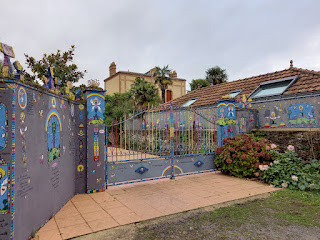
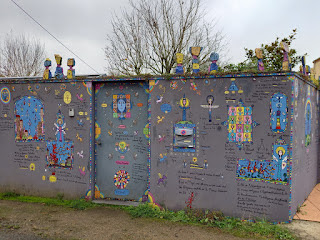
Trentemoult is a small commune in France, located along the left bank of the Loire River, near the city of Nantes, which lies on the right bank. In a street in Trentemoult there is a house that has an exterior that is decorated with a variety of frescoes and sculptures.

Life and works

These decorations were added by Jean-Paul Baudoin, who lives in the house and has his workshop there.


Life and works

Baudoin was born in 1946. His father was a butcher who ran a shop on Place Delorme in Nantes, France.

After completing his primary education, Jean-Paul went to work in his father's business. He did so, although from a young age his heart went out to drawing and painting. Being active artistically was therefore an activity for the evening hours.


It is not known how long Baudoin combined his daily work in the butcher's shop and his evening creative activities, but at some point there was an intervention by a cousin who urged him to follow his heart, so actually entering the world of art and becoming a practicing artist.

Baudoin followed suit and probably in the late 1970s/early 1980s he began to manifest himself as a sculptor, painter and artisan potter.


As a potter, a craft he still practices, Baudoin focused on a style of work known as Old Quimper, creations of vases, cups and saucers decorated with hand-painted characters ("petit Bretons") in a style strongly influenced by traditional Brittany.

By working as potter he rediscovered the nature and meaning of the creative process: an  activity through which a living form springs from formless, inert clay.


In his fist period as an artist Baudoin also began making metal sculptures composed from pieces of iron or old tools welded together and finished with a cover in bright colors.

In 1987, when he was in his early 40s, the first exhibition of his artistic work took place from his home in Trentemoult.

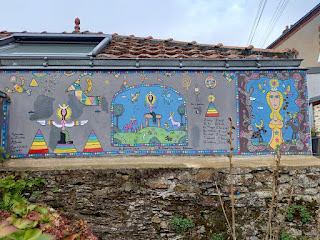
From 1991 Baudoin also began making colorful images on cardboard and recycled paper, evoking, for example, a whole world dedicated to pagan female deities, such as Isis and Ishtar, but also fairies, mermaids and the heroes of the Arthurian legend.

Perhaps the early 1990s were also the time when he started to decorate the outside walls of his house (sources on the internet are inconclusive), because among the images several are dedicated to goddesses. 

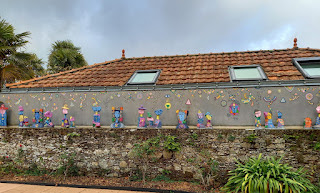
These goddesses appear in the midst of an extensive arrangement of all kinds of colorful, mostly small-scale characters, captured in sculptures or frescoes. With his sometimes magical and kabbalistic-looking images, Baudoin is an artist who expresses the unusual in forms that nevertheless feel familiar.


Documentation

* Article (January 2022) on the weblog of Sophie Lepetit, with a variety of pictures

* Photographs (January 2019) by Corinne Grassy Photography on Facebook

* Photographs and article (October 2011) by Claude Joannis on Flickr


Jean-Paul Baudoin

Decorated house

rue des 7 Maries

Trentemoult. Rezé, dept Loire-Atlantique, region Pays de la Loire, France

can be seen from the street

streetview

January 06, 2022

Ivan Pisarenko, Реплики кремлевской классики / Replicas of Kremlin classics

this picture and the next one: screenprints
from the video below

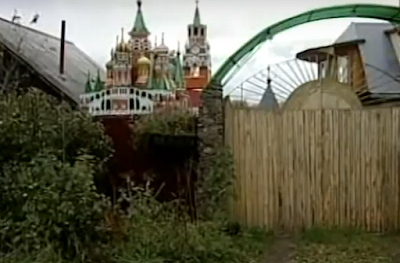
Khabarovsk is a large city in the Far East of the Russian Federation, located at the confluence of the Amur and Ussuri Rivers, near Russia's border with China.

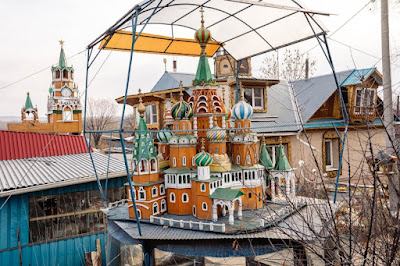
In a street in a suburb of the city, a scene like the one pictured above can be seen from the street. An outer part of a house is decorated with replicas of buildings.

Life and works

About Ivan Pisarenko, the self-taught artist who made these creations, not much biographical information is available. He was probably born in the 1950s, had a job as a carpenter and apparently possessed rather good technical skills, because he had a workshop with professional technical equipment, such as a lathe. 

Once retired he got the idea to use his skill and equipment to make replicas of famous buildings in Moscow's Kremlin.

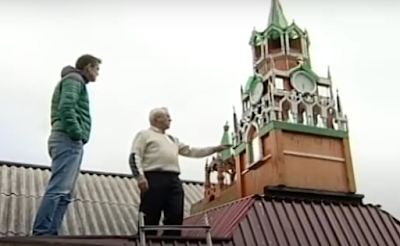
Pisarenko and a reporter  on the roof, 
looking at the Spasskaya tower
 
The Spasskaya Tower

His first creation was a replica of the 71 meter high Spasskaya Tower (Tower of the Savior), the main tower on the eastern wall of the Kremlin, built in 1491.

A comparison of the Wikipedia image of the tower -after its restoration in 2015- with the images of the tower in this blog, shows that the Pisarenko replica is very similar.


This is also demonstrated in the two images above, from the website Tutu Art 2021¹, that show how accurately Pisarenko has shaped the various decorative elements that adorn the tower.

The same goes for the large clock, which is characteristic of this building. In ancient times the clock of the Spasskaya Tower was the leading clock: its display of the time was fol owed by  all other clocks in Moscow.

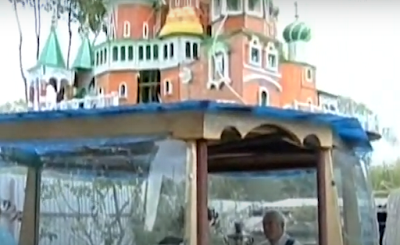
The Cathedral of Vasily the Blessed

The Cathedral of Vasily the Blessed, commonly known as Saint Basil's Cathedral, is also located in Moscow's Red Square. Built from 1555-1561 it was originally an orthodox church, now it is a museum,

this picture from the video below,
the next three from the Tutu Art 2021 website ¹ 
 
This was Pisarenko's second project, and it took him six months to complete it. 

The cathedral is made of plywood and polycarbonate, a virtually unbreakable type of plastic that can withstand both high and low temperatures.

The patterns on the domes are made from bits of colored tubes and bits of plastic, which he cut from some thirty plastic buckets. It was quite a task to visit so many hardware stores to find buckets in the right color.  


As the large image above in the middle shows, this replica is situated on the roof of the gazebo in the garden. A special facility allows the cathedral to rotate, a gesture for passers-by who can now see the replica from all sides.

And when it is dark, the creation will also be lit up.


Pisarenko's art environment was selected in 2021 to participate in a Most Valued Non-Professional Creation competition organised by Tutu, a Russian travel organisation

Documentation
* Article (2021) and pictures on the website Tutu Art
* Article (November 2021) on the website Amur Media

note
¹ the website Tutu Art 2021reports about a competition among non-professional artists organised by the Tutu travel organisation

Ivan Pisarenko
Replicas of Kremlin classics

Khabarovsk, Far Eastern Federal District, Russian Federation

can be seen from the street