August 26, 2022

Jacky Aymon, Procession de totems sculptés / Procession of carved totems

 
photos from Artension  on Facebook

Created by Jacky Aymon, a retired carpenter-cabinetmaker, the above collection of wooden sculptures, is located in Valencisse, a community of some 2300 inhabitants, about 10 km east of the city of Blois along the river Loire in France.

In earlier years, the sculpted totem poles formed an arrangement of thunyas, kind of conifers that, as can be seen from the image, can provide a beautiful, closed fence.

Gradually, however, the greenery was lost and only the bare trunks, remained, almost in line, as if forming a procession or parade.

For Jacky Aymon, who lived opposite the fenced area that he owned., the row of tree stumps offered the opportunity to draw attention to a municipal decision he did not agree with.

A series of municipal mergers

The decision in question concerned the merger of the independent municipalities of Molineuf and Orchaise, which was taken in the course of 2015 and resulted in the origin of the municipality of Valencisse on 1 January 2016. 


To publicly show that he did not agree with the merger of these two villages, Jack Aymon in 2016, with a chainsaw and a grinder transformed the tree stumps into totems. 

On a panel he explained his view on the merger.

He says there that he understands that these mergers fit the spirit of the times, but that he wonders if they have any benefit. However, that the decision was taken without any consultation of the residents. disturbed him the most. As he says in the panel: Où le bât blesse, c'est ce que cette entente s'est faite en catimini (Where the shoe pinches is that this agreement was made on the sly).

Incidentally, Aymon also mentions that on January 1, 2017, the former municipality of Chambon-sur-Cisse also merged into Valencisse and that the relevant decision was taken after consultation with the residents.


The ensemble of totems includes about twenty figures, each with its own facial expression, but all almost identical in posture, except for the totem at the front of the procession, that carries a staff and points the direction.

On the panel Aymon also says that in order to understand everything properly, one must know that Molineuf in past times was called Saint Secondin, because of a beautiful 12th century church Saint Secondin des Vignes, located somewhat outside Molineuf in the middle of vineyards.


This church has a warm place in the hearts of Molineuf's inhabitants. 

The first photo in this article shows that the foreman of the procession of totems is leading the way  As Aymon's panel notes, the church is the target to which the group moves.  

Allégrement (cheerfully), as Aymon says.

St Secondin church (Tripadvisor)

A makeover of the sculptures in 2024

this image (2024) from the FB page of Agatha Halais

In 2024, Jack Aymon decided to give the sculptures a facelift and provide them with a new coat of paint. The project was undertaken when the Olympic Games were held in Paris and the site contains a reference to this sporting event.

Documentation
* Jacky Aymon on Facebook 

first published August 2022, revised August 2024

Jacky Aymon
Procession of carved totems
Valenaisse, dept Loir-et-Cher, region Centre-Val de Loire, France
decorated totems can be seen from the road
Google Streetview, just before the make over of the sute

August 20, 2022

Jean-Marie Pidou, Pierres Initiatiques de Saint-Nicolas / Initiatic Stones of Saint-Nicolas


this image and the next ones courtesy of
Sophie Lepetit, from her weblog

Surrounded by rolling green hills, the city of Limoges in south-west France, some 400 km south of Paris, is known for its production of Limoges Porcelain, a hard-paste porcelain produced in factories around the city. 

Jean-Marie Pidou, the protagonist of this article, lived in a hamlet 18 km east of Limoges and all his professional life he was a decorator of porcelain products, working in a factory in Saint-Léonard, some 5 km from his home.
Life and works

The hamlet where Jean-Marie Pidou lived, named Saint Nicolas, is part of the municipality of La Geneytouse with all together some 975 inhabitants. Because of the name of that place of residence, Pidou was also known as Jean-Marie de Saint Nicolas.

Jean-Marie used a bicycle to go to his work, but also to make longer trips through the region to photograph scenes that he would capture in a painting at home. 

Performing such artistic activity occupied an important place in his life


This was also clearly expressed when, after his father's death, he inherited the granite quarry that his father had exploited for years. With no training in sculpting at all, in 1981 he embarked on a project to transform the grounds near the house into a sculpture garden.

After about a quarter of a century of carving, he had made some 140 sculptures of Limousin granite, a material with a white appearance as the images show.


The generally man-sized sculptures include all kinds of different representations, such as animal figures, sometimes with political puns, various female characters, whether or not inspired by mythological creatures, but also images of religious buildings, Celtic menhirs and other structures.

The surrounding images only give a limited impression of the variety of the creations. 

Neither can the appearance be depicted here which radiates from the collection of sculptures as a whole, set up on a sloping site as it is, with a view on the more eastern Vassivière mountains, 


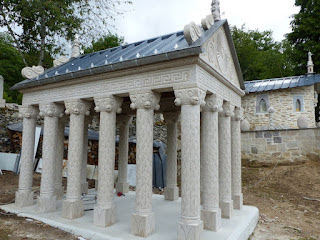
Once the collection of sculptures was more or less voluminous in size, Pidou began to create structures that could make the stay even more enjoyable for visitors, such as a studio where his paintings could be viewed (and eventually purchased), a Greek temple-like building for visitors to pause (Temple de Léonard) and a seven-meter high tower (Tour de Jeanne) from which one gets a beautiful view of the entire art environment, and Pidou's herd of sheep roaming freely.

the studio

A guided tour provided by Pidou for visitors can last an hour and a half, part of which is devoted to an explanation and discussion on topics close to Pidou's heart, such as dietetics, metaphysics, geobiology and aura measurements, which can be arranged on site if desired.


Documentation
* Weblog (August 2022) of Sophie Lepetit with a variety of images
* Article about the site on the website of the Tourist Office of Noblat
Article on the HenriTrip website with some photos and route map
* Article (May 2021) on the website of regional journal Le Populaire du Centre 
Article on the touristic website Haute Vienne with photos of the architecture in particular

Video
* Video (3'28", YouTube, undated) by France 3 Nouvelle Aquitaine


Jean-Marie Pidou 
(also known as Jean-Marie de Saint Nicolas)
Initiatic Stones of Saint-Nicolas
208 Route De La Porcelaine (=D65)
87400 Saint Nicolas, La Geneytouse, dept Haute-Vienne, region Nouvelle-Aquitaine, France
open for visitors in July and August, 14-17 hrs
other months on Sundays, 14-17 hrs, on appointment

August 13, 2022

Evgeny Smolik, Дом украшен резьбой по дереву / House decorated with wood carving


this photo and the next one (2019) 
from newspaper HKK (Oleg Kuzmin)

The image above offers a view of the house of Evgeny Smolik located in Irbeysky, a rural community with some 1100 inhabitants, one of 43 administrative units in the Krasnoyarsk region of the Asian part of Russia ¹. 

With its covered entrance and specific roof structure, the building resembles a small church or chapel, but if Smolik built his house himself, as is not unusual in the Russian countryside, this design can also be seen as an expression of his creative attitude.

decorated fence in front of the entrance of the house

Anyway, this attitude can be seen very clearly in the decorations Smolik has added to the fence around the house.

The image above shows the fence, probably a part on the backside, with a door leading to an entrance of the house, which has been decorated with a depiction of Adam, Eve and the serpent.

The image below shows another part of the fence, perhaps located along the street because of the decorated letterbox on the right. This fence is also richly decorated, including angel-like characters equipped with spears on the left and right of the door, guarding the decorated entrance. 

part of the decorated fence outside
photo from website account.travel

Life and works

As for Evgeny Dmitrievich Smolik, there is no orderly biography available on the internet. He was born  in a community in the Krasnoyarsk region, presumably in 1958.

After school, he completed his military service in Kamchatka in Russia's Far East, home to Russia's Pacific submarine fleet, before returning to his native region and settling in Irbeysky; where he had all kinds of jobs, such as electrician, concrete worker, but also photo reporter and graphic designer.

It isn't clear when it was, but at some moment Smolik came into contact with someone who worked wood in a creative way. This appealed to him and he started working as an autodidact sculptor himself. As a self-taught artist. he would devote further life to woodcarving

a decorated door and wall in the interior,
this photo also from newspaper HKK

He became an enthusiastic worker, taking care of everything that could be decorated with carvings. 

Not only the outside of his house was tackled, as already outlined above, nothing in the interior was also untouched.

There are large decorated panels, all kinds of decorated medallions and wooden sculptures, but also kitchen utensils and tables, chairs and cabinets were creatively worked.

this photo and the next three on artsphera

A clock on the wall in the bedroom is not just decorated with some motifs, but includes a carved portrait of Czar Peter the Great (1672-1725).


Smolik also had a personal sense of humour, what entailed for example that he made birdhouses with gloomy pirate faces, as in the examples above.

These and similar small-scale creations were intended for sale. For example, they were offered on the Artsphera website.


Other works of art by Smolik, intended for sale, had a more classical appearance, as can be seen in the above scene.

photo from livejournal
(museilesa-krks)

It is unclear to what extent Smolik's individual works of art have been included in an art museum. 

However, the chair as shown above, a luxurious wooden chair, carved from pine wood and decorated with intricate carvings, has been acquired by a museum, namely the Forest Museum in Krasnoyarsk, the capital of the region of the same name.

Documentation 
* Article (November 2019) in newspaper HKK 
* Article (March 2012) in Livejournal
* Article (May 2007) in newspaper Gazeta

note
¹ The reviews in this weblog relate to  art environments in Europe. Nevertheless, characteristic sites in the Asian part of the Russian Federation are also included, in order to give a balanced and coherent picture of the entire field of Russian art environments.

Evgeny Smolik
House decorated with wood carving
Irbeysky District, region Krasnoyarsk, Russia
exterior decorations can be seen from the street

August 05, 2022

Erkki Känkänen, Muistojen puisto / Park of Memories


except the picture of the church in Muolaa, all images are 
published here in accordance with Juho Haavisto, Association 
for Rural Culture and Education

The art environment Park of Memories, located in the south of Finland, includes numerous scenes that evoke memories of the time when the Karelian Peninsula was still part of Finland and of the experiences of all those people who lived there and had to evacuate because of the wars that started at the end of 1939.

Above pictured decorated wall, for example, refers to a war waging from 1939-1940, in Finland called the Winter War. It started at the end of November 1939, when Russia wanted to conquer the Karelian Peninsula, located in south-western Finland, bordering Russia. In March 1940 the combat actions ended in an armistice. 

However, on June 22, 1941, Germany launched an attack on the Soviet Union, which also led to Finland's war with Russia continuing on June 25, 1941, the so-called Continuation War. This war ended in a ceasefire in September 1944.

Peace negotiations started that resulted in a treaty in 1944, in which Finland had to cede large parts of its territory in he Karelian Peninsula to Russia and 440,000 Finns had to leave their homes.


Life and works

Among them was 16-year-old Erkki Känkänen (25-7-1927/7-7-2022), born in and living with his parents in Muolaa, a former Finnish municipality on the Karelian Peninsula in South Karelia. It was the second time the family was evacuated, because already in the 1930s, when the threat of war had increased, the Finnish government had ordered them to leave their residence.

After the first armistice in March 1940 the family, like many other.inhabitants, returned to Muolaa with the intention of resuming their former life and repairing the damage.Times were tough because of the Continuation War, with food shortages and rationing.The plan to restore the church of Muolaa, which was completely destroyed during the Winter War, came to nothing. 

In 1944 the inhabitants of Muolaa definitively had to leave their home and start a new life elsewhere in Finland. They first stayed in Sääksmäki, a village in Western Finland, but in 1948 moved to Forssa

the church in Muolaa before the Winter War
picture licensed under Wikimedia Commons

So it happened that in Forssa, a town of currently some 16.500 inhabitants in the Kanta-Häme region in the south of Finland, some 960 residents of Muolaa, the Känkänen family included, ended up and formed a close-knit community, currently still referred to as Pikku Muolaa (Small Muolaa).

In Forssa, the young Erkki Känkänen developed into a successful vegetable farmer. who introduced modern technology, such as cold stores. The farm was initially run by Känkänen and his wife Hilkka, also from Muolaa,  then his son Jari and his wife were in charge and now (2022) the third generation is at the head, Jari's son Essamati.


Känkänen was actively involved in the development of the local society, especially with regard to the position of the Karelian community

He was a member of Forssa's city council for 16 years, supported and did a lot of work for candidates for parliamentary elections and was active in the Karelian community, collecting stories and books about earlier times in Karelia.

In 1964 Känkänen was asked to organize a nationwide competition of a traditional Karelian outdoor game in the sphere of skittles (a game called kyykka), which would take place for more than 50 years.

From 1973, he was closely involved with Forssa's local Museum, which set up a particular space dedicated to Muolaa, including a large portion of rescued artifacts from Muoola's ruined church.

And then, in the early 1990s, when he was in his mid sixties, Känkänen decided to create a memory park in relation with his early years in Muolaa and the history and culture of Karelia.


Creating an art environment

Känkänen created his Park of Memories, an art environment full of artistic creations, emotion and information, on the site of his summer residence named Rajaranta, located in the community of Salkola near the Lake Salkolanjärvi, some 28 km south-west of Forssa in the Varsinais-Suomi region.

The images at the beginning of this article show a number of bungalow-style buildings. 

The art environment includes six of these structures, which were common in the Karelia of Känkänen's childhood. They are richly decorated with colorful scenes, offering a reminder of the former living environment to residents who had to evacuate.

replica of the former church in Muolaa

Among the first buildings Erkki Känkänen made for the memorial park is the iconic miniature version of the church in Muolaa, built from 1849-1852 and completely destroyed in the Winter War.

When constructing this replica, a project that took a year and a half, Känkänen flawlessly respected the proportions of the original. 

Twenty people can enter the replica of the church a the same time. Inside they can view photos of the ruins of the original church and other documentation, such as the sermons of Toivo Rapeli, the preacher attached to the church during Finland's war with Russia.


The images above and below show a horse and carriage in a stable. This ensemble symbolizes the journey the evacuees had to undertake, leaving their home and living environment behind, on their way to an uncertain future.

In the photo above there is also a kind of signpost on the right, indicating the distance from the site to towns and villages that were involved in the war in one way or another, such as the distance to Muolaa which is 371 km.


The horse pulling the wagon, as depicted above, was made by Kankänen himself and has a very realistic impression, which fits well with this scene depicting the journey of the evacuees.


This applies just as much to the person on the box, above left, who steers the horse and it certainly applies to the little luggage that could be carried, as in the image above right 


The red colored character in the image above is  a stylized Karelian cuckoo. 

Protected by an open wood and glass enclosure, the bird bears the coats of arms of all the municipalities that were part of Karelia ceded to Russia. It was quite a quest to find all those coats of arms, Känkänen is reported to have said.


The above image in all probability represents a memory of the Karelian lake Äyräpäänjärvi, because of the many birds that almost completely fill the sky above the lake. There are also numerous fish, swans and other animals present.

The lake, known for its rich bird life, borders the community of Muolaa where Känkänen was born.


Above picture portrays Känkänen seated on a bench in his Memory Park during in open day in July 2020.

Erkki Känkänen passed away on July 7, 2022, at age 94.

Documentation

* Article by Paula Susitaval, with images by Juho Haavisto. on the website ITE-taide in memory of Erkki Känkänen
Article (November 2009) on the page of Finnish broadcasting company Yle about Känkänen's first visit to his former home in Karelia
* Article (July 2022) on the Facebook-page of ITE-taide in memory of Erkki Känkänen
* Article (July 2020) on the Facebook-page of ITE-taide about an open day in July 2020 at the Memory Park, with a large series of pictures 
* Website Vihannestila Känkänen Oy of the vegetable farming business of the Känkänen family
Article by Eeva Suojanan (July 2007) in newspaper Turum Sanomat
Känkänen has written several books, mostly related to Karelia, such as: Karelianism the source of strength (2011), but also about his art environment: Rajaranta is the Karelia of Memories (2012)

Erkki Känkänen
Park of Memories
Salkola, region south west Finland, Finland
pending further notice about opening after Känkänen's death