October 25, 2016

Yevgeny M. Malakhin (artist name Bukashkin), Краска мусора / Paint the garbage


the artist on a mural in a pink dress
this picture and the others of the murals from 
website ural-n.ru (no names of photographers listed)

This is the story of a very special non-conformist outsider artist, who in the 1990s brightened the center of Yekaterinburg with music and a lot of colorful murals he painted on buildings and fences.

Yekaterinburg is a large city in the Russian Federation, located at the eastern edge of what in geographical terms in general is considered as Europe.

Life and works

Born in Irkutsk on September 16, 1938, Yevgeny Mikhailovich Malakhin studied in Izhevsk, where he graduated as an engineer in energy supplies. After his studies, in 1961 he went to live in Sverdlovsk (as Yekaterinburg was called from 1924 to 1991), a city where he would stay for  the rest of his life. 

He got a job as senior engineer at the electricity company Uralenergo. In 1965 he married Valerie Petrovka and the couple would have a daughter, Nastya. In 1971 he and his wife made a long journey, visiting Senegal and various European countries.

Development as an artist

Malakhin was rather interested in philosophy and music. The 1970s became for him a period to try out all kinds of artistic activities. In the early 1970s he was active in experimental photography. Later he  worked with wood, made paintings as a self-taught painter and wrote poetry and published books.

In the mid 1980s he had a first exposition and from that time his need to present himself as an artist was growing.

So he equipped himself with an artist name, first Kakiem Akahievich Kashkin, also K.A. Kashkin, which later would become B.U. Kashkin or Bukashkin. He also rented his own studio, a small room in the basement of a building on Tolmachev Street in the center of the city and began to live more and more on his own.

picture from website aziko.ru
(no name of photographer listed)

In 1992 Malakhin ended his job at Uralenergo and fully devoted himself to a sober, but pronounced existence as an artist.

As Bukashkin he would become Yekaterinburg’s major non-conformist artist of the 1990s. He was also quite recognizable as such, a bearded man, walking around in the city with a balalaika, a large tambourine on his neck and bells on his hat.

In his artwork he promoted family relations and love for one’s country as important values and he urged citizens not to drink or smoke, to love others, enjoy life and do good deeds. One will find these these themes in the some twenty educative and ecological books he wrote and published himself and also in his paintings and drawings, he often handed out to onlookers for free.


He became rather well known in his country and was also named  Russian people's janitor (for a short period he worked as janitor at a bank).

Paint the garbage, paint the town 

In the early 1990s Bukashkin began a campaign with the slogan Paint the garbage.

He developed a theory about garbage to the effect that waste can be seen as art or as a basis of an artwork, probably a fairly unusual opinion in Bukashkin's society of that time, but then already prevalent in the field of art environments elsewhere in Europe.

In his view even the ugliest places in town could be made pretty to look at. So he began making paintings on concrete fences, garages, walls of buildings, garbage bins and so on. It has been said the whole city was his canvas.


In the city of Yekaterinburg as it was in the 1990s, Bukashkin probably was the first to do such murals and he can be seen as a pioneer of what later would be considered as street art.

The idiom which is reflected in his wall decorations marks him as an artist in the field of outsider art.

Bukashkin has made over thirty murals, which meanwhile partly have faded away or have gone lost. An association of friends has ensured that some were restored and that on various spots replicas have been placed.

At the end of 2004 Bukashkin had to leave his studio at Tolmachev Street, because the building would be demolished and replaced by a new construction. Some months later, the artist died of an acute asthma attack on March 13, 2005.

 An association of friends 

To keep the memory of Bukashkin alive on January 8, 2008 a group of friends founded an association named Old Man Bukashkin, presided by Yevgeny Artyukh, well-known in political and business circles in Yekaterinburg. One of their activities was to make a Bukashkin Trail, a walk along the spots where the artist had put up his wall paintings. The association also has contributed to the realization of a museum in Yekaterinburg devoted to Bukashkin.

B.U. Kashkina Museum 

Initiated by professors and students of the Ural Federal University the B.U. Kashkina Museum opened on December 19th 2008.

portrait of Bukashkin on a wall of the museum
(screenprint from a TV-video of the opening of the museum)

The museum, located at Lenin Avenue 51 in Yekaterinburg, aims to present and study non-standard modern urban culture in its various forms in order to understand its creative role in shaping a positive image of the urban environment.

It holds works and documents of and about Bukashkin and it also documents other non-conformist movements and naive artists in the Ural.

Documentation
* B.U.Kashkin (1938–2005): Life and Art of Ural Punk Skomorokh, Edited by Aleksandr Shaburov.    This book, a first collection and review of Bukashkin’s creative work, was published at the occasion of the exhibition in 2015 I’ve Lived My Life, I’m Not Dead Yet. A Tribute to B.U.Kashkin

cover of the book

* Website of the association of friends (with various details of Malakhin's life, such as that in 1978 he told his wife that there was another woman in his life with whom he had a child; in the early 1980s he would start a new family with her)
* Alexander Shaburov, "The last of Skomorokhs. In memory of B.U. Kashkin", in: Umelec Magazine, 2010/2 (February 2010) (in English, a portrait of Bukashkin in the context of the Russian avantgarde) 
* On the website Uralnash an article (June 2011) by Irina Schminke, with pictures of murals at the inner court at Lenin Avenue

Videos
* The internet has a lot of videos about the artist. Here is a link to a list of mainly Russian spoken videos
* Just for a first introduction, here is a video (by MrMediaProduction) that even if you do not understand Russian, gives a good idea of Bukashkin's various activities (11'56", YouTube,  January 2014)


Yevgeny M. Malakhin
also known as Bukashkin
Yekaterinburg, Sverdlovsk region, Russian Federation
to see what is left of the murals there is a walking trail
(starts at Lenin Avenue 5b, see a tourist guide or get info at a tourist office)

October 02, 2016

Boguslawa Iwanowskiego, Quo Vadis sculpture garden


pictures (2014) courtesy of Sophie Lepetit
  
Tyrawie Woloskiej (Tyrawa Woloska) is a small community in the south of Poland, not far from the border with Ukraine. It is known from Quo Vadis, an exhibition of numerous wooden sculptures in the garden of a private house 

Life and works

Boguslawa Iwanoskiego (Boguslav Ivanovski), who created this art environment, was born in 1934 in Dorhun (district Grodno), a community that currently is part of Belarus but which before World War II belonged to Poland.

The shift of the border between Poland and Belarus, which took place after World War II, resulted in the russification of Ivanovski's birthplace, such as collectivization of agriculture. Opposition of villagers was brutally oppressed, Ivanovski's father was imprisoned, his brother was executed and he himself, although rather young was deported to Russia, where he for a number of years had to work in a labor camp.

In later years while still staying in Russia, he succeeded in doing a training as a car mechanic.


In the early 1960s Ivanovski returned to Poland. In 1961 he settled in Szczecin, a harbour town located along the Oder river and near the Baltic Sea in the north of the country. He got a job as a service technician at the local public transport company.

A career as folk artist

In the course of the 1960s Ivanovski as an amateur artist began to develop his artistic talent, initially in the fields of poetry and painting, but soon turning to making wooden sculptures, which would become his lifelong passion.

He became a member of the Klubu Plastyków-Amatorów i Twórców Ludowych (Club of amateur painters and folk artists) that would meet in the provincial House of Culture. He took part in various expositions, including one in the context of the in Poland well known Centralne Dożynki (Central Harvest Festival).


In 1986 Ivanovski moved from Szczecin to Tyrawa Woloska, a village that reminded him very much of his native region.

Here he would stay for the rest of his life, fully devoting himself to making wooden sculptures and setting up an open-air exhibition area.

Ivanovski in 2014

Ivanovski has created an imposing amount of artwork since in the mid 1960s he began making folk art. His wooden sculptures, made in several sizes, including a number that are larger than life, have a naturalistic character and are sculpted in a classical folk art style.

His work reflects his attachment to his native Poland. The collection, divided between the house and the outdoor exhibition area, includes sculptures and sculpted reliefs which refer to important personalities and happenings in the history of Poland, such as Polish kings and princes, the statesman Józef Pilsudski (a series of works depicting various stages in his life) and the Katyn Massacre

Another series of sculptures is devoted to Pope John Paul II, altogether some 24 monumental sculptures.


But one can also see  characters derived from fairy tales and all kinds of portrayals of common people, such as the one of a young lady with a cat in her arms.


Ivanovski currently (2016) is in his early eighties and processing wood is becoming rather hard for him to do, so he is considering switching to other artistic approaches, such as making ceramics or working with concrete.

The garden is open to the public

Ivanovski's sculpture garden can be visited by the public. It attracts a lot of visitors and when at home the artist is gladly willing to inform visitors about his work. 

Ivanosvski was awarded a bronze medal

In march 2016 on the occasion of the 50th anniversary of his artistic calling, the chairman of the parliament of the Podkarpackie voivodeship (province) awarded Ivanovski with a bronze medal Gloria Artis.

Documentation 
* Article by Wieslaw Hop on weblog Opowiadania współczesne (Contemporary stories), June 12, 2016 (with a series of pictures)
* Website of Tyrawa Woloska with a page devoted to Ivanovski and the sculpture garden
* Article on weblog Na Pogórzu (Foothills), October 2013 (illustrated)
* French author of a weblog about French outsider art and art environments Sophie Lepetit in 2014 made a trip to Poland and published a large series of pictures of the Quo Vadis sculpture garden on her weblog

Boguslawa Iwanowskiego
Quo Vadis sculpture garden
38-535 Tyrawie Wołoskiej (Tyrawa Woloska), region Subcarpathia, Poland
can be visited by the public

Petr Leonidovich Zhurilenko, скульптуры в саду / sculpture garden


picture courtesy of  Sergey Chegra 
 Museum of Russian lubok and naive art, Moscow

Petr Leonidovich Zhurilenko (August 1929 - ??) was a folk art artist who lived in the small community of Sudbodarovka in the Oldenburg region in the Russian Federation ¹. 

He made a variety of naive paintings, which were exposed in the region, but also in Moscow, where he took part with a single painting in the large exhibition of naive and outsider art in 2013.

The catalogue of this exposition said that Zhurilenko meanwhile had switched from making paintings to making sculptures.

this picture and the next one by unknown photographer

Above picture also has the scene as in the first picture, but then with added signs, that say the sculptures have been made in 2014.

The sign on the left indicates that the three characters are Mikhail Illarionovich Kutuzov with his adjutant and a guard as in 1812. 

The sign on the right, insofar readable, says that the queen is in Moscow because of negotiations. 

Kutuzov (1745-1813) was a famous Russian army commander, who in 1812 repelled Napoleon’s invasion of Russia. The queen must be Queen Elizabeth, who, accompanied by Prince Philip, in October 1994 was the first British monarch to visit Moscow, where she met former president Boris Yeltsin.


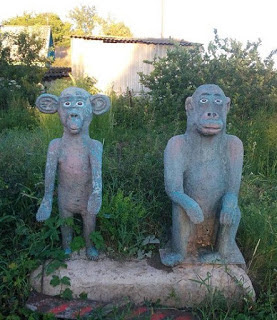
The in my opinion rather impressive scene with general Kutuzov and Queen Elizabeth is undoubtedly part of a just started and gradually expanding art environment in Zhurilenko's garden, because another picture of a creation by Zhurilenko is available, that shows two monkey's (?) with in the background a barn and another construction, which might be the residential house.

Up to now the internet has no descriptions of Zhurilenko's art environment. but further research has begun and this will hopefully bring more information ².

In 2021 it has been reported hat Zhurilenko had passed away, this without any referral to  in what year this happened. 

notes
¹   I am grateful to Alexander Emelyanov, creator of an art environment in Samara, Russian Federation,  who contacted the museum in Moscow about the first photo in this post and is actively engaged in collecting more information about this art environment
²  I would like to get in touch with the unknown photographer(s) of some pictures in this post

Petr Leonidovich Zhurilenko
Sculpture garden
Sudbodarovka, Orenburg region, Russian Federation