pictures courtesy of the author of the website Underground Exploitation, not available anymore
The Jezuiëtenberg (Jesuits Mountain) is a marl-stone quarry in the southern-most part of the Netherlands, near the city of Maastricht. It was exploited between 1704 and 1880.
Traditionally Maastricht housed a school for Jesuit priests. Its students would enjoy their free afternoon on Wednesdays by retreating into the cave, to find silence and relaxation, as one would suppose.
These weekly trips toke place from 1860 until 1960, and a hundred year of Wednesday afternoons in the cave somehow has resulted in all kinds of creative activity.
The walls have been decorated with hundreds of pictures in black-and-white and in colour, and the cave was provided with all kinds of reliefs and sculptures, themes ranging from the Alhambra (pictureabove) to Buddha and to "Egyptian" representations.
In 1967 the Jesuit school left Maastricht.
In 1966 the quarry got an monumental status and from 1968 on it has been cared for by a foundation. It can be be visited by the public.
Documentation
* Wikipediawith an overview of the history of the caves * Website with information for visitors
Video
* video by Harry Kerckhoffs (YouTube, 2015, 10'43")
first published February 2009, last revised April 2023
Jezuiëtenberg
Maastricht, Netherlands can be visited by the public (see this website for opening hours)
The northern part of France that borders on Flanders in Belgium, historically has many links with that Flemish area: cultural traditions, food and drinks, linguistic influences..... So the name Vanabelle and the name of the community where the site is located, Steenwerck, have a Flemish ring.
Life and works
Born on a farm near Steenwerck, Arthur Vanabelle (1922-2014) all his life has been living there. He became a farmer, never married and after his parents had died he lived together with his brother on the family farm.
After WWII Vanabelle collected all kinds of (military) objects he traced in the fields around the farm and along the roads in the neighborhood. Having a pile of these materials, at some moment in the 1960s he made a weather-vane.
This inspired him to continue and to construct a model of an airplane, one, another one, and more. He also has made tanks and big guns. He displayed all these creations around the farm and on the roofs of the farm's buildings
.
picture (2010) courtesy of Alain Cadet
Arthur Vanabelle has been making these constructions for many years, until age 80.
The result is a large collection of "military" objects, displayed on top of and around the farm-houses.
The ensemble can be seen when driving the autoroute E42/A25 from Lille to Dunkerque, a road, constructed in the 1970s which runs right past the farm.
picture (2004) courtesy of A. van de Weerd
Warfare in the region
Although Vanabelle himself said that he wouldn't know why he made these warlike creations. it can be noted that he himself also liked to talk about what happened around the farm in an early phase of the war in northern France.
In the spring of 1940, when Arthur Vanabelle was 18, in the area where he lived, the German, British and French troops were heavily at war (resulting in the narrow escape of the British troops from Dunkerque).
The farm was in the midst of the movements of all troops and the Vanabelle family housed a lot of people on refuge.
It is quite possible that this events deeply impressed young Vanabelle and that this resulted in his later fascination for military objects.
picture (2004) courtesy A. van de Weerd
In this context it is interesting to note that Vanabelle's farm is located near a bunker of the Maginot Line, named the Base de la Ménégate. Vanabelle referred to this by adding a placard with this name to the collection.
So it is quite possible that this art environment should be referred to as Base de la Ménégate.
I first learned about this through Alain Cadet's interview (September 2010), mentioned below. When I wrote the original version of this post (February 2009), I referred to the site with the name which at that time was used in most French publications, i.e. farm with the airplanes. Interview with Alain Cadet
In September 2010 Vanabelle was interviewed by French freelance journalist Alain Cadet. The interview is special, because it introduces him talking about his life and works (translation into english published in OEE texts). Asked why he made these creations, Vanabelle said: "Do not ask me why! I do not know! I did it: that's it!".
He also talks about what happened in the area around the farm in the early phases of WWII, warfare activities that, as said, may have influenced him as a young man.
The Lille Art Museum
Another aspect of the interview is that Vanabelle says that he was contacted by a museum.
Indeed, the Lille Art Museum in 2010 commissioned a cabinet of architects in Mons-en-Baroeul (Lille region) to make a 1:100 maquette of the site.
picture Voix du Nord/Alain Cadet Franck Ghesqière, Gabriel Levieuge and Sébastien Loutreau
working at the scale model
During the summer of 2010 the architects stayed for some days on the farm, measuring, photographing and talking with Vanabelle. They characterize him in this way: "C’est un personnage fantastique qui vit dans la plus totale liberté" (He is a fantastic character, who lives in most complete freedom).
Here is a picture of the completed maquette, currently in the collection of the museum:
picture courtesy of Lucy Konieczny
Arthur Vanabelle died in 2014
In January 2014 Arthur Vanabelle, together with his brother, moved to a home for the elderly.
A public discussion arose about the future of Vanabelle's art environment. An association was formed to save the site which organized a petition (January 2014) and a subscription to collectively buy the farm.
After Arthur Vanabelle passed away early September 2014, in December 2014 the farm was bought by a private party that transformed the property into a private dwelling. However, the purchase contract provided that the mayor of Steenwerck was allowed to remove a number of creations in favor of a local museum.
Exposition of a representative part of the creations
In agreement with Arthur Vanabelle's brother, the mayor in the course of 2015 removed some twenty items. with the idea to add these to the collection of the local Musée de la vie rurale (Museum of rural life) as soon as a planned expansion would be ready.
At the beginning of April 2019, it was announced that the financing of such an expansion had been arranged (with contributions from the municipality, the department, the region, the state and the European Union) and that construction had started.
However, the expansion originally provided to situate Vanabelle's creations could not be used due to manufacturing errors. Work is now underway on locating the creations in another part of the museum, a project that will be completed in 2022. The start and progress of this project will be reported on the museum's website.
A memorial stone on Vanabelle's grave
The association to save the farm, after offering a memorial stone for Vanabelle's grave, has cancelled it's activities.
memorial stone offered by the association to save the site
Documentation
* Pictures (April 2010) on the weblog les grisgris de Sophie * In OEE texts an interview (September 2010) with Arthur Vanabelle by Alain Cadet.
* The site is presented in the Rémy Ricordeau/Bruno Montpied movie (2011) Bricoleurs de Paradis
* l'Inventaire général du patrimoine culturel. Région Hauts-de-France, pictures and description
* Website Habitants-paysagistes (Lille Art Museum from march 2018 on) has a variety of pictures (by Francis David 1983 and others)
Video
* Video by French regional TV (You Tube, 1981, 5'26"),
first published February 2009, last revised February 2024
Arthur Vanabelle La ferme aux avions 4 rue de l'Hollebecque 59181 Steenwerck, dept Nord, region Hauts-de-France, France
The picture above shows the facade of a house in the neighbourhood of Pont l´Étoile in the community of Rocquevaire in the south of France. This Maison de celle qui paint (the house of she-who-paints), fully decorated (exterior and interior) by its inhabitant Danielle Jacqui, has become a famous creation in the field of art environments, well known both inside and outside France.
Life and works
Born in 1934 in Nice, Danielle Jacqui at a young age already was attracted to creative activities, but due to personal circumstances she initially couldn't pursue an artistic direction.
Married in 1952, she got divorced in 1970 and then she became a brocanteuse -someone who trades in curiosities. She had a stand on local markets, where she also exposed the paintings she had begun to make.
In the 1970s Danielle Jacqui mainly was active in making paintings. Her first exposition was in 1976, in Marseille.
She took some art lessons. In February 2009 she described on her weblog how she entered these art classes in the same way as she went into the world of brocantes: without any preparation or schooling.
But, as she explains: "I knew how to be free enough to go for a direction different from the one that presented itself as self-evident: the provencalists, the impressionists, the aquarellists, the pastellists, the painters making oil paintings, tarred and covered with patina on request... (les provencalistes, les impressionistes, les aquarelleux, les pastelleux, les huileux goudronnés et patinés a souhait....).
Indeed, Danielle Jacqui has her opinion about mainstream art and artists.
It is not surprising that she felt more at home with those artists in the south of France who united under the banner of art singulier. Danielle Jacqui herself has been rather active in bringing them together, for example by taking the lead in organizing from 1990 on festivals of art singulier in her home town Roquevaire.
This festival would develop into a biennial in Aubagne, famous for many years: the Festival d'art singulier. When in 2014 the local authorities ordered the removal of some artworks they considered pornographic, the festival was canceled. In 2015 it returned to Roquevaire.
In 1982, after she had visited Robert Tatin's art environment La Maison des Champs, a site near Laval in France, she began decorating the facade and the interior of her house in Roquevaire, where she lived since 1961.
This became a passionate project in the 1980s. Exterior and interior of the house have been completely decorated in bright colors.
The interior has a colorful collection of artistic dolls and all walls, ceilings and staircases have been decorated with mosaics, paintings and inscriptions.
The facade of the house has been redecorated a number of times. The picture below shows the facade as it was in November 2015. In 2016 Danielle Jacqui -at age 82- for the fourth time repainted it.
picture from Facebook
The project "Colossal d' art brut ORGANuGAMME"
From 2006 on Danielle Jacqui has been active in an extensive project in Aubagne: the Colossal d' art brut ORGANuGAMME, a project scheduled to be completed in 2016.
picture from Danielle´s weblog.
Originally meant to transform the facade of the Aubagne train station into an international artistic attraction by decorating it completely with all kind of brightly colored ceramics, sculptures of some twelve meters high included, in the course of 2014/2015 a start has been made to assemble the parts of the artwork along a roundabout that marks the eastern entrance of the town.
However, after local elections in 2014 a new political climate reigned and the new authorities of Aubagne showed themselves no longer interested in this artwork. Work on the project was halted and although some parts of the work are still present on the roundabout, in the meantime these have been almost overgrown by the present vegetation.
Meanwhile the Swiss community of Renens, not far from Lausanne, expressed it's interest in the creation and proposed to install (a large part of) the Colossal d'Art Brut on the premises of the Ferme de Tilleuls, a 17th century estate bought in 2008 by the community with the idea to transform it into a museum.
Early 2016 a large number of ceramics was relocated to Renens.
picture from Facebook
In September 2020 a start was made with the permanent exhibition of these ceramics in the outdoor area of the museum.
As the photo above shows, a high scaffold of braided iron wire has been placed on the grounds of the museum. On September 26, 2020 this first part of the Colossal d'Art Brut ORGANuGAMME II, filled with a selection of ceramics, was inaugurated.
The idea was to set up a number of such decorated pylons in order to encompass all creations. In 2021 and 2022 more pylons have been decorated, resulting in a decorated structure in August 2022, as in the picture below. The lady with the cane represents Danielle Jacqui.
The ORGANuGAMME was officially inaugurated on November 5, 2022
picture from Facebook
Eventually the Colossal d'Art Brut ORGANuGAMME has been scattered over a variety of places.
In Switzerland apart from the large collection on the premises of the museum in Renens, the Collection de l'art brut in Lausanne also has a number of creations.
Parts are still in Aubagne, at the roundabout and in the ambulatory of the Observance monastery.
In Draguignan there is a fresco combined with a large sculpture by Emmanuelle Not exposed in the inner courtyard of the Town Hall.
There are parts in the Musée Anatole Jakovsky in Nice, in Roquevaire, Danielle Jacqui's hometown and in Montpellier at the Musée d'art brut.
Some parts will go to the Musée des Arts Modestes, in Sète, France.
Chapelle Saint-Sauveur (photo by Eduard-Rainaut, licensed under Creative Commons)
TheORGANuGAMMusEum Danielle Jacqui
And then some parts of the Colossal d'Art Brut ORGANuGAMME have been included in a new museum entirely dedicated to the work of Danielle Jacqui. It is housed in the ancient Chapelle Saint-Sauveur in the community of Draguignan in southern France, a building in Romanesque style, especially made available for this purpose by the municipality.
This ORGANuGAMMusEum Danielle Jacqui, that comprises around 150 works dating from 1970 to the present, was inaugurated on July 4, 2019.
pictures (2019) by Michel Ferdinand (on Facebook)
As the photo of the chapel shows, the building has high walls. All interior walls are up to the ceiling and seamlessly covered with creations, as also is the case in the Danielle Jacqui's house. It is not out of place to state that the interior of the chapel has been transformed into an art environment.
Documentation
* Danielle Jacqui on Facebook
* Michèle Perez, "La Maison de Celle Qui Paint and the Colossal d'Art Brut", in: Raw Vision 73 all/Autumn 2011)
*The weblog of Sophie Lepetit has the story, both of the Aubagne project and of the exterior and the interior of the house in Pont l´Étoile, see posts of 10/9/2011, 11/9/2011, 12/9/2011 and 13/9/2011 (in french, but lots of pictures); see also her post of 9/25/2014 (pics of the interior)
* Article on SPACES website
* RobertaTrapani, "Danielle Jacqui e la casa della meraviglie" (Danielle Jacqui and the house of wonders), in: Rivista Outsider Artnr 18 (autumn 2018), pp 78-91)
Video
* A video (23'05", YouTube, May 2016) by Cendrine Muller entitled Un jour en Avril avec Danielle Jacqui (An April day with Danielle Jacqui)
* Video (October 2020, Vimeo, 2'10") by the Ferme de Tilleuls Museum with Danielle Jacqui talking about the ideas behind the Colossal d'Art Brut ORGANuGAMME as erected in Renens
first published February 2009, last revised August 2022
Danielle Jacqui
Maison decorée
Pont de l'Étoile
13360 Roquevaire, dept Bouches du Rhône, region Provence-Alpes-Côte d'Azur, France -facade of the house can be seen from the street
-the Colossal d'Art Brut can be seen in Renens, Switzerland
-the museum with Danielle Jacqui's works, the Chapelle Saint-Sauveur can be visited in Draguignan
pictures (Flickr, july 2007) courtesy of garethschweitzer click to enlarge
Driving the busy coastal road along the Mediterranean between Port-de-Bouc and Fos-sur-Mer, west of Marseille, one passes an enclosure wall with a large inscription reading Musée Moralès.
Life and works
Behind that wall Raymond Moralès (1926-2004) had his exposition grounds.
A son of an immigrant from Spain, at age fourteen Moralès became an iron worker at the shipyard of Port-de-Bouc.
When in 1966 the shipyard had to close, he began a small business as a blacksmith, producing iron elements, like handrails for stairs and ornaments for gardens,
Around 1970 he settled on the spot where eventually the Museum would be established. The house has a large plot of land, some 5000 m² (1.2 acres) and around 1982 Moralès transformed the terrain into an open air museum, a parc-exposition.
As an autodidact artist he already had made paintings, like he also had made some sculptures from concrete, but his main passion became making sculptures from forged and welded iron material, small ones, but mainly big creations. Some of these would be some four meters high. He had some technical equipment available, derived from the closed shipyard.
Ultimately, some 700 creations were installed in the area.
click to enlarge
Moralès' creations in general are rather robust. They have been described as menacing or frightening.
This may be so. But then, Raymond Moralès's view of nowadays society was not very optimistic: "Life in society is not easy...you must fight against the problems that pop up ever again" ..... "There are problems since mankind exists, and as long as there are problems I will continue...." (quotes from the video by Raphael Wertheimer, see documentation).
The expo-grounds could be visited by the public, until in the course of 2007 the site was closed.
Expositions * From September 14 till October 6 2012 some 36 works by Moralès have been exposed in the Gagarine gallery in Port de Bouc, while at the same time some six of his monumental sculptures were installed on various public places in the municipality.
* In 2015 (from July 5 until August 8) the IFF Gallery in Martigues, France, exposed a selection of Moralès' sculptures together with photographs of the site made by Bernard Borme.
A sculpture transferred to Atelier Musée, Montpellier
In 2015 one of Moralès' sculptures has been added to the garden of the Atelier Musée, an art brut museum in Montpellier, southern France, opened March 18, 2016
Documentation
*Series of articles (2012-2015) on the weblog og Sophie Lepetit, with a variety of images * Entry on SPACESwebsite (2014)
Videos * A video published in 2009 (but shot in 2000) by Raphael Wertheimer. This video not only shows the sculptures, but also introduces Moralès talking about his creations (A transcript of the text, translated into English, is available in my collectionOutsider Environments Texts).
* Impression of the site on Serflac's video Southern France Trip (September 2022)
Future of the site?
Closed since 2007 and currently (2025) still extant, the future of the site is unclear..
first published February 2009, last revised February 2026
Raymond Morales
Parc-exposition
Route de Fos (N568), corner Avenue des Pins
13110 Port de Bouc, dept Bouches-du-Rhône, region Provence-Alpes-Côte d'Azur, France
closed streetview, with a view of the (now rusty) sculptures from the public road
picture by petitge licensed under Wikimedia Commons
Just as the Palais Ideal, the Jardin de nous deux is not far from the city of Lyon in France (in fact it is 20 km NW of it). The site, in Civrieux d´Azergues, was created by Charles Billy (1909-1991), with a lot of assistance by his wife Pauline.
Life and works
Charles and Pauline Billy liked to travel around and visit famous buildings all over Europe. When in 1975 Billy retired from his job as a corset maker, he wanted to decorate the garden around the house in Civrieux the couple had acquired some time before. In 1968 he had visited the Palais Idéal and probably he was impressed by what he had seen and wanted to make some creation like Cheval had done.
The garden behind the house was situated on a slope with a difference in height of some 15 meters (49 ft), so before he actually could start building and decorating, he had to make horizontal platforms. As far as I understand some seven of these terraces have been laid, most of these provided with ponds, that are interconnected with a water supply.
On these terraces Billy constructed replicas of world famous architectural showpieces, like the Tower of Pisa, the Arc de Triomphe in Paris, Venetian Palaces, etc. The constructions are a couple of meters high, none higher than 3 meters (9.8 ft), but I do not know if they are on scale or not.
picture (September 2009) jardindenousdeux
The stones he used came from demolished buildings in the area and most constructions have the typical yellow-brown color that is characteristic of stones from the Beaujolais area. Many of these stones had to be cut into smaller units in order to obtain proportionality.
Many items have been decorated with smaller sculptures which appear in high relief, such as the postman on next picture who indicates the mailbox at the entrance of the property.
The construction of the platforms and the making of the various replicas must have required a tremendous physical effort. It is without doubt that Pauline Billy actually has collaborated in creating the site and the name garden of the two of us really reflects the involvement of the two of them.
The Billys have been working on this project for some fifteen years and the site has become quite a wonderful scene.
Actual situation
Charles died in 1991 and Pauline in 2002. The couple had decided to legate the property to the Regional Council of the Rhône department. The department's cultural authority (DRAC), however, doubting the artistic and technical quality of the site, advised negatively and the council decided to reject the legacy.
Currently the site is a private affair and whether the site can be visited depends on the owner.
In July 2024, Dominique Clement and his partner got permission to visit the site. Here is a selection of photos Dominique took, showing that the constructions are still in good condition.
Documentation
* For a long time the internet had no evaluative reports of the site, just a number of short notes, mainly with the same, rather global information.
* Good news however: the weblog of Sophie Lepetit (june 2012) has three posts with the story and pictures of all relevant aspects of Billy's creative work, take a look here, here and here.
Acknowledgement
* In the revised version of this post (October 2011) I have inserted some factual data derived from the chapter about the Billy couple in the book (2011) by Bruno Montpied Éloge des jardins anarchiques. In the next revision (June 2012) I inserted the refusal of the legacy as related on Laurent Danchin's biography of Charles Billy, as published in Sophie Lepetit's weblog (June 2012)
first published March 2009, last revised April 2025
Charles and Pauline Billy Le jardin de nous deux 69380 Civrieux d´Azergues, dept Rhône, region Auvergne-Rhône-Alpes, France
The Palais Idéal is among the best known art environments in the world. It is quite possible this creation inspired other outsiders, in France and elsewhere, to make their creations and it is quite sure that it aroused the interest of mainstream artists and writers, like André Breton, who discovered the Palais in 1931.
Life and works
Born in 1836 in a small village near Hauterives, Joseph Ferdinand Cheval lost his mother when he was 11 and his father when he was 18. He just had some years of primary education and did not have to be in a military service, possibly because of his small size.
In 1856, twenty years old, he started working as a baker. In 1858 he married Rosalie Revol. In 1864 the couple got a son who died after a year. A year later a second son was born.
In 1867 Cheval exchanged the baker's trade for a job at the French national post service, first working in places outside of Hauterives.
In 1873 his wife Rosalie died. In 1878 Cheval was stationed in Hauterives as post deliverer, distributing the post to the inhabitants of his district, making a daily walk of 32 kilometers. In the same year he met Claire-Philomène Richaud to whom he got married for the second time.
The story has been told many times: in 1879, on an April day, doing his 32 km Cheval stumbled upon a rock, was surprised by its form and got the idea to realise the dream he sometimes had during his post distributing tours: to create a beautiful building.
In October 1879 a daughter was born, named Alice. She would die in 1894 at age 15, one more tragic event in Cheval's life.
Cheval got retired in 1896 at age 60. His wife would die in 1914. His second son died in 1922. Cheval himself died in 1924.
this picture and the next ones: old postcards, courtesy of Françoise Genty, from her collection
Creating the Palais Idéal
Starting in 1879, when in his early forties, Cheval continued this creative activity for 33 years, working all by himself, often in the evening or in the night, just using simple utensils.
During the first twenty years, his project only became known to the local residents, who probably viewed Cheval's activities with some surprise. Only after those years, in the beginning of the new century, his activities became more widely known, with in 1905 a first article in the national magazine La Vie Illustrée.
The rise of photography was also of importance, in particular the arrival of the phenomenon of the picture postcards
In 1902 Cheval agreed with a proposal of a photographer to make picture postcards of the Palais Idéal as it was in the making. A few years later he would acquire the rights to the sale of these postcards, just as illustrated magazines a very important visual communication medium of the early 20th century. Cheval can often be seen posing on these picture postcards,
eastern facade
The eastern facade of the Palais includes an Egyptian monument and a Hindu temple and there are three rising sculptures depicting Caesar, Vercingetorix and Archimedes.
western facade
The western facade has -separated by pillars- a number of niches in which there are miniature monuments from various cultures, it also has some balustrades accessible via staircases, and there is a replica of a mosque.
northern terrace
The northern and southern side of the Palais have terraces, columns and all kinds of structures that somehow refer to a variety of cultures and civilizations.
southern terrace
In 1912 Cheval considered his project as completed: it had resulted in a singular architecture 26 m (85 ft) wide, 14 m (46 ft) deep and between 8 and 10 m (26/33 ft) high.
Cheval made his own tomb
Cheval had indicated that he wanted to be buried in his Palais, but the authorities would not allow this. So, starting in 1914, on the local cemetery he also constructed a tomb, which took him some eight years to complete.
He has been buried there after he died in 1924.
Recognition
In the 1930s Cheval's creation was discovered and discussed with admiration by artists such as Andre Breton and Picasso.
But it took some time before official France acknowledged the importance of Cheval´s achievement. However, despite strong opposition, in 1969 France's Culture Minister formally declared that the site was a Monument Historique, which also implied it got a protected status.
It took some more time before the French national Postal Service did honor facteur Cheval, but in 1984 a stamp with his image was issued and in 2007 an exposition in the national Musée de la Poste in Paris was organised that featured him an his creation.
Owned by the city of Hauterives since 1994, the site attracts over a 100.000 visitors a year. It can be visited (almost) daily the year round.
Documentation Since the internet has a lot of information about the Palais Idéal, this documentation just includes the sources I especially like:
* The official website of the Palais Idéal * Article on SPACES website, with some photo's made in 1988 by Seymour Rosen and other photo's (2008) by Pavel Konečný
* The site appears in Jarvis Cocker's Journeys into the Outside (1999, on YouTube in 2012, see my post of august 23, 2012)
* Website Habitants-paysagistes (by Lille Art Museum from March 2018 on) with a large variety of photographs (1990) by Francis David and documentary panels (1984-2001) by André Escard
* On the websiteGoogle Art and Culture a contribution (2021) about the Palais Idéal with a large amount of photos and informative material, such as a reproduction of Cheval's last interview (1919) and an illustrated collection of the quotes that appear on the building.
first three pictures (July 2009) courtesy of Emma Jane Falconer
Shells and pebbles are among the materials used by people who create art environments. England has a number of shell decorated sites. In that country shells are also favourite as decoration in follies, singular architecture rich people from around 1700 on would commission to be constructed on their estates.
This weblog is not about follies or about mysterious places in Europe. It is about artistic creations made by non-professional artists. The Margate Shell Grotto for sure is an artistic creation, but who created it?
The discovery of the decorated cave
The site has underground passages and rooms, it has a large dome, and all walls are decorated with shell mosaic, altogether some 190 m², 4.6 million shells.
And it is unknown who made this, why, and when.....
Some say it is a folly. However, the land where the site is situated never was part of an estate. Before 1835 when the grotto was discovered by accident, nobody knew about its existence, which also is an argument, because follies -and their owners- are meant to be admired and talked about.
The discovery of the site was announced to the world in 1838 by local schoolteacher James Newlove, who told a daily newspaper that it happened after a gardener's shovel sank into the depths, after which upon further investigation the cave was found. But probably his son Joshua already knew about the cave from 1835, because he and his friends already played in the entrance passages of the cave.
James Newlove must have heard something about this from his son, because before 1838 he bought the piece of land under which the cave was located.
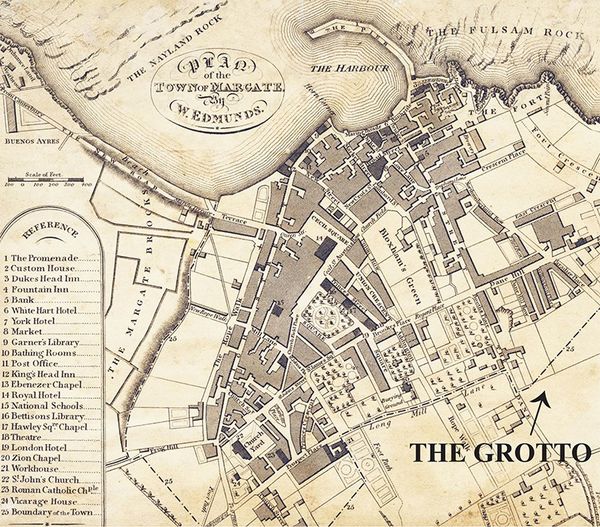
The map below dates from 1821 and the arrow, added later, points to the current location of the cave, which the old map makes no mention of.
A few weeks after the report in the newspaper, the grotto was opened to the public.
Twyman's theory
An interesting theory about the history of the grotto was presented by the late Mick Twyman, who was related to the Margate Historical Society. He measured the lay out of the decorations in the dome in relation with the passage of the sunbeams that enter the dome through the small circular opening in its top, which made him conclude there was equinox-compatibility around 1141 (if this is abracadabra to you, here is an explanation of the precession of the equinox).
This might be an indication of the time the grotto was decorated. The patterns in the mosaic made Twyman suppose this site was a hide-out or temple of the Knights Templar.
The link to Twyman's article is no longer available on the official website of the Shell Grotto (and it is not available elsewhere too) since the management of the Grotto prefers not to take sides with regard to the various theories about the Grotto's origin and adheres to "we do not know".
picture courtesy of Jessica Straus
Theorizing about the grotto's origin goes on. Take a look at an article by Megan Manson (April 2014) on the Patheos.com website.
Preservation of the grotto
In 2008 an association Friends of the Grotto was formed to promote the survival of the Grotto as a unique historical monument.
The Grotto is classified and British Heritage has co-financed a conservation project. The first phase began in 2009 and focused upon preventing that rain water would penetrate the soil above the grotto and damage the decorations.The next phase started autumn 2011 and included repairs and cleaning of the shell mosaics.
The Margate Cave
Not far from the Shell Grotto, there is another grotto, called Margate Cave. This one, however, since 2006 is closed for the public because of safety problems. The history of this cave is also rather mysterious and curious. The future of this cave as a touristic site is uncertain, because of a plan to build a housing complex close to it. Documentation/more pictures
* Website of the Margate Shell Grotto * Wikipedia * Shell Grotto group on Flickr
* Shell Grotto on Facebook
* Shell Grotto's page on YouTube
Video
* A video (2017, 1'13") by Culture Trip, from the Grotto's Facebook account
first published February 2009, last revised May 2023
Margate Shell Grotto
Grotto Hill Margate, Kent, South East England, UK can be visited, daily in summer, weekends in winter streetview
picture by Apolline Lepetit, courtesy of Sophie Lepetit, from her weblog
Located along the Loire river in France, the Saumur region has the highest concentration of troglodytes, underground dwellings dugged out and lived in by man.
The area has grottos too.
Cave with sculptures
A very special grotto is the Cave aux Sculptures near the village of Dénezé-sous-Doué. It isfamous because of the 234 characters sculpted into the cave's walls of soft stone.
That this cave existed seems to have been forgotten for a long time, until in 1956 it was rediscovered and became a regional tourist attraction.
The sculptures probably date from the 16th century and there is no agreement about who made them. Theories range from fugitives of the religious wars to adherents of religious sects.
picture courtesy of Jerôme and Laurent Triolet from their website Monde Souterrain
In 1969 the Cave became a Monument Historique and since 1973 it is owned by the local community.
An association of friends of the site, Actions Caverne, was formed, which is active in promoting the protection of the site and in stimulating research on the origins and the meaning of the sculptures.
This association has a website with plans, pictures, accounts of the history of the cave and the hypotheses around the sculptures, and so on.
Documentation/more pictures * On her weblog a report by Jessica Strauss about a visit she paid to the grotto in spring 2017 * Touristic website of the Saumur region with practical information * Pictures (January 2013) by Apolline Lepetit on Sophie Lepetit's weblog
* A touristic website, in English, has a story about the troglodytes in the area and also information on the cave aux sculptures and other caves in the region.
Video
.* Video by Champigny2014 (8'28". YouTube, August 2014)
first published February 2009, last revised April 2020
Cave aux sculptures
Rue de la Caverne 49700 Dénezé-sous-Doué, dept Maine-et-Loire, region Pays de la Loire, France can be visited in the summer months, check tourist office website 1/4 - 31/10, not on Mondays