this picture and the next three (2012) courtesy of Nádasdi Zoltán Szabó
An art environment for me isa relatively large-scale creative construction that is related to the place of living of the one who makes it. So, building a castle with your own hands is obviously making something large-scale, but not relatively ....
A castle might rank as a creative construction XXL
Life and works
IstvánTaródi (1925-2010) from the community of Sopron in Hungary, did it.
In 1945, as a young man of less than twenty year old, on a plot of land that belonged to his parents, he already constructed kind of a (wooden) tower of some 8 m high. He settled there with his wife he had married in 1946.
Around 1951 Taródi could become the owner of a piece of land, an abandoned orchard in the eastern outskirts of Sopron.
On this plot in 1959, in his mid thirties, he began to build a castle. It became a project that would keep him (and the members of his family) busy for the next fifty years. He would work on the project while he also had a job during the day, so he started at five in the morning, to continue in the afternoon after he had done his daily job.
In preparing his project Stephen Taródi made a long distance journey by bike along Hungarian castles to observe their layout.
The result of all this industrious labor is quite impressive.
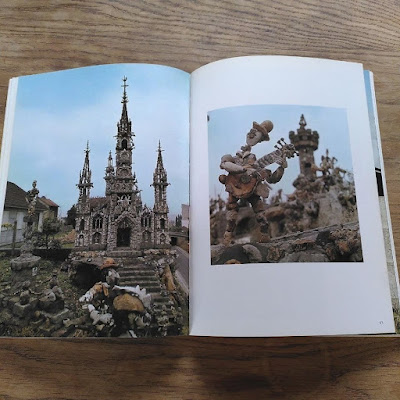
The castle has everything a castle should have: a fenced gate, a bridge, a court-yard, towers, donjons, spiraling staircases, a stylish decoration .....
The construction covers an area of some 4300 m² and the highest tower is 20 m high.
The interior has a number of rooms, where Taródi stored items he collected during his life, like classic furniture, motorcycles, paintings, farm tools and so on. Due to the lack of financial means. it is not possible to show the collection in a somewhat orderly arrangement or take measures to refresh the museum's somewhat sloppy and dusty appearance.
Actual situation
Stephen Taródi passed away in February 2010.
picture (2010) Kisalfold newspaper
article and image not available any,more
His sons István and Tibor continued to take care of their father's castle, establishing a family company to manage the site as a museum that can be visited.
In 2018, the national government financed a renovation of the exterior of the castle. Overgrown vegetation has been removed, defects in walls have been corrected, and joints have been renovated. The walls were also provided with a water-repellent layer.
Situation in 2022
Above photo, made in November 2022 by Tiramisu Bootfighter who traveled Eastern Europe with his Galerie Ambulante, shows that the castle is still in a good condition.
Documentation/more pictures
* Wikipedia
* Pictures (2012) on the weblog of Nádasdi Zoltán Szabó
* A series of photos on Flickr by the author of the weblog Curious Expeditions, with many pictures of exterior and interior of the castle.
* Tarodi wrote a book about his life and work (published in 2007), but up to now I couldn't trace it.
Videos
* Video (undated) by Maskepp Mint Masok (YouTube, 2'21")
this picture and the next two (May 2008) courtesy of Bruno Montpied, from his weblog
The inscription on above money box reads N'OUBLIE PAS LE CRÉATEUR (do not forget the creator). This box was on the fence of the garden, so visitors could pay a donation after visiting the site. Life and works
Raymond Guitet (1876-1956) lived in Sauveterre de Guyenne, a community in the south-west of France. He was a market-gardener (jardinier) by profession, trading in vegetables, fruit, eggs and poultry. And he also was active in the local government acting as a deputy mayor during some periods before 1940.
In the late 1940s he began making sculptures which he displayed in his garden, working in the same tradition as Gabriel Albert, Fernand Chatelain, Rene Escaffre and others. It is somewhat curious to note that some authors describe him as a humble edition of the Palais Ideal, since facteur Cheval's concept was quite different
The websiteHabitants-Paysagistes (Lille Art Museum) has as series of photos by Francis David, which present the site as it original capacity.
The garden has been referred to as zoological, and indeed Raymond Guitet has created a number of sculpted animals. But he also made sculptures of personalities, famous ones like Jeanne d' Arc and general leClerc, and allegorical ones like the three wise men (hear, see, keep silent...)
Jeanne d´Arc
The site is in decay
After Guitet had passed away in 1956, the garden was no longer cared for. Apparently no one in the community felt inclined to help maintain the site, so the garden steadily declined.
The photo below (by Bruno Montpied) shows how in May 2008 the site looked like.
Many sculptures have been stolen and most of those still present (like Jeanne d´Arc, above) are in decay.
Bruno Montpied, author of the weblog le Poignard Subtil,in his post of May 31 2008 has reported about his visit to the garden, describing it's grandeur and décadence.
It´s tragic, such a decay.
situation in 2017
photo by Sophie Lepetit
situation in 2024 photo by Sonia Terhzaz
Being that as it is, let´s keep in mind the text on the money-box and let's remember Raymond Guitet as the creator of one of France's interesting art environments.
Documentation
* Photosby Francis David of the site before its neglect on the website Habitants-Paysagistes (Lille Art Museum)
Raymond Guitet
Le jardin zoologique
Sauveterre de Guyenne, dept Gironde, region Nouvelle Aquitaine, France site in decay
screenprint from the video by Serflac (see documentation)
Located in Lemgo, a small town in Nordrhein-Westfalen, Germany, the Junkerhaus is an artwork as such, singlehandedly created by Karl Junker. The creation can be classified as an art environment, but although Junker has been seen as an outsider artist, German art historians currently do not relate him to outsider art any more.
I agree with these authors, but will present Junker in this blog since he for such a long time has been seen in various respects as an outsider artist.
Life and works
Born in Lemgo, Karl Junker (1850-1912) early in his life lost his mother, father and brother, and from his seventh he was educated by his grandfather.
In 1869 he went to Hamburg to learn the trade of carpenter. He fell in love with the daughter of his teacher, but this love affair did not last and around 1871 the young man went to Munich, where in 1875 he became a student at the Akademie der Bildenden Künste. It is unclear what he has been doing between 1871 and 1875. Maybe he was in the army for some years.
Around 1877, kind of finishing his artistic education, he began a long journey to Italy, to return in 1881, when he was in his early thirties, to Lemgo, where he would stay for the rest of his life.
Professionally trained as a carpenter and a visual artist, Junker tried to get a position in the arts, but he was not very successful and gradually he may have become an artist without any relation to the world of art. He had inherited an amount of money, so he could live independently.
In 1889 he asked the local authorities permission to build a house. It was to be constructed as shown by his own design, which was not exactly what authorities considered to be a gutbürgerliches haus (bourgeois house). However, they made no problems and agreed.
In 1891 the construction of the house as such was ready and Junker began decorating it on the outside and the inside. He has been working on this project until his death in 1912.
He designed all the furniture and constructed it himself from wood. And he decorated the various items in a rather personal style with woodcarving, paintings and small wooden constructs.
He made paintings on the wall, decorated the walls and the ceilings with wooden structures.
Junker also created over a hundred stand alone wood carved totem-like sculptures with garlands, flowers and heads. The house as a "Gesamtkunstwerk"
The layout of the interior of the house would enable a family to live there, with a sitting room, a master bedroom, a children's´room, a guests room and so on. But Junker himself did not use these facilities, nor did he marry and a raise a family. He was alone and lived and slept in a small room in the attic This has been seen as a sign of eccentricity, but if the house and the interior as such is the artwork, isn't it rather normal that you do not sleep or eat in the artwork?
In my opinion he was driven by an enormous creative ambition, directed upon making the house as such a complete artistic construction, what in German is named a Gesamtkunstwerk (a total work of art, an expression first coined by Richard Wagner) He combined architecture, painting and wood sculpturing in the creation of this artwork.
In his visual art Junker would depart from the rather classical style he had been taught in München, and develop an individual approach. However, during his life and also thereafter, leading circles in German art never have given him any status as an artist.
Schizophrenic?
The locals of Lemgo may have regarded Junker as eccentric. Some German authors have diagnosed him as a schizophrenic. The trend was set by Gerhard Kreyenberg who, sixteen years after Junker died and without ever having met him, wrote the article "Das Junkerhaus zu Lemgo. Ein Beitrag zur Bildnerei der Schizophrenen" in: Zeitschrift für die gesamte Neurologie u. Psychiatrie no.114, Berlin, 1928, p.152-172).
Kreyenberg interpreted Junker's art, which he obviously did not like, as the work of a schizophrenic.
Describing Junker's creative work as a result of and in relation with schizophrenia is rather easily done on many sites on the internet, also by writers who do not depart from a medical point of view, but from an artistic one. The schizophrenia approach can also be found in an article in Raw Vision; John MacGregor, Junker House, The architecture of madness (Raw Vision, nr 41, 2002)
Some scientists however (for example Hartmut Kraft, 2005) have a more differentiated opinion. Although Junker had fantasies that can be related with schizophrenia (he had constructed a throne in the sitting room and said to know the thoughts of Bismarck), his creative work was based upon carefully prepared sketches and was not done in a gush.
In the original version of this post (2009) I said it would be wise not too quickly accept causal relations between artistic drives/ambitions and psychiatric diseases.
Currently German art historians (like Carolin Mischer, Das Junkerhaus in Lemgo und der Künstler Karl Junker. Künstlerisches Manifest oder Aussenseiterkunst? Köln [SH Verslag], 2011) no longer accept the assumption of Junker's madness, nor do they see him as an outsider artist, but will regard him, following Carolin Mischer, as an artist who through his very special creation voiced an artistic manifest.
It has been reported that Junker himself said that only later generations would appreciate his creation, maybe after fifty or a hundred years.
Well, I do.
The house has become a museum
Since 1962 the city of Lemgo owns the house. Around 2000 a restoration started, which was finished in 2004. To accommodate visitors, an annex has been constructed, that is linked to the original house with a glass corridor. Because of the fragility of the wooden constructs (and to prevent theft and graffiti by visitors) not all rooms are open to the public.
Some documentation * TheJunker House (before it became a museum) appears in Jarvis Cocker's Journeys into the Outside (1999, on YouTube in 2012, see my post of August 23, 2012)
*The official website of the Junker House (text in German and in English).
* Available on the internet: Bettina Rudhof, Building as in a dream, the Junkerhaus in Lemgo, 2010
* Another example of the actual view on Junker: Bettina Vaupel, Wie Karl Junker sich seine Welt schnitzte. Die Holzorgie von Lemgo. Article on website Monumente. Magazin für Denkmalkultur in Deutschland (august 2012)
* Also on the internet a publication of the museum (in German)Ein Aussenseiter in der Kunst. Karl Junker und das Junkerhaus in Lemgo. Bielefeld (Verlag für Regionalgeschichte, 2011)
* Article about Karl Junker on SPACES website
Video
* Video "Karl Junker and the Junkerhaus" (YouTube, 8'18", camera Thomas Moormann, Westfälisches Landesmedienzentrum, 2004), english spoken
* Scenes of the Junkerhaus on the North Germany Tripvideo (2017) by Sergio Flaquer Carraras (Serflac) (starts at 13'37")
first published March 2009, last revised September 2024
Junkerhaus
Hamelner Straße 36
32657 Lemgo, North-Rhine Westphalia Federal State, Germany
this picture and he next five courtesy of the Skiadas family
click to enlarge
Maybe you did not recognize immediately the scene depicted in above picture, but this is a replica of the Terrace ofLions along the Sacred Way on the isle of Delos, the famous Greek former sanctuary and currently important archaeological site, just in the center of the Cyclades Archipelago in Greece.
This replica was made by self-taught sculptor Benetos Skiadas (b.1944), who lives on the Greek isle of Paros.
Life and works
Born on Paros, Benetos Skiadas at age eleven began working in the fishery and after he had various other jobs he became a fisherman by profession, sailing for many years seas far away from his home.
Throughout his life he was interested in making replicas, like he has been making a number of beautiful models of ships, as in next picture.
When he had worked in the fishery for many years, Benetos Skiadas re-settled on Paros and around 1990 he succeeded in realizing his dream: a creative project to promote and maintain the Cycladic tradition.
Part of this project includes making replicas of monuments and other structures that represent that tradition, such as the above Lions Gallery.
church of the Virgin Mary on Tinos
The visitor of the open air museum will see replicas of the Andros lighthouse, the ancient theater of Milos, the basilica of Tinos, the monastery of Amorgos, a typical Cycladic windmill, and so on.
the monastery on Amorgos
Alongside the exhibition at the outside of replicas of famous built structures, there is an inside exhibition of ship models and other pieces of folklore art of the Cyclades.
Skiadas regularly made new replicas, such as the harbor café at Parikia, the main town of Paros. If ever as a tourist you departed from Paros, you may have been sitting on the cafe's terrace, awaiting the arrival of the ferry.
Sweet memories, the café in this version no longer exists
the harbor café in Parikia as it was in former days
The newest replica
Skiada's most recent creation, finished early 2014, is a replica of the Panagia Ekatontapiliani.
This Church with a hundred doors, located in lower Parikia, not far from the harbor, is one of the oldest christian churches in Greece, it's origins dating from the fourth century.
photo of Folklore Art Museum Of Cycladic Civilization by Benetos Skiadas (courtesy of TripAdvisor)
Above picture (August 2012, courtesy TripAdvisor) shows the model under construction.
Skiadas has made a wonderful, faithful copy of the building, using pieces of Paros' marble for the walls and argile for the roofs.
From 2014 on this replica can be seen by the public on the grounds of the Folklore Museum.
No more large replicas
This replica of the Church wit a hundred doors may be the last addition to Skiadas' oeuvre of replicas, since in the course of 2015 he has decided to stop making new creations, a decision that may have to do with his age and the tragic event that end 2014 his beloved wife died.
Some time after the death of his wife, Benetos Skiadas handed over the management of the museum to his daughter Katerina.
Video
* Video by Paroshoteliers (April 2012, 2'44", You Tube) scenes from Paros and the Museum
first published March 2009, last revised October 2023
Benetos Skiadas Cycladic Folklore Museum near Aliki, Paros, Greece open for the public May 1st -September 30th, 9.30-14.00 located near Paros' airport, north of Aliki
Masgot, a small community in the department Creuse in the south of France, has become famous because of a very special creative talent of one of its former inhabitants.
Life and works
François Michaud (1810-1890), who all his life lived in Masgot, at some moment manifested himself as a self-taught sculptor.
Not much is known about his life. His father was a mason, Michaud himself a farmer. He married at age 19 and the couple had four children.
From around 1850 until around 1880 Michaud made sculptures in granitic stone which he displayed at various locations throughout the village. In this way the community was transformed into a large scale 19th century art environment with some fifty sculptures depicting all kinds of people and animals.
It is quite possible that for many decades the villagers did not consider it special that their village was decorated with such a lot of sculptures, and indeed in the course of the years these creations became neglected and got covered with vegetation.
Revaluation in the 1980's
However in the early 1980s Daniel Delprato, mayor of Fransèches (of which Masgot is part) and also a professor in the crafts of building, remarked the particularity of Michaud's creations and began working with Masgot's inhabitants to clean and if necessary restore the sculptures.
When this resulted in TV-crews visiting the village and newspapers publishing articles, the inhabitants must have realized the significance of Michaud's work.
So, in 1987 the association Les amis de la Pierre de Masgot was formed. Their website (in French) has a lot of information about Michaud and it presents various ways to discover the sculptures (simple map, audio, illustrated booklet)
Masgot currently has a visitors center where tourists can get information and in summertime various activities are organised, like lectures, guided visits, but also weekly courses in sculpting in stone.
Documentation
* Website of the association of friends
* A collection of pictures (2013) of the sculptures by Julia Sisi and Dan Casado on Sisi's FB page * A series of pictures (2021) of the sculptures on the weblog of Sophie Lepetit
Videos
Video by Videoguide Nouvelle-Acquitaine (2023, YouTube, 3'55")
>
* Video by Mimsy L. showing the sculptures (August 2010, 4'56", You Tube)
* Video by France 3 TV (February 2020, YouTube, 3'32")
first published March 2009, last revised April 2023
François Michaud
Masgot, village with sculptures
23480 Fransèches, dept Creuse, region Nouvelle Aquitaine, France
Cabrières d´Avignon, a small community east of Avignon in the Vaucluse in France, is one of the very picturesque villages in the south of France as it has retained much of its original character.
Life and works
Leopold Truc (1912-1991), an inhabitant of this community, was a farmer. He had a small cabin where he kept his farmer tools and around 1955 he decorated this cabin with mosaics.
This inspired him to continue this creative activity and he decided to transform his garden into an art environment, which he did by laying out small lanes, making sculptures and small buildings, and adding decorations of (shell) mosaic in geometric patterns.
The garden has a single-handedly constructed tower of some 8 m (26 ft) high, which allowed him and eventual visitors to take a look at the beautiful landscape of the Luberon.
And then, the site also has an ornamented grave, which Truc had made for himself. Eventually he has not been buried here, since French law does not permit this.
Leopold Truc has been embellishing his garden for almost forty years. He died in 1991.
Actual situation
Truc´s project was appreciated by artists living in the south of France, grouped around art singulier, but generally speaking this art environment has been somewhat forgotten.
The site still (partly) exists today, but it is situated on the premises of a private house and is not meant to be visited by the general public.
Documentation/more pictures * Catherine Gardone, Le Paradis de Leopold Truc, 2013 -56 p
Exposition * Catherine Gardone's photo's of the garden (see documentation) have been exposed from May 30 - June 14 2013 in Cabrières d'Avignon (salle des expositions)
Leopold Truc Le jardin paradis Chemin des Frileuses 84220 Cabrières-d'Avignon, dept Vaucluse, region Provence-Alpes-Côte d'Azur, France private, not open for the public
Dating back from 893, the Confrécourt farm, located near Soissons, in the area just north of the Aisne river, France, was the theatre of violent warfare between French and German troops in september 1914.
the farm
Near the farm the frontline between the armies came to stay and the troops for years had to fight a war from the trenches.
In the neighbourhood of the farm, still in ruins today, there are quarries, that during the war would serve as a depository, a hospital, a place for soldiers to rest, for better or worse it was a habitat for the soldiers.
The Confrécourt cave had a chapel, decorated and sculpted by soldiers, named la chapelle du père Doncoeur
the chapel of father Doncoeur
The caves, like other memorabilia from the war in the region, are cared for by a group of volunteers, the Association Soissonnais 14-18. One of their aims is to make better known and to protect the artworks made by soldiers during the war.
In 2008 this association published a book, Le Graffiti des tranchées, devoted to the many pictorial and sculptural creations in and around the trenches.
The Confrécourt caves can be visited on appointment with Soissonnais 14-18 (from March-September).
Documentation * website of the Association Soissonnais 14-18 * article in Wikipedia
* an academic study of trench art: Nicholas J. Saunders, Trench art: materialities and memories of war, Oxford (Berg), 2003 .
Carrières de Confrécourt
near Soissons, dept Aisne, region Hauts-de-France, France can be visited on appointment
The picture above, made by Bernard Lassus ¹, shows a group of French people, gathering on a Sunday afternoon around 1967 to watch kind of a show presented by Marcel Landreau in his decorated garden in Mantes-la-Jolie, France.
Life and works
Born in the community of Noirterre in the Deux-Sèvres area in France, Marcel Landreau (1922-1992), after school became a pastry chef. After WWII for some years he stayed in french Indochine (what nowadays is Vietnam), to settle around 1961 in Mantes-la-Jolie, west of Paris. where he had a job at the French railway company as a foreman in shunting freight trains.
In Mantes he acquired a plot of (sloped) land, where he built his house.
At the same time he began making sculptures from pebbles he glued together, often in such a way that parts of the creations could be animated.
the cathedral and a sculpture as depicted in
Jacques Verroust (photos) and Jacques Lacarrière (texts),
Les inspirés du bord des routes, Paris (Ed du Seuil), 1978
He also made structures and constructions to decorate his garden. The most impressive singular architecture was a cathedral he began to construct in 1965 (images above and all the way above). It took him two years to complete this building, which was so large that a child could fit inside.
A special feature of the garden became a procession of people descending from the cathedral.
Another feature was a scene of people dancing at a wedding party. Probably that's why the garden has been named after the bride. Controlled by wires connected to electric motors the impersonations could make movements
On Sundays, after lunch, the locals liked to gather on the street in front of the garden and watch the life show of people dancing at a wedding on music from a homemade sound system, which also could produce the sound of ringing church bells.
At the end of 1989, when Landreau was approaching his seventies, he wanted to return to the Deux-Sèvres area where he was born. He sold the house and the new owner eventually demolished the site, although he had made other promises ².
Recovered sculptures (2009)
For a number of years it was assumed that all of Marcel Landreau's creations had gone.
However, in October 2009 it was announced that a collection of the smaller sculptures had been discovered. As far as I understand Marcel Landreau himself had taken a number of his sculptures
to his new residence..
The recovered items were traced by antique dealers Fred and Cathy Tavard, who as far as I understand, found them at a firm that trades in old construction materials.
Documentation/more pictures
* Marielle Magliozzi, Art brut, architectures marginales. Un art de bricolage. Paris (l'Harmattan), 2008 .
* Pictures of the recovered items can be seen on the weblogAnimula Vagula of October 18, 2009 This blog also has a diashow of various sculptures
first published March 2009, last revised February 2022)
notes
¹ The picture by Bernard Lassus is derived from his paper in The Vernacular Garden (1993), a collection of papers of a conference on the history of landscape architecture. Lassus is a well known French writer on landscapes and gardens. His book Jardins imaginaires (1977) was an important factor in the rise of interest in the art environments created by ordinary people and self-taught artists.
² This is the frequently heard version, also supported by Laurent Danchin. However, Bruno Montpied (Le gazouillis des éléphants, 2017. p. 352) says Landreau demolished the site himself
Marcel Landreau
Le jardin de la mariée (formerly) rue Louise Michel 26210 Mantes-la-Jolie, dept Yvelines, region Île-de-France, France site demolished,
some items have been saved and are in a private collection