Showing posts sorted by relevance for query Vasseur. Sort by date Show all posts

January 21, 2009

Robert Vasseur, La Maison de la vaisselle cassée / The Broken Crockery House

picture courtesy of Sophie Lepetit, from her weblog 

This art environment can be compared with the one made by Raymond Isidore (also Picassiette), although it is less famous.
  
Life and works

Textile worker and milk transporter. Robert Vasseur (1908-2002) lived in the Normandy community of Louviers in a house he had rented in 1942. After he could buy the house in 1948, Vasseur made several structural changes and in 1952, when he had broken a plate, he decorated a kitchen sink and a wall with some broken crockery.

Vasseur and his wife liked the result. Mrs Vasseur in particular, because the mosaic decorated kitchen sink was easier to clean than the original one from reinforced concrete. So the couple decided it would be fine to have more mosaic decorated elements in their house.

Vasseur began a project that would keep him active for the next fifty years: decorating house and garden with mosaic from kitchenware, glass, sea shells and so on.

the dog kennel, used as such 
picture (2007) courtesy of website Outsider Art in France

The neighbors would bring him empty bottles and broken crockery which could be used in the creations.

Although Vasseur's art environment may be not so well known as the Maison Picassiette in Chartres, his creation is based upon the same principles and it has the same appearance. With respect to themes and the use of materials there are differences of course. For example, Isidore's creation has more religious connotations and he did not use shells.

decoration of an interior wall
picture (april 2010) courtesy of Jessica Straus

Robert Vasseur died in 2002. 

Further developments

Vasseur's art environment was maintained first by his son Claude Vasseur and then in 2025 by his grandson Jean Vasseur.
.
Sophie Lepit, author of the weblog Les grigris de Sophie (see Documentation) in the spring of 2010 paid a visit to the site. She was warmly welcomed by Claude Vasseur. He told her that he would like to continue restoring and developing this art environment, both as a tribute to and a continuation of his father's work.

In May 2025 the management of the site was subsequently passed on to Robert Vasseur's grandson, Jean Vasseur. The art environment is now known as La Maison mosaïque.


Here is a short video of the site in January 2026


The site, which has a Facebook page, reopened to the public in mid-2025 after a period of preparation..


a picture on Facebook of the site in 2025

Documentation
* Robert Vasseur appears in Jarvis Cocker's Journeys into the Outside (1999, on YouTube in 2012)
* Pictures (spring 2010) of the site by Sophie Lepetit on her weblog. with overviews and details
* The local Musée de Louviers has published the book La maison aux papillons (1966), text and photographs by Claude and Clovis Prévost
* The website Outsider Art in France has two pages with pictures of the site, both from the interior and the exterior.
* Report of a visit to the site in February 2017 by Jessica Straus
* Article by Sonia Terhzaz, reporting the visit she paid to the site in 2020 on her website Cartographie des Rocamberlus
* Website Habitants-paysagistes (by Lille Art Museum from March 2018 on) has a series of pictures by Francis David (1983) and l'Aracine (1981-1986), and also documentary panels by André Escard (1984-2008)
* La Maison Mosaïque on Facebook

Video
* Video Voyage en Normandie by Catalan 66270 (2009, YouTube, 6'.05")


first published January 2009, last revised January 2026

Robert Vasseur and son and grandson
La Maison de la Vaisselle Cassée, 
from 2025 on referred to as La Maison Mosaïque  
80 Rue du Bal-Champêtre
27400 Louviers, dept Eure, region Normandy, France
site can be visited, see Facebook 

June 23, 2021

Edmond Delaporte, Au Moulin Fleuri / At the Flowery Mill

picture courtesy of Sylvie Perrot-Clemot

The French community of St-Pierre-du-Vauvray, a town of some 1300 inhabitants, located about 120 km north-west of Paris, lies on the left bank of the Seine. The towpath that used to be on that bank is partly still present. It starts where the Quai de Seine, located in the town's built-up area, ends.

Along this former towpath, now a rural road named route de l'Ormais, there is a sculpture garden referred to as Au Moulin Fleuri (At the flowery mill).

Life an works

This garden was created by Edmond Delaporte, who was born on June 11, 1934, in Blonville sur Mer, south of Le Havre on the Channel coast and died on November 6, 2020 in Evreux, about 25 km from St-Pierre-du-Vauvray.

The internet hasn't much biographical information about him. For example, it is not clear whether he practiced a particular profession.

With regard to the origin of the sculpture garden there is somewhat more information. It has been reported that in 1980 Delaporte acquired the land on which the garden would be laid out. This area, located along the above-mentioned former towpath along the Seine, was then still rather untidy.

this picture from the Facebook page of the 
municipality of St-Pierre-du-Vauvray, 
the next pictures courtesy of Sylvie Perrot-Clemot

Delaporte had a passion for making sculptures of rural scenes with animals and he bought the site along the Seine with the intention of transforming it into a sculpture garden. A self-taught artist, in 1980 he started the project, that would keep him engaged for over thirty years.

When Delaporte bought the site, he lived in Evreux, about 28 km south of St Pierre-du-Vauvray. He would live there all the years he was making sculptures, working on his creations in general during the winter months, using a garage as a workshop.
 
With his partner Marguerite, who supported him in every way in his creative activities, over the years he must have traveled many times up and down between Evreux and St Pierre-du-Vauvray.


The various images show that Delaporte's decades of creative activity have produced a lovely garden with a rustic feel, where sculptures are arranged in groups on small islands of gravel nestled in an area of green grass.

It has been said that Delaporte's creative work was inspired by that of Robert Vasseur (1908-2002), who transformed his house and garden in Louviers, a community some nine kilometers to the west of St Pierre-du-Vauvray, into an art environment. 


From the point of view of geographical proximity there is something to be said for this. 

Vasseur, however, incorporated a lot of mosaic into his creations and seen from the use of material the depiction of persons in Delaporte's work is more similar to that of René Escaffre (1921-2008), who enlivened his garden in Roumens, dept Haute-Dep. Garonne with scenes of daily life in rural villages in France as it was in the first half of the 20th century.

Considering the depiction of people as done by Delaporte, it seems that he worked from the same point of view. for example portraying farmers manually plowing with oxen.


The way Delaporte portrayed animals is also very similar to Escaffre's.

All this does not mean that Delaporte knew Escaffre's art environment. It's just a resemblance in their way of portraying humans and animals.

The garden has been saved for the future

As Delaporte got older, it became more difficult for him to maintain the garden, so he probably welcomed that in 2019, when he was 85, the Agglo Seine-Eure, a regional conurbation, was willing to buy the garden. 

The municipality of St-Pierre-du-Vauvray, part of this Agglo Seine-Eure, showed great commitment to the art environment within its borders when early July 2020 it arranged a major refurbishment, this with the help of a large number of volunteers from the city. 

The garden was stripped of too exuberant greenery that had grown up in many places, and paths between the different scenes with sculptures were renovated or re-laid.


Documentation
* A sign at the entrance to the garden gives some information about Delaporte
Message on Facebook from the municipality of St Pierre-du-Vauvray regarding the death of Edmond Delaporte
* Another message of the municipality, this one about the refurbishment in July 2020
* The site had a review in Bruno Montpied's Le Gazouillis des éléphants. Paris (Ed. du Sandre), 2017 

Edmond Delaporte
Au Moulin Fleuri 
along the route de l'Ormais
St-Pierre-du-Vauvray, dept Eure, region Normandy, France
can be visited by the public
the route de l'Ormais can be closed for cars during 
summer holidays, this to maintain tranquility for residents 

August 23, 2012

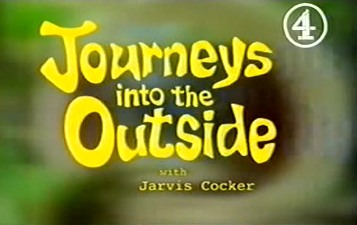
Jarvis Cocker, Journeys into the Outside


British singer Jarvis Cocker in 1998 made a trip along a lot of outsider environments in Europe and the USA in order  to produce a tv-movie, Journeys into the Outside, broadcasted by British Channel 4 in 1999.

This movie has become kind of a classic among those who are interested in outsider art and art environments by non-professionals. However, after the film was broadcasted, it didn't become available through any public medium.

But enthusiasts could rejoice: in April 2012 the movie was downloaded on YouTube  (however, since 2016 it is not available in some countries due to a copyright claim)

The movie comes in three parts. The first part deals with some classic French sites and when present those who created them. Jarvis' voice-over is in English, but his conversation with the creators of the sites is in French (subtitled in English).


These are the French art environments Jarvis Cocker visited:
* the mosaic decorated house and garden of Robert Vasseur, with Vasseur talking about the project (starts at 5'40")
* Bodan Litnianski's art environment, with Litnianski talking about the decorations and constructions he made (starts at 10'45")
* the house of monsieur G as it was some twelve years after he died, with fragments of the Prévost movie about monsieur G and his site, and an interview with Prévost (starts at 16'28")
* la Maison Picassiette, with an interview with a stepson of Raymond Isidore (starts at 21'25")
* the site of Chomo, with fragments of the Prévost movie, but without Chomo himself (starts at 27'00")

The second part deals with sites in the USA (out of topic in this blog, but of course very interesting).


* Edward James' built structure in Mexico
* the Eben-Ezer Tower, with Robert Garcet giving his views (starts at 11'40") 
the Junker House (before it became a museum) (starts at 22'0")
* Bruno Weber's site in Switzerland (starts at 30'24")
* Michel Thévoz of the Lausanne Art Brut Museum (starts at 34'50")
* Nek Chand's Rock Garden (starts at 42'38")

Journeys into the outside is a classic indeed. 

November 19, 2008

Musée-jardin de la Luna Rossa / Garden museum of la Luna Rossa

part of of the Luna Rossa Garden Museum 
with  sculptures by Séraphin Enrico 
(photo courtesy Marcello 14, Flickr)

Initiated by Olivier Thiébaut, the Musée-jardin de la Luna Rossa is a private museum, located in the rue Damozanne in Caen, Normandy. France. The museum is set in a garden that was originally owned by a lady living in rue Damozanne. She left the 950m² of land to the municipality on condition that it would be used as a garden¹. The municipality agreed with the use of the garden as an exhibition space. as in Thiébaut's concept.

Supported by a group of volunteers, one of its aims is to save the works of creators of art environments that are in danger of neglect or demolishment. As the site was not maintained for many years, the volunteers involved had to give the garden a major makeover.

The museum opened in 1996.

Also in 1996 Thibaut published Bonjour aux promeneurs. Sur les chemins de l'art brut, Paris (Ed. Alternatives), a book, currently a collector's item, that describes seventeen outsider artists² and creators of environments in western and northern France. As this book, the museum focuses on creations which originate from these parts of France

The museum also has a number of works that originate from sites that already have disappeared (such as creations made by Enrico and by Tourquetil).

The name of the museum is derived from the inscription la Luna Rossa on the Venus sculpture in the group of sculptures made by Séraphin Enrico (picture above). This weblog has the interesting story that relates how Thiebaut and friends in 1995 recovered the dumped sculptures made by Séraphin Enrico.

The museum's collection includes works of Fernand Chatelain, Euclide da Costa Ferreira, Emile Taugourdeau, André Hardy, Louis Tourquetil, Séraphin Enrico, Arthur Vanabelle, Bodan Litnianski, Robert Vasseur and others.

Documentation
* Article (December 2025) on the website Tipeek Photos
* On the weblog les grisgris de Sophie (May 2010) a description of the museum and a varied collection of pictures.
* On Flickr a photostream by Herbaltablet, uploaded July 2009.
* Another series by Marcello 14, uploaded between September 2008 and August 2009

notes
¹ this info thanks to Françoise Genty
² the book documents the works of Euclide da Costa Ferrera, Fernand Chatelain, Henri Chéné, Louis Tourquetil, Raymond Macé, André Hardy, Robert Vasseur, Emile Taugourdeau, Jean Clérembaux, Auguste Le Boulch, Arsène Enouf, Eugène Firek, Gabriel Albert, Bodan Litnianski, Joseph et Paulette Alberca,  Arthur Vanabelle and Séraphin Enrico

first published November 2008, last revised December 2025


Musée-jardin de la Luna Rossa
6 rue Damozanne
14000 Caen France
open Sundays 10-18 h (apr-oct)

May 11, 2014

Louis Auffret, La campagne / The countryside


pictures in b/w by Marielle Magliozzi, 
as published in Gazogène nr 21 (2000)

Louis Auffret's art environment in southern France, which currently doesn't exist anymore, to my knowledge has only been described by one author: Marielle Magliozzi.

She wrote a thesis in which she studied the phenomenon of bricolage (DIY, home crafts) in relation with outsider art, using the art environments of Chomo, Bodan Litnianski, facteur Cheval, André Bindler, Robert Vasseur and Louis Auffret, the one in this post, as examples. 

The (re-edited) thesis became available to the general public as Art Brut, architectures marginales. Un art du bricolage. Paris, 2008.

Life and works

Born in Bretagne in a family of farmers, Louis Auffret (1918-2006) after finishing his primary education held various jobs, to become around 1938 a sports instructor in the French army. He participated in World War II and in the French war in former Indochina. His military service took him to continents like Africa and Asia, what may have influenced his view of the world.

In 1953, after he had left the army, he settled in the community of Six-Fours-les-Plages on the Mediterranean coast in southern France.  He married and the couple got a son, but due to a traffic accident his wife tragically died in 1957.


In the late 1950s Auffret began to decorate the exterior of his house, which in those years was located in a still quite and rural part of the community (Hence it's name La Campagne, the countryside).

His first creation was a bas relief in remembrance of the birth of his son, added to the exterior wall of the house, near the entrance. Using all kinds of left-over material, Auffret continued decorating the exterior of the property until it was abundantly covered with frescoes, mosaics and other adornments.

Thereafter Auffret was active for over thirty years in transforming the garden into an art environment by constructing columns, arches and other assemblies, all  provided with ornaments, small sculptures, frescoes or drapings.


Marielle Magliozzi, who visited and interviewed Auffret in 1999, observed that the site had a number of interrelated elements scattered around the grounds, such as the dwelling house itself, some cottages, and various customized (and abundantly decorated) pleasant places to enjoy the outdoors, such as an outdoor kitchen, a porched spot with a large oven, an outdoor shower......... 

The interrelation of these constructions was expressed in the corresponding ways of decorating and the use of construction materials.

When Magliozzi did the interview, Auffret's son already was living in the main house and Auffret himself stayed in the cottage. In the interview Auffret gave evidence that he and his son had different opinions about the value of a garden decorated with creative constructions.

At the time of the interview the main house already had been modernized by removing the decorations and as far as I know the decorative aspects of the garden have been removed in 2004, two years before Auffret died.

Currently, because of ongoing urbanization, the property is surrounded by houses and its rural character is history.

Documentation
Marielle Magliozzi, "La 'campagne' du Breton du Var", in: Gazogène nr 21 (2000) (In this article, upon which my post draws, Auffret is named "Père Louis", after his death in publications his full name would be used)
* Marielle Magliozzi, article in Raw Vision nr 49 (2004/2005)
* Marielle Magliozzi,  Art Brut, architectures marginales. Un art du bricolage.  Paris (l'Harmattan), 2008. -322 p.

Louis Auffret
La Campagne
Six-Fours-les-Plages, dept Var, region Provence-Alpes-Côte d Azur, France
the site doesn't exist anymore

November 11, 2016

Eighth anniversary of this blog


Bonjour aux promeneurs, Hello walkers
picture of Chatelain's sculpture 

With the idea to raise awareness of the at that time little known phenomenon of art environments on November 11, 2008 I published the first post in a weblog I entitled Outsider Environments Europe.

So today this blog has its eighth anniversary and as in previous years, I will relate here some data (as of November 10) as provided by Blogger's statistics "behind the scenes".

Number of visitors

On November 10, 2015 the all time number of page views was 420.277. On November 10, 2016 it was 583.287 an increase of 163.010 during  last year, or on the average 446 visitors a day.

All time page views by country

As in previous years here is the all time rank of top ten countries as regards page views:

 1.  United States 177030 (rank 2015: idem)
 2   Netherlands 63517 (rank 2015: idem)
 3.  France 57951 (rank 2015: idem)
 4.  Germany 46971 (rank 2015: idem)
 5   United Kingdom 41398 (rank 2015: idem)
 6.  Ukraine 20171 (rank 2015: idem)
 7.  Russia 18496 (rank 2015 idem)
8.  Spain 12020 (rank 2015: 9th)
9.  Italy 11366 (rank 2015: 8th)
10.  Poland 4619 (rank 2015: idem)

As in previous years, the top is rather stable: the same countries appear, almost all in the same order, except Italy and Spain which changed places.

The last time I paid close attention to the phenomenon of art environments in Eastern Europe and the Russian Federation and I feel happy that the interest from people in these countries remains at the same level

Most viewed sites all time

 2. Joseph Ferdinand Cheval, Palais Idéal 5401 (rank 2015: 4)
3. Robert Garcet, Tour Eben-Ezer 4901 (rank 2015: 1)
 4. Abbé Fouré, Rochers sculptés 4782 (rank 2015: 2)
 5. Robert Tatin, Musée  4341 (rank 2015: 3)
 6. José María Garrido, Museo  4226 (rank 2015: idem)
 7. Bodan Litnianski, Jardin  3931 (rank 2015: 5)
 8  Joseph Pujiula i Vila, Labyrinth  3636 (rank 2015: 9)
 9. Chomo, Preludian art  3500 (rank 2015:7)
10. Karl Junker, Junkerhaus 3469 (rank 2015: 8)
The first place for Bill and Elisabeth Charge is without any doubt due to a one time event. End October 2016 the husband of a granddaughter of Bill and Elisabeth posted a message on the Watford Memories and History page on Facebook, asking -with a link to the relevant post in this blog- if anyone remembered the decorated garden. Well, thousands of people did and this resulted in over 5000 hits of the post in a few days time.

This year the top ten of most viewed sites once more is rather stable, with Garcet (from Belgium), Abbé Fouré, Robert Tatin, Facteur Cheval, Bodan Litnianski and Chomo (all from France), Josep Pujiula i Vila en José Maria Garrido (both from Spain) and Karl Junker (from Germany).

On the 11th place is Francisco González Grajera, El Capricho de Cotrina (3203 views), Willem van Genk, Arnhem bus station, who left the top ten, this year is on the 12th place (2923 views), and Erich Bödeker, Garten mit Skulpturen is on the 13th place (2908 views). 

Other creators of sites that rank high in terms of number of times viewed are: Robert Vasseur (2799 views), Yves Floc’h (2596 views, Raymond Isidore (Picassiette)  (2493 views, Oreste Fernando Nannetti   (2378 views) and Stephen Wright (2309 views)

Pages

The weblog also has some pages. Most popular is the Index by country/region, consulted over 98000 times, followed by the Index of names, consulted over 5000 times.

The General introduction attracted around 2200 viewers, the page about sources etc had some 1000 viewers  and the one about expositions over 1900.

November 11, 2018

Tenth anniversary of this blog


Bonjour aux promeneurs, Hello walkers
picture of a sculpture by Fernand Châtelain
  
Today, November 11, 2018, this blog exists for ten years and it meanwhile includes an inventory of over 450 art environments in a variety of countries in Europe.

As in previous years I will relate here some data (as of November 10) about numbers/origin of visitors and about most viewed art environments.

Number of visitors

On November 10, 2017 the all time number of visitors was 697.157. On November 10, 2018 it was 755.533 an increase of 58376, or on the average 160 visitors a day. Over the period 2016-2017 the average was 312

All time page views by country

As in previous years here is the all time rank of top ten countries as regards page-views:

   1. United States 259.539 (rank 2017 idem)
   2. Netherlands 75.870 (rank 2017 idem)
   3. France  68.414 (rank 2017 idem)
   4. Germany 54.874 (rank 2017 idem)
   5. United Kingdom 48.974  (rank 2017 idem)
   6. Russia 23.201 (rank 2017 was 7)
   7. Ukraine 21,718 (rank 2017 was 6)
   8. Italy 18.437 (rank 2017 was 9)
   9. Spain 14.780 (rank 2017 was 8 )
 10. Poland 6.391 (rank 2017 idem)

The top ten list includes the same countries as in 2017, almost in the same order. Once more the interest from Russia and Eastern Europe is lasting.

Most viewed sites all time

These are the sites with the most all time views (as on November 9):

    1. Bill and Elisabeth Charge, UK Shell garden 6192
    2. Robert Garcet, Belgium Tour Eben-Ezer 5300
    3. Jose Maria Garrido, Spain Shell decorated interior 4800
    4. Joseph Ferdinand Cheval, France Palais Idéal 4489
    5. Robert Tatin, France Singular architecture 4440
    6. Bodan Litnianski, France Decorated garden 4128
    7. Abbé Fouré, France Sculpted rocks 3487
    8. Chomo, France Préludian art 3877
    9. Francisco Grajera, Spain Decorated house 3594
  10. Joseph Pujiula i Vila, Spain Labyrinth 3447

The first place for Bill and Elisabeth Charge has to do with a one time event. End October 2016 the husband of a granddaughter of Bill and Elisabeth posted a message on the Watford Memories and History page on Facebook, asking -with a link to the relevant post in this blog- if anyone remembered the decorated garden. Thousands of people did remember the site and this resulted in over 5000 hits of the post in a few days time, which meanwhile has grown to over 6000.

For the rest, the top ten includes the same set of names as in previous yeas, with Robert Garcet from Belgium. Facteur Cheval, Robert Tatin, Bodan Litnianski, Abbé Fouré and Chomo from France and José  Maria Garrido, Francisco Grajera and Joseph Pujiula from Spain ¹.

On 11-14 the same artists as in 2017 appear: Erich Bödeker (Sculpture garden, 3366) from Germany,  Karl Junker (Decorated interior, 3359) also from Germany. Willem van Genk (Arnhem bus station, 3151) from the Netherlands and Jean-Daniel Allanche (Decorated interior, 3074) from France.

Julius Klingebiel (Decorated hospital room, 3050from Germany is now on 15, Stephen Wright  (House of dreams, 3119, England) is on 16 and Raymond Isidore, also known as Picassiette (Mosaic Picassiette, 2958, France) on 17.

The other most viewed posts in 2017 include Robert Vasseur (Mosaic decorated house, garden, 2937,France) on 18, José García Martin (Sculpture garden, 2933, Spain) on 19 and Viktor IV (=Walter Karl Glück) (Floating structures, 2763, Netherlands) on 20.

Eastern Europe and Russia

The past three to four years I have focused my attention on searching art environments in Eastern Europe and Russia west of the Urals. which until November 2018 delivered some 65 sites, including some 35 located in Russia.

These are the sites with all time views above 1400 (as on November 9):
   
Eastern Europe
   Bogdan Ziętek, Interior with sculptures, Poland, 2320 
   Václav Levý, Sculpted rocks, Czech Republic, 2250
   František RintSedlec Ossuary, Czech Republic2247
   Stanislav Sartsevich, Sculpture garden, Ukraine, 2109
   Nicolas Golovan, Decorated house, Ukraine, 2049
   Boguslawa Iwaneskiego, Sculpture garden, Poland, 1655
   Felicja Curylova, Decorated house, Poland, 1639

Russia
   Alexander Emelyanov, Architectures, sculptures, 2125
   Alexander LadoginaSingular architecture, 2002
   Pjotr ZhurilenkoSculpture garden, 1653
   Sergey KirillovDecorated house, 1651
   Yevgeny Malakhin (=Bukashkin)Frescoe decorated walls,  1512

Creating art environments is not kind of a competition of course, so above listings are just meant to give an idea of the focus of the visitors who visit this blog.

Pages

This weblog includes a number of pages (a general introduction, a time line, referrals to books, expositions and museums). In 2017 the all time most viewed pages were the index of sites by region/countries (in 2017 some 10900 views) and the index of sites by name of artist (in 2017 some 5500). Recently I have revised these two indexes, creating new pages and deleting the former ones, so the data of all time visitors got lost.  But it is obvious these pages are used a lot.

note
¹ In 2017 I added the number of visitors to posts about books, expos and other happenings with regard to Cheval and Fouré to the number of visitors of the main post about life and work of these artists. This year I only counted the number of visitors to the main post, which has affected the current order, but not the entry in the top ten. Info about books etc now is published on the Facebook page Outsider Art Environments Europe