images are screenprints from the video below, re-use licensed under Creative Commons
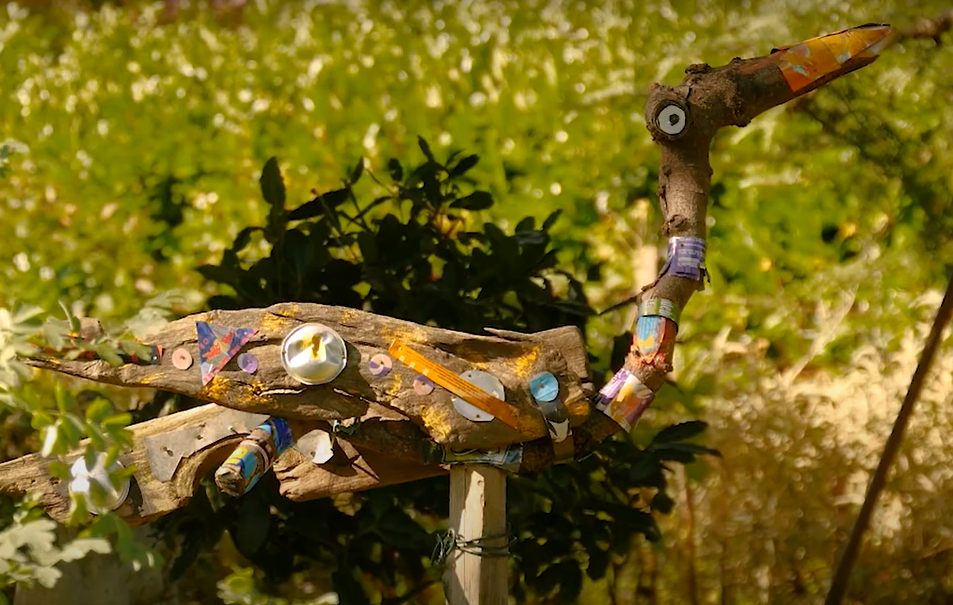
The image above shows wooden animal sculptures as present in a garden in Montauban, a municipality of some 61,000 inhabitants in the Tarn-et-Garonne department in the Occitan region of France.
This garden with its variety of mainly wooden sculptures of animals is a creation of François Werlen.
Life and works
Werlen was born in Montauban in the early 1950s. The information about his life available on the internet focuses mainly on his development as a painter.
Self-taught, Werlen started painting in 1972, when he was in his early twenties. In reviews his work was classified as art singulier (singular art), a designation mainly used for non-professional artists active in the south of France. His work has also been characterized as halfway between folk art and art brut
The paintings he created over the past forty years have a poetic appearance and testify to a great love for color. His themes mainly include animals and human characters. As a material to be painted, he not only uses canvas, but also paper, wood and metal.
Ma peinture, c’est de l’expression, ce n’est pas qu’un loisir, c’est aussi un besoin de le faire, même si cela reste un plaisir (My painting is about expression, it's not just a hobby, it's also a need to do it, even if it remains a pleasure.
In recent years, Werlen's work has been exhibited in galleries in and around Montauban.
Werlen's garden with wooden sculptures
In the in general rather short reviews in newspapers of Werlen's exhibitions, there are often brief references to the garden with wooden statues created by the artist, most likely the garden of the house where Werlen lives. The article by Gregory Pamadou, mentioned in the documentation, gives the most information.
The sculptures are made from raw recycled materials, mainly wood, but also iron, materials that are given a second life through Werlen's processing.
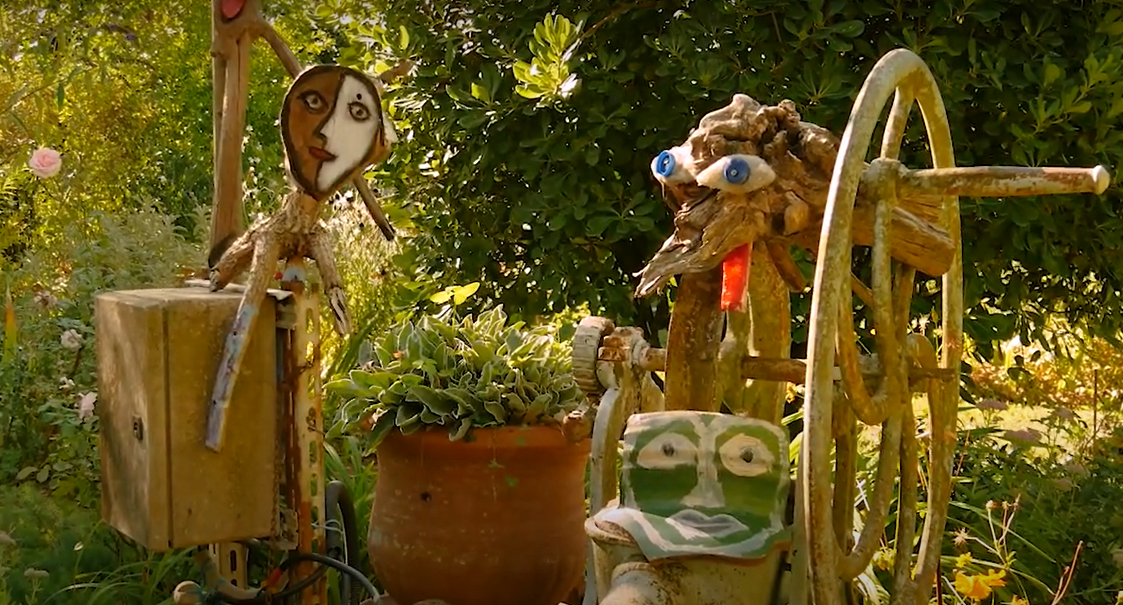
As in his paintings, his sculptures mainly depict animals and human characters.
The images of the wooden sculptures show that Werlen starts from the form he finds in the piece of wood he is going to use, evoking the nature of the person or animal by adding other wooden elements and applying colours, eyes or other distinguishing features,
The landscaping of the garden is so lush that the sculptures occupy almost a modest position in the entire entourage, a modesty that seems characteristic of this art environment, because there is no information in the local press about the origin, nature and location of Werlen's sculpture garden.
Fortunately, in 2020 a video was recorded and published.
Documentation
* Article (December 2014) by Gregory Pamadou about Werlen and his artistic work
Video
* Video (2020, YouTube, 5'40") by Nonoko Home Studio
François Werlen
Sculpture garden
location unknown
Montauban, dept Tarn-et-Garonne, region Occitan, France.
It all started in the early 1990s, when Henk Lamers (1953-2022) bought a decorative ensemble representing Stan Laurel and Oliver Hardy, an ensemble he placed in the front yard of his house.
After that there was no stopping him, he continued to buy other figurines and after some twenty years the garden had the appearance as in the picture above.
this image and the next four from the videos in the documentation
Life and works
Born in the early 1950s, Lamers after his primary and craft schooling got a job as a house painter. He married and the couple moved into a house in Weurt.
The village of Weurt, with some 2025 inhabitants, is part of the municipality of Beuningen, bordering the western part of Nijmegen, one of the oldest cities in the Netherlands, located along the river Waal.
After twenty years of house painting, Lamers developed an illness in early 1990, caused by wrong substances that were still in the paint at the time, and he was declared unfit for work.
To have something to do, in 1992 he began decorating the front yard of his house with all kinds of fairytale characters and other figurines, an art environment that grew in size over the years. Currently the display is 35 meters long and a couple of meters high.
Lamers' site is comparable to gardens and houses richly furnished with dolls elsewhere in Europe, such as Lubomir Votava in the Czech Republic, Margarita Travkina in Russia and Francis Barale, in France.
Among the hundred or so characters that decorate the front yard are a peacock, a crocodile, a stork, a flamingo, an orange sheep, a kangaroo with glasses, a pig also with glasses and a frog with a football on its head......
As for famous personalities, apart from Laurel & Hardy also Elvis Presley, Pinocchio, Puss in Boots and Snow White can be seen, And of course there are gnomes, as pictured below.
Given Lamers' profession, it goes without saying that the figurines are well painted. They form a colorful whole, and are selected to make viewers happy.
Lamers passed away in August 2022. His wife has indicated that the collection will continue to exist.
Documentation
* Article (August 2020) in Michiel van Hunenstijn's weblog
this picture and the next two from Facebook, Skabelonen
The image above shows a covered area next to a bakery. There are tables and benches for visitors to the bakery, but also walls decorated with carvings, depicting all kinds of characters and decorative items.
Welcome to the small village of Årdal, part of the municipality of Hjelmeland in southern Norway. Lovers of art environments will find a lot to see in terms of wooden sculptures, created by Eldfinn Austigard.
These sculptures are not only located around Austigard's house, in his workshop, in the covered area or flanking the entrance, but also a few kilometers away in a forest with some 50 wooden characters installed along a walking path of 1.5 km.
In above left image Eldfinn Austigard, standing in front of his bakery shop Skabelonen which he started around 2017. shows a loaf of bread he baked himself. The character carved in wood above right shows a sign with the text Bakstehuset, Opnar kl 15 (The bakery opens at 3 pm).
Austigard does his bakery work as a hobby, going to work on Thursday and selling the homemade bread on Friday.
the entrance to Austigard's bakery, workshop. house
In his younger years Eldfinn Austigard probably wouldn't have thought that he would become a hobby baker later in life and that he would make a large variety of wooden sculptures as a non-professional.
He was born in 1953 in Årdal and after his primary education he attended secondary education in Stavanger.
He started his working life assisting his father, who owned the local bus company and he succeeded his father when he retired in 1977. A few years later the bus company was taken over by another company.
Eldfinn and Gunhild, to whom he was now married, then bought a petrol station and a workshop from the bus company which they operated until 2007.
this picture and the next ones, scenes of the adventure forest,
from Facebook, Eventyrskogen
Austigard was now in his mid-fifties, and the part-time job as a cultural mediator he could get with the Hejelmeland municipality, undoubtedly suited the social and creative activities he had undertaken in the previous years.
In 2005, for example, he received the culture prize from Hjelmeland for his efforts in a local sports team, but also for his activities in the social and cultural field. He was apparently already active as a maker of wooden sculptures in previous years.
For his wife Gunhild the termination of the work at the gas station was also pleasant, because now she could devote more time to her activities as an amateur painter.
In 2009 Austigard became head of culture at the municipality of Hjelmeland.
Wooden sculptures in Eventyrskogen
Many years before the opening of Eventyrskogen (Adventure forest), the municipality of Hjemeland had already planned to create such a tourist attraction and for that purposeEldfinn Austigard was already creating a collection of wooden sculptures.
As part of a national project aimed at developing a National Tourist Route, which was also planned to pass through Hjelmeland, the municipality started negotiations with the owner of a wooded area (Bønardalen) to locate the fairytale park there.
But initially the negotiations with the landowner were unsuccessful. They came to a halt in 2010.
After some time negotiations were resumed and the municipality concluded an agreement with the land owners, which also included the construction of parking spaces and toilet facilities.
The park was officially opened in April 2013 and by the end of that month some 6000 people had already visited it.
Along a circular path in the spruce forest stand the dozens of wooden figures from various fairy tales and legends created by Austigard. The trip among the trees in the mysterious forest takes about an hour and is suitable for the whole family.
Eldfinn Austigard has not only produced the wooden sculptures for the forest area, in his spare time he also contributes in other ways, such as in the construction and maintenance of the paths and all kinds of management arrangements.
The adventure forest has become a success, it is very popular with families with children and easy to reach for young and old.
In October 2021 Eldfinn Austigard received the Rogaland Public Health Award 2021.
Norway uses a broad definition of public health and so the recipient of the award should have contributed to social support and to well-being and quality of life of the population.
Considerations of awarding the prize to Austigard included that he has made a contribution to public health beyond his function, that he is the "father" of Eventyrskogen, that he encourages people to do outdoor activities and creates social encounters and activities across generations, all things that promote public health.
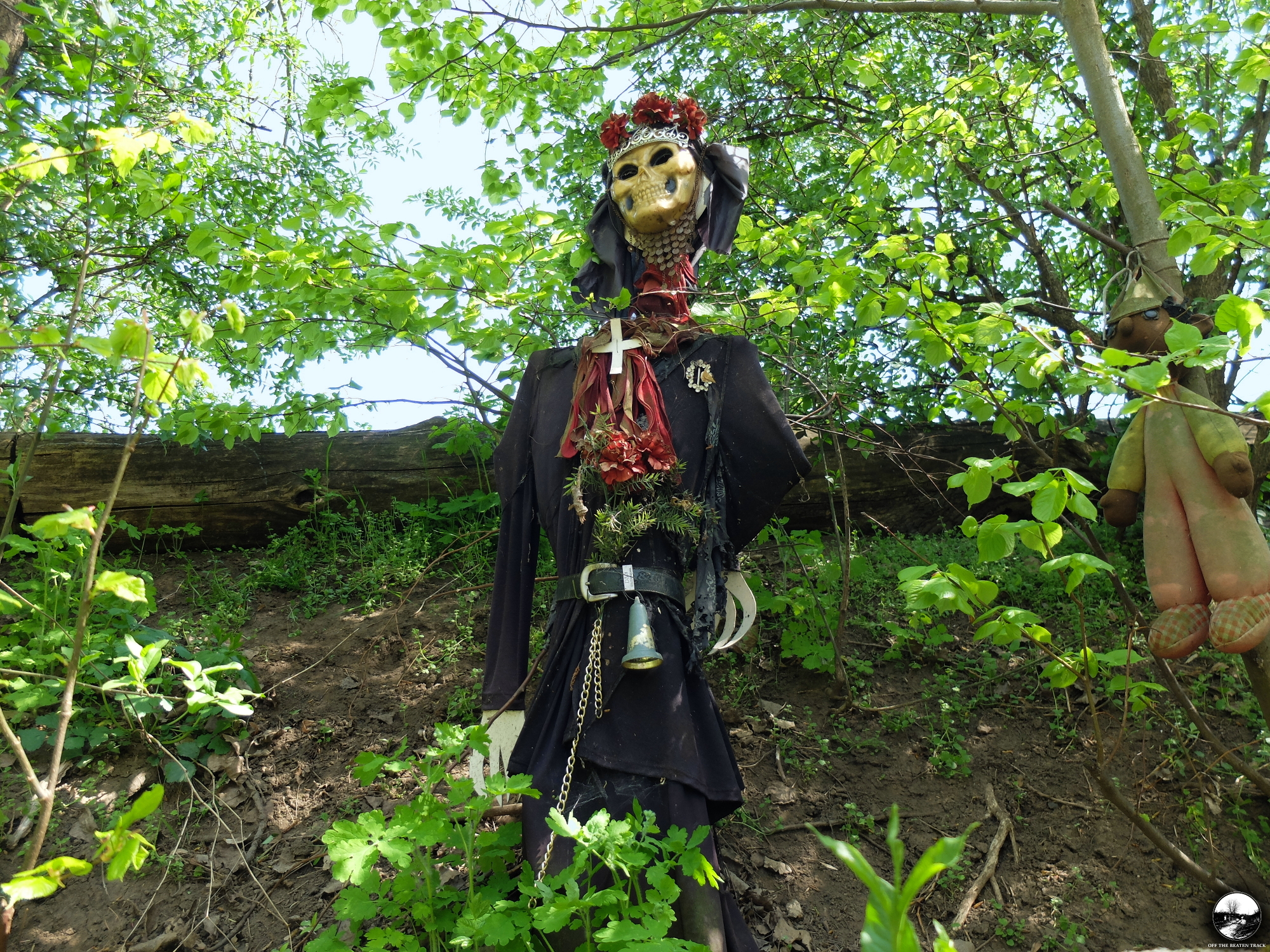
pictures courtesy of Justina Orlovska from her website Step off he beaten track
On her website Step off the beaten track Czech researcher Justina Orlovska publishes the discoveries she makes about abandoned, unusual and undiscovered buildings, which she encounters when traveling through the Czech Republic and other Eastern European countries.
While doing her research she also encounters art environments with a character that fits in with her research design. From the point of view of the field of art environments, it is of great significance that such art environments can also be mentioned in the inventory undertaken by this blog.
In the following text an art environment is presented, which was first published in January 2022 on Justina Orlovska's website in an article entitled Weird Sculptures in the Forest. A Visit of the Outsider's House (Czech Republic).
Mainly through numerous photos this article reports about a small hut in a forest somewhere in the Czech Republic, that was built by an anonymous homeless person, who has lived here for 20 years.
Over the years, the hut has been surrounded by numerous sculptures, made by the hut's resident, whose name is (rightly) not mentioned.
In her text accompanying the photos of the site, Justina says that it doesn't happen too often to see such an extraordinary place. And indeed, among the now around 580 art environments listed in this blog, not one is situated near a forest hut where the maker lives.
The site has a number of creations that depict people who wear long coats, which indicates that the maker has used an internal structure like a kind of mannequin over which the long coat gives shape to the figure.
Mostly equipped with a rifle or other shooting weapon, these persons, set up near the hut, could be a kind of guardsmen, Their heads are almost always provided with a headgear, glasses or other items.
What is most striking about the figures is the array of attributes with which they are decked out, not only weapons, but also ornaments, belts, chains, sometimes a gas mask....
In addition to the combative types, as set up near the hut, there are other more lovely creations, such as the little man pictured below.
Inside the hut the walls are decorated with small-scale creations, these mainly of a decorative nature, in the form of puppets in colorful bouquets, as below, or other decorations
This art environment includes a variety of sculptures, often each with its own specific decorations.
Take a look at Justina Orlovska's website to see the various outfits
Documentation
* Article (January 2022) on website Step off the beaten track\
this picture: screenprint from the video in the documentation
There are non-professionals who create miniature structures with the intention that all those creations represent a community, usually a village, such as Pierre Bouvarel (Ron des Fades) or Henri Galtier (Occitan Village). Their creations are of course set up in an outdoor area.
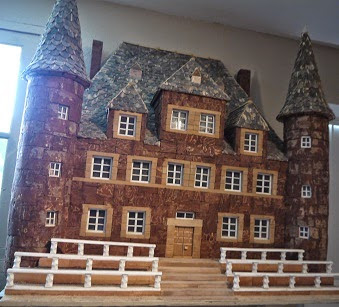
There are also non-professional artists who create miniatures from a specific, personal point of view, such as Willem van Genk, who made an extensive collection of buses, fascinated as he was in (nodes of) transport, or Gerald Dalton who, because of his great interest in palaces, castles and stately homes, especially made miniatures in that genre. Such creations are mostly set up indoors.
this pictures and the next four courtesy of Sophie Lepetit from her weblog
Life and works
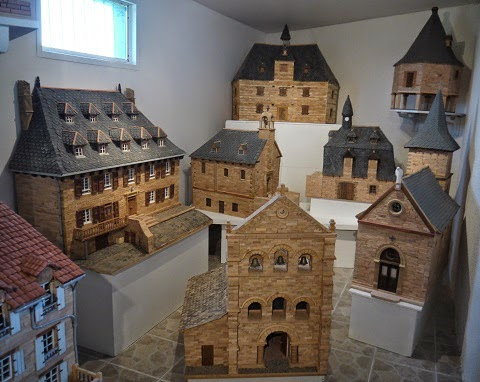
Robert Goudergues (1937-2017) belongs to the second category. His creative work is driven by the inner need to pay tribute to the architectural heritage of the French department Cantal, his native area.
He was born in the small community of Lacapelle-del-Fraisse, about 25 km south of Aurillac, where he would move when he was 17 years old. He first had a job with a trading firm, and in the 1970s he joined a company that made supplies for shoemakers.
This company ceased to exist five years before the date Goudergues would have formally retired, so he was out of work in the mid 1990s at age 57. For Goudergues this was the time to start making wooden miniatures.
.
Working in the garage belonging to his home, he has been making wooden miniatures of buildings in his native region for around twenty years.
Technically speaking, he worked on a scale of 1:15 or 1:19, carefully considering the appearance in reality of the buildings he replicated. To get a realistic miniature he also studied images of his subject.
In general Goudergues made stand-alone creations, and each miniature took about four to five months of work. The four meter long miniature of the row of traditional houses along the Jordanne River in Aurillac, an ensemble he also made, took him a year and a half (image at the top of this article)
Goudergues used all kinds of wood from discarded objects, such as pieces of chestnut wood or the bottoms of crates. He also found special ways of modelling, for example the red tiles and the ridges of some buildings he made from elderberries cut in half.
All together he made some 40 miniatures of castles, churches, famous buildings and all kinds of houses, but also smaller items such as fountains.
Robert Goudergues and the Musée de Veinazès
Located in Lacapelle-del-Fraisse, the native village of Goudergues, the Musée de Veinazès is a private project, undertaken on the initiative of Raymond Coste, an inhabitant of the village.
Opened on June 27, 2003, the museum focused in its early years on the technical development of regional agriculture between 1880 and 1970 (including a display of all kinds of tractors), and it showed a number of craft workshops, also from the region like a clog-maker's business (around 1930) and a carpenter's workshop (around 1922), all fully in operation after restoration.
In later years, when Raymond's son Bernard Coste took charge, the museum also began to focus on regional contemporary folk art. For example, after the death of Rene Delrieu in 2008, part of his art environment was included in the museum.
From 2010-2012 the museum had a temporary exhibition of Goudergues' miniatures.
Also because the space in Goudergues house was too tight to accommodate all his creations, he and his wife Lucienne decided to donate the collection to the museum and in 2013 some 40 miniatures became part of the museum's permanent collection. To this end, a space was added to the museum.
The museum shows how initiatives at a regional level can make an important contribution to the preservation of artworks and art environments by non-professionals
Robert Goudergues passed away on March 2, 2017 and if the museum hadn't been there, his creations could have been lost.
* Weblog (April 2014) of Sophie Lepetit with a series of photos
* Article (May 2013) in newspaper La Montagne on the occasion of the opening of a new space in the museum for the collection of Goudergues
* Booklet in the series Rencontres en Veinazès (Encounters in Veinazès) published by the museum: Robert Goudergues, l'Architecte des chutes de bois (The architect of scrap wood) (available at the museum)
Video
* Video (undated, 3'15", YouTube) by Un Moment Avec with a presentation of the museum (shots of Goudergues' miniatures start at 2'05")
Robert Goudergues
Wooden miniatures of Cantal's heritage
Aurillac
miniatures in the collection of Musée du Veinazès,
12 rue des Fourmillères, 15120 Lacapelle-del-Fraisse, dept Cantal,
region Auvergne-Rhône-Alpes, France
can be seen in the Museum (see it's website for opening hours)