July 20, 2009

Federico Diaz Falcon, Monumento a los ojos / Monument for the eyes

(anonymous) picture from the website pueblos-espana.org

In terms of art environments this Monument for the eyes ranks as a singular architecture.

A monument

Located along a the main road M 215, some 1.7 km south of Ambite, a community which is part of Madrid, the Monument for the eyes is an assembly of three identical structures, the one in the middle being higher than the two flanking ones. The three structures resemble the facade of a church and all are topped with kind of a small bell tower.

The walls of this ensemble have been fully covered with plates, about 250 in total, which represent in text and picture all kind of themes that can be associated with eyes, partly of a universal character, partly reflecting actualities of the 1960s.

this picture and the next one from the website popmadrid.com

Based on an idea of Federico Diaz Falcon (around 1900 - 1982), the monument was constructed in the 1960s.

Diaz Falcon was a respected inhabitant of the community of Ambite, who had inherited enough money to live independently, writing texts, travelling the world and thinking about realizing this monument.

.

When around 1969 the creation was finished, it was located in a garden which was surrounded by a wooden palisade. This plot of land must have been private property, probably owned by Diaz Falcon (or his family), because it has been  reported that the community talked with his heirs about a transferal of the property rights of the grounds where the monument is located.

Today the palisade is gone, and the site has a rather public appearance.

Diaz Falcon was the auctor intellectualis of the monument, but he hasn't made it himself.

A report by the Alpha Grupo, published in march 2010, says that he commissioned the project and that the structure as such was built by Angel Lopez Fernandez, a master builder who has constructed many more buildings in the region.

The images on the plates have been created by the artists Miguel Gimeno and Rafael García Bodas and the plates have been produced by Talavera and Manises, a well known firm producing platter.

Many people have wondered why Diaz Falcon happened to be fascinated by eyes and what kind of message he had for the onlookers. A variety of websites discuss the site in a context of mystery, demonic powers and the like.

Not surprisingly, with regard to the themes of inspiration and meaning there are no definite answers, but as far as I understand, Diaz Falcon just wanted to present the community with a nice monument at the entrance of the village, but then with as central theme a topic that interested him in a philosophic way, namely the different aspects associated with the eye, and that through the centuries

The monument is in decay

After Diaz Falcon died in 1982 (and was buried in or around Ambite) the monument was not very well maintained and a number of plates with texts have disappeared.

Documentation
* Article (2015) on website Panibericana with more information about the history of the creation

Videos
Scenes of the site (2014) on the North Spain trip video by Serflac (YouTube, starts at 1.26.16, cannot be embedded here)
* Video by Grupo Alpha (4'53", YouTube, uploaded april 2010)


first published july 2009, last revised october 2023

Federico Diaz Falcon 
Monumento a los ojos 
Calle del Almendro (M 215)
Ambite, Madrid region, Spain
can be seen from the street
streetview

July 16, 2009

Manuel Fulleda Alcaraz, Casa de las Conchas / Shell decorated house


picture courtesy of Jo Farb Hernandez

This post is about a shell decorated house in the community of Rojales in the southeast of Spain, not far from the coast in the touristic area of Alicante.

Life and works

Manuel Fulleda Alcaraz (1933-around 2018) as a young boy already had to go to work to sustain the family's budget. When older he had several jobs for which no schooling is necessary, such as working as laborer in the construction of regional railways and in vineyards in southern France.

He succeeded in saving enough money to buy -around 1974- a house in the community of Rojales, in these years still at the outset of touristic development.

When retired in 1992 and making a walk on the beach of the nearby coast, he got the idea to use shells as a convenient form of maintenance of the exterior walls of his property. So he collected loads of shells and began decorating an exterior wall.

this picture and the next one (jan 2008) 
courtesy of Annieta (Flickr)

It became a project that would keep Fulleda active for some twelve years.

He not only covered all exterior walls with shells, which he arranged in various decorative patterns, but he also decorated the external staircases, an interior room and the various rooftop terraces.


The local authorities had no problems with regard to the decorations.

The Casa de las Conchas became a tourist attraction (it is located near another attraction, the Caves at the Calle Cuevas del Rodeo). And Fulleda himself, apart from being proud of his artistic creation, was satisfied by the level of protection of the walls the shells offered.

Fulleda has passed away, 

On a touristic website it has been reported that Fulleda has passed away. The year in which this happened is not specified and official sources have no relevant info.

TripAdvisor has messages dating from 2016 that show that in that year the site still could be visited. Because such messages are subsequently interrupted, it can be assumed that Fulleda died after 2016.

The house was inherited by his son José Manuel, who offers visitors the opportunity to visit the house

Documentation
* Articles (April 2025) on the weblog of Sophie Lepetit, with a variety of pictures and more pictures in a seperate collection on Facebook
* The site got a scholarly review in: Jo Farb Hernandez, Singular Spaces. From the Eccentric to the Extraordinary in Spanish Art Environments, Seattle (Raw Vision, SPACES, San José State University), 2013. ISBN 978-0-615-78565-3. An abridged version of this article is on the website of SPACES
* Article (August 2018) by  Caros Pastor, "La Casa de las Conchas de Rojales: quan tota petxina fa paret" (The 'Casa de las Conchas' of Rojales: when every shell makes a wall), on website Alicante Plaza

Video
* Video by Pueblos y Patrimonio (January 2025, YouTube, 1'41")


note
when in 2009 I wrote the first version of this post, I could not trace biographical data; the data in this revised text, rely upon Jo Farb Hernandez' book (2013), referred to in the documentation.

first published July 2009, last revised May 2025


Manuel Fulleda Alcaraz
Casa de las conchas
10 Calle Cuevas del Rodeo
Rojales, Alicante, Valencia region, Spain
can be seen from the street

July 14, 2009

Longino Ayuso, El safari de piedra de Arroyolugar/The stone safari of Arroyolugar

pictures by Paco Ayuso

On the outskirts of the small Spanish community of Iglesuela (Toledo area) an open air "museum" named el safari de piedra de Arroyolugar shows a large number of rock-carved animals.

Life and works

These sculptures have been created by Longino Ayuso (1923-1990), a farmer who around 1970
began transforming the area around his farmhouse on the outskirts of the community into an art environment.

Ayuso has made most of the sculptures in situ, carving the granite rocks that abound in the area. It was his dream to create a harmonious constellation of the animal kingdom and nature.


Ayuso has also been active in making paintings in a naturalistic style (see pictures in the website mentioned in the documentation)

Actual situation

After Ayuso's death in 1990 the inheritors, who do not live in the area, have given the land into lease to a neighbouring farmer. This situation probably has continued for years, because in 2020 on a weblog a referral to the site was made.

Documentation
* The site got a scholarly review in: Jo Farb Hernandez, Singular Spaces. From the Eccentric to the Extraordinary in Spanish Art Environments, Seattle (Raw Vision, SPACES, San José State University), 2013. ISBN 978-0-615-78565-3. An abridged version is available on SPACES website.
* Website La Iglesuela with a variety of pictures
* Weblog Agualuz y Viento (November 2020) with a short referral to the site

first published July 2009, last revised February 2022

Longino Ayuso
El safari de piedra de Arroyolugar
Iglesuela, prov. Toledo, Castilla-la Mancha, Spain

July 12, 2009

Stephen Wright, The House of Dreams Museum


all pictures courtesy of Stephen Wright

Located in a house on a regular street in East Dulwich, a suburb of London, the mosaic creation pictured above is part of a wealth of other creations that adorn the garden and ground floor of this house, which in this way has been transformed into a art environment, called The House of Dreams Museum

Life and works

The museum was created by Stephen Wright (born 1954), a stationary and textile designer, who took his life in a very different direction in the late 1990s.

He had watched Yarvis Cocker's TV series Journeys into the Outside (1999) and felt attracted to the world of outsider art, how outsider artists express their feelings and manage to create beautiful works of art, often using all sorts of ordinary and discarded materials.


Inspired by this experience, Stephen Wright and his partner Donald Jones traveled through France to visit different art environments such as Raymond Isidore's Maison PicassietteRobert Vasseur's Maison de la Vaiselle Cassée (The Broken Crockery House) and Le jardin aux coquillages (Shell garden) by Bodan Litnianski.

In 1999 they decided to transform their home and garden into an art environment.

The ground floor and garden of the house were embellished with mosaics, paper-mâché and cement constructions, compositions of found objects, decorated dolls, etc.


However, after working on the creation for a few years, Jones fell ill. He was admitted to hospital where he died after six months in intensive care. 

And a little later Stephen Wright's parents also died.


These tragic and emotional events left Stephen unable to continue making creations for some time.

After about a year, however, he went back to work on further development of the site, feeling that this could be done in response to loss. Wright's new partner, actor Michael Vaughan, whom he met in 2006, also encouraged him to keep going.

Death became a recurring theme, and references to the folk art of Mexico, South America and Asia appeared alongside the work of French outsider artists. The overall look of the site is bright and colorful. 

It has a very personal character, which is also reflected in a number of personal statements on the walls. The House of Dreams museum is Stephen Wright's own world.


During the lockdown due to the Corona virus that hit the UK in 2020, Wright began creating black and white paintings of ghosts and monsters. 

This led him to build new large-scale mosaic sculptures for the garden of the House of Dreams Museum, along with large-scale wall panels. The pictures above and below give an impression of the recent additions to the garden.

Stephen Wright is currently still working on a large-scale mosaic monster sculpture.


He has a passion for flea markets and when traveling abroad he likes to visit markets and rummage through trash and take home items such as old dolls or glass eyeballs. 

And then, among the creations on display in the museum, there are items donated by people who have visited the site, often items that belonged to deceased relatives, finding a home in this way.


During the first years in which the site was established, its creators were reluctant to seek publicity. 

However, in the course of the first decade of the new century, the art environment became better known.

This weblog published the first version of this post about the site in July 2009 and in September and November 2009 there was an exhibition of Wright's artworks in Milagros, a London company that sells all kinds of (handmade) Mexican products, followed in 2010 by an exhibition at The Last Tuesday Society and by the group exhibition Flashier en Trashier in the St Pancras Crypt in London.


The museum is bequeathed to the National Trust of the United Kingdom, a heritage protection organization that takes care of the site when the creator is gone.

Documentation
* Website of Stephen Wright
* In  OEE-texts the introduction to the July 2010 exhibition at the Last Tuesday Society, as published on their Facebook page
* An article by Kate Davey, "Stephen Wright's House of Dreams" in Raw Vision  #86, spring 2015.
* An article by Homa Khaleeli (January 2016) in newspaper The Guardian newspaper, presenting some creators of  art environments in the UK ( Robert Burns , Sue Kreitzman , Stephen Wright, Mary Rose Young en Kevin Duffy )
* An informative and well illustrated article by Sandra Lawrence in the Londonist (March 2016)

Videos
* Video (2013, Vimeo 5'01") on the website Majestic Disorder  


* Video House of Dreams Online by Chris Howse (2'40 ", April 2019, YouTube )


first published July 2009, last revised April 2023

Stephen Wright
House of Dreams Museum
45 Melbourne Grove
East Dulwich, London, United Kingdom
can be visited on open days, in general the last Saturday of the month
see Stephen's website 

July 10, 2009

Exposition Annan Konst / Other Art

this picture and the next three 
courtesy of murrehund (Flickr, june 2009) ¹

Above picture depicts the entrance of Göteborg Kunstmuseet, Sweden, which in the spring of 2009 had an exposition, entitled Annan Konst (Other art).

Curated by Staffan Backlund and Borghild Häkansson from the Postfuturistic Society, this exposition showed creations by self-taught artists from Sweden, Norway and Finland. Some of these artists also created an art environment.

Here is a small impression of what the expo looked like.

The picture below shows singular architecture by Swedish Jan-Erik Svennberg, who for many years has been active in making 1:10 models of mosques.


The next picture, the man in the blue jacket, is a self-portrait created by Helmer Jarl, also from Sweden.


In the background there are some sculptures of animals, made by Alpo Koivumäki, who is from Finland.

The next picture gives a closer view.


On the picture of the entrance at the top, one can see a sculpture that was exposed on the square on front of the museum. It depicts a dragon and was made by the Swedish outsider artist Leif Andersson from the city of Arjang.

photo by Inga Magnussen

The exposition highlighted creations by self-taught artists from Sweden, Finland and Norway, a number of whom were rather unknown.

A travelling expo

In July and August 2009 the exposition could be visited in Norway (Bomuldsfabriken Kunsthall, Arendal) and from January till March 2010 it was in Vaasa, Finland.

The same exposition, with some works added and renamed Eljest (Other),in the summer of 2010 
(June 12-August 15) could be seen in Stockholm's Liljevalchs Konsthall (the municipal museum)

Documentation
* Sinziana Ravini "Outside and inside", article (March 2011) in Aftonblattet (Sweden), with some pictures by Veli Grano

Video
* Video by Nordikkulturfondsen (January 2011, YouTube, 3'34")


note
¹  this link is not operational anymore

Annan Konst
Göteborg , Arendal, Vaasa 
(entitled Eljest, in Stockholm)
Travelling exposition 2009-2010

July 05, 2009

José Ramòn Gallego Rebollar, Casa de las Conchas / Shell decorated house

picture courtesy of jacilluch (Flickr)

Tazones, a small community of some 300 inhabitants on the north coast of Spain (Asturias area) has an abundantly shell decorated house, created by José Ramòn Gallego Rebollar.

Life and works

His name appears in an inscription on the frontispiece of the the decoration, just under the flowerpots at the central window. The inscription also says that Gallego Rebollar began making the decoration in 1985 and that he finished it in 2005. 

When I wrote the original version of this note in 2009, I could not find other data about Gallego. However, some years later the new SPACES website about art environments published an article about this shell decorated house. which has all relevant biographical information.

picture courtesy of Pedro Ferrer 

Apart from the inscription, there are some other statements within the creation, one of them reading Bendita es la Reine de nuestras montañas que tiene par trono Isa Cuna de España (Blessed be the queen of our mountains, who is on here throne, Isa Cuna de España). Another statement relates to Real Madrid, the famous Spanish football-club.

Then one of the bigger shells has a text bringing to memory the presumed historical event of the landing by ship in 1517 of Charles V, already emperor of a big part of Europe and then on his way to become king of Spain, Carlos I. Official historiography does not confirm that this landing actually happened, but in Tazones the event is celebrated by the population every year, and why not?

One more gadget: there is a centolla (kind of a sea crab) in between the decoration of shells, that is quietly smoking a cigar.

picture by vicente at pueblos-espana.org

Tazones would be worth to pay a visit to, not just because of the shell decorated house, but also because of the seafood provided in the local restaurants.

Situation late 2021


The picture above, made in October 2021 by Tiramisu Bootfighter, who traveled through Spain in the context of his project La Valise, Galerie Ambulante, shows that the decoration at that time still was in good condition. The facade is now fully decorated with shells

Documentation
* Short review and a large series of pictures on touristic website All-Andorra 
* Article by Jo Farb Hernandez on SPACES website

Video
* Scenes (2011) of the site on the North Spain trip video by Serflac (YouTube, starts at 10.44, cannot be embedded here)

first published  July 2009, last revised October 2021

José Ramòn Gallego Rebollar
Casa de las Conchas
Barrio San Roque 42

Tazones, Asturias, Spain

can be seen from the street

July 03, 2009

Horace Diaz, l'Arche de Noë / Noah's Arc

this picture and the next three 
from the TECFA webpage 

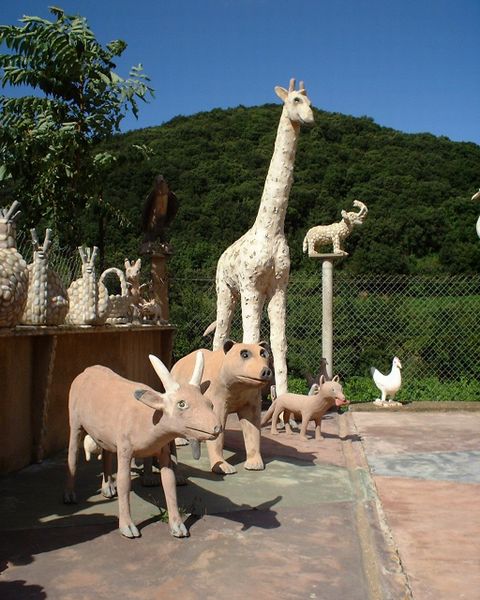
I am not quite sure if Horace Diaz' art environment really answered to the name of Noah's Arc, but if not, such a name anyhow would have been a good description of what Diaz  created and exposed on a terrain he owned south of the community Lodève, in the Herault-area in France.

Life and works

Horace Diaz (1929-2013) was born in Malaga, Spain. In 1938 the family moved to France, fleeing the regime in Spain. Grown up, Diaz had a training as a mason and succeeded in making a career in all kinds of construction works.

One day when he had built a house for a client, he was asked if he also could create a garden around that house, garden ornaments included. Diaz decided to give it a try. He successfully created some ornaments and, his interest in sculpting aroused, this became kind of a passion.

Beginning in 1966, through the years Diaz has made a variety of sculptures mainly depicting animals, some of which were rather large-sized.


For some thirty years Horace Diaz has been active in making sculptures.

Although the site at Lodève's industrial area had a (mosaic decorated) pied à terre, Diaz didn't live there. He had an apartment in the center of Lodève with a balcony decorated with some sculptures of animals ¹.

Exposition

Horace Diaz was a respected sculptor. He was a guest of honor in an open air summer exposition in the community of Salasc in southern France (summer 2009). The exposition showed one of Diaz' well known creations, the giraffe.

Photo

The site doesn't exist anymore

Horace Diaz passed away in March 2013. Following his death the site at the industrial area was cleaned up. The sculptures have been scattered across various private collections.

this picture and the next one 
from the museum's Facebook page

One of the sculptures, a large crocodile, in 2015 has been added to the garden of the Art Brut Musée in Montpellier in southern France, opened for the public April 9th 2016.


The crocodile also appears in the new museum's first affiche.

Documentation
* Website Habitants-paysagistes (Lille art museum) with photos by Francis David
* Illustrated article (June 2011) in the weblog of Jean-Michel Chesné
* In her website Les grigris de Sophie Sophie Lepetit has published a large number of pictures of Diaz' creations: November 2012June 2013 and August 2013
* The same goes for the website l'Herault insolite (March 2012)

Note
¹ as reported by Bruno Montpied, Le gazouillis des éléphants, 2017, p. 386

first published July 2009, last revised November 2017

Horace Diaz
l'Arche de Noë
Zone Industriel
34700 Lodève, dept Herault, region Occitanie, France
site doesn't exist anymore